

Why Home Service City Pages Are Your Secret Weapon for Local Growth
If you want to win more local customers online, creating dedicated home service city pages is the single best way to rank in neighboring towns where you do not have a physical office.
These pages act as local doorways to your business. When done right, they help you capture high-intent search traffic below Google’s map pack.
Here is the quick blueprint to make them work:
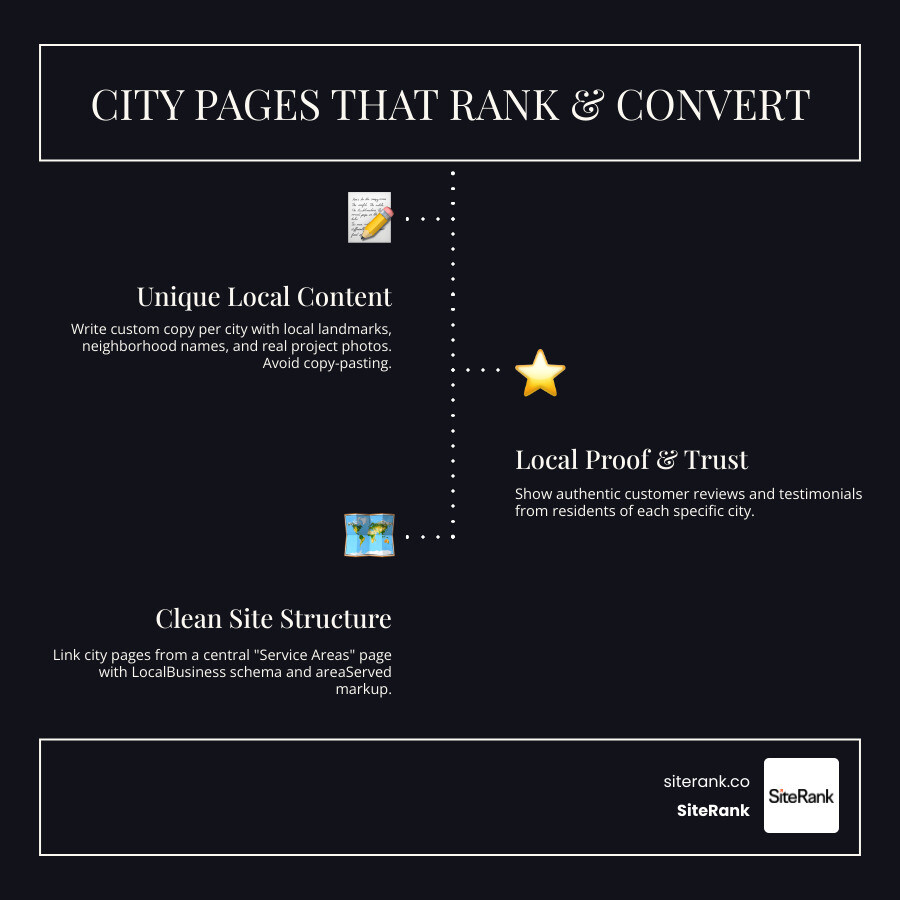
- Be Unique: Do not copy and paste the same text. Write custom content for each town, including local project photos and neighborhood references.
- Show Local Proof: Add real customer reviews and testimonials from people who actually live in that specific city.
- Build a Clean Structure: Link your city pages naturally from a central “Service Areas” page on your main menu so users and search engines can find them.
- Use Local Schema: Add structured data like
LocalBusinessschema with theareaServedproperty to tell search engines exactly where you work.
Most business owners struggle to rank in surrounding suburbs because Google’s map pack heavily favors physical addresses. High-quality city pages solve this problem by helping you win organic search results instead.
I’m Craig Flickinger, founder of SiteRank, and I have spent over 15 years helping local businesses dominate search engines using high-performing home service city pages. By combining proven local search strategies with modern AI-driven tools, my team and I build local landing pages that rank quickly and turn search traffic into paying customers.
Home service city pages word roundup:
Why Your Business Needs Dedicated Home Service City Pages
If you are running a plumbing, HVAC, electrical, or roofing company, you already know that your target market is not limited to the street where your office sits. You serve a broad region, driving from suburb to suburb to help homeowners. However, search engines do not automatically know how far your trucks can travel.
Many business owners believe that having a Google Business Profile (GBP) is enough. While a GBP is incredibly powerful, it has major limitations. Google’s local “three-pack” is heavily bound by the distance factor. Search engines want to show searchers the closest physical business. If a homeowner searches for “AC repair” in an outlying suburb fifteen miles from your main office, you are highly unlikely to show up in their local map pack.
This is where organic search results come to the rescue. While at least a third of all mobile searches have local intent—and up to half of all search activity is related to local queries—a full 93% of searchers with local intent see Google’s three-pack first and get to organic search results snippets right after. By building highly optimized home service city pages, we can bypass the strict physical address requirements of the map pack and capture that massive stream of organic traffic.
To learn more about setting up your overall local framework, check out The Ultimate Guide to Local SEO for Home Services and find out Why Your Home Service Business Needs a Local SEO Overhaul.
Overcoming the Proximity Barrier for Service Area Businesses
For service area businesses (SABs) that operate on a mobile basis without a traditional storefront, establishing geographic relevance is a unique challenge. Google’s guidelines allow us to hide our physical addresses on our GBPs to protect our privacy, but this does not change how the algorithm ranks us. In fact, even when a business hides its address, search engines still calculate local map rankings based on the physical verification address on file.
To break through this proximity barrier, we must use dedicated local pages. These pages act as digital bridges, proving our active presence in outlying towns. By creating high-quality pages for the suburbs we target, we show search engines that our mobile professionals are regularly working in those zip codes. This strategy is incredibly effective; for example, creating pages for sublocations in major metro areas has been shown to improve business by 10 percent for local service networks.
To map out your coverage zones systematically, read our guide on How to Map Out Your Home Service Location Strategy Without Losing Your Mind and master the art of local targeting with Your Guide to Geo-Targeted Keyword Research.
Technical SEO Best Practices for Home Service City Pages
To ensure search engines crawl, understand, and rank your city pages, we need to implement a clean technical foundation. This is not just about writing great copy; it is about structuring the code of your page so search bots can easily digest your location data.
- Title Tags: Keep your title tags under 60 characters and use a clear, localized formula: Core Service in [City, State Abbreviation] | Brand Name. For example: Emergency Plumbing in Alpharetta, GA | SiteRank.
- Meta Descriptions: Write compelling, localized meta descriptions under 160 characters that encourage clicks. Example: Need an electrician in Alpharetta? We offer fast, same-day repairs, upfront pricing, and fully licensed pros. Book your service online today!
- LocalBusiness Schema: Implement JSON-LD structured data on every city page. Instead of using generic markup, customize the
LocalBusinessorServiceschema specifically for that page. - The areaServed Property: This is the secret weapon for service area businesses. Within your schema code, use the
areaServedproperty to list the specific cities, counties, or zip codes that the page targets. This explicitly tells search engines where you operate without requiring a physical office there. - FAQ Schema: If you include a helpful Frequently Asked Questions section on your page, use FAQ schema. This helps your page win rich snippets in search results, increasing your visibility and click-through rates.
For a deeper dive into why local technical optimization matters, explore our resource on Local SEO Services USA Why Local Expertise Matters.
City Pages vs. Doorway Pages: Navigating Google’s Guidelines
Many business owners hesitate to build city pages because they fear being penalized by Google’s doorway page algorithm. This is a very valid concern. Historically, many marketers used automated “content spinners” to generate hundreds of low-quality pages. They would write one basic template and swap out the city names programmatically, creating a massive matrix of thin, repetitive content.
Google’s quality systems, particularly since the historic Panda updates, are designed to filter out these low-value search results. If you “squirt out” hundreds of identical pages that offer no unique value to the user, search engines will flag them as doorway pages and refuse to index them.
The goal of a doorway page is simply to capture search traffic and funnel the user to a different page, without providing any real local utility. To rank safely and sustainably, we must build pages that are genuinely helpful, highly localized, and structured to provide a great user experience.
For the complete breakdown of how to build authority safely, read The Local SEO Blueprint for Tradesmen to Rank Number One.
What Makes a Page Helpful vs. Spammy according to Google
Google wants to show searchers content that is unique, authoritative, and helpful. To prevent your local pages from looking like spam, you must treat each one as a standalone homepage for that specific town.
A helpful page includes:
- Localized Customer Reviews: Do not display the same generic testimonials across your entire site. Feature reviews from customers who actually live in the target city.
- Real Project Photos: Skip the generic stock photography. Show real images of your team working on homes in that specific area, complete with captions mentioning the neighborhood.
- Regional Challenges: Address local issues. For example, if you are an HVAC company, discuss how the specific local climate affects air conditioning systems. If you are a plumber, mention how older home pipe styles in historic neighborhoods require specialized care.
To see how this applies to specific trades, check out The Complete Local Search Optimization Guide for House Painters.
Common Mistakes to Avoid with Home Service City Pages
When scaling your local pages, it is easy to fall into traps that trigger penalties or hurt your conversion rates. The most common mistakes include keyword stuffing (forcing the city name into every single heading and paragraph) and template errors.
A classic template error is leaving placeholder text or displaying incorrect regional office addresses on the wrong pages. For example, some large multi-location campaigns have accidentally displayed a Philadelphia address on a Pittsburgh landing page because of poorly managed automation. This completely destroys customer trust and signals low quality to search engines.
To help you visualize the difference between high-quality execution and spammy tactics, we have put together this comparison:
| Feature | Thin Doorway Page (Spammy) | High-Quality City Page (Helpful) |
|---|---|---|
| Content Uniqueness | 99% identical copy with only the city name swapped. | Highly customized text addressing local home types and regional climate. |
| Visual Elements | Generic, repetitive stock photos used across all pages. | Real photos of local projects, technicians, and branded trucks. |
| Trust Signals | No local reviews or generic reviews without locations. | Verified reviews and testimonials from residents of that specific city. |
| Internal Linking | Hidden from site navigation, existing as “orphan pages.” | Integrated naturally into a directory or a “Service Areas” hub. |
| Value to User | Exists only to redirect users to a main contact form. | Provides local pricing, seasonal advice, and helpful local FAQs. |
How to Structure and Scale High-Converting Local Landing Pages
A great city page does not just rank; it converts passive searchers into active leads. To achieve this, your page architecture must balance search engine optimization with conversion rate optimization (CRO).
When a homeowner lands on your page, they should immediately see strong trust signals—such as licensing, insurance, and local chamber memberships—along with a clear, localized Call to Action (CTA).
To maximize your lead generation, read The Ultimate Guide to Finding and Keeping Home Service Leads and dive into Home Services Online Marketing.
Essential Content Elements for Local Relevance
To prove to both Google and your visitors that you are truly active in a community, we recommend including specific hyper-local elements.
First, include natural mentions of local landmarks, major roads, and transit directions (for example, mentioning how your trucks route via local highways to reach customers quickly).
Second, add a structured seasonal maintenance calendar tailored to the local climate. This shows that you understand the unique yearly needs of the region, such as preparing HVAC systems for harsh northern winters or scheduling exterior roofing work before the spring rainy season.
To see real-world examples of highly structured local landing pages, you can study how regional brands organize their content across different markets:
- Review the layout for southern coastal regions on the Home Services in St. Petersburg, FL page.
- Observe how seasonal winter prep is handled on the Home Services in Pittsburgh, PA page.
- See how local transit signals are integrated on the Home Services in St. Paul, MN page.
- Analyze Midwestern suburban targeting on the Home Services in Iowa City, IA page.
- Look at Pacific Northwest climate-specific content on the Home Services in Seattle, WA page.
- Study Atlanta-area suburban expansion on the Home Services in Alpharetta, GA page.
Internal Linking and Site Navigation Integration
Search engine crawlers cannot index pages they cannot find. If your city pages have no internal links pointing to them, they become “orphan pages” and will likely be ignored by Googlebot.
To prevent this, we use a clean hub-and-spoke internal linking model. Create a main “Service Areas” or “Locations” page in your main navigation menu to act as the “hub.” From there, link out to each individual city page (the “spokes”).
To keep your main navigation menu from becoming cluttered and annoying to human visitors, you can also place links to your top city pages in your website’s footer or create an organized HTML sitemap specifically for your service locations. This ensures search engines can crawl your entire site easily while keeping the user experience clean.
To build powerful external signals to match your internal structure, read our guide on Local Link Building Strategies.
Scaling Production Without Sacrificing Quality
If you serve thirty different cities, writing thirty completely unique pages from scratch can feel incredibly overwhelming. To scale your production efficiently without triggering duplicate content penalties, we recommend building a hybrid content team structure.
In this model, your central team designs a master layout with high brand standards. Then, you use localized data modules to inject unique, real-time information into each page. For example, while the core description of your plumbing service remains consistent, the reviews, project photos, local technician bios, and neighborhood-specific FAQs are dynamically updated for each city. This keeps your production scalable while ensuring every page is highly unique and valuable to local visitors.
For more insights on modern scaling techniques, explore Digital Marketing for Home Services.
Measuring Success and Optimizing Underperforming Pages
Launching your city pages is only the first step. To ensure they continue to drive business, you must track their performance systematically.
By monitoring search metrics and user behavior, we can identify which pages are succeeding and which ones need a little extra help to reach the first page of search results.
For a comprehensive overview of tracking your campaign’s performance, see our guide on Home Service SEO.
Key Performance Indicators for Local Pages
When measuring the success of your home service city pages, we focus on a few key performance indicators (KPIs) in Google Search Console and Google Analytics 4:
- Organic Impressions: Are your pages starting to show up in search results for local queries? An increase in impressions is the first sign that search engines are indexing your pages.
- Click-Through Rate (CTR): Are searchers actually clicking on your page when they see it? If your CTR is low, you may need to write more compelling title tags and meta descriptions.
- Local Leads and Conversions: This is the ultimate metric. Track how many phone calls, form submissions, and online bookings originate from each specific city page.
- GA4 Engagement Rate: Are users spending time reading your page, or are they bouncing immediately? A high engagement rate proves that your content matches the searcher’s intent.
To learn how to rank for high-value terms that drive these KPIs, read The Best Local Contractor Services Near You.
How to Audit and Revitalize Low-Performing Pages
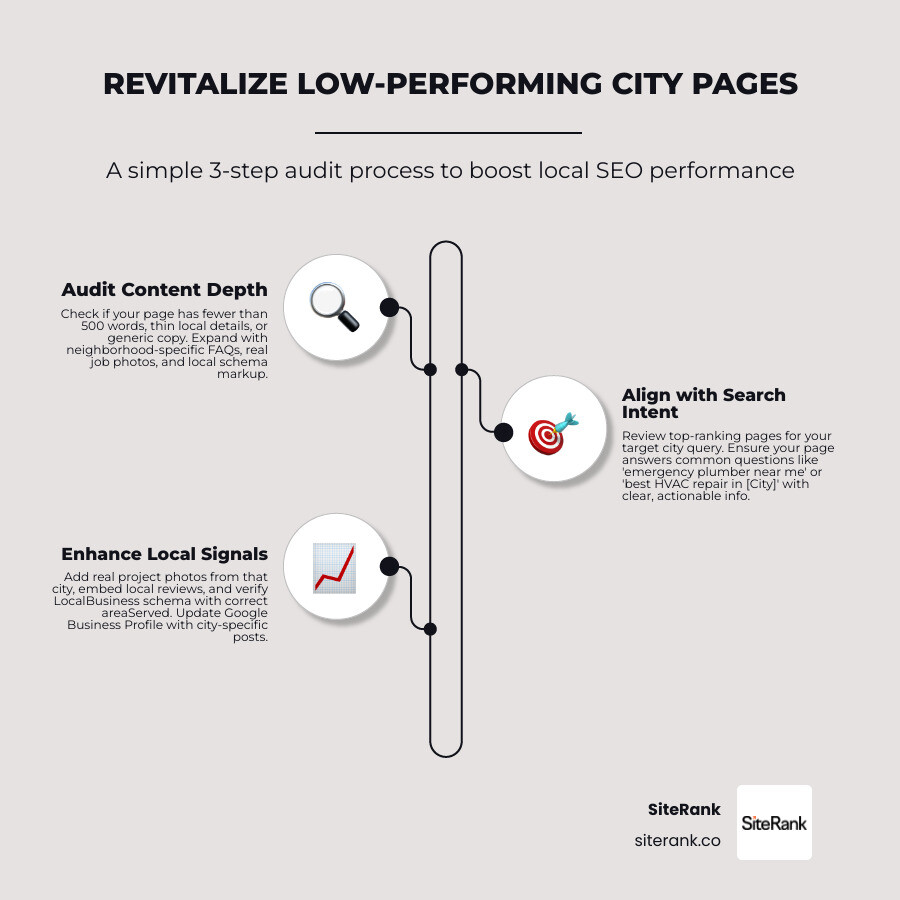
If a city page has been live for several months but is not ranking or driving leads, it is time for an audit. Most underperforming pages suffer from a lack of content depth or poor search intent alignment.
To revitalize a weak page, start by expanding the content. Add more detailed local FAQs, insert real photos of recent jobs in that city, and ensure your local schema markup is complete.
Additionally, you can boost the page’s authority by building local citations and high-quality local backlinks. Directory listings on sites like Yelp, YellowPages, and local chamber of commerce websites help reinforce your geographic relevance to search engines.
To start boosting your pages, check out our Local Citation Building Services and read the Local SEO Backlinks Guide 2025.
Frequently Asked Questions about Local SEO
How many city pages should my business create?
You should only create as many pages as you can maintain with high quality. We recommend starting small and scaling smart. To determine which cities to target, use the following criteria:
- Service Capacity: Only target cities where you actually have the capacity to send trucks and technicians.
- Search Volume: Use keyword research tools to target cities and suburbs with a healthy volume of local search queries.
- Proximity to Core Market: Start with the immediate suburbs surrounding your physical office and expand outward systematically.
- Resource Availability: Ensure you have enough unique local assets (reviews, project photos, local details) to make each page highly valuable.
Can I rank in a city where I don’t have a physical office?
Yes, absolutely. While Google’s map pack heavily favors physical proximity, you can rank highly in the organic search results below the map pack by using well-optimized service area pages. By proving your local expertise, showing real work completed in that area, and using clean schema markup, you can build strong local authority and outrank competitors who only rely on their physical locations.
How do I prevent my scaled city pages from being flagged as duplicate content?
To prevent search engines from flagging your pages as duplicate content, avoid using find-and-replace templates where only the city name changes. Instead, ensure that at least 30% to 50% of the content on each page is completely unique. You can easily achieve this by featuring localized customer reviews, writing neighborhood-specific service descriptions, uploading unique local job photos, and addressing the specific climate or home-building styles of that town.
Conclusion
Building high-performing home service city pages is one of the most effective ways to expand your market reach, outrank local directories, and drive a steady stream of high-intent leads to your business. By focusing on unique, high-quality content, clean technical optimization, and smart internal linking, you can build a highly profitable digital footprint that grows with your business.
At SiteRank, we specialize in helping home service businesses dominate local search. As an AI-powered SEO agency, we deliver customized, tailored SEO strategies designed to increase your clicks, engagement, and bookings without burying you in unnecessary deliverables.
Ready to scale your local reach and win more customers in every suburb? Maximize your local reach with SiteRank’s Home Services SEO and let us build a high-converting local strategy for your business today.