

Why Most Tradesmen Are Invisible on Google (And How to Fix It)
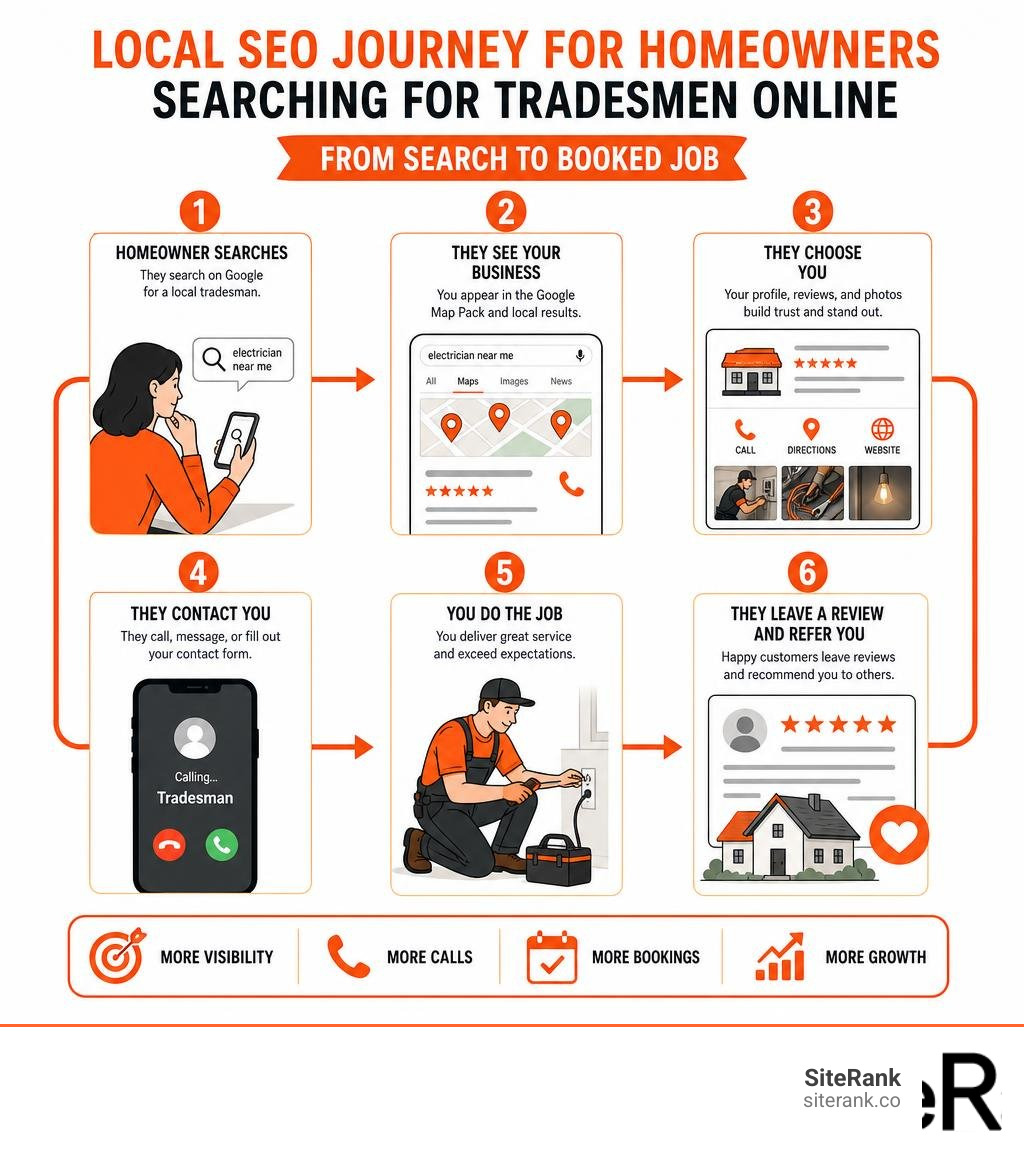
Local SEO for tradesmen is the process of optimizing your online presence so your trade business appears at the top of Google when nearby customers search for your services.
Here’s what it covers at a glance:
| What to Optimize | Why It Matters |
|---|---|
| Google Business Profile | Drives calls and map visibility |
| Service and location pages | Ranks for “[trade] in [city]” searches |
| Customer reviews | Builds trust and boosts rankings |
| NAP consistency | Tells Google your business is legitimate |
| Local backlinks and citations | Increases your authority in your area |
More than 70% of online searches for home services happen on Google. If your business isn’t showing up on page one — ideally in the map pack — those customers are calling your competitors instead.
The good news? You don’t need a big budget or a technical background to fix this. You just need the right system.
Unlike paid ads that stop the moment you stop spending, local SEO builds a compounding asset. Every review you earn, every page you optimize, and every citation you build keeps working for you month after month.
I’m Craig Flickinger, founder of SiteRank and an SEO practitioner with over 15 years of experience helping businesses dominate local search — including trades businesses looking to win at local SEO for tradesmen without wasting money on agencies that deliver reports instead of results. In this guide, I’ll walk you through exactly what works in 2026.
Local seo for tradesmen glossary:
Demystifying local seo for tradesmen: Why It Beats Traditional Marketing
For decades, tradesmen relied on word-of-mouth, yellow pages, local newspaper ads, and vehicle wraps to keep the phone ringing. While physical branding still has its place, the consumer journey has fundamentally shifted. In 2026, when a pipe bursts, the power goes out, or a roof starts leaking, homeowners do not look for a flyer they threw in the recycling bin last week. They grab their smartphones and search Google.
This is where local search comes into play. When users search for home services, Google displays the “Local 3-Pack” (or Map Pack) directly below the sponsored ads but above the traditional organic search results.
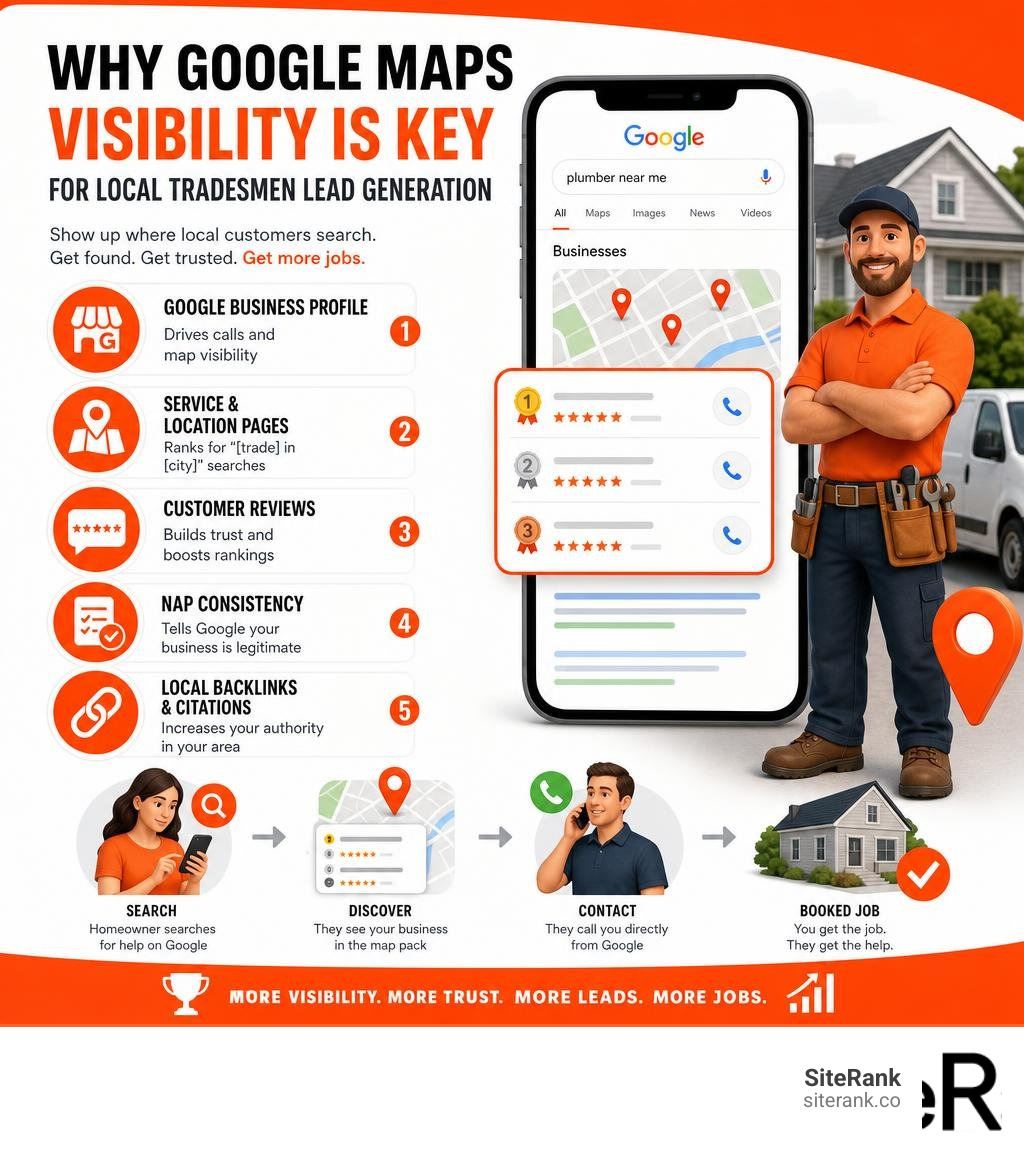
The Map Pack captures over 60% of all clicks for local contractor searches. If your plumbing, electrical, or roofing business secures one of these three coveted spots, you gain a massive, unfair advantage in local lead generation.
But why should you invest in local seo for tradesmen instead of just running Google Ads or buying leads from third-party directories? It comes down to conversion rates and economics.
Paid ads are like renting space; the moment you stop paying, your lead flow drops to zero. Conversely, organic local search rankings act like real estate you own. They keep working for you 24/7.
By building a strong local presence, you align your business with high-intent searchers. These are people actively looking to hire a professional immediately, resulting in significantly higher conversion rates compared to cold social media marketing. For a deeper dive into this ecosystem, check out The Ultimate Guide to Local SEO for Home Services.
Local SEO vs Traditional SEO for Trades
To win this game, you must understand how local SEO differs from traditional SEO.
Traditional SEO focuses on ranking a website for broad, non-geographical keywords on a national or global scale. For example, writing a blog post about “how to fix a leaky faucet” might attract thousands of readers from around the world. However, unless you plan to fly across the country to fix a sink, those visitors will never write you a check.
Local SEO, on the other hand, is hyper-focused on geographic targeting and search intent. Google understands when a query has “local intent” (e.g., “boiler repair near me” or “electrician in Bristol”). When it detects this intent, Google’s algorithm prioritizes three core ranking factors:
- Proximity: How close is your business location to the searcher?
- Relevance: How well does your website and Google Business Profile match the user’s search query?
- Prominence: How well-known and trusted is your business online (driven by reviews, backlinks, and citations)?
To explore how these targeting differences impact your broader marketing strategy, read our breakdown on Geo vs SEO.
The Core Components of a Winning Strategy
A successful strategy for tradesmen is built on four pillars:
- Google Business Profile (GBP): Your absolute highest-leverage asset. It acts as the digital storefront that directly feeds Google Maps.
- On-Page Optimization: Structuring your website’s service and location pages so search engines know exactly what you do and where you do it.
- Reviews and Reputation: Cultivating a steady stream of authentic, high-quality customer feedback.
- Local Citations and Backlinks: Establishing digital proof of your physical existence and authority in your local community.
When these four components work in harmony, Google gains the confidence to rank your business above the competition. To get a sense of how comprehensive execution looks, see our dedicated Local Business SEO Services page. For an honest, plain-English overview of how these pieces fit together specifically for contractors in 2026, you can also consult this SEO for Contractors — Plain-English 2026 Guide .
Optimizing Your Google Business Profile and Reviews

Your Google Business Profile (formerly Google My Business) is the absolute foundation of your local search presence. If you do not have a claimed, verified, and fully optimized GBP, you are essentially invisible to the 60% of homeowners who click on the Map Pack. Let’s walk through how to set it up for maximum visibility.
First, during the setup process, you must choose your business categories carefully. Your primary category holds the most weight in Google’s ranking algorithm. If you are primarily a plumber, select “Plumber” as your primary category, not “Heating Contractor” (you can add that as a secondary category). Google allows one primary category and up to nine secondary categories—use them to cover all the services you offer.
Next, write a compelling, keyword-rich business description. You have 750 characters; use them to clearly explain what you do, the areas you serve, and why customers should trust you. Avoid keyword stuffing (e.g., “We are the best plumber, plumbing company, emergency plumber in London”), but do mention your core services and primary service areas naturally.
Finally, upload high-quality, original photos regularly. Trade businesses that upload real photos of their team, branded trucks, and active job sites receive significantly more engagement than those relying on generic stock imagery. Aim to upload 10 to 20 photos initially and add more weekly to signal to Google that your business is active.
Maximizing Google Business Profile for local seo for tradesmen
If you operate as a service-area business (SAB)—meaning you travel to customers but don’t have a physical storefront where customers visit you—you must set up your profile correctly. Google allows you to hide your physical address and instead define your service areas.
You can list up to 20 specific towns, cities, or postal codes. A common mistake is selecting a massive, multi-county radius. Instead, keep your service areas tightly focused on the regions where you actually want to book jobs. This tells Google exactly where your proximity signals should apply.
Keep your business hours accurate and updated, especially during holidays. You can also utilize Google Posts to share weekly updates, special offers, completed projects, or seasonal maintenance tips. Think of Google Posts as social media updates that live directly on your search listing, helping to convert searchers into callers.
For a real-world example of how service-area targeting translates to local map dominance, check out our guide on Google Maps SEO for Landscapers: From Hidden Gem to Local Legend.
The Power of Customer Reviews and Reputation Management
Once your profile is optimized, your primary focus must shift to gathering reviews. In 2026, reviews are not just social proof; they are a direct ranking signal.
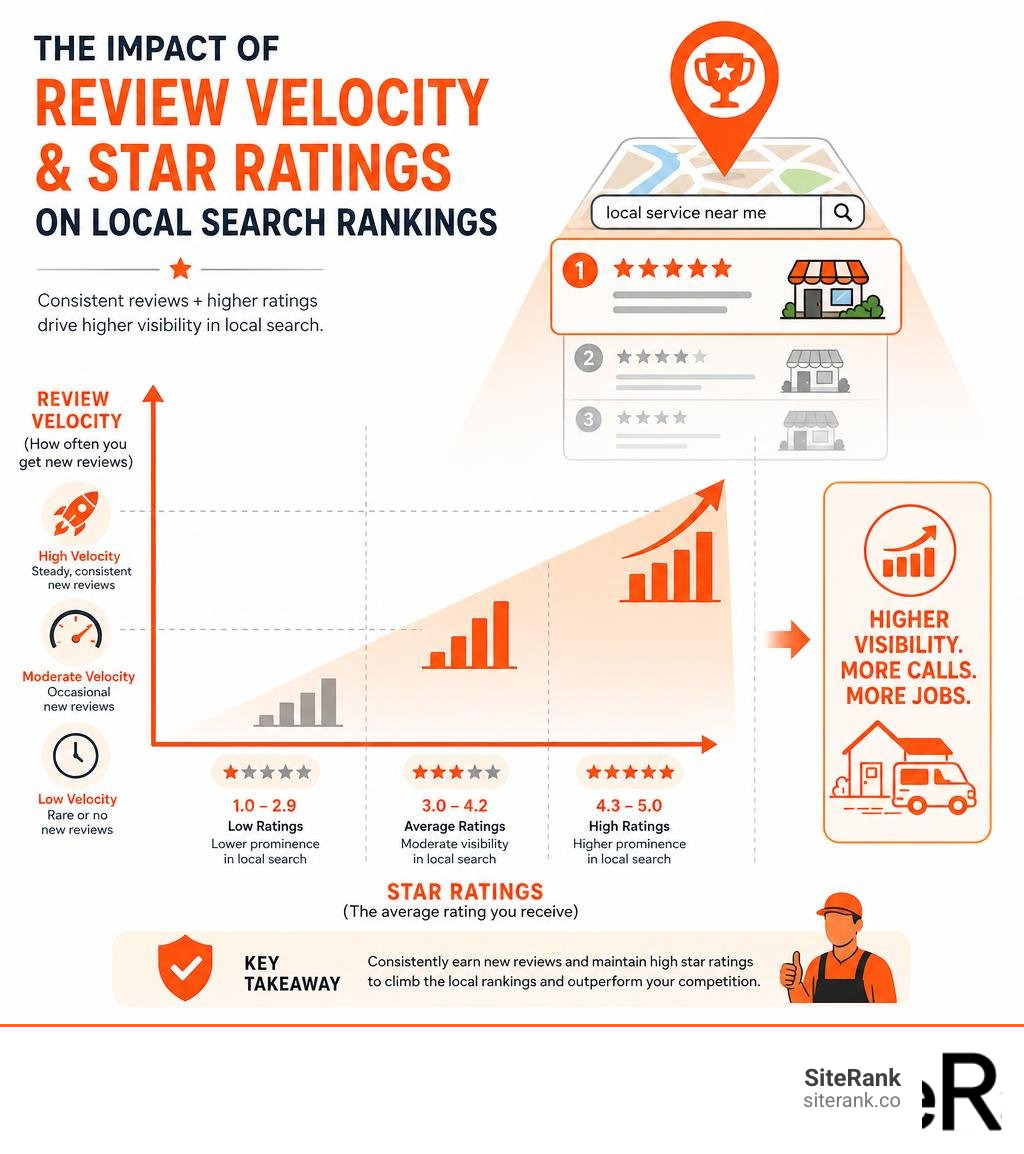
Google’s algorithm closely monitors three review metrics:
- Review Velocity: How frequently are you getting new reviews? Getting 50 reviews in one week and then zero for six months looks unnatural to Google. Consistent, steady acquisition (e.g., 2-4 new reviews every month) is far better.
- Review Recency: Are your reviews fresh? Homeowners and search engines discount reviews that are more than a few months old.
- Review Sentiment and Keywords: When customers write detailed reviews mentioning specific services and locations (e.g., “They did a fantastic job replacing my water heater in Croydon”), Google parses that text to understand your relevance for those specific search terms.
To build a reliable review-generation engine, you must make the process frictionless for your customers. Send a direct Google review link via text message or email within 24 hours of completing a job. You can also place a QR code on your digital invoices or physical business cards that links directly to your review form.
Always respond to every review—both positive and negative—within 24 to 48 hours. When responding to positive reviews, thank the customer and naturally mention the service performed. When handling negative reviews, remain calm, professional, and brief. Acknowledge their concern, apologize for any frustration, and invite them to resolve the issue privately offline. Prospective customers will judge your business based on how you handle criticism.
For more tips on leveraging local trust signals, see this guide on Local SEO for Contractors: Boost Your Business – Kore Komfort Solutions % .
On-Page SEO and Keyword Strategy for Trade Websites

While your Google Business Profile drives Map Pack visibility, your website is the engine that ranks for organic search queries and turns visitors into paying leads. To rank for the jobs you actually want, you must build a site structured around dedicated service and location pages.
A common mistake tradesmen make is putting all their services on a single homepage. If you offer plumbing, heating, boiler installations, and bathroom remodeling all on one page, Google’s crawlers will struggle to determine what that page is primarily about.
Instead, build one dedicated page for each core service you offer. For example:
yourdomain.com/boiler-repairyourdomain.com/emergency-plumbingyourdomain.com/bathroom-remodeling
Additionally, if you serve multiple distinct towns or suburbs, build unique location landing pages (e.g., yourdomain.com/areas-we-serve/guildford). Each location page should feature 400 to 600 words of completely unique, locally-relevant content, customer testimonials from that specific area, and a clear call to action. Never copy-paste the same text across multiple location pages and simply swap out the town name; Google views this as thin, duplicate content and may penalize your site.
Geo-Targeted Keyword Research for local seo for tradesmen
Effective keyword research for tradesmen is all about finding terms with high commercial and transactional intent. You want to target keywords used by people who are ready to hire a professional right now.
When starting your research, combine your core services with your target geographic locations. For example:
- Head Keywords (High Volume, High Competition): “Plumber in Manchester”
- Long-Tail Keywords (Lower Volume, Lower Competition, High Conversion): “Emergency 24-hour plumber Manchester” or “blocked drain specialist Manchester”
Use keyword research tools to analyze local search volumes, but don’t ignore terms with lower monthly search volumes (e.g., 30-50 searches a month). In a local service niche, ranking number one for a highly specific, high-intent term can easily generate several high-ticket jobs every single month. To master this process, read our comprehensive resource, Your Guide to Geo-Targeted Keyword Research.
On-Page Best Practices and Content Marketing
Once you have identified your target keywords, you must place them strategically throughout your on-page elements:
- Title Tags: Keep them under 60 characters. Format them as:
Service + Location | Business Name(e.g.,Emergency Plumber in Guildford | Surrey Plumbing Co.). - Meta Descriptions: Write a compelling 150-160 character summary that includes your keyword and a strong call-to-action (e.g.,
Need an emergency plumber in Guildford? Available 24/7 for rapid response repairs. Call Surrey Plumbing Co. today for a free quote!). - Header Tags (H1, H2, H3): Use only one H1 tag per page, and make sure it includes your primary local keyword. Use H2 and H3 tags to break up your content and target secondary or long-tail terms.
- Image Alt Text: Rename your image files before uploading them (e.g., use
boiler-installation-guildford.jpginstead ofIMG_4829.jpg) and add descriptive alt text that explains what the image shows while naturally incorporating local keywords.
To take your on-page optimization a step further, start publishing “project notes” or local case studies. Instead of writing generic blog posts like “5 Tips for Clean Pipes,” write about real jobs you’ve completed in your local area. Explain the problem, show before-and-after photos, describe the solution, and mention the specific neighborhood. This provides authentic local proof that builds trust with both human visitors and search engine algorithms.
To learn more about aligning your content with real-world booking goals, read the expert tips in SEO for contractors: rank locally and book more jobs | ProTradeHQ .
Technical SEO, Mobile Optimization, and Link Building
Before you begin executing your local strategy, you must decide whether to handle it yourself or hire a professional agency.
| Optimization Area | DIY SEO (The Realistic Path) | Professional SEO (The Scaled Path) |
|---|---|---|
| Google Business Profile | Easy to set up, update, and manage reviews weekly. | Managed professionally with advanced tracking and geo-grid tracking. |
| On-Page & Keyword Strategy | Good for basic service pages, but hard to write unique copy for 10+ cities. | Scale with custom service and location pages built with unique local copy. |
| Technical & Mobile SEO | Challenging unless using simple builders (Wix/Squarespace). | Managed by developer-level experts to pass Core Web Vitals and secure the site. |
| Link Building & Citations | Can manually submit to 10-15 local directories. | Advanced local outreach, sponsorship links, and automated citation cleanup. |
| Average Timeline for Results | 6 to 12 months of consistent trial and error. | 3 to 6 months with professional optimization and tracking. |
Technical Foundations and Mobile-First Design
Because more than 70% of local home service searches occur on mobile devices, Google uses mobile-first indexing. This means Google evaluates the mobile version of your website to determine your search rankings. If your site is slow, hard to navigate on a phone, or has tiny text that requires zooming, your rankings will suffer.
Ensure your website uses a fully responsive web design that automatically adapts to any screen size. Optimize your page load speeds by compressing large images, leveraging browser caching, and minimizing unnecessary code. You can monitor your site’s performance using Google’s free PageSpeed Insights tool, aiming to meet Core Web Vitals standards (such as keeping Largest Contentful Paint under 2.5 seconds).
Additionally, make sure your site is secured with HTTPS (SSL certificate), has a clean XML sitemap submitted to Google Search Console, and features a touch-friendly user interface. Your phone number should be a prominent, clickable “click-to-call” button at the top of every page, making it incredibly easy for emergency callers to contact you instantly.
For specialized technical insights regarding climate-control services, check out our guide on HVAC Local SEO Services: Don’t Let Your Rankings Freeze.
Building High-Quality Local Backlinks and Citations
Backlinks (links from other websites to yours) act as digital votes of confidence. In local SEO, getting links from relevant, trusted local organizations carries far more weight than getting links from random global blogs.
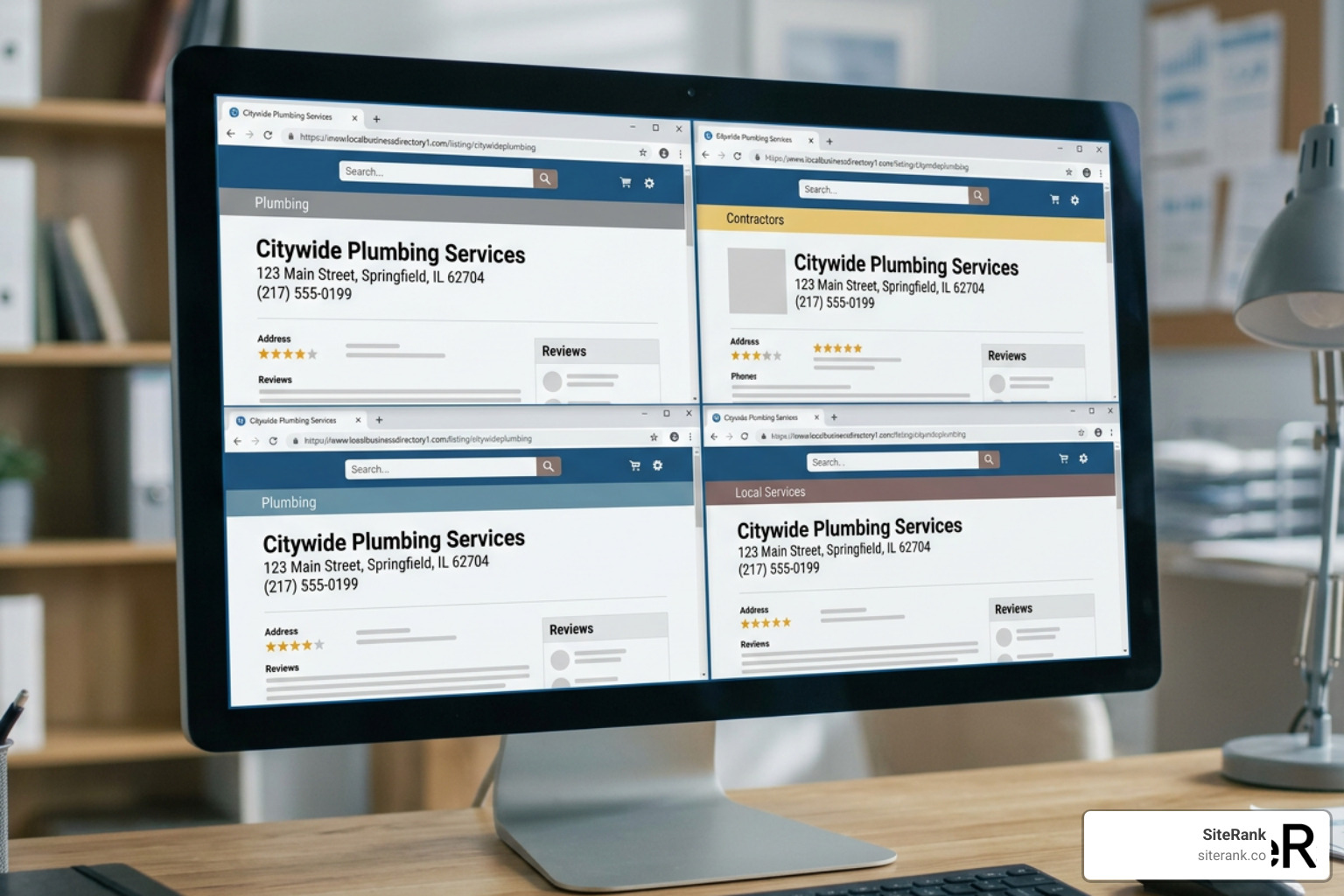
Start by building local citations. A citation is any online mention of your business’s Name, Address, and Phone number (NAP). Ensure your NAP is formatted identically across your website, GBP, and major directories like Yelp, Yellow Pages, and local Chambers of Commerce. Inconsistent NAP formatting (e.g., listing “123 Main Street” on one site and “123 Main St.” on another) can confuse Google’s algorithm and lower your local trust score.
Beyond basic directories, seek out high-quality local link opportunities:
- Trade Associations: Join local chapters of trade organizations (e.g., Checkatrade, NICEIC, or local building associations) which often link back to member directories.
- Supplier Directories: Many manufacturers feature “find an installer” directories on their high-authority websites. Ask your suppliers to list your business.
- Community Sponsorships: Sponsor a local youth sports team, charity event, or community center. These organizations almost always feature their sponsors on their websites with a high-value local backlink.
To build a robust, natural link profile that drives real authority, explore our specialized guides on Local Link Building Strategies, Local Citation Backlinks, and Local Citation Building Services.
Frequently Asked Questions About Local SEO for Trades
How long does it take to see results from local SEO?
For a brand-new website with a fresh domain, it typically takes 6 to 12 months of consistent effort to build enough authority to rank for highly competitive local search terms. However, if you are optimizing an existing website and Google Business Profile, you can start seeing noticeable improvements in search visibility, Map Pack exposure, and inbound phone calls in as little as 4 to 6 weeks. Local SEO is a long-term, compounding investment; the work you do today will continue to generate leads for years to come.
What are the most common local SEO mistakes tradesmen make?
The most damaging mistakes we see tradesmen make include:
- Inconsistent NAP Data: Having different phone numbers or old addresses scattered across various directories.
- Keyword Stuffing: Overloading your website text or Google Business Profile title with keywords, which can lead to search penalties.
- Buying Backlinks or Fake Reviews: Google’s algorithm is incredibly sophisticated and can easily detect fake review velocity or spammy link networks, which can result in your business being completely removed from search results.
- Thin Location Pages: Creating dozens of identical, templated location pages that offer zero unique value to local searchers.
How much do local SEO services for tradesmen cost?
The cost of local SEO varies widely depending on your market size, industry competition, and the scope of work required.
- DIY SEO: Costs very little cash ($0 to $100/month for basic tools) but requires a massive investment of your personal time.
- Freelancers / Low-Cost Agencies: Typically charge $300 to $800 per month, but often rely on automated software and generic templates that fail to move the needle.
- Professional SEO Agencies: High-quality, tailored local SEO campaigns generally range from $1,000 to $3,000+ per month. While this requires a larger budget, it delivers a custom strategy, comprehensive technical optimization, active link building, and measurable ROI tracking.
To learn more about the pricing and execution of citation campaigns, visit our page on Local Citation Building Services.
Conclusion

Dominating your local market in 2026 isn’t about having the flashiest truck wrap or the biggest billboard; it’s about being visible exactly when and where your customers are searching for you. By claiming your Google Business Profile, optimizing your service and location pages, consistently collecting authentic customer reviews, and building strong local backlinks, you can build an organic lead-generation engine that outlasts any paid advertising campaign.
At SiteRank, we specialize in helping trade businesses cut through the noise. We build customized, AI-powered SEO strategies designed to drive clicks, calls, and booked jobs—without charging you for unnecessary deliverables or confusing reports.
Ready to stop renting attention and start owning your local search market? Get started with SiteRank’s Home Services SEO today, and let’s get your phone ringing.