

Why Geo-Targeted Keyword Research Matters for Local Businesses
Geo-targeted keyword research is the process of identifying search terms that include location-specific modifiers or imply geographic intent, helping businesses appear in search results when potential customers look for products or services in a specific area. Here’s how to get started:
- Identify your seed keywords – Start with your core services or products
- Add location modifiers – Combine with city names, neighborhoods, or “near me” terms
- Analyze search intent – Determine if searchers want explicit locations or rely on their device’s geolocation
- Validate demand – Check local search volumes and difficulty scores
- Map to content – Assign keywords to specific location pages or service areas
Nearly half of all Google searches have local intent, and local searchers often have higher commercial intent than non-local searchers. When someone searches for “japanese noodles london” instead of just “japanese noodles,” they’re telling you exactly what they want and where they want it. That specificity makes them more likely to convert.
The challenge? What works in one city might fail completely in another. Search volumes vary, competitors change, and even the language people use differs by region. A sandwich might be called a “sub” in one area, a “grinder” in another, and a “hero” somewhere else entirely.
I’m Craig Flickinger, and over my 15 years optimizing websites for local visibility, I’ve seen how geo-targeted keyword research transforms small businesses from invisible to dominant in their local markets. At SiteRank, we’ve helped businesses from single-location shops to multi-city franchises connect with customers who are ready to buy right now.
Understanding the Importance of Geo-Targeting
At its core, geo-targeted keyword research is about understanding how people in specific geographic areas search for products and services like yours. It’s not just about adding a city name to your keywords; it’s a strategic approach to local search engine optimization (SEO) that significantly impacts your business’s online visibility and bottom line.
Why is this so crucial? Because local searchers are often ready to act. They’re not just browsing; they’re looking for a solution now, nearby. This high commercial intent means that ranking for geo-targeted keywords can lead directly to increased foot traffic, phone calls, and online conversions. Businesses that rank highly in their target area can expect more website clicks, calls, and visits to physical locations. In fact, nearly half of all web searches are local, highlighting the immense opportunity for businesses to capture this audience.

The distinction between geo-targeted keyword research and general keyword research is fundamental. General keyword research aims to capture broad interest, often focusing on national or global search volumes. It might identify “plumbing services” as a high-volume keyword. However, a local business doesn’t need to rank nationally for “plumbing services”; they need to rank for “plumbing services in Toronto” or “emergency plumber near me.” This is where geo-targeting steps in, narrowing the focus to terms that are relevant to your specific operational area.
Our approach at SiteRank recognizes that local SEO requires different data than global SEO. Local market trends can change rapidly, and relying on country or global SEO data alone is insufficient. We dig into geographic identifiers and market relevance to ensure our strategies are precisely custom. This deep dive into local search intent helps us connect with your audience where they are, when they need you most. For a broader perspective on how location plays into your overall SEO strategy, you can explore our insights on Geo vs SEO and learn more about comprehensive Local SEO.
How to Conduct Effective Geo-Targeted Keyword Research
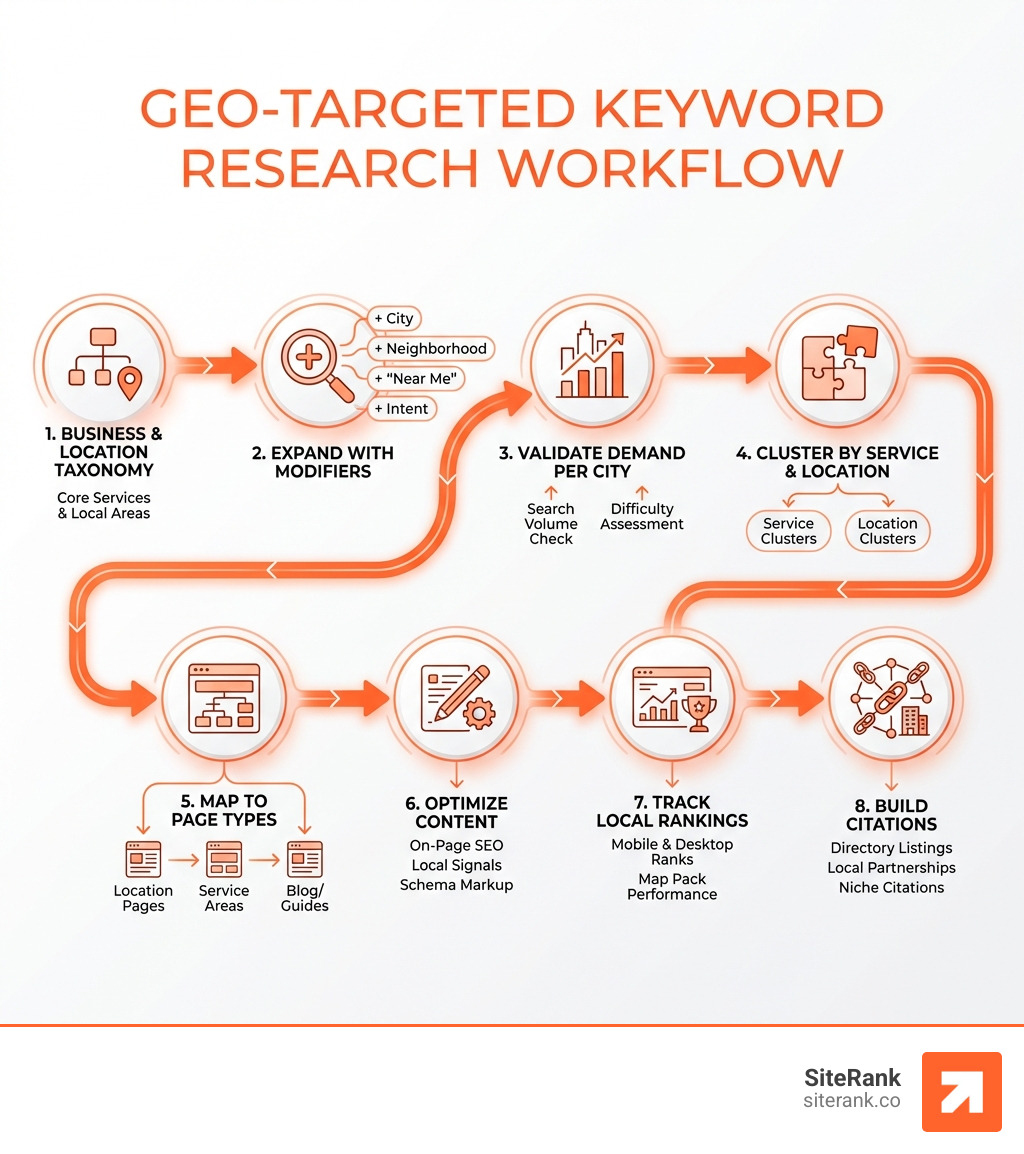
Successful geo-targeted keyword research is a systematic process. We start by building a comprehensive seed list, expand it with scalable geo-modifiers, validate local demand, and prioritize keywords for maximum impact.

1. Building Your Seed List: We begin with your business taxonomy—services, products, and unique selling points—and layer on your location taxonomy, including state, city, and neighborhoods. This creates a seed grid like “{service} + {location}.” For example, a plumber might target “emergency plumber in Austin.”
2. Expanding Keywords with Scalable Geo Modifiers: We expand the list by adding:
- Core patterns: “best {service} in {city}”, “{city} {service} company”
- Seasonal modifiers: “{service} for winter in {city}”
- Hyperlocal cues: Using landmarks or ZIP codes (e.g., “bakery near Crandon Park”).
3. Validating Local Demand and Difficulty: We use tools to ensure people are searching for these terms:
- City-level demand: Google Keyword Planner helps pinpoint local search volumes. Even low-volume local keywords can represent highly qualified leads.
- Analyzing local SERPs: We simulate local searches to see competitors and Google Business Profiles. We look at keyword difficulty scores to gauge ranking effort.
- Intent and conversion: We prioritize keywords with high commercial intent, even if volume is lower.
4. Clustering and Prioritizing Keywords: To avoid keyword cannibalization, we cluster terms by service first, then location. We separate informational queries for blogs from transactional queries for service pages, assigning priority based on potential ROI.
Our Keyword Research services provide a clear roadmap for local visibility. For dedicated support, our Local SEO Services can help implement these strategies.
Identifying Geomodified vs. Geolocated Searches
Understanding the difference between geomodified and geolocated searches is fundamental to geo-targeted keyword research.
Geomodified searches include an explicit location, like “plumber in Austin” or “best pizza San Francisco.” These signals high local commercial intent.
Geolocated searches don’t include a location, but Google infers intent based on the user’s physical location. If someone in Seattle searches for “coffee shop,” Google shows local results.
- For geomodified searches: We optimize content directly with location-specific terms in titles and headings.
- For geolocated searches: We focus on “localization clues” like a robust Google Business Profile, consistent NAP (Name, Address, Phone Number), and local schema markup (see schema.org LocalBusiness documentation).
Leveraging Audience Insights
To master geo-targeted keyword research, we must understand the local audience. Communities often have unique slang; a sandwich might be a “sub,” “grinder,” or “hoagie” depending on the region.
We uncover these insights through:
- Community Forums and Groups: Reddit and local Facebook groups reveal natural language and local nostalgia.
- Call Logs and Staff Feedback: Your staff knows the exact phrasing customers use.
- Surveys: Directly asking the community provides insight into searcher demographics.
We also consider voice search, focusing on conversational phrases like “where can I get my phone fixed in downtown San Francisco?” Understanding preferred device types and local sentiment ensures content resonates. For more on integrating keywords, see our guide on Keyword Research for Blog Posts.
Advanced Strategies for Local Content Optimization
Once geo-targeted keywords are identified, we weave them into your content. This is about intelligent, user-focused optimization that signals relevance to search engines.
1. On-Page SEO for Location Pages:
Dedicated location pages are crucial for multi-location businesses. Each must be unique:
- Unique Titles and Meta Descriptions: Use geo-modified tags like “{Service} in {City}.”
- Localized Content: Include local testimonials, case studies, and photos of your team in the community.
- NAP Consistency: Ensure your Name, Address, and Phone Number (NAP) are consistent across your site and Google Business Profile.
- Image Optimization: Use location-related keywords in file names and alt text (e.g., “plumbers-austin-texas.jpg”).
2. Keyword Mapping: We map keyword clusters to specific pages to prevent cannibalization. An “Austin kitchen remodeling” keyword belongs on the Austin page, not the Dallas one.
3. Building Topical Authority:
We create supporting content to dominate local search:
- Localized Guides: “Cost of {service} in {city} in 2025.”
- City-Specific Case Studies: Highlighting projects in specific neighborhoods.
- Local Regulations: Discussing permits or codes relevant to a city.
Our Home Services SEO expertise highlights these granular strategies. Building local signals is also critical; learn more with our Local Citation Building Services.
The Role of Google Business Profile and Reviews
Your Google Business Profile (GBP) is a powerful local SEO tool. Optimizing it is non-negotiable.
1. GBP Optimization:
- Complete Information: Fill out your business name, address, phone, and hours accurately.
- Keyword-Rich Categories: Select accurate categories, as these act as local keywords. Tools like GMB Spy or GMB Everywhere can help identify competitor categories.
- Visuals and Posts: Upload high-quality photos and use GBP posts to share local updates.
2. The Power of Online Reviews:
Reviews are a major ranking factor and influence trust. Actively encourage satisfied customers to leave reviews and respond to all feedback. Reviews often naturally include keywords related to your services and location.
3. Local Citations:
Citations are mentions of your NAP on directories like Yelp. Consistency is key; inconsistent data confuses search engines. Google’s guidelines for local ranking emphasize the importance of these signals. This is also a core part of our Local Link Building Strategies.
Measuring Performance and Local Market Adaptation
After all that hard work, how do we know if our geo-targeted keyword research and SEO efforts are paying off? Measuring success is crucial for refining our strategy and demonstrating tangible results.

1. Key Performance Indicators (KPIs) for Local SEO:
We track a range of metrics to evaluate the effectiveness of our geo-targeting:
- Website Traffic from Specific Locations: Using tools like Google Analytics, we monitor visitors coming from your target cities and neighborhoods. Increased traffic from these areas is a strong indicator of success.
- Local Search Rankings: We track your position in the local pack and organic search results for your geo-targeted keywords. Seeing your business climb the ranks for terms like “best bakery Joliet” (like Milano Bakery, which ranks #1 for “joliet bakery” and gets 3,000 desktop visits/month) is a clear win.
- Engagement Metrics: This includes click-through rates (CTR) on your search listings, conversion rates (e.g., phone calls, form submissions, direction requests from GBP), and time spent on location-specific pages.
- Google Business Profile Insights: GBP provides invaluable data on how customers are finding and interacting with your profile – calls, website clicks, direction requests, and even the specific search queries that triggered your listing’s appearance.
- Local Pack Visibility: Beyond organic rankings, we specifically monitor your presence in the coveted local 3-pack, as this drives significant local traffic.
- Customer Feedback and Online Reviews: An increase in positive reviews and mentions of your services/location indicates growing local recognition and satisfaction.
2. Adapting for Different Local Markets (Urban vs. Rural):
The approach to geo-targeted keyword research and optimization can vary significantly between densely populated urban areas and more spread-out rural regions.
| Feature | Urban Markets | Rural Markets |
|---|---|---|
| Keyword Focus | Hyperlocal (neighborhoods, districts, landmarks), diverse service terms | Broader geo-modifiers (county, region, nearest town), niche services |
| Search Volume | Higher search volume for specific terms | Lower search volume, but high intent, for many terms |
| Competition | High, many businesses vying for same terms | Lower, but still need precise targeting |
| GBP Importance | Critical for local pack visibility | Still important, but less dense map results |
| Content Strategy | Focus on unique selling propositions per micro-location, local events, partnerships | Emphasize service area, community involvement, local testimonials, problem-solving |
| NAP/Citations | Extensive directory listings, highly localized blogs | Community-specific directories, local news sites, regional associations |
Challenges and Best Practices:
- Low Search Volume: For rural or highly niche local terms, keyword tools might report “zero volume.” Don’t dismiss these! If they have clear local intent and relevance to your business, they can still drive highly qualified traffic. Your business insight often trumps tool data here.
- Keyword Cannibalization: For multi-location businesses, ensure each location page offers unique, helpful content rather than just swapping out city names. Google’s Helpful Content Update devalues content created primarily for ranking.
- Regional Variations: Continuously listen to your community (forums, social media) to adapt to local slang or preferred terms.
- Consistency is King: Maintain absolute consistency in your NAP information across all online platforms.
By continuously monitoring performance, adapting our strategies to local market nuances, and embracing best practices, we ensure your local SEO efforts deliver sustained growth. Our SEO Marketing Services Online are designed to provide this continuous optimization and adaptation.
Frequently Asked Questions about Geo-Targeted Keyword Research
What is the difference between explicit and implicit local intent?
Explicit local intent occurs when a searcher includes a geographic modifier, such as “bakery in Miami” or “plumber near me.” Implicit local intent happens when the searcher doesn’t specify a location, but Google infers it based on their physical location or the nature of the query (e.g., searching for “coffee shop” while downtown). Our strategy optimizes for both by using explicit terms in content and maintaining strong local signals for implicit searches.
How do service-area businesses (SABs) use geo-targeted keywords?
Service-area businesses (SABs) travel to customers rather than having a storefront. Their geo-targeted keyword research focuses on targeting specific service areas (counties or cities) and creating dedicated service-area pages. They rely heavily on “near me” optimization, consistent NAP data, and local reviews that mention the specific locations where they performed work.
How can I adapt my strategy for urban vs. rural markets?
- Urban Markets: Focus on hyperlocal terms, neighborhoods, and districts. Competition is high, so we prioritize long-tail, niche queries and maintain a very active Google Business Profile.
- Rural Markets: Use broader geographic terms like county names or the nearest large town. While search volume is lower, the intent is often very high. Content should emphasize community involvement and service area coverage.
In both cases, understanding the unique search habits of the local audience is the key to success.
Conclusion
Mastering geo-targeted keyword research is no longer optional for local businesses; it’s a fundamental pillar of digital growth. By understanding the nuances of local search intent, leveraging audience insights, and strategically optimizing your online presence, you can connect with customers who are actively looking for what you offer, right in their backyard.
At SiteRank, we understand that every business and every local market is unique. Our AI-powered SEO agency specializes in crafting custom strategies that cut through the noise, driving increased clicks and engagement without unnecessary deliverables. We take the complexity out of local SEO, allowing you to focus on what you do best: serving your community. Ready to dominate your local market? Explore our Local Business SEO Services and let’s get started.