

Why the Shift from SEO to GEO Matters for Your Business
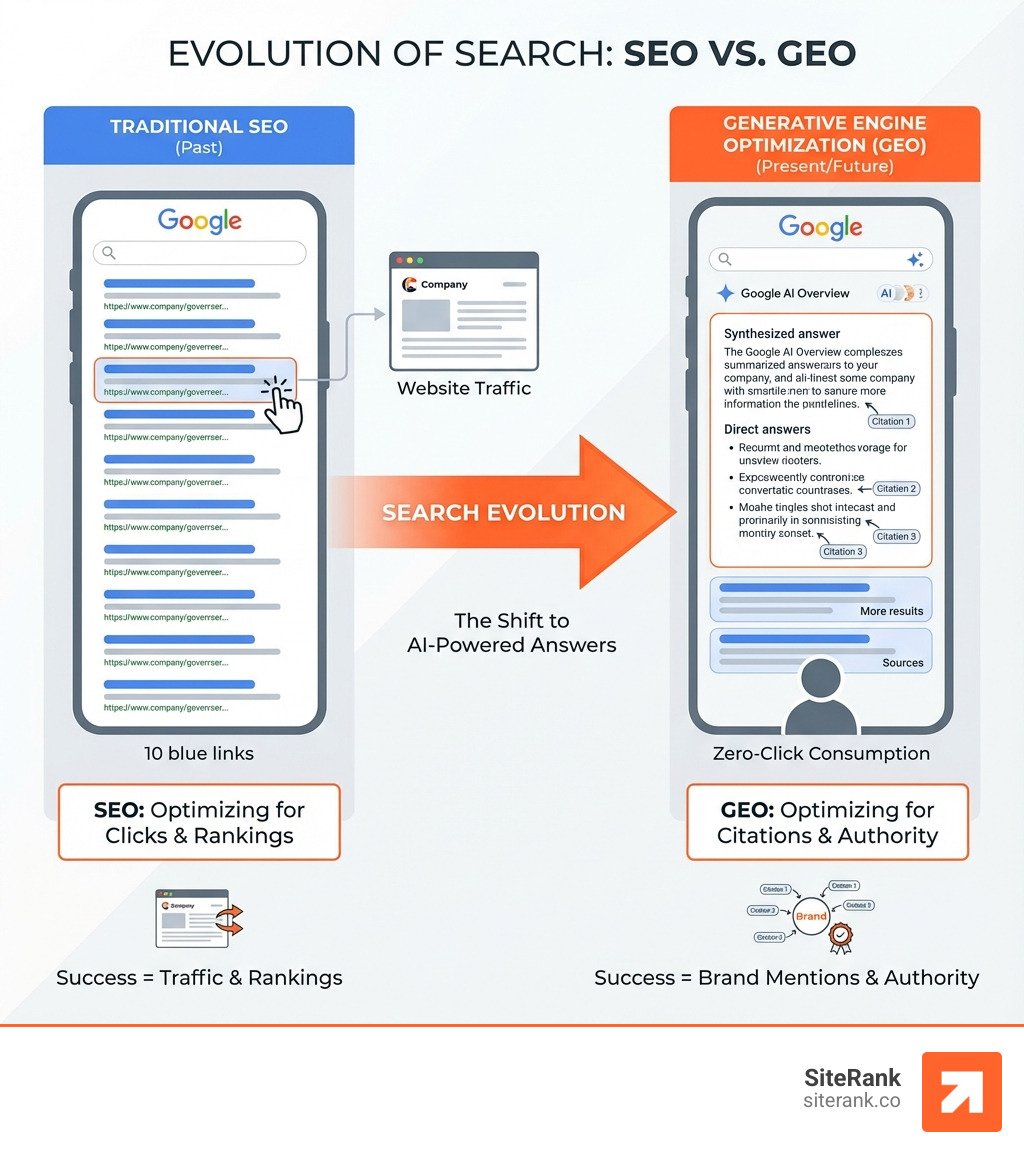
Geo vs seo isn’t about choosing one over the other—it’s about understanding two complementary approaches to visibility in an evolving search landscape. Here’s the quick breakdown:
| SEO (Search Engine Optimization) | GEO (Generative Engine Optimization) |
|---|---|
| Optimizes for traditional search engines like Google | Optimizes for AI-powered answer engines like ChatGPT and Google AI Overviews |
| Goal: Rank high to drive clicks to your website | Goal: Get cited directly in AI-generated answers |
| Success = traffic and rankings | Success = brand mentions and authority in AI responses |
| Focuses on your website | Focuses on your entire web presence |
The search world is splitting into two channels. Traditional search still drives 40-60% of traffic for most businesses, but AI platforms are reshaping how people find information. Nearly 60% of searches now end without a click—users get their answers directly from AI-generated summaries instead of visiting websites.
This doesn’t mean SEO is dead. It means the game has expanded.
If you’ve built a solid SEO foundation but noticed prospects arriving at sales calls already educated about your competitors, you’re seeing GEO in action. They’re not finding that information through blue links anymore—they’re asking ChatGPT, Perplexity, or Google’s AI Overviews for comprehensive answers.
The good news? The fundamentals overlap significantly. Quality content, topical authority, clear structure, and trust signals matter for both. But GEO adds new dimensions: your content needs to be extractable by AI, your brand needs mentions across the web, and your information architecture must help machines understand context, not just keywords.
I’m Craig Flickinger, founder of SiteRank, and over the past 15 years I’ve watched the evolution from keyword stuffing to mobile-first indexing to today’s AI-driven search landscape. Understanding the geo vs seo relationship has become critical for the businesses we help—it’s not about abandoning what works, but building on that foundation for where search is heading.
What is GEO and How Does It Differ from Traditional SEO?
The digital marketing landscape is always evolving, and the emergence of AI-powered search has introduced a new player: Generative Engine Optimization (GEO). While traditional Search Engine Optimization (SEO) has been our playbook for online visibility for decades, GEO represents a significant shift in how users find information and how we optimize our content.
The Core Focus: Clicks vs. Citations
At its heart, the biggest difference in the geo vs seo debate lies in their primary goals. Traditional SEO is all about driving clicks. Our aim has always been to rank high on Search Engine Results Pages (SERPs) so users click our links and visit our websites. We measure success by organic traffic, click-through rates, and ultimately, conversions on our own domain.
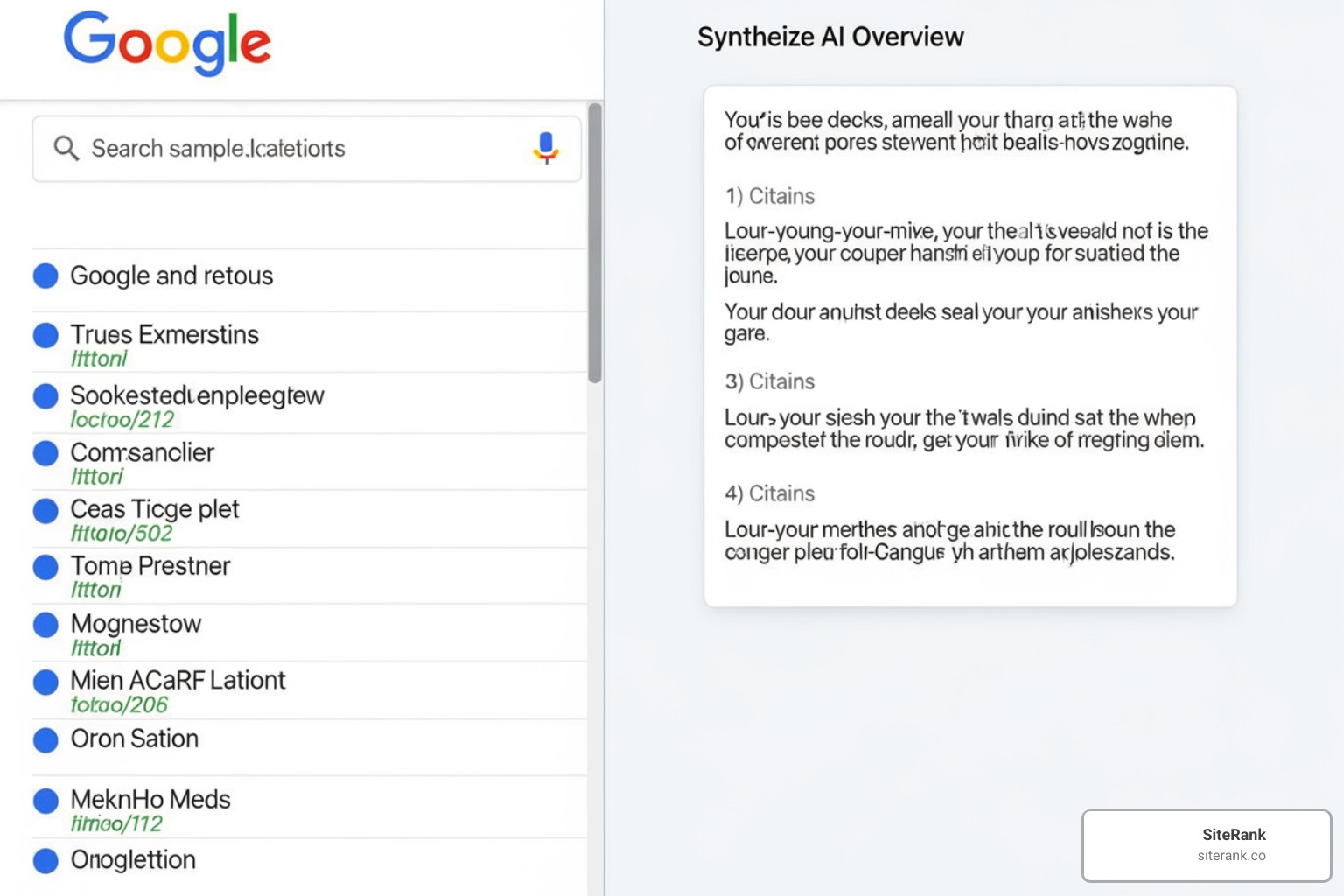
GEO, on the other hand, shifts the focus from clicks to citations. In the age of AI-generated answers, users often get the information they need directly from the AI, without ever clicking a link. This is the “zero-click search” phenomenon that has been gaining traction. A recent study by the PEW Research Center recently studied how searches interact with Google’s AI Overviews, finding that users click on search results only 8% of the time when AI summaries appear, versus 15% without them. That’s nearly 50% fewer clicks. The goal of GEO is to ensure your brand, expertise, or content is mentioned, referenced, or summarized within these AI responses, establishing your authority and presence even if a direct click doesn’t occur.
The Battleground: Search Results vs. AI-Generated Answers
With SEO, our battleground is the traditional SERP—a list of blue links, sometimes augmented with featured snippets or knowledge panels. We optimize our content, site structure, and backlinks to appear prominently in this ranked list. Our On-Page SEO Optimization Techniques are carefully designed to appeal to search engine algorithms, ensuring our content is deemed relevant and valuable enough to earn a top spot.
For GEO, the battleground is the AI-generated answer itself. This could be Google’s AI Overview, a ChatGPT response, a Perplexity AI summary, or a Microsoft Copilot output. These generative engines deliver direct answers, synthesized summaries, and often multimodal content (text, images, even code) that aims to fulfill the user’s query comprehensively without the need to browse multiple sites. Our optimization efforts for GEO are geared towards making our content digestible, extractable, and trustworthy for these AI models.
The Scope: Your Website vs. The Entire Web
Traditional SEO primarily focuses on your owned properties—your website. While off-site signals like backlinks and brand mentions are crucial for SEO, the ultimate goal is to drive traffic to your site.
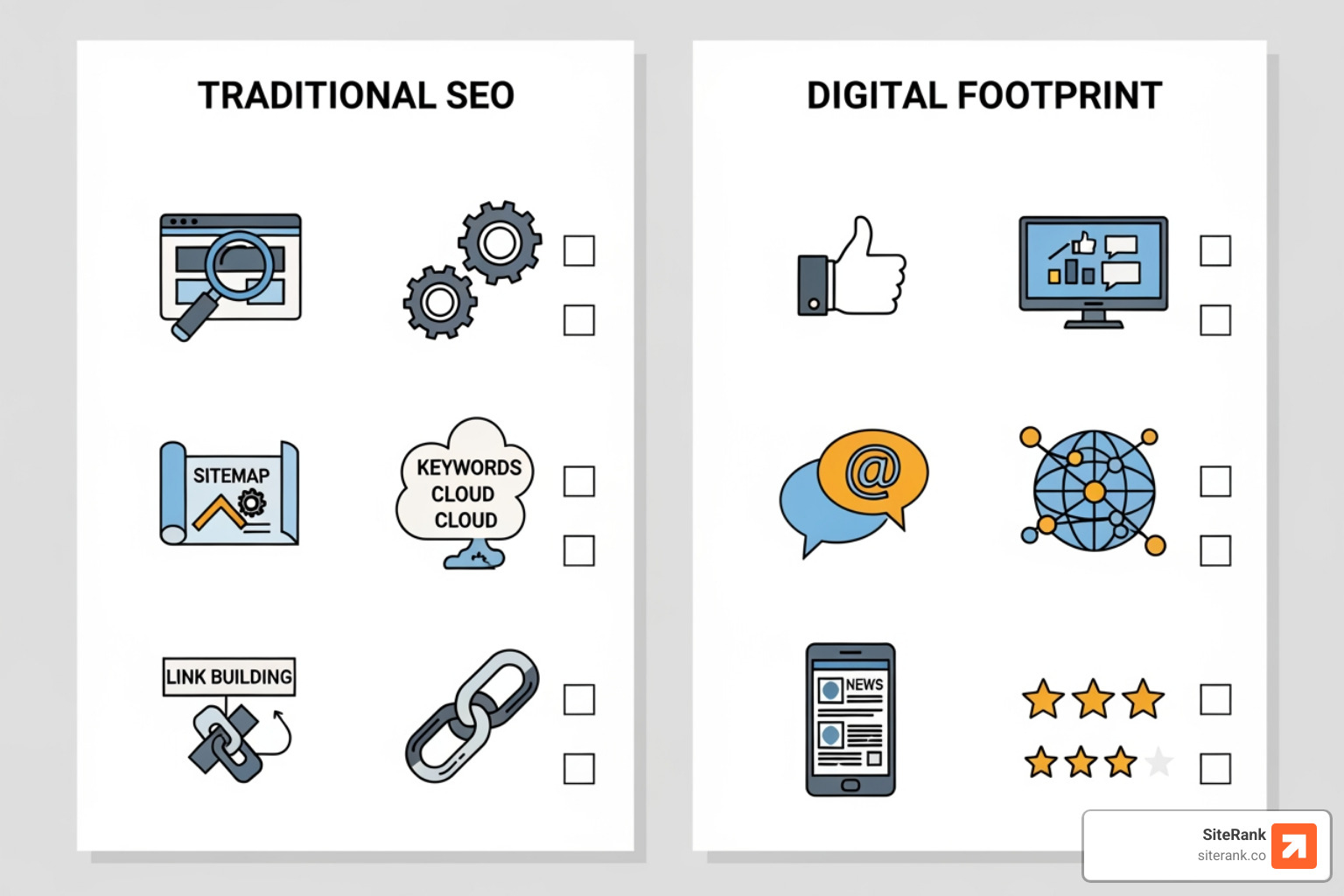
GEO expands this scope significantly. While your website remains a critical source of truth, GEO recognizes that AI models pull information from a much broader range of sources across the entire web. This includes user-generated content on platforms like Reddit and Quora, social media, news outlets, and even industry forums. For GEO, our focus isn’t just on our website, but on our overall digital footprint. Building authority through diverse channels and ensuring consistent, accurate information about our brand across the internet becomes paramount. This is where strategies like managing Local Citation Backlinks and fostering positive third-party mentions become even more vital. AI engines interpret SEO signals through entity recognition, meaning they connect mentions of your brand or key concepts to your overall authority and trustworthiness, regardless of where they appear.
The Great Overlap: Core Similarities Between GEO and SEO
Despite their differences, geo vs seo are not entirely separate disciplines. In fact, they share a deep common ground rooted in fundamental principles of good content and user experience. We often tell our clients that a strong SEO foundation is the best springboard for effective GEO.
The Foundation: Quality Content and User Intent
Both SEO and GEO ultimately aim to satisfy user intent. Whether a user is clicking a blue link or receiving an AI-generated summary, they are looking for helpful, comprehensive, and accurate information. This means that creating high-quality content remains the cornerstone of both strategies. Content that clearly explains concepts, uses natural language, and ties ideas together stands a better chance of being surfaced by both traditional search engines and AI platforms.
Our Content Writing Services are designed to produce content that is not only engaging for human readers but also structured and factual enough for AI models to interpret and use. The focus is on directly answering potential user questions and providing detailed, contextually rich information on a topic.
The Pillars of Trust: E-E-A-T and Authority
In both SEO and GEO, Experience, Expertise, Authoritativeness, and Trustworthiness (E-E-A-T) are non-negotiable. Google’s algorithms heavily favor content from credible sources, and AI models are no different. They are designed to prioritize information from entities perceived as experts or authorities in their field.
For us, this means emphasizing original research, expert quotes, and verifiable information. It involves ensuring clear attribution and citing sources within our content to bolster its credibility. Building strong domain authority through strategies like earning quality backlinks (which our Why Backlinks Are Important for SEO guide explains) increases the likelihood of AI citations. AI systems lean heavily on well-known and reputable sources, making a robust E-E-A-T profile critical for both traditional rankings and AI visibility.
The Technical Backbone: Keywords and Structured Data
While the application evolves, keywords and structured data remain vital for both geo vs seo. For traditional SEO, keyword research helps us understand what users are searching for and optimize our content accordingly. For GEO, the focus shifts slightly from exact keyword matches to understanding conversational queries, long-tail questions, and entity targeting. AI platforms encourage longer, more natural language queries, and our content needs to reflect this shift by addressing these intents directly.
Structured data, such as schema markup, is the unsung hero that bridges the gap. While basic schema helps search engines understand data types, advanced schema (like Article, FAQ, HowTo, or Product markup) provides explicit signals to AI models, making our content easier to parse and extract. Our Keyword Research Services now include analyzing conversational patterns and intent clusters, not just static keywords, to ensure our content is optimized for both human and AI understanding.
A Practical Guide to the GEO vs SEO Landscape
Navigating the evolving search landscape requires a dual approach. We can’t abandon traditional SEO, as it still drives significant traffic, but we must accept GEO to future-proof our digital presence.
Essential Tactics for GEO vs SEO
To give you a clearer picture, here’s a comparison of essential tactics for both:
| SEO Tactics | GEO Tactics |
|---|---|
| Keyword Targeting (short-tail, exact) | Entity & Intent Layer Targeting (conversational, long-tail) |
| On-Page Optimization (keywords, readability) | Content Structuring for Extraction (SCUs, FAQs, lists) |
| Link Building (backlinks) | Building Authority Signals (E-E-A-T, brand mentions, citations) |
| Technical Audits (crawlability, speed) | Multi-Platform Presence (Reddit, YouTube, social, forums) |
| Optimizing for Clicks & Rankings | Optimizing for Citations & Direct Answers |
Traditional SEO targets shorter, keyword-focused queries averaging 3-4 words. AI platforms encourage longer, more conversational queries because users can provide detailed context. This means our content strategy needs to expand beyond simple keyword matching to understanding and addressing complex user intents. We also consider AIO Optimization as a holistic approach for optimizing content across all AI-driven platforms.
Integrating GEO into Your Existing SEO Workflows
The good news is that we don’t need to reinvent the wheel. GEO builds on a strong SEO foundation. Here’s how we integrate GEO into our existing SEO workflows:
- Start with a Solid SEO Foundation: Ensure your website has clean technical performance, smart keyword targeting, and high-quality content. This is the bedrock upon which GEO success is built.
- Reformat Content for AI Extraction: Take your best-performing SEO content and reformat it for clarity and extractability. This means using clear, hierarchical headings, incorporating FAQ sections, and structuring information into concise, self-contained units (SCUs) that AI models can easily parse.
- Target Conversational Queries: While traditional keywords still matter, our Content Marketing Strategy Complete Guide emphasizes creating content that directly answers common questions and anticipates follow-up queries. AI Overviews appear most often for long-tail, informational queries, so optimizing for these is key.
- Leverage Structured Data: Implement schema markup (FAQ, HowTo, Product) to explicitly signal the nature of your content to AI models. This helps them understand and use your information more effectively.
- Expand Content Presence: Don’t limit your content distribution to just your website. AI platforms pull heavily from community-driven sites like Reddit and Quora, news outlets, and trusted publishers. Expanding your brand’s presence to forums, social platforms, and multimedia channels can increase your chances of being cited.
- Keep Content Fresh and Factual: AI search engines prefer content that is 25.7% fresher than average. ChatGPT, for example, typically cites pages less than 3 years old. Regularly updating your content with new data, insights, and facts is crucial.
Measuring Success: Shifting from Clicks to Influence
Measuring success in the geo vs seo landscape requires a shift in mindset and metrics. While traditional SEO tracks rankings, organic traffic, and click-through rate, GEO success is measured by different signals:
- AI Citations: How often is your brand, content, or specific information mentioned or referenced in AI-generated answers?
- Brand Mentions: Tracking mentions of your brand across AI-powered platforms and summarizing tools.
- Sentiment Analysis: Understanding the tone and context of these mentions to gauge brand perception.
- Share of Voice in AI Answers: What percentage of AI-generated answers for relevant queries include your brand or content?
New tools are emerging to help marketers track these metrics. As stated by Profound Measurement principles overlap., the consistent signal for both approaches is simple: content that helps users is more likely to be surfaced. The good news here is that on the GEO side, we are seeing more tools emerge to track AI platform visibility. While direct clicks might decrease due to zero-click searches, increased AI citations can lead to higher brand awareness, trust, and ultimately, more qualified direct searches.
The Future of Search: Why Ignoring GEO is a Risk
The digital landscape is a dynamic beast, and adapting to its changes isn’t just about staying competitive—it’s about staying relevant. Ignoring GEO in favor of traditional SEO alone is akin to driving with one eye closed.

The Impact of AI on Traditional SEO Effectiveness
The rise of AI-generated answers directly impacts the effectiveness of traditional SEO. With nearly 60% of searches ending without a click, the value of a top ranking might not translate directly into website traffic as it once did. This “zero-click” trend is accelerating as more AI Overviews roll out. A study by Adobe’s recent study found that three in 10 U.S. respondents trust ChatGPT more than other search engines, and 36% finded a new product or brand through it. This indicates a significant shift in user behavior, where AI is becoming a primary findy channel, potentially cannibalizing traffic that would have traditionally gone to organic search results.
The ROI Mindset Shift for GEO vs SEO
The Return on Investment (ROI) mindset shifts significantly when considering geo vs seo. For SEO, ROI is often tied to direct traffic, lead generation, and conversions on your website. For GEO, the ROI is more nuanced, focusing on:
- Brand Authority: Being cited by AI establishes your brand as a trusted expert.
- Influence: Shaping the information users receive directly from AI.
- High-Intent Traffic: Users who then perform branded searches after encountering your content in an AI summary are often highly qualified.
- Thought Leadership: Positioning your brand at the forefront of AI-driven conversations.
While direct clicks might decrease, the influence and brand recognition gained through GEO can lead to deeper engagement and higher-quality leads in the long run. We track these evolving metrics closely through our Case Studies to ensure our clients are getting maximum value.
The Risk of Invisibility
The biggest risk of ignoring GEO is, quite simply, invisibility. If your content isn’t optimized for AI, you risk being absent from a growing number of user interactions. As AI search becomes more prevalent, businesses that fail to adapt will lose authority and influence, becoming irrelevant to a significant and expanding user base.
The competitive disadvantage will only grow. While SEO is about ranking, GEO is about being the answer. If your competitors are being cited by AI for key queries, they are building trust and awareness that you are missing out on. This isn’t just a trend; it’s a fundamental change in how information is consumed, and businesses that don’t participate will be left behind. This is why we are heavily investing in AI SEO strategies for our clients.
Frequently Asked Questions about GEO vs. SEO
Does GEO replace SEO?
No, GEO is an extension of SEO, not a replacement. A strong SEO foundation is essential for GEO to be effective, as AI engines often rely on traditional search indexes to find and vet information. Think of SEO as the foundation and GEO as the next level of optimization. You still need SEO for your content to be findable by AI models in the first place.
If I rank well on Google, will I automatically show up in AI answers?
Not necessarily. While high rankings are a good starting point, AI engines prioritize content that is structured for easy extraction, factually dense, and explicitly answers questions. A page can rank well for SEO due to backlinks and domain authority but be overlooked by AI if the content is not easily parsable or doesn’t provide direct, concise answers suitable for a summary.
How can a business start with GEO?
Begin by auditing your existing top-performing SEO content. Identify pages that answer common user questions and reformat them with clear headings, FAQ schema, and direct, concise language. Start tracking your brand mentions in AI answers to see what’s already working. Prioritize content that clearly explains what your product or service does, who it’s for, and what problems it solves.
Conclusion: It’s Not SEO or GEO, It’s Both
The geo vs seo discussion isn’t a zero-sum game. It’s an evolution, a continuation of the same core mission: connecting users with the best, most relevant information. SEO provides the essential foundation, ensuring your website is findable, technically sound, and authoritative. GEO then builds upon this, optimizing your content and overall digital presence to be trusted, cited, and influential in the rapidly expanding world of AI-powered search.
At SiteRank, we believe the future of digital visibility lies in an integrated strategy. We help businesses not only maintain their strong SEO foundation but also adapt and thrive in the AI-first era by layering in effective GEO tactics. By focusing on quality content, clear structure, strong E-E-A-T signals, and a comprehensive digital footprint, we ensure your brand remains visible, authoritative, and impactful across all evolving search channels.
Don’t just rank; be the answer.
Explore our AI-powered SEO Services and let us help you steer the new search landscape.