

The Essential Elements of On-Page SEO
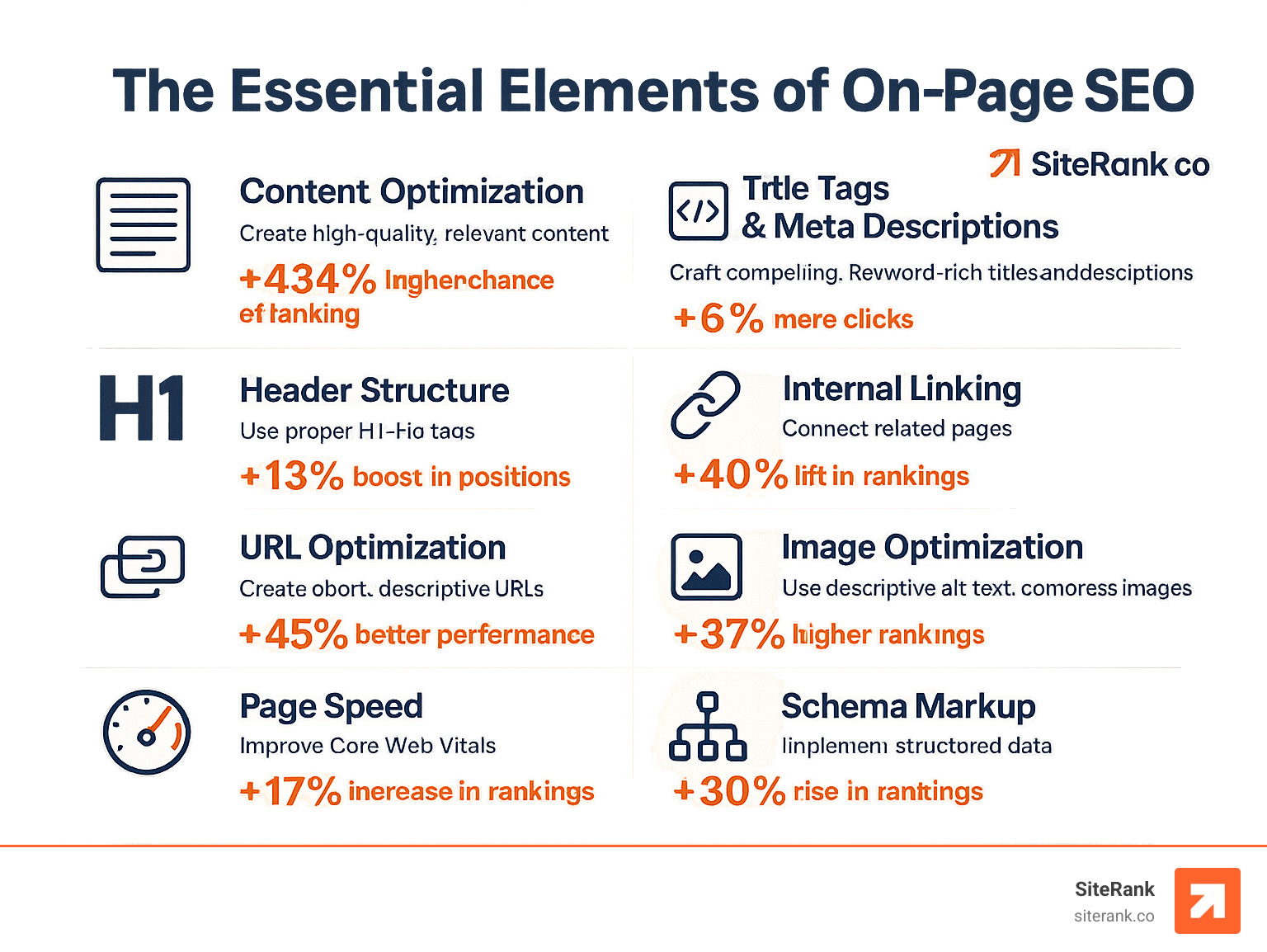
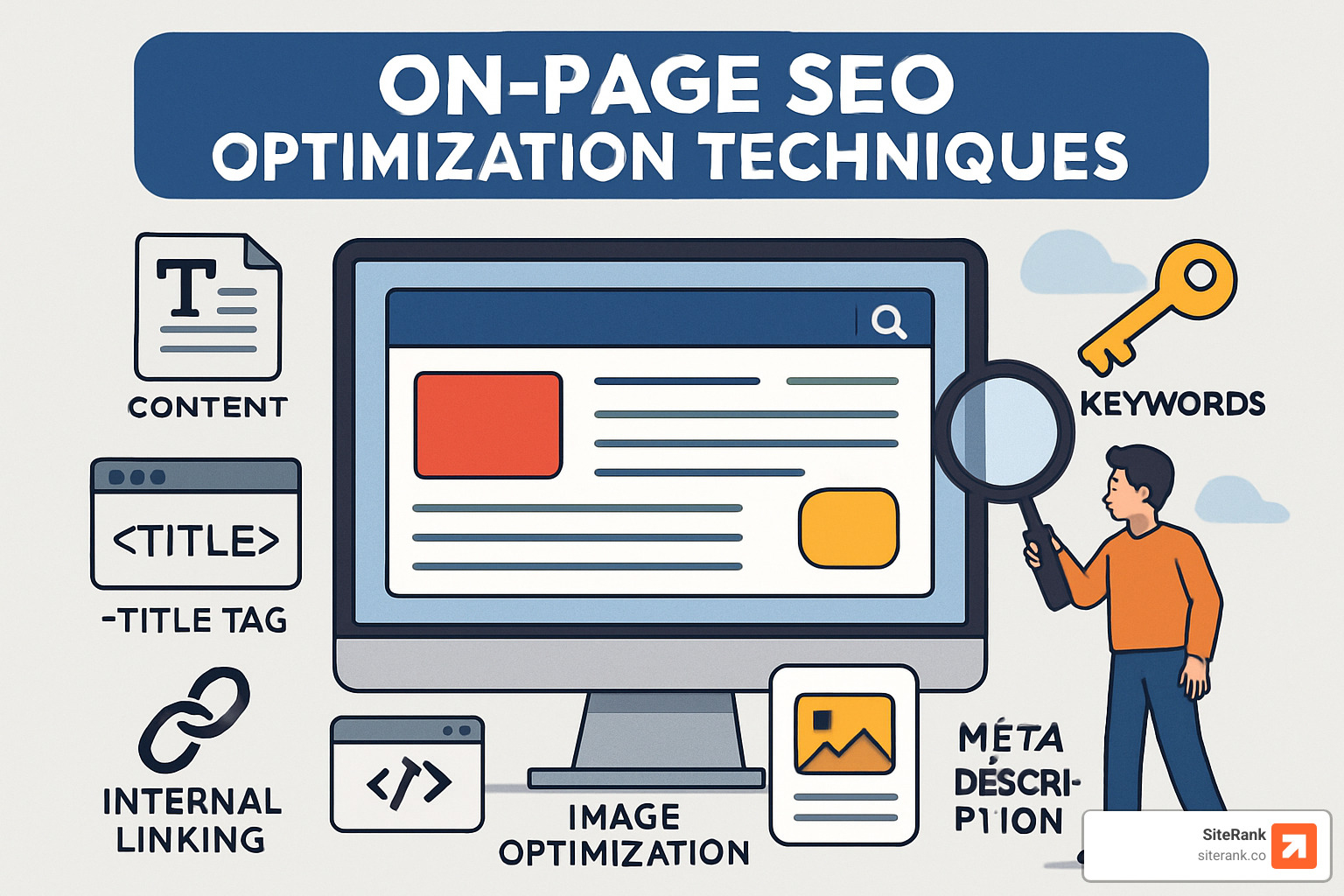
On page SEO optimization techniques are the practices of optimizing individual web pages to rank higher in search engines and earn more relevant traffic. Here are the most important techniques to focus on:
- Content Optimization: Create high-quality, relevant content that satisfies user intent
- Title Tags & Meta Descriptions: Craft compelling, keyword-rich titles (50-60 characters) and descriptions
- Heading Structure: Use proper H1-H6 tags to organize content logically
- URL Optimization: Create short, descriptive URLs with target keywords
- Internal Linking: Connect related pages with descriptive anchor text
- Image Optimization: Use descriptive alt text, compress files, and unique images
- Page Speed: Improve Core Web Vitals metrics for better user experience
- Schema Markup: Implement structured data to earn rich snippets
On-page SEO has evolved significantly over the years. While it once focused primarily on keyword placement and density, modern on page SEO optimization techniques now prioritize user experience, content relevance, and satisfying search intent.
As Google’s algorithms have become more sophisticated, they now reward pages that provide genuine value rather than those that simply check technical boxes. According to research, Google rewrites title tags 61.6% of the time, most often for titles that are very short or very long. Additionally, pages with a meta description get approximately 6% more clicks versus pages with missing descriptions.
Small changes to your page elements can have a big impact on search rankings and traffic. For example, question-based title tags have a 14.1% higher organic CTR compared to non-question titles, while emotionally-charged titles get clicked on 7% more often.
I’m Craig Flickinger, founder of SiteRank.co with over 15 years of experience implementing effective on page SEO optimization techniques for businesses of all sizes, helping them achieve measurable ranking improvements and increased organic traffic.
On-Page vs Off-Page vs Technical SEO
When you’re just getting started with SEO, it can feel a bit like learning a new language. Let’s break down the three main branches of SEO so you can see exactly where on page SEO optimization techniques fit into your overall strategy.
Think of your website as a store. On-page SEO is like arranging your products beautifully inside the shop, technical SEO ensures the building is structurally sound, and off-page SEO is about getting people around town to recommend your store to others.
| SEO Type | Focus Area | Key Elements | Control Level | Impact Timeline |
|---|---|---|---|---|
| On-Page SEO | Individual page content and HTML | Content, meta tags, headings, internal links, images | High (you control directly) | Short to medium-term |
| Off-Page SEO | External signals | Backlinks, social signals, brand mentions | Low (indirect influence) | Medium to long-term |
| Technical SEO | Website infrastructure | Site speed, mobile-friendliness, crawlability, indexing | Medium to high | Short to medium-term |
Here’s why this matters: on page SEO optimization techniques are your secret weapon because they’re completely within your control. You don’t need to wait for other websites to link to you or for your developer to fix complex technical issues – you can start making improvements today.
As SEO expert Nick Eubanks puts it: “On-page SEO is where you have the most control. It’s the foundation upon which all other SEO efforts are built.”
While off-page factors like backlinks might take months to develop, and technical fixes might require specialized knowledge, on-page optimizations can start working for you almost immediately. This is why we at SiteRank often recommend beginning your SEO journey by mastering on-page elements.
The best part? Many on page SEO optimization techniques directly improve user experience too. When you organize content with clear headings, write compelling meta descriptions, and create readable, valuable content, you’re not just pleasing search engines – you’re making your site better for actual humans.
Now that we understand where on-page SEO fits into the bigger picture, let’s explore the specific techniques that will help your pages climb those search rankings.
1. Write People-First, Keyword-Focused Content
The cornerstone of effective on page SEO optimization techniques is creating high-quality, relevant content that serves both users and search engines. Google’s algorithms have evolved to prioritize content that demonstrates Experience, Expertise, Authoritativeness, and Trustworthiness (E-E-A-T).
Understanding Search Intent
I remember working with a client who couldn’t figure out why their beautifully written content wasn’t ranking. The issue? They were answering questions nobody was asking. That’s why understanding search intent is so crucial.
When someone types a query into Google, they’re looking for something specific. This intent typically falls into one of four categories:
Informational searches are like raising your hand in class – “How does SEO work?” or “What is a backlink?” These searchers want to learn something new. Navigational searches are more direct – someone typing “Facebook login” just wants to get to a specific site. Commercial intent shows up when people research before buying (“best SEO tools 2023”), while transactional searches indicate someone ready to convert (“buy SEO software” or “hire SEO agency”).
At SiteRank, we don’t just guess what people want – we analyze the top-ranking pages for your target keywords to understand exactly what’s working. This helps us create content that feels like it was made specifically for your visitors.
Conducting Effective Keyword Research
Keyword research has evolved from simply finding words to stuff into content. Today, it’s more like becoming a mind reader for your audience.
The most successful approach focuses on organizing related keywords into topic clusters – think of these as neighborhoods of related ideas rather than isolated phrases. Long-tail keywords might have smaller search volumes, but they often attract people who know exactly what they want.
“I was skeptical about focusing on long-tail keywords until we tried it,” one of our e-commerce clients told me. “Now those specific phrases drive 60% of our sales with just 30% of our traffic.”
User questions have become goldmines too. The “People Also Ask” boxes in search results reveal exactly what your audience wants to know. And don’t forget to balance ambition with reality by analyzing keyword difficulty – sometimes the smartest strategy is targeting phrases your competitors have overlooked.
Creating Comprehensive, Valuable Content
Once you understand what your audience is searching for, it’s time to create content that delivers genuine value.
Comprehensive coverage means answering not just the main question but all the related ones too. When we rewrote a healthcare client’s product pages as thorough guides addressing patient questions and concerns, their organic traffic jumped 200% in just three months, with inquiries up 40%.
Real-world examples help readers connect abstract concepts to practical applications. Original research or data positions you as an authority worth citing (hello, backlinks!). And regular updates signal to both readers and search engines that your content remains relevant.
The freshness factor matters more than ever. In competitive niches, we’ve seen updated content outperform newer but less comprehensive articles. Google appreciates when you keep things current, especially for topics that evolve quickly.
For businesses looking to scale their content efforts without sacrificing quality, our Content Writing Services can help develop people-first, keyword-optimized content that not only ranks well but actually converts visitors into customers.
The best on page SEO optimization techniques start with understanding real people and their needs. When you write for humans first and optimize for search engines second, you create the kind of content that naturally earns both rankings and reader loyalty.
2. Craft Compelling Title Tags & Meta Descriptions
Your title tags and meta descriptions are like tiny billboards for your content in search results. These crucial on page SEO optimization techniques don’t just impact rankings—they’re often the deciding factor in whether someone clicks on your page or scrolls right past it.
Title Tag Best Practices
I can’t overstate how important your title tags are for SEO success. They’re the first impression you make in search results, and getting them right can make a world of difference.
Keep your titles between 50-60 characters to prevent Google from cutting them off mid-sentence. It’s also smart to place your primary keywords near the beginning where they’ll have the strongest impact. Don’t forget to include your brand name at the end (like “Amazing Guide to SEO | SiteRank”) to build recognition over time.
Want to boost clicks? Try using power words that spark emotion—terms like “essential,” “proven,” or “ultimate” can make your title more compelling. We’ve seen question-format titles increase click-through rates by a whopping 14.1%! Something as simple as changing “SEO Techniques” to “Which SEO Techniques Actually Work in 2024?” can dramatically improve performance.
In our client work at SiteRank, we’ve witnessed how changing just one word in a title tag can move a page up seven positions in search results. That’s the difference between being buried on page two and appearing on page one!
Meta Description Strategies
While meta descriptions aren’t direct ranking factors, they’re conversion powerhouses that can significantly boost your click-through rates.
Keep them under 160 characters (roughly 920 pixels) to avoid truncation. Include your primary keyword naturally—Google bolds matching search terms, making your result stand out. Write in active voice with a clear call-to-action that compels readers to click.
Don’t forget to highlight what makes your content special. What unique benefits or insights will readers gain? For time-sensitive content, adding the current year signals freshness (like “Updated for 2024”).
The difference is measurable—pages with well-crafted meta descriptions receive approximately 6% more clicks than those without. That’s free traffic just waiting to be claimed with a few minutes of thoughtful writing!
Emotional Triggers and CTR
Finding the right emotional balance in your titles and descriptions is a bit like cooking—too little seasoning and you’re forgettable, too much and you’re overwhelming.
Research shows emotionally-charged titles get clicked 7% more often than neutral ones. However, going overboard with power words can actually hurt—titles with excessive emotional language saw a 12% decrease in CTR.
The sweet spot? Authentic enthusiasm that delivers on its promise. Instead of “SEO Tips,” try “7 Proven SEO Techniques That Boosted Our Client’s Rankings by 200% (With Real Examples).”
For deeper insights into optimizing your title links based on Google’s research, check out Google’s guidelines on title links. And if you’re looking for a comprehensive approach to implementing these techniques, our On-Page Optimization Strategy can walk you through the process step by step.
3. Structure With Headings & Semantic HTML
Proper content structure using headings and semantic HTML is a fundamental on page SEO optimization technique that helps both users and search engines understand your content.
Heading Hierarchy Best Practices
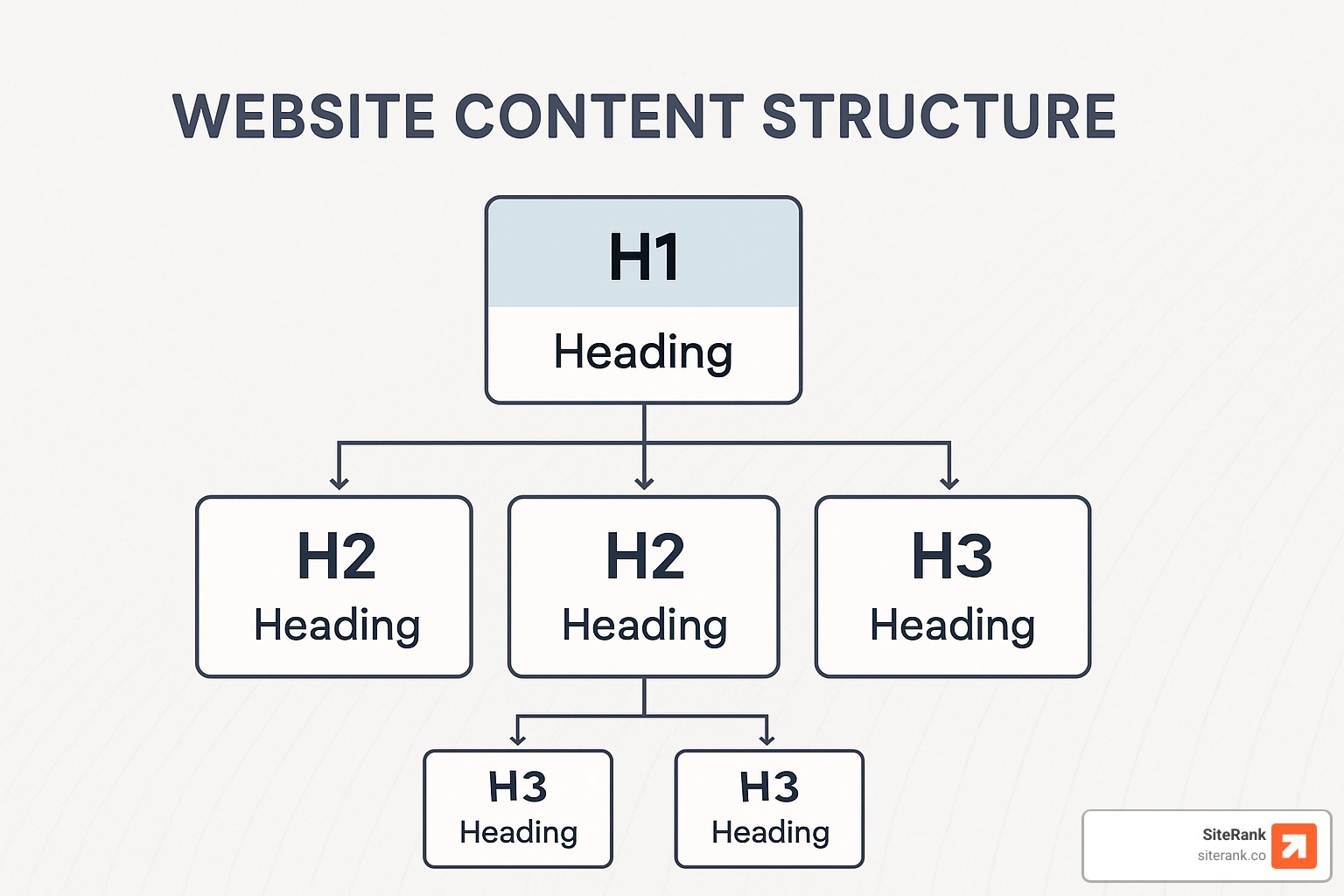
Think of your content’s heading structure as a roadmap guiding visitors through your ideas. When I explain this to clients, I often use the book analogy – your H1 is the title, H2s are chapters, and H3s are the sections within those chapters.
For effective heading structure, always use just one H1 tag per page – this is your main title and sets the stage for everything that follows. From there, follow a logical path downward (H1 → H2 → H3) without skipping levels, which would confuse both readers and search engines.
Including keywords in your headings comes naturally when you’re writing for real people. Your H1 and H2 tags are particularly valuable spots for these terms, but never force them in awkwardly. These headings need to be descriptive enough to help readers scan your content easily.
As Lily Ray, a respected SEO consultant, puts it: “Proper heading structure is like creating a table of contents for your page. It guides both users and search engines through your content in a logical way.”
Keyword Placement in Content
While the days of keyword stuffing are thankfully behind us, thoughtful keyword placement remains crucial. I always advise getting your target keyword into the first 100 words of your content – this signals relevance right from the start.
Throughout your text, use variations and synonyms naturally. This not only prevents repetitive writing but also helps with semantic search understanding. Aim for a natural keyword density (roughly 1-2% is plenty) rather than hitting a specific number.
We recently worked with an e-commerce client who was struggling to rank their product pages. By simply restructuring their descriptions to include target keywords in the opening paragraph and organizing content with proper heading hierarchy, they saw significant ranking improvements within weeks.
Semantic HTML for Improved Understanding
Beyond just headings, the structure of your HTML code tells search engines a lot about your content. Think of semantic HTML as giving Google additional context clues about what each section of your page actually means.
Instead of generic <div> tags everywhere, use descriptive HTML5 elements that add meaning: <article> for standalone content, <section> for thematic grouping, <nav> for navigation areas, and <figure> for images with captions.
For content like lists and tables, proper markup makes a difference too. Well-structured lists using <ul> and <ol> tags improve accessibility and search engine understanding. Similarly, tables with proper <thead> and <tbody> elements provide clearer structure.
When you emphasize text, do it meaningfully with <em> and <strong> tags rather than just for visual styling. This adds semantic weight to important concepts and helps screen readers properly convey emphasis to users with visual impairments.
These semantic HTML practices not only improve your SEO but also improve accessibility – something that’s increasingly important for both user experience and compliance reasons.
5. Optimize URLs for Humans and Crawlers
Have you ever looked at a URL and had absolutely no idea what page it would take you to? Those long, jumbled strings of numbers and symbols are not just confusing for people—search engines struggle with them too. Creating clean, descriptive URLs is one of those on page SEO optimization techniques that delivers benefits on multiple fronts.
Creating SEO-Friendly URLs
Think of your URL as a mini-billboard for your page. When it’s clear and descriptive, both humans and search engines immediately understand what your page is about.
Good URLs are like good directions—simple, clear, and to the point. Keep them under 60 characters when possible, and place your primary keyword near the beginning where it carries more weight. Always use hyphens to separate words (not underscores or spaces), as Google specifically recommends this approach.
For example, compare these two URLs:
https://siterank.co/store?p=123&category=shoes&color=red
versus:
https://siterank.co/shoes/red-running-sneakers
Which one tells you more about the page content? The second one, of course! It’s immediately clear you’re looking at red running sneakers, while the first URL could be about anything.
I’ve seen dramatic improvements when clients simplify their URLs. One SiteRank e-commerce client saw a 25% increase in organic traffic just from restructuring their product URLs to be more descriptive and keyword-focused.
Implementing Breadcrumb Navigation
Breadcrumbs aren’t just for fairy tales! These navigational aids show users exactly where they are in your site’s hierarchy—like digital breadcrumb trails leading back home.
When properly implemented, breadcrumbs help both visitors steer your site and provide search engines with additional context about your site structure. The best part? Google often displays breadcrumbs in search results, improving your listings and potentially boosting click-through rates.
A real estate client we worked with implemented breadcrumb navigation with proper schema markup and saw their pages getting indexed 80% faster. Plus, their visitors spent more time exploring the site because they always knew where they were and how to get back.
HTTPS and Secure URLs
Security isn’t just a nice-to-have anymore—it’s essential for SEO. Google has confirmed that HTTPS is a ranking signal, and Chrome now marks all HTTP sites as “not secure.”
When visitors see that “not secure” warning, many will immediately click away. Would you enter your credit card on a site with a security warning? Probably not, and neither will your customers.
Implementing HTTPS across your entire site, setting up proper redirects from HTTP to HTTPS, and ensuring all internal links use the secure protocol are fundamental on page SEO optimization techniques that protect both your visitors and your rankings.
For more detailed guidance on creating effective URLs, check out Google’s recommendations on using simple URLs. These guidelines come straight from the source and can help ensure your URLs are working for you, not against you.
5. Strategic Internal Linking
Internal linking is a powerful on page SEO optimization technique that helps distribute page authority, establish site hierarchy, and improve user navigation.

Internal Linking Best Practices
Think of internal links as friendly tour guides for both your visitors and search engines. They’re showing everyone around your digital home, pointing out what’s important and how everything connects.
When we work with clients at SiteRank, we emphasize the importance of descriptive, keyword-rich anchor text rather than generic phrases like “click here” or “read more.” These descriptive links give both users and search engines valuable context about the destination page.
I remember working with a client who consistently used “click here” for all their internal links. After we updated them to descriptive text, their pages started ranking for terms they hadn’t specifically targeted because Google better understood their content relationships.
High-authority pages on your site are like popular friends with lots of influence. When these pages link to other content, they pass along some of their authority. We always recommend identifying your strongest pages (often your homepage, popular blog posts, or key service pages) and using them strategically to boost important content you want to rank higher.
Your internal linking should create a logical structure that mirrors how you’d explain your business offerings to someone face-to-face. This helps both users and search engines understand the relationships between your pages and topics.
John Mueller from Google has emphasized that “internal linking is super critical for SEO,” noting that it helps Google understand which pages are most important on your site. We’ve seen this play out countless times with our clients’ sites.
Hub-and-Spoke Model
One of my favorite internal linking approaches is the hub-and-spoke model. It’s simple but incredibly effective.
Imagine your content as a bicycle wheel. At the center, you have a comprehensive hub page covering a broad topic in depth. Radiating outward are your spoke pages that explore specific aspects of that topic in greater detail.
For example, this very article on on-page SEO is a hub, while individual sections could be expanded into their own dedicated spoke pages. The magic happens when you link from the hub to all spokes using relevant anchor text, and then link from spokes back to the hub and to related spokes.
This creates a tightly-knit content ecosystem that search engines love because it clearly demonstrates topical expertise and authority. We’ve implemented this approach for numerous SiteRank clients and consistently seen improvements in topic rankings.
Fixing Broken Links and Redirects
Even the best internal linking strategy needs regular maintenance – think of it as digital housekeeping.
Broken links frustrate users and waste valuable link equity. We recommend quarterly link audits to identify and fix broken links across your site. Several of our clients have seen notable traffic increases after simply fixing broken internal links that were hampering their site’s authority flow.
Redirect chains are another common issue. When Page A redirects to Page B, which redirects to Page C, you’re creating a chain that dilutes link equity and slows down both users and crawlers. We try to keep redirects to a maximum of one hop whenever possible.
A SiteRank client in the education sector saw a 35% increase in organic traffic after implementing a comprehensive internal linking strategy that connected related courses and resources using descriptive anchor text. The improvement wasn’t just in rankings – users stayed longer and explored more content because the pathways were clear and intuitive.
For more comprehensive assistance with internal linking and other on-page factors, explore our On-Page SEO Services which include detailed site audits and implementation plans. We’ll help you turn your internal linking into a powerful ranking asset rather than an afterthought.
6. Leverage Authoritative External Links
Have you ever noticed how the most trustworthy articles tend to cite reputable sources? That’s no accident. Linking to authoritative external websites is a powerful on page SEO optimization technique that builds credibility while signaling to search engines that your content is well-researched and valuable.
The Value of External Links
Think of external links as digital votes of confidence. When you reference respected sources, you’re essentially telling both readers and search engines, “I’ve done my homework.”
External links serve as trust signals that improve your content in multiple ways. They establish credibility by connecting your content with trusted authorities in your field. They provide helpful context for readers who might want to dive deeper into a topic. Most importantly, they signal topical relevance to search engines, helping them understand what your content is about.
As Marie Haynes, a respected SEO expert, puts it: “External links are a way of showing search engines that you’ve done your homework. They help establish the context and credibility of your content.”
What’s particularly interesting is that research consistently shows websites that link out to authoritative sources tend to outrank those that don’t. This makes perfect sense—quality outbound links demonstrate thoroughness and a commitment to providing comprehensive value to your readers.
Best Practices for External Linking
To get the most benefit from your external links, follow these proven approaches:
Always link to reputable, authoritative sites that are directly relevant to your content. Quality matters more than quantity here. Choose established, trusted sources that improve your reader’s understanding rather than linking to just any related website.
Use descriptive anchor text that clearly indicates what readers will find when they click. Vague phrases like “click here” waste an opportunity to provide context to both users and search engines.
Unless there’s a specific reason not to (like preserving a checkout flow), keep external links opening in the same tab. This creates a more seamless browsing experience for most users.
Be specific with your links. Rather than linking to a homepage, link to the exact page that contains the relevant information. This creates a better user experience and more precisely signals topical relevance.
Set a calendar reminder to periodically check and update external links. Nothing undermines credibility faster than sending visitors to broken pages or outdated information.
Do-Follow vs. No-Follow Links
Understanding when to use different link attributes is an important part of your external linking strategy:
Do-follow links are the default when you add a link. They pass link equity (ranking power) and are appropriate for trusted resources you want to endorse.
No-follow links (using rel="nofollow" attribute) don’t pass link equity. Use these for untrusted content, paid links, or when linking to sites you don’t necessarily want to endorse.
Sponsored links (rel="sponsored") should be used when linking to paid or sponsored content to maintain transparency with search engines.
UGC links (rel="ugc") are appropriate when linking to user-generated content like comments or forum posts.
Google’s John Mueller has specifically addressed the importance of adding links to authoritative external sources in a helpful video where he explains how these connections help search engines better understand your content’s context and relevance.
At SiteRank, we’ve seen clients achieve significant ranking improvements after implementing thoughtful external linking strategies that connect their content with authoritative sources in their industry. This simple yet effective on page SEO optimization technique helps establish topical authority while creating a more valuable experience for your readers.
7. Image & Multimedia Optimization
Images and multimedia elements do more than just make your content look pretty – they significantly boost user engagement. However, they need proper optimization to support your on page SEO optimization techniques and avoid dragging down your page performance.
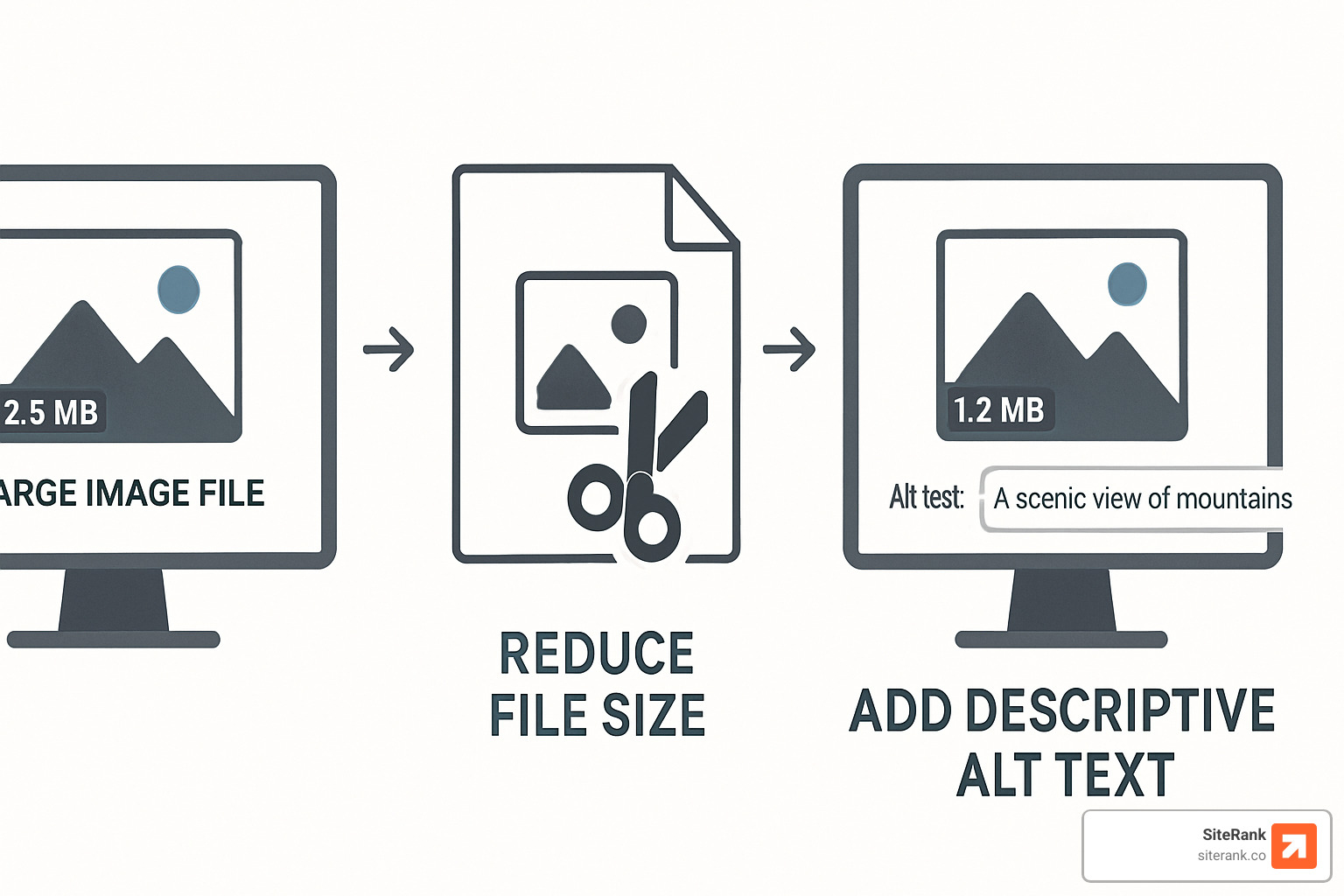
Image SEO Best Practices
Think of your images as silent SEO workers. When I’m helping clients at SiteRank, I often find their images doing nothing for their SEO – what a missed opportunity!
Start with descriptive, keyword-rich filenames. That “IMG001.jpg” isn’t telling Google anything, but “red-nike-running-shoes.jpg” certainly is. This simple change gives search engines valuable context before they even process the image.
Alt text is equally crucial – not just for SEO but for accessibility too. Keep these descriptions under 125 characters and naturally include relevant keywords. I like to think of alt text as explaining the image to someone who can’t see it while sneaking in a keyword or two when it makes sense.
Image size can make or break your page speed. One e-commerce client came to us with beautiful product images that were absolute performance killers. After implementing proper compression techniques, their product pages loaded 40% faster and saw a 25% increase in conversion rates – all without any visible quality loss.
Choosing the right file format matters too. JPEGs work best for photographs, PNGs for graphics needing transparency, and WebP for the best overall compression. And don’t forget to specify image dimensions in your HTML – this prevents those annoying layout shifts that frustrate users and hurt your Core Web Vitals scores.
Lazy Loading for Performance
Lazy loading is like a good party host who only introduces guests as they’re needed. Instead of loading all images at once (and potentially overwhelming your page), lazy loading delays loading images until they’re about to enter the viewport.
Modern browsers support native lazy loading with a simple loading="lazy" attribute – it’s one of the easiest performance wins you can implement. For critical above-the-fold images, skip lazy loading so they appear immediately when someone lands on your page.
I recently helped a travel blog implement lazy loading for their image-heavy destination guides. The initial page load time dropped by over 60%, dramatically reducing bounce rates from mobile users with slower connections.
Video Optimization
Videos can be SEO powerhouses when properly optimized. Whether you’re hosting on YouTube, Vimeo, or your own servers, start with descriptive titles, detailed descriptions, and relevant tags.
One often overlooked video optimization trick is adding transcripts. Not only do transcripts make your content accessible, but they also give search engines text to index, essentially turning your video into searchable content.
Don’t underestimate the power of an enticing thumbnail either – it can significantly impact click-through rates. And if you want to really level up, implement structured data for videos to help search engines understand your content and potentially earn rich results.
The numbers speak for themselves – our research shows pages with optimized videos receive 157% more organic traffic than those without video content. That’s too significant to ignore!
For those looking to quickly optimize image file sizes without sacrificing quality, I highly recommend ImageOptim. This free tool can reduce file sizes by 20-80% with just a few clicks – it’s been a game-changer for many of our clients at SiteRank.
Every second counts when it comes to page load time. Properly optimized images and videos not only improve your user experience but send positive signals to search engines that your site deserves to rank higher.
8. Page Speed & Core Web Vitals
Let’s talk about something that directly impacts both your users and your rankings – page speed. In today’s digital world, nobody likes to wait for a slow website to load. In fact, page speed is one of the most crucial on page SEO optimization techniques you should focus on in 2024.
Understanding Core Web Vitals
Google’s Core Web Vitals have become the gold standard for measuring user experience on your website. Think of them as your website’s vital signs:
- Largest Contentful Paint (LCP): This measures how quickly the main content of your page loads. Aim for under 2.5 seconds – anything longer and you’re likely losing impatient visitors.
- First Input Delay (FID): This tracks how responsive your page is when a user first interacts with it. Keep this under 100 milliseconds for a smooth experience.
- Cumulative Layout Shift (CLS): Ever had elements jump around while you’re trying to read a page? That’s what CLS measures – aim for under 0.1 to avoid frustrating your visitors.
Google has explicitly confirmed that these experience signals directly influence your rankings. It makes sense when you think about it – Google wants to send users to sites that provide a great experience, not ones that test their patience!
Speed Optimization Techniques
Improving your page speed doesn’t have to be complicated. Here are some practical approaches that have worked wonders for our clients:
Compressing images is often the quickest win – I’ve seen sites cut load times in half just by properly optimizing their visuals. Minifying your code (CSS, JavaScript, and HTML) removes unnecessary characters without changing functionality, making files smaller and faster to load.
Browser caching is another game-changer. By storing resources locally in a visitor’s browser, you’re essentially saying, “Hey, you’ve already downloaded this once – no need to do it again!” This dramatically speeds up return visits.
Your hosting quality matters more than you might think. I’ve seen clients switch from budget hosting to quality providers and cut their server response time by 70%. For larger sites with global audiences, using a Content Delivery Network (CDN) places your content on servers closer to your visitors, reducing the physical distance data needs to travel.
One of our travel industry clients came to us with painfully slow pages and poor Core Web Vitals scores. After implementing these optimization techniques, they moved from “Poor” to “Good” ratings across the board. The results? Their bounce rate dropped by 35%, and users started exploring 28% more pages per session – real business impact from technical improvements.
Mobile Optimization
With Google’s mobile-first indexing, your site’s mobile performance isn’t just important – it’s primary. Google now uses your mobile site for ranking purposes, even for desktop searches.
Make sure your design is truly responsive and adapts beautifully to all screen sizes. Those tiny buttons that work fine with a mouse? They need to be at least 48×48 pixels for comfortable tapping on mobile. And those pop-ups that take over the whole screen? Google explicitly penalizes “intrusive interstitials” that make content hard to access on mobile.
Don’t forget about text size – squinting at tiny fonts drives users away. A minimum of 16px for body text ensures readability across devices.
Want to see how your site stacks up? Google’s PageSpeed Insights tool gives you both lab data (controlled tests) and field data (real-world performance) along with specific recommendations for improvement. It’s like having a performance coach for your website – and it’s completely free!
At SiteRank, we’ve seen how speed improvements translate to ranking gains. When you’re ready to stop losing visitors to slow load times, our team can help identify and fix the specific issues holding your site back.
9. Schema Markup & Featured Snippets
Implementing schema markup is an advanced on page SEO optimization technique that helps search engines understand your content and can earn you improved listings in search results.
Understanding Schema Markup
Think of schema markup as a translator between your website and search engines. While humans can understand context by reading content, search engines sometimes need extra help figuring out exactly what your page is about. That’s where schema comes in.
Schema markup creates those eye-catching rich snippets you see in search results – the ones with star ratings, product prices, or recipe cooking times. While it’s not directly a ranking factor (Google has been clear about this), the improved visibility and higher click-through rates it generates can dramatically boost your search performance.
I’ve seen businesses transform their search presence overnight after implementing the right schema. One of our e-commerce clients saw their CTR jump by 35% after adding product schema with pricing and availability information. Users simply prefer these improved listings – they provide more information before the click.
Implementing Common Schema Types
The beauty of schema is its versatility. There’s a schema type for virtually every kind of content, but some provide more immediate value than others.
For local businesses, LocalBusiness schema is gold – it helps you appear in those valuable map packs with your address, hours, and phone number clearly displayed. If you sell products, Product schema showcases prices, availability, and reviews directly in search results.
FAQ schema has become one of my personal favorites to implement for clients. It expands your search listing with dropdown questions and answers, increasing your search real estate dramatically. Similarly, HowTo schema works wonders for instructional content, breaking down steps in a visually appealing way.
JSON-LD is definitely the way to go for implementation. Unlike older methods that required modifying your visible HTML, JSON-LD is a clean script that sits in your page’s header. It’s easier to add, update, and won’t mess with your page’s appearance – Google prefers it too.
Optimizing for Featured Snippets
Featured snippets – those answer boxes that appear at “position zero” in search results – are the closest thing to an SEO shortcut that exists today. While you can’t directly apply for them, you can optimize your content to be selected.
The secret is understanding what Google looks for. Clear, concise answers to specific questions (ideally 40-60 words) are the sweet spot. Format matters too – use paragraphs for definitions, bulleted lists for steps, and tables for comparisons. Proper heading structure is crucial, with questions as H2 or H3 tags followed by direct answers.
I remember working with a financial advisor who was struggling to gain visibility for retirement planning terms. After restructuring their content with clear question headings and implementing FAQ schema, they captured featured snippets for several high-value keywords. Their organic traffic increased by 58% in just three months.
Voice search optimization is another compelling reason to pursue featured snippets. When someone asks their Google Assistant or Alexa a question, the response is often pulled directly from a featured snippet. As voice search continues growing, these position zero placements become even more valuable.
For a comprehensive guide to every schema type available, check out Schema.org. It’s the official resource created by the major search engines and provides detailed documentation for implementation.
Advanced On Page SEO Optimization Techniques
Once you’ve mastered the fundamentals, let’s explore some advanced on page SEO optimization techniques that can give you a genuine competitive edge. These strategies separate good SEO from great SEO, and they’re exactly what we implement for our most successful clients at SiteRank.
Content Gap Analysis
Have you ever wondered why your competitors rank for certain keywords that you don’t? That’s where content gap analysis comes in – one of my favorite advanced techniques.
I recently worked with a SiteRank client in the fitness industry who couldn’t understand why they weren’t ranking for certain terms. When we analyzed their top three competitors, we finded they were missing entire content categories around post-workout nutrition that their audience was actively searching for.
The process is straightforward but powerful:
First, identify who’s consistently outranking you. Then dive into their top-performing content using tools like Ahrefs or SEMrush. Compare this against your own content inventory to spot the gaps – topics they cover that you don’t. Finally, create thoughtful, comprehensive content that fills these gaps while providing even more value than your competitors.
Semantic Keyword Optimization
Google has evolved far beyond exact-match keywords. Today, it understands topics and concepts – which means you should too.
Semantic keyword optimization involves understanding the relationship between words and concepts. Instead of focusing solely on your primary keyword, accept related terms that help Google understand your content’s context and depth.
“Modern SEO is about topics, not just keywords,” notes SEO expert Andy Crestodina. “The algorithm understands semantics and rewards comprehensive coverage.”
For example, if you’re writing about coffee brewing methods, don’t just repeat “coffee brewing” throughout your content. Include semantically related terms like extraction, grind size, water temperature, and specific brewing devices. This signals to Google that you’re covering the topic comprehensively.
The best sources for finding these semantic relationships? Look at Google’s “Related searches” and “People also ask” sections. These reveal exactly what Google considers topically related.
Voice Search Optimization
With smart speakers in millions of homes and voice search becoming second nature, optimizing for voice queries isn’t just forward-thinking – it’s essential now.
Voice searches tend to be longer, more conversational, and often question-based. “Where can I find the best pizza near me?” rather than “best pizza Chicago.”
A SiteRank client in the home services industry implemented a simple but effective voice search strategy. We created FAQ sections addressing common customer questions using natural, conversational language. The result? A 45% increase in local leads within three months, many coming directly from voice searches.
To optimize for voice search, focus on conversational phrases, provide direct answers to common questions, and aim for featured snippets (which are often what voice assistants read aloud). Local businesses should pay special attention, as “near me” searches are among the most common voice queries.
UX Metrics and A/B Testing
User experience and SEO have become inseparable partners. While Google doesn’t directly use metrics like bounce rate as ranking factors, user behavior indirectly influences your rankings in significant ways.
I always recommend clients implement A/B testing for important pages. This might mean testing different:
- Headline formats (questions vs. statements)
- Content structures (case study first vs. explanation first)
- Visual elements (more images vs. more text)
- CTA placements and wording
One SiteRank e-commerce client finded through A/B testing that moving their product benefits above technical specifications increased both time on page and conversion rate by 23%. These improved engagement signals correlated with gradual ranking improvements over the following months.
Monitoring on page seo optimization techniques with Data & Tools
The difference between good SEO and great SEO often comes down to measurement and iteration. You need to know what’s working and what isn’t.
Essential Monitoring Tools
The tools you choose shape the insights you gain. Here are the ones we rely on daily at SiteRank:
Google Search Console gives you direct data from Google about how your site is performing in search. Pay special attention to the Performance report (showing impressions, clicks, and CTR) and the Coverage report (showing indexing issues).
Google Analytics helps you understand what happens after users land on your site. Are they engaging with your content? Converting? Bouncing immediately?
PageSpeed Insights provides both lab and field data about your page performance, with specific recommendations for improvement.
Screaming Frog allows you to crawl your site like a search engine would, identifying technical issues that might be holding you back.
SiteRank’s SEO Dashboard brings all these metrics together in one place, making it easier to spot patterns and opportunities.
Key Metrics to Track
Not all metrics deserve equal attention. Focus on these high-impact indicators:
Your organic traffic trends tell the overall story of your SEO success. Look beyond day-to-day fluctuations to spot meaningful patterns.
Keyword rankings show where you stand for specific terms. Track not just your primary keywords but also long-tail variations.
Click-through rate reveals how compelling your titles and meta descriptions are. A low CTR with a high ranking suggests your SERP listing needs work.
Bounce rate and time on page indicate whether your content meets user expectations. High bounce rates might signal a mismatch between search intent and your content.
Core Web Vitals metrics directly impact both user experience and rankings. Monitor LCP, FID, and CLS regularly.
Updating Your Content: When On Page SEO Optimization Techniques Need a Refresh
Even the best content doesn’t stay fresh forever. Regular updates are essential for maintaining and improving rankings.
Signs Your Content Needs Updating
Pay attention to these warning signs that it’s time for a refresh:
When rankings begin to drop for previously well-performing pages, it often indicates that competitors have published more comprehensive or current content.
Declining traffic despite stable rankings suggests your click-through rate is suffering – perhaps your title tag or meta description no longer resonates with searchers.
Obviously, when information becomes outdated or inaccurate, updates are essential not just for SEO but for user trust.
When you notice competitors publishing more comprehensive content on the same topics, it’s time to evaluate what they’re doing right.
Falling user engagement metrics like increased bounce rate or decreased time on page indicate that your content is no longer meeting user needs effectively.
Effective Content Update Strategies
When refreshing content, don’t just make superficial changes. Google (and users) can tell the difference between meaningful updates and simply changing a few words.
Start by updating statistics and references with the most current data available. Nothing dates content faster than old stats.
Look for opportunities to expand sections that could provide more depth. Perhaps new questions have emerged in your industry that weren’t addressed in your original content.
Consider adding new sections addressing emerging subtopics that have become relevant since your original publication.
Refresh examples and case studies to remain current and relatable. What worked three years ago might not resonate today.
Don’t forget to update internal links to point to your newer content, creating a stronger internal linking structure.
Sometimes, simply revising title tags and meta descriptions can breathe new life into existing content by improving click-through rates.
A SiteRank client in the technology sector implemented a quarterly content refresh strategy and saw a 40% increase in organic traffic to their resource pages within six months. They prioritized their updates based on a combination of traffic potential and current performance gaps.
After significant updates, remember to request recrawling through Google Search Console. This accelerates the findy of your updated content and helps rankings improve more quickly.
The most successful on page SEO optimization techniques aren’t set-it-and-forget-it tactics – they require ongoing attention, analysis, and refinement. But with the right approach, the results are more than worth the effort.
Frequently Asked Questions about On-Page SEO
What is the difference between on-page, off-page, and technical SEO?
When I explain SEO to my clients, I like to use a simple house-building analogy:
On-page SEO is like the interior design of your home – it’s everything visitors directly experience. This includes your content, meta tags, headings, images, and internal links. The beauty here is that you have complete control over these elements. You can rearrange, improve, and perfect them anytime.
Off-page SEO resembles your home’s reputation in the neighborhood. It’s what others say about your house that builds its standing. This primarily involves backlinks from other websites, social media mentions, and brand citations. While you can influence these factors, you can’t directly control them.
Technical SEO is your home’s foundation and framework – the structural elements that keep everything functioning properly. This includes site speed, mobile-friendliness, secure connections (HTTPS), proper indexing, and crawlability. Without this solid foundation, even the most beautiful interior won’t matter if visitors can’t get through the front door!
Most of our clients at SiteRank find that focusing on on page SEO optimization techniques gives them the quickest wins, since these elements are completely within their control and often show results faster than other approaches.
How often should I review my on-page SEO?
Think of your on-page SEO like your car – it needs different levels of maintenance at different intervals to keep running smoothly.
For most websites, we recommend this maintenance schedule:
Monthly check-ups: Just like checking your oil, take a quick look at your key metrics in Google Search Console and Analytics. Look for any sudden drops or gains in traffic that might need attention.
Quarterly tune-ups: Every three months, conduct deeper reviews of your most important pages – those driving significant traffic or revenue. This is when you might update content, refresh statistics, or improve underperforming elements.
Annual overhauls: Once a year, perform a comprehensive review of all your content and on-page elements. This is your chance to align everything with your current business goals and the latest SEO best practices.
I also always tell clients to check their on-page SEO whenever Google announces a major algorithm update (which happens several times a year) or when you notice your competitors making significant changes to their content strategy.
As one of our clients recently shared, “I thought SEO was a one-time thing, but the regular reviews we do with SiteRank have kept us ahead of our competition for three years running.”
Which tools simplify on-page optimization?
Having the right tools makes implementing on page SEO optimization techniques so much easier – it’s like trying to build furniture with or without power tools!
For content optimization, tools like Clearscope, MarketMuse, and Frase help ensure your content covers all the right topics and keywords. One of our e-commerce clients increased their organic traffic by 37% simply by using these tools to optimize their product descriptions.
When it comes to technical aspects, Screaming Frog is our go-to crawler for identifying issues, while SiteRank’s Site Audit provides more actionable recommendations custom to your specific situation.
For keyword research, the standards remain SEMrush, Ahrefs, and Moz Keyword Explorer – each with their unique strengths. I personally love using SEMrush for competitive analysis and Ahrefs for backlink research.
Performance monitoring is crucial, and fortunately, Google’s free tools (Search Console and Analytics) provide incredibly valuable data about how users find and interact with your site.
For schema implementation, tools like Schema Markup Generator and JSON-LD Schema Generator can save hours of manual coding work.
And don’t forget page speed – PageSpeed Insights, GTmetrix, and WebPageTest all provide insights into what might be slowing down your site.
At SiteRank, we’ve developed a system that combines the strengths of these tools with our own proprietary algorithms to deliver truly personalized recommendations that make sense for your specific business needs – not just generic best practices.
Conclusion
Mastering on page SEO optimization techniques is like having a superpower in the digital marketing world. The beauty of on-page SEO? It’s completely within your control, unlike many other ranking factors that depend on external websites or Google’s mysterious algorithm updates.
When you implement these techniques effectively, you’re not just ticking boxes—you’re creating a better experience for both search engines and real humans. And that’s where the magic happens.
Throughout this guide, we’ve walked through the essential elements that can transform your website’s performance:
Creating content that actually answers people’s questions while naturally incorporating keywords. Google’s getting smarter about detecting content that truly helps users versus content that’s just trying to rank.
Those title tags and meta descriptions? They’re your first impression in search results. A compelling title with the right emotional triggers can be the difference between a click on your site or your competitor’s.
Proper page structure using headings doesn’t just make your content scannable—it helps search engines understand what’s most important on your page. Think of it as giving Google a roadmap to your content.
Clear, descriptive URLs signal professionalism to both users and search engines. No one wants to click on a mysterious string of numbers and parameters!
Strategic internal linking isn’t just about helping users steer—it’s about distributing that precious “link juice” to the pages that need it most.
External links to authoritative sources show Google you’ve done your homework and care about providing comprehensive information.
Those beautiful images on your site? They need optimization too, from descriptive alt text to proper compression techniques that keep your pages loading quickly.
Speaking of speed—those Core Web Vitals metrics aren’t just technical jargon. They directly impact how users experience your site, and Google’s taking notice.
Schema markup might seem technical, but it’s really about helping search engines understand your content better, potentially rewarding you with those eye-catching rich snippets.
The most successful SEO strategies aren’t “set it and forget it” endeavors. They involve regular monitoring, testing, and refreshing your content to keep it relevant and valuable.
SEO isn’t a destination—it’s a journey. Google makes thousands of algorithm updates yearly, and your competitors aren’t standing still. By consistently applying these on page SEO optimization techniques and tracking your results, you can adapt to changes and maintain strong visibility in search results.
At SiteRank, we’ve seen how systematic on-page optimization transforms businesses. Our clients don’t just see temporary ranking boosts—they build sustainable organic traffic that drives real business results. Our approach focuses on identifying the changes that will make the biggest impact for your specific situation, helping you prioritize your efforts for maximum return.
Ready to take your website to the next level? Our On-Page SEO Services are designed to help you outrank competitors and drive qualified visitors who are actually looking for what you offer. Let’s turn your website into the powerful business asset it should be.