

Mastering Your On-Page SEO Foundation
Let me ask you something: have you ever baked a cake without following a recipe? The results can be… unpredictable at best! The same applies to SEO. Without a solid on page optimization strategy, your website might look good but fail to attract the right audience.
An on page optimization strategy is simply your game plan for fine-tuning each webpage element to boost search visibility and improve user experience. Think of it as the recipe that ensures your website not only looks delicious but also satisfies Google’s appetite for quality content.
What makes this approach so powerful is that it’s entirely within your control. While you can’t force other sites to link to yours, you absolutely can perfect what happens on your own digital property.
Did you know that 95% of search traffic goes to the first page of search results? This isn’t just a random statistic—it’s a wake-up call that highlights why methodical on-page work isn’t optional in today’s competitive landscape.
As Brian Dean from Backlinko cleverly puts it: “On-page SEO is like icing on a cake—great content is the cake, on-page tweaks are the icing.” Both elements need to work together for the best results.
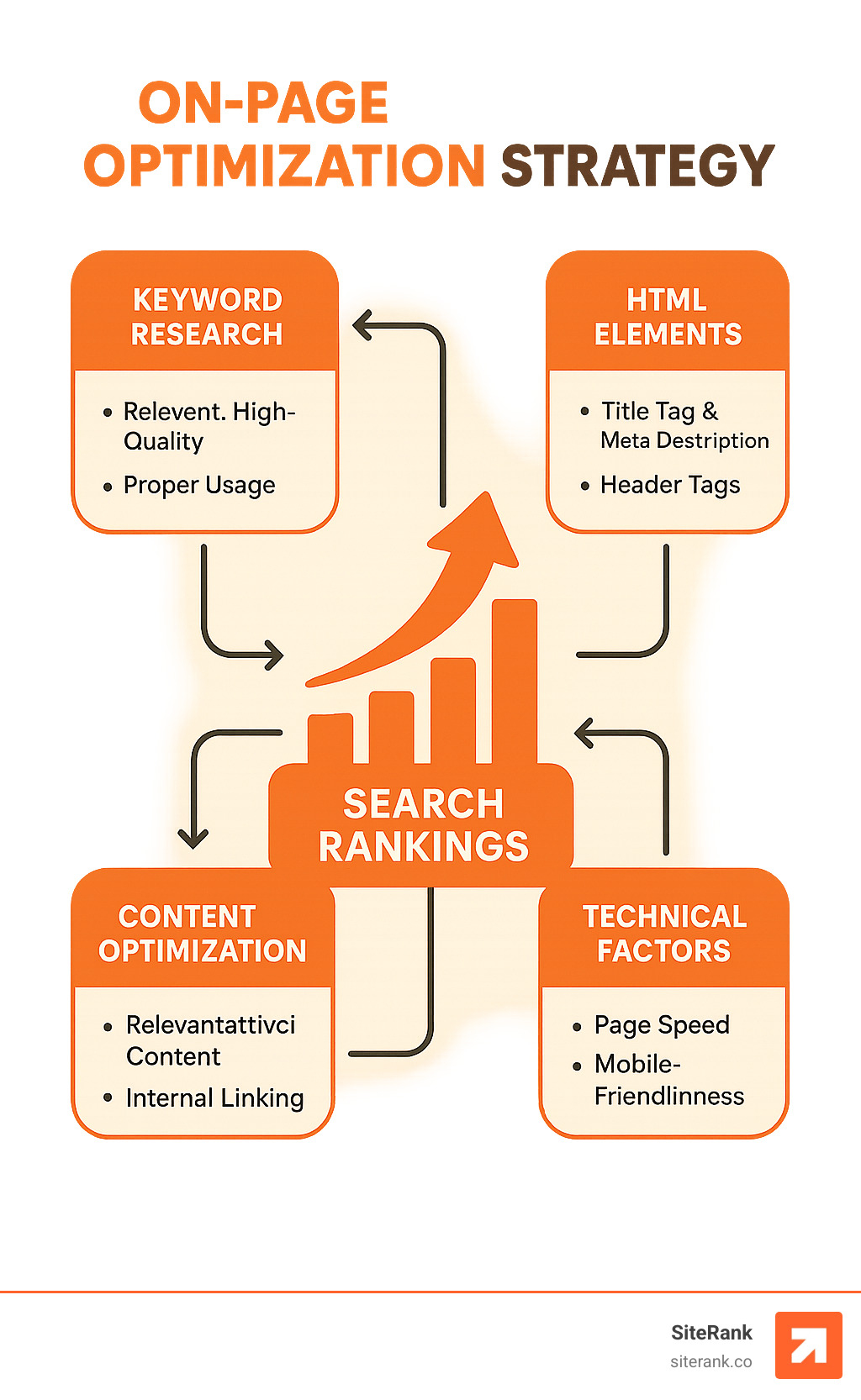
Your comprehensive on page optimization strategy should focus on several key areas. Keyword research forms the foundation, guiding how you craft your title tags (keep them under 60 characters) and meta descriptions (aim for 155-160 characters). Your content quality must satisfy search intent while providing genuine value to readers.
Structure matters tremendously too. Header structure using H1-H6 tags helps organize content logically, while URL optimization with descriptive, keyword-rich slugs makes both users and search engines happy. Don’t forget about image optimization—proper alt text and compression can make a significant difference in both accessibility and load times.
The way you connect your content matters as well. Internal linking establishes site architecture and distributes authority throughout your site, while external linking to reputable sources signals your content’s credibility. Technical factors like page speed (aim for under 3-second loading) and mobile responsiveness complete the picture, ensuring your site meets Google’s Core Web Vitals standards.
Unlike off-page SEO (which revolves around external signals like backlinks) or technical SEO (focused on site architecture and crawlability), on-page optimization addresses elements directly visible on your webpages. It’s the part of SEO where content meets code—where what users see intersects with what search engines understand.
Hi there! I’m Craig Flickinger, founder of SiteRank.co. With over 15 years developing effective on page optimization strategies for businesses of all sizes—from neighborhood shops to enterprise organizations—I’ve seen how these principles drive sustainable growth through improved search visibility.
What Is On-Page SEO & Why It Matters
On-page SEO is like the foundation of your digital home – it’s the practice of optimizing individual web pages to climb higher in search rankings and attract visitors who are genuinely interested in what you offer. It encompasses everything users can see on your page, from the content they read to the HTML code working behind the scenes.
Here’s something fascinating: A Google trial exhibit from 2017-2019 revealed an eye-opening admission from one of their engineers: “We do not understand documents, we fake it.” This confirms what many SEO professionals have suspected all along – even with sophisticated algorithms, search engines still heavily rely on specific signals within your content to determine its relevance and quality.
Why should this matter to you? Because you have complete control over these signals. While Google’s algorithms continue to evolve, they still operate on four fundamental principles:
Relevance – Does your content actually address what people are searching for?
Quality – Is your content valuable, thorough, and trustworthy?
User experience – Can visitors easily consume and steer your content?
Technical foundation – Can search engines properly access and understand what you’ve created?
As Google themselves state in their Search Engine Optimization Starter Guide: “When you built your website, you likely created it with your users in mind, trying to make it easy for them to find and explore your content—one of those users is a search engine.”
The introduction of Core Web Vitals has transformed how Google evaluates page experience. These crucial ranking signals measure real-world user experience through three key metrics:
Largest Contentful Paint (LCP) shows how quickly your main content loads.
First Input Delay (FID) measures how responsive your page is when users interact with it.
Cumulative Layout Shift (CLS) evaluates how stable your page elements are as they load.
With mobile-first indexing now the standard approach, Google primarily uses the mobile version of your page for indexing and ranking. This means your on page optimization strategy must prioritize creating an exceptional mobile experience first and foremost.
| SEO Type | Focus Areas | Control Level | Time to Impact |
|---|---|---|---|
| On-Page SEO | Content, HTML elements, images, internal links, keywords | High (100% under your control) | Relatively quick (days to weeks) |
| Off-Page SEO | Backlinks, social signals, brand mentions | Low (requires external action) | Slower (weeks to months) |
| Technical SEO | Site speed, mobile-friendliness, indexing, crawlability | Medium (server/platform dependent) | Variable (immediate to weeks) |
For deeper insights into the technical aspects that support your on-page efforts, explore our technical SEO services.
How On-Page Differs From Off-Page & Technical SEO
Think of SEO as a three-legged stool – each component is essential, but they serve different purposes. Understanding these differences helps you prioritize your efforts effectively:
On-Page SEO is where you have the most direct control. It’s like arranging furniture in your home – you decide exactly what goes where. This includes crafting compelling content, optimizing HTML elements like title tags and meta descriptions, adding descriptive alt text to images, creating strategic internal links, and enhancing overall user experience signals.
Off-Page SEO is more like your reputation in the neighborhood. You can influence it, but ultimately it depends on what others say about you. This includes earning quality backlinks from reputable websites, generating social media buzz, securing brand mentions across the web, and collecting positive reviews from satisfied customers.
Technical SEO resembles the plumbing and electrical systems in your home – essential infrastructure that most visitors don’t see but absolutely notice when something goes wrong. This covers website architecture and crawlability, optimizing site speed and server response times, ensuring mobile responsiveness, implementing structured data, and managing indexing controls through robots.txt and XML sitemaps.
As demonstrated in Eric Lancheres’ case study with On-Page.ai, Google’s initial ranking mechanism heavily relies on entity recognition and on-page signals before conducting deeper analysis. This confirms what we’ve always believed – your on page optimization strategy provides the essential foundation upon which all other SEO efforts build.
Building Your On Page Optimization Strategy: 10 Essential Elements
Creating an effective on page optimization strategy isn’t about checking boxes—it’s about crafting a thoughtful approach that connects with both search engines and real people. Let’s explore the 10 essential elements that make up a winning strategy:
1. Keyword Research: Foundation of Your On Page Optimization Strategy
Think of keyword research as listening to your audience before you speak. It’s not just about finding popular search terms—it’s about understanding what people actually want when they type those words.
We’ve finded at SiteRank that long-tail keywords (those with three or more words) typically bring in visitors who know what they’re looking for. For instance, someone searching “chocolate cake recipe” has much clearer intent than someone typing just “chocolate”—and they’re more likely to stick around and engage with your content.
When digging into keywords, balance search volume with competition, identify related concepts and entities, and group similar terms into topic clusters. Most importantly, understand the intent behind searches—are people looking for information, trying to steer to a specific site, researching before a purchase, or ready to buy?
Tools like Ahrefs can uncover valuable keyword opportunities, but it’s how you implement them that makes all the difference. For more custom guidance, check out our keyword research services.
2. Content & HTML Elements: Executing the On Page Optimization Strategy
Once you’ve identified your target keywords, it’s time to weave them naturally into your content and HTML elements.
Your title tags are like book titles—they need to grab attention while accurately describing what’s inside. Keep them under 60 characters to prevent truncation in search results, include your primary keyword (preferably near the beginning), and don’t forget your brand name when space allows.
Meta descriptions are your 155-160 character pitch to searchers. While they don’t directly impact rankings, a compelling description with a clear call-to-action can dramatically improve click-through rates.
For headers, think of them as signposts guiding readers through your content. Use one H1 containing your primary keyword, structure main sections with H2s, and use H3s and beyond for subsections. Sprinkle secondary keywords in these subheadings naturally.
Your body content should include your primary keyword in the first 100 words, but focus on readability and value above all. Google’s “people-first content” emphasis means your on page optimization strategy should prioritize genuinely helpful information over keyword stuffing.
Remember E-E-A-T (Experience, Expertise, Authoritativeness, Trustworthiness)—it’s not a direct ranking factor, but it’s what Google’s quality raters look for when evaluating content. Show your expertise, back up claims with evidence, and be the trusted resource your audience needs.
3. Media Optimization: Images & Video
We process visual information 60,000 times faster than text, making images and videos powerful engagement tools. Research by Shai Aharony shows pages with original images outperform those with stock photos in search rankings.
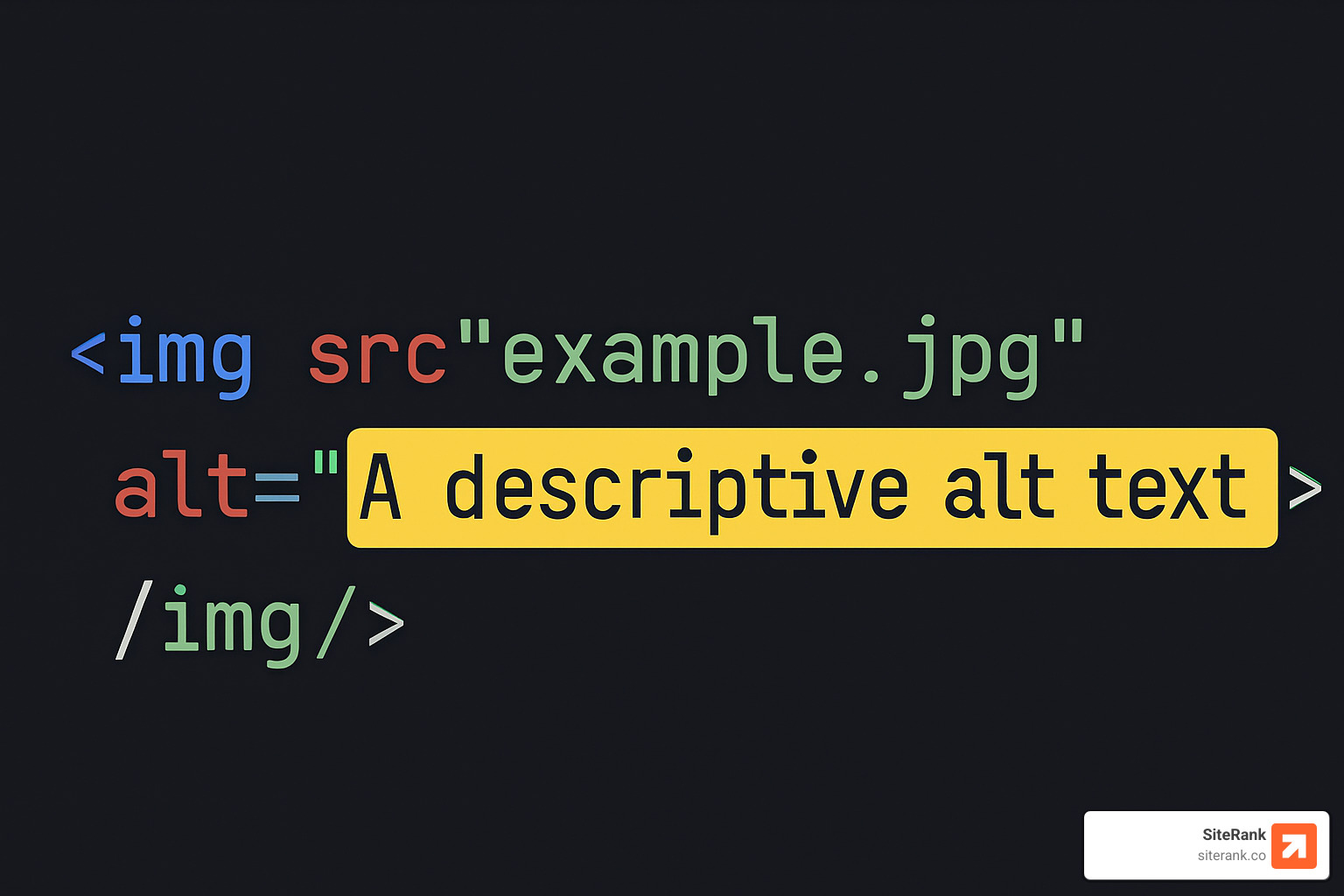
When optimizing images, compress file sizes without sacrificing quality (nobody likes pixelated photos), use descriptive filenames instead of generic ones like “IMG001.jpg,” and add alt text under 125 characters—screen readers typically stop reading after this point, and it’s a key accessibility feature.
For videos, consider hosting them on dedicated pages with descriptive titles and transcripts (which provide accessibility and additional keyword opportunities). Use schema markup to help search engines understand your video content, and select thumbnails that entice clicks.
4. Link Architecture: Internal & External
Links are the roads connecting the neighborhoods of your website. A thoughtful linking strategy helps both users and search engines steer your content universe.
For internal linking, use descriptive anchor text with relevant keywords, maintain a logical hierarchy where no page is more than 3-4 clicks from the homepage, and leverage your high-authority pages to boost newer content. Think of creating hub-and-spoke models around your key topics—central pages linking to more specific related content.
With external linking, quality trumps quantity. Link to authoritative, relevant sources that improve your content’s value. Aim for 3-5 external links per 1,000 words, using descriptive anchor text that helps readers understand where they’re going.
Interestingly, Reboot Online’s experiments showed pages with outbound links to high-authority sites ranked higher than identical pages without external links—suggesting that thoughtful external linking is an important part of your on page optimization strategy.
For more detailed guidance on building an effective linking structure, explore our internal linking tips.
5. UX Signals: Speed & Mobile
User experience has moved from “nice to have” to “must have” in the SEO world. Two critical aspects are page speed and mobile responsiveness.
Page speed isn’t just about rankings—it’s about keeping visitors engaged. Users expect pages to load in 3 seconds or less, and Google’s Core Web Vitals have codified this expectation into ranking factors. Aim for Largest Contentful Paint under 2.5 seconds, First Input Delay under 100 milliseconds, and Cumulative Layout Shift under 0.1.
With mobile optimization, design for mobile-first (since Google uses mobile-first indexing), ensure tap targets are properly sized for human fingers, avoid intrusive pop-ups, and test regularly with Google’s Mobile-Friendly Test tool.
The business impact is real—scientific research on page speed has shown that conversions drop by 12% for every second of load time. That makes speed optimization not just an SEO concern but a direct revenue factor.
Advanced Techniques: Schema, Featured Snippets & Voice Search
Ready to take your on page optimization strategy to the next level? Let’s explore some advanced techniques that can help you stand out from the competition and capture more search real estate.
Targeting Featured Snippets
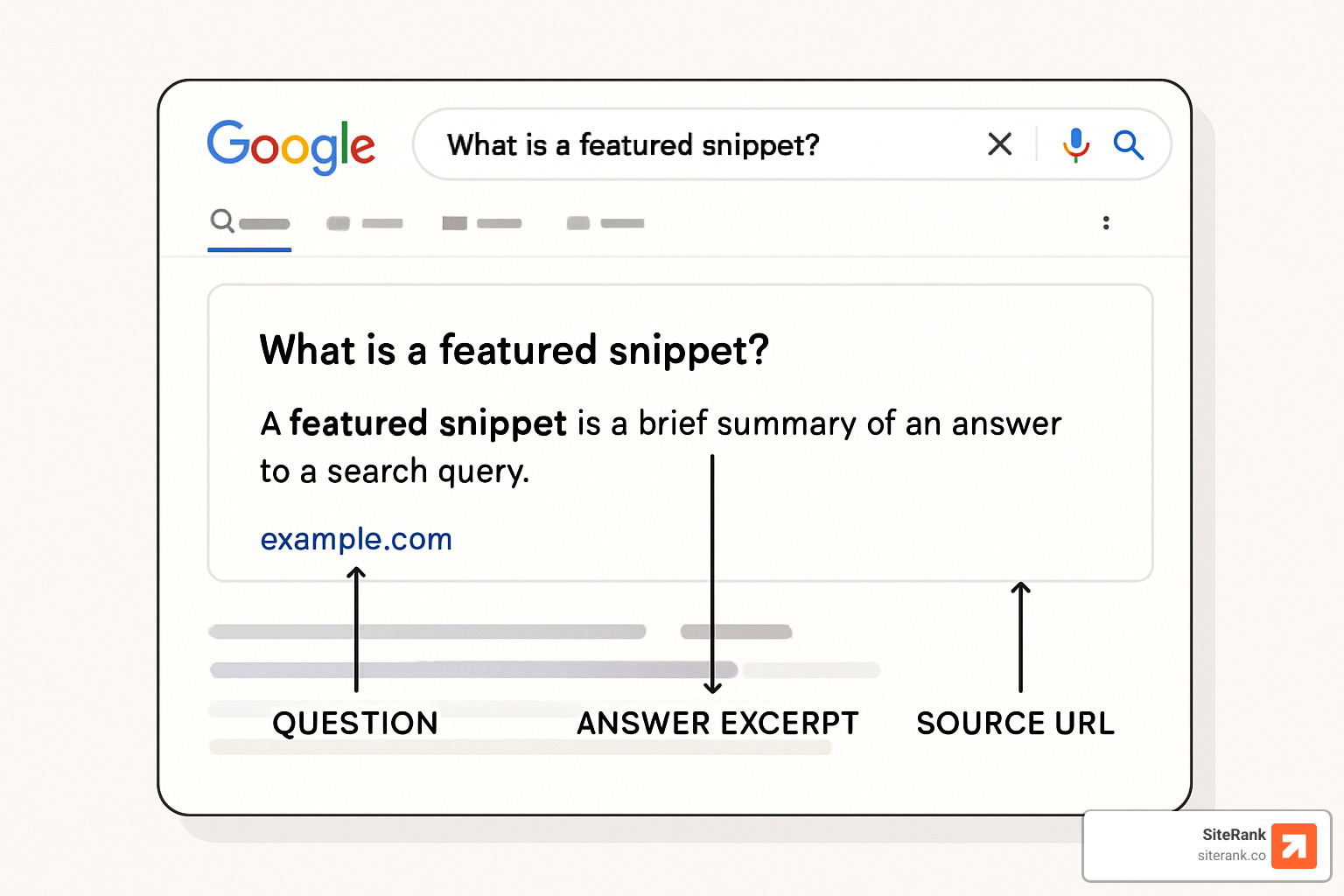
Have you ever noticed those handy answer boxes at the top of Google search results? These featured snippets (sometimes lovingly called “position zero”) are prime digital real estate that can dramatically boost your visibility and clicks.
When I work with clients at SiteRank, we’ve seen traffic increases of 5-8% just by optimizing for snippets – even when we don’t actually win the snippet! That’s because the content improvements make pages more valuable to visitors overall.
To capture these coveted positions, start by identifying keywords that already display featured snippets. Then, structure your content to match what Google is looking for:
For definition snippets, provide clear, concise explanations that get straight to the point. If you’re targeting list snippets, use clean HTML ordered or unordered lists that are easy for Google to parse. Table snippets work beautifully for comparison data (think pricing, features, or specifications). And for paragraph snippets, aim to answer questions concisely in about 40-60 words.
One of my favorite tricks is using question-based headings throughout your content. Our research shows these have a 14.1% higher organic CTR than non-question titles – people love getting direct answers to their questions!
Implementing Structured Data Correctly
Think of structured data (schema markup) as your way of speaking Google’s language more fluently. It helps search engines understand your content with incredible precision and can open up those eye-catching rich results in search listings.
The most effective schema types I’ve seen for improving on page optimization strategy include FAQ Schema for question-answer content, HowTo Schema for tutorials and guides, Review Schema when you’re showcasing products or services, Article Schema for blog posts, LocalBusiness Schema for brick-and-mortar locations, and Product Schema for e-commerce pages.
When implementing schema, stick with JSON-LD format – it’s Google’s preferred method and keeps your markup separate from your HTML content. Only include information that’s actually visible on your page (Google considers hidden schema spam), and always test your implementation with Google’s Rich Results Test tool before going live.
I’ve seen businesses struggle with schema implementation only to find simple validation errors. Save yourself the headache by checking your work at Schema.org’s Validator before publishing.
For a comprehensive reference on every possible schema type (there are hundreds!), the Schema.org documentation is your best friend.
Voice search optimization has become essential with over 40% of adults now using voice search daily. The secret here is thinking about how people actually talk. We don’t speak in keyword phrases – we ask conversational questions.
Focus on natural language patterns and consider how questions might be phrased verbally rather than typed. Local businesses should pay special attention to “near me” queries, which dominate voice searches. And remember that page speed matters even more for voice results – they typically load significantly faster than average pages.
One fascinating finding from Backlinko’s research: FAQ pages absolutely dominate voice search results. If you’re serious about capturing voice traffic, a well-structured FAQ section should be part of your on page optimization strategy.
By implementing these advanced techniques, you’ll not only improve your chances of ranking well in traditional search results but also position yourself to capture featured snippets and voice search queries – giving you multiple opportunities to connect with potential customers.
Scaling & Auditing Your On-Page Efforts
Let’s be honest—when your website grows beyond a handful of pages, keeping track of all your on-page SEO elements becomes like herding cats. I’ve seen businesses with hundreds of pages struggle to maintain consistency, which is why having a system is absolutely crucial.
Think of your on page optimization strategy as a garden that needs regular tending. Without systematic care, weeds (SEO issues) will inevitably sprout up and choke your beautiful content.
Tools & Templates for Enterprise Sites
For larger websites with dozens or hundreds of pages, flying by the seat of your pants simply won’t cut it. You need structure and systems that scale.
The backbone of any scalable SEO effort is a centralized tracking system. At SiteRank, we help our enterprise clients develop comprehensive SEO templates that track everything from target keywords to performance metrics for each page. This isn’t just about staying organized—it’s about having visibility across your entire digital ecosystem.
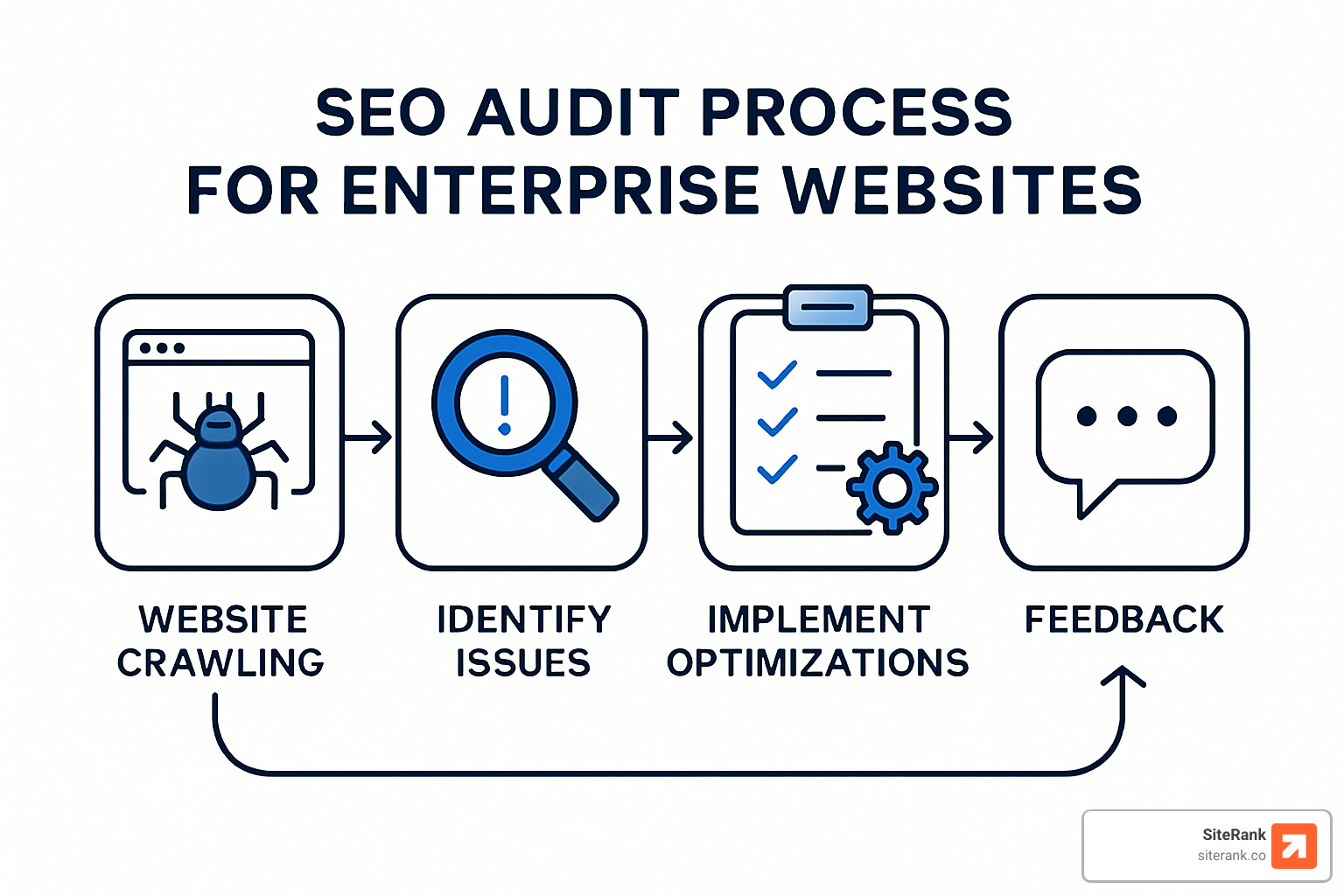
Regular site crawls become your early warning system. By scheduling automated crawls weekly or monthly (depending on your site’s size), you’ll quickly catch those sneaky issues that can drag down your rankings: missing meta descriptions, duplicate titles, broken links, or pages with thin content that need beefing up.
Performance dashboards are your compass. They help you understand if you’re heading in the right direction or need to course-correct. The most useful dashboards combine Core Web Vitals data, organic traffic trends, ranking changes, and most importantly, conversion rates by page.
I’ve found that the most successful enterprise SEO strategies involve smart segmentation. Rather than treating all pages equally, we segment them by content type (product pages vs. blog posts), performance level (your superstars vs. underperformers), and update frequency (static pages vs. constantly changing content). This approach lets you focus your precious time and resources where they’ll have the biggest impact.
Google Search Console is truly an unsung hero when it comes to scaling your on page optimization strategy. It’s like having a direct line to Google, telling you exactly what’s working and what needs attention. We regularly mine it for performance data by page and query, index coverage issues, mobile usability problems, and those all-important Core Web Vitals metrics.
One client came to us with over 5,000 pages and no system for tracking their SEO efforts. We started with our free SEO audit to establish baselines, then implemented a custom spreadsheet template that automatically flagged high-priority issues. Within three months, they saw a 32% increase in organic traffic simply by addressing the most critical issues our system identified.
Scaling your on page optimization strategy isn’t about working harder—it’s about working smarter. The right systems turn what could be an overwhelming task into a manageable, even enjoyable process of continuous improvement. And best of all, these systems create a feedback loop that helps you get better results with less effort over time.
Common Mistakes & How to Measure Success
Let’s face it – even the SEO veterans among us stumble sometimes. I’ve seen countless on page optimization strategy efforts fall short because of simple oversights that could have been easily avoided.
Common On-Page SEO Mistakes
Remember when keyword stuffing was the go-to tactic? Those days are long gone. Today, forcing keywords into your content unnaturally not only makes for a terrible reading experience but can actually trigger Google penalties.
I recently reviewed a client’s website that had the same keyword repeated 37 times on a 500-word page! Needless to say, they weren’t ranking well despite their enthusiasm.
Thin content is another frequent pitfall. When you skimp on depth and substance, you’re essentially telling visitors, “I don’t really care enough to give you a complete answer.” Google notices this too, and rewards comprehensive content that truly satisfies user intent.
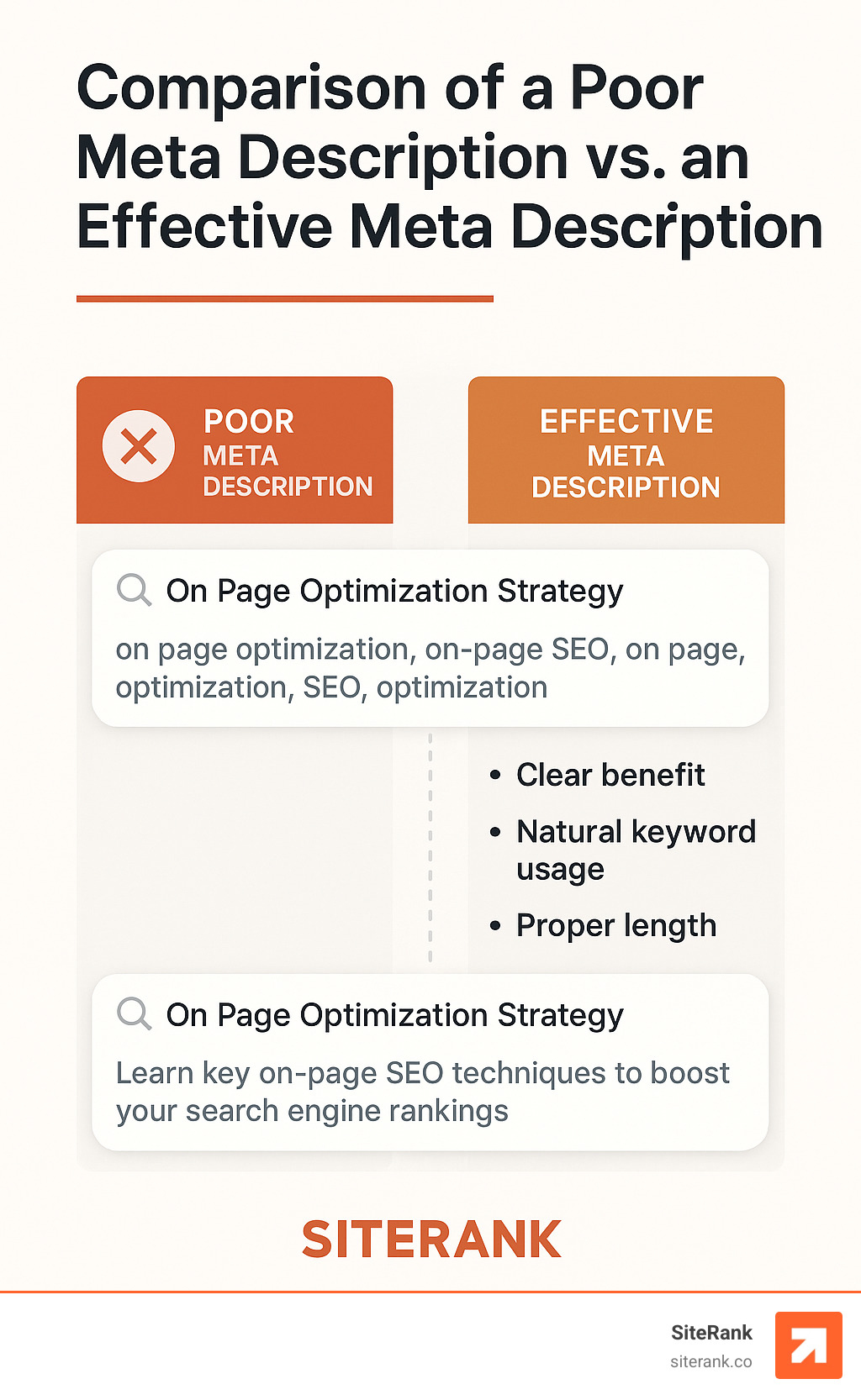
Duplicate titles and descriptions across your site? That’s like showing up to a party where everyone’s wearing the exact same outfit – confusing and a bit embarrassing. Each page deserves its unique identity to stand out in search results.
Missing alt text isn’t just an accessibility issue (though that alone should be reason enough to fix it) – it’s also a missed opportunity to give search engines more context about your images.
Slow loading pages and poor mobile experiences are practically conversion killers in 2023. With Google’s mobile-first indexing, your site’s performance on smartphones isn’t just important – it’s essential.
Perhaps the most frustrating mistake I see is content that completely ignores search intent. You might rank briefly for a term, but if visitors don’t find what they’re looking for, they’ll bounce faster than a rubber ball.
And then there’s over-optimization – the SEO equivalent of trying too hard at a casual gathering. When your content sounds like it was written for robots rather than humans, you’ve missed the point entirely.
Measuring On-Page SEO Success
Success isn’t just about rankings – it’s about results. At SiteRank, we track a holistic set of metrics to truly understand how our on page optimization strategy is performing.
Ranking improvements are obviously important, but they’re just the beginning. What we really care about is whether those rankings are driving more organic traffic to your pages. After all, being #1 for a term nobody searches for isn’t particularly valuable.
Click-through rate from search results tells us whether your titles and meta descriptions are doing their job – enticing people to choose your result over the competition. I’ve seen cases where moving from position #3 to #2 actually decreased traffic because the title wasn’t compelling enough!
Bounce rate and time on page help us understand if visitors are finding what they need once they arrive. High bounce rates often signal a mismatch between what you promised in search results and what you delivered on the page.
Of course, the ultimate measure of success is conversions – whether that’s leads, sales, or signups. A page that ranks well but doesn’t convert is like a store with a great location but nothing worth buying inside.
According to the latest research on meta impact, pages with well-crafted meta descriptions receive approximately 6% more clicks than those without. That might not sound like much, but multiply that across thousands of visitors, and you’re leaving significant traffic on the table without them.
Tools like Google Analytics, Search Console, and heatmap solutions like Hotjar give us valuable insights into real user behavior. I particularly love watching heatmaps to see where visitors are actually clicking versus where we want them to click – the difference can be eye-opening!
Tracking Core Metrics Post-Launch
Once your on page optimization strategy is implemented, the work isn’t done – it’s just changing phases. Establishing a consistent monitoring schedule is crucial for long-term success.
Weekly check-ins on ranking changes and traffic trends help catch potential issues before they become problems. I recommend setting up automated alerts for significant drops in either metric.
Monthly analysis of user behavior and conversion rates gives you enough data to spot meaningful patterns without overreacting to normal fluctuations. This is when we typically make minor tweaks to titles, descriptions, or call-to-action placement based on performance.
Quarterly comprehensive audits are your opportunity to step back and look at the bigger picture. Is your strategy still aligned with business goals? Has the competitive landscape shifted? Are there new opportunities you should pursue?
At SiteRank, we’ve consistently found that clients who actively monitor and refine their on-page elements see 30-40% better performance compared to the “set it and forget it” crowd. SEO isn’t a one-time project – it’s an ongoing relationship with your audience.
Pay special attention to pages with high impression counts but low CTR – these are golden opportunities to improve your titles and descriptions. Similarly, high bounce rates often indicate a content quality issue or intent mismatch that needs addressing.
Pages with declining rankings might need a content refresh to maintain relevance. Your competitors aren’t standing still, and neither should you.
The most successful on page optimization strategy is one that evolves with your business, your audience, and the ever-changing search landscape. Keep measuring, keep learning, and keep improving – that’s the real secret to sustainable SEO success.
Frequently Asked Questions about On-Page Optimization Strategy
What’s the ideal keyword density today?
Remember those days when SEO meant stuffing your page with keywords until it was barely readable? Thankfully, we’ve moved far beyond that! There is no magic “ideal” keyword density anymore. Google has grown much smarter about understanding content.
Instead of counting keywords, focus on creating comprehensive, valuable content that covers your topic naturally. When you write with your readers in mind, you’ll naturally include relevant terms and related concepts.
As Google’s Search Central guide puts it quite plainly: “Write easy-to-read text with your users in mind. There’s no specific ‘keyword density’ or frequency that you should aim for—just make sure your content is written in a natural way.”
The best approach? Write for humans first, then make subtle adjustments for search engines where needed. Your on page optimization strategy should prioritize quality and readability above all else.
Do meta descriptions still influence rankings?
Here’s a question I get all the time! While meta descriptions don’t directly influence your rankings as a ranking factor, they play a crucial role in your overall SEO success.
Think of your meta description as your ad copy in search results. A compelling description dramatically impacts click-through rates, which sends positive engagement signals back to Google. These user behavior signals can indirectly affect your rankings over time.
Interestingly, Google rewrites meta descriptions about 63% of the time when they don’t adequately match what the user is searching for. This shows how important context is to Google.
For best results, craft descriptions that:
- Stay under 155-160 characters (Google typically truncates beyond this)
- Naturally include your primary keyword
- Offer a clear value proposition (“Learn how to…” or “Find why…”)
- Include a subtle call-to-action when it makes sense
A well-written meta description might be the difference between a user clicking on your result or scrolling past it!
How often should I audit my on-page elements?
SEO isn’t a “set it and forget it” endeavor. Your on page optimization strategy requires regular maintenance to stay effective in today’s competitive landscape.
For most websites, I recommend this practical audit schedule:
Monthly checks for your most important pages—your homepage and top-performing landing pages deserve regular attention. A quick 15-minute review can catch issues before they impact performance.
Quarterly deep-dives for your entire site help identify patterns and opportunities you might miss when looking at individual pages. Block out a few hours every three months for this more comprehensive review.
When you notice significant ranking drops, don’t wait for your scheduled audit—investigate immediately! Sometimes a quick fix can reverse a negative trend before it becomes a bigger problem.
For content that’s meant to have a long shelf life (what we call “evergreen content”), plan to refresh it every 6-12 months. Add new information, update statistics, and ensure it remains relevant.
At SiteRank, we’ve found that larger websites benefit from more frequent automated checks. Our enterprise clients receive weekly automated reports highlighting urgent issues, allowing their teams to focus on strategic improvements rather than manual monitoring.
Your on page optimization strategy is a living, breathing approach that evolves with your business, your audience, and search engine algorithms. Regular auditing ensures you stay ahead of the curve rather than playing catch-up.
Conclusion
Implementing a comprehensive on page optimization strategy isn’t just a technical exercise—it’s the foundation of lasting SEO success. While Google’s algorithms continue to evolve (sometimes dramatically!), the core principles remain refreshingly consistent: create genuinely valuable content that answers real questions, structure it thoughtfully for both human readers and search engines, and deliver it with technical excellence.
At SiteRank, we’ve witnessed how methodical on-page optimization transforms organic performance. One of our e-commerce clients saw their organic traffic jump by 142% in just six months after implementing the strategies we’ve shared in this guide—and they didn’t build a single new backlink during that period! That’s the power of getting your on-page elements right.
The most beautiful thing about on-page SEO? It’s entirely within your control. Unlike the sometimes mysterious world of backlinks or the technical limitations of your hosting platform, you can directly influence every aspect of your on-page strategy.
Remember these key takeaways as you move forward:
Start with thorough keyword research that truly aligns with user intent (not just search volume). Optimize all on-page elements systematically rather than piecemeal. Create comprehensive, valuable content that answers questions thoroughly. Implement schema markup for improved visibility in increasingly visual search results. And perhaps most importantly, regularly audit and refine your approach as you learn what works for your specific audience.
The websites that will thrive in tomorrow’s search landscape aren’t those trying to outsmart algorithms—they’re the ones genuinely serving their audience’s needs while making valuable content easily findable. As Google gets better at understanding content like humans do, the gap between “SEO content” and “great content” continues to narrow.
Ready to take your on page optimization strategy to the next level? We’d love to help. Explore our on-page SEO services to see how SiteRank can partner with you to achieve sustainable organic growth without the usual agency fluff.
Remember—the best time to optimize your on-page elements was when you first published your content. The second best time is today.