

Why AI Optimization Matters for Your Business in 2025
Aio optimization (Artificial Intelligence Optimization) is the practice of optimizing digital content so AI systems—like ChatGPT, Google’s AI Overviews, and voice assistants—can understand, trust, and cite it as an authoritative source. Unlike traditional SEO, which targets rankings for human users, AIO focuses on getting your brand featured in AI-generated answers. This means prioritizing context over keywords, ensuring structured clarity, building authority signals, and aligning content with conversational queries.
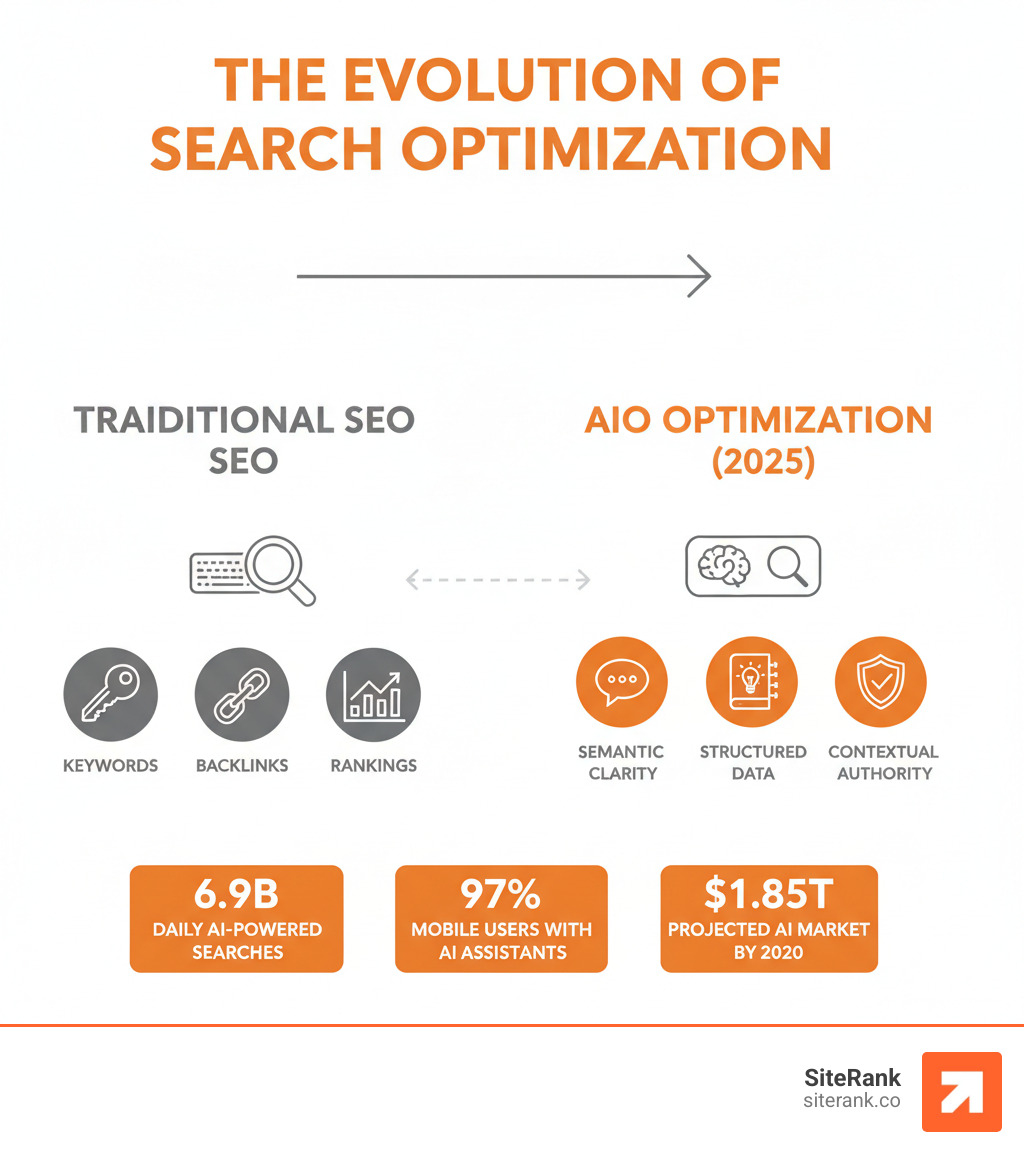
The digital landscape is shifting. Google now uses AI to process 6.9 billion daily searches, and nine out of ten leading companies are investing in AI. Traditional SEO wasn’t built for this reality. When a user asks an AI for a recommendation, your content must be structured for AI to find, comprehend, and cite it.
This is a matter of survival. With 97% of mobile users having access to AI assistants and 40% using voice search daily, not optimizing for AI means risking invisibility. The goal is no longer just to rank; it’s to be the answer AI provides.
I’m Craig Flickinger, founder of SiteRank. With 15 years in SEO, I’ve seen many shifts, but aio optimization is the most significant. It’s what separates thriving businesses from those left behind. This guide will provide practical steps to adapt your content strategy for this AI-first world.
What is Artificial Intelligence Optimization (AIO)?
When you ask an AI a question, it gives you a direct answer, not a list of links. Aio optimization is what makes your business the trusted source that AI cites for that answer.
Artificial Intelligence Optimization (AIO) is the process of structuring your content so AI systems—like ChatGPT, Google’s AI Overviews, and voice assistants—can understand, trust, and feature it in their responses. While traditional SEO aims to rank your website on a results page, AIO aims to make your content become the answer itself.
This shift is driven by changing user behavior. As noted in the USC Annenberg study “From SEO to AIO: Artificial intelligence as audience”, people are moving from “searching” to “asking.” They want direct, conversational answers. If AI can’t easily parse and trust your content, your business becomes invisible in this new ecosystem.
The Shift from Traditional SEO to AIO
The move from traditional SEO to aio optimization is a fundamental change in digital strategy. Here’s a breakdown of what’s different:
- From Keyword Placement to Contextual Relevance: AI understands meaning and intent, not just keywords. Comprehensive, topic-focused content now outperforms pages stuffed with exact-match phrases.
- From Link-Based Ranking to AI Source Selection: Instead of backlinks determining your rank, AI systems now select and cite sources based on clarity, authority, and factual consistency. Being chosen by AI is the new number one ranking.
- From a Human Audience to an AI Intermediary: We now optimize for machine comprehension. AI systems are the gatekeepers, so content must have a clear structure, logical flow, and semantic clarity for them to interpret and share.
This evolution builds on the foundation of traditional SEO. Our On-Page SEO services integrate both approaches, ensuring your content meets the demands of this new, hybrid landscape.
Why AIO is the Next Frontier in Digital Marketing
Aio optimization is not a fleeting trend; it’s a necessary adaptation to mainstream user behavior. Consider that 97% of mobile users have AI assistants, and 40% use voice search daily. Your customers are already asking AI for recommendations. The question is whether your business will be part of the conversation.
Users now ask conversational questions like, “What running shoes are best for marathon training with flat feet?” and expect a direct, personalized answer. If your content isn’t structured for AI, you won’t be included.
The global AI market’s projected growth to $1.85 trillion by 2030 confirms this is a fundamental technological shift. Ignoring AIO today is like ignoring mobile optimization a decade ago. The convergence of conversational queries, AI assistants, and voice search is a revolution. Implementing AIO is about future-proofing your content strategy to ensure you remain relevant and visible.
The Core Principles and Methodologies of AIO

Successful aio optimization requires understanding how AI systems think. They operate on a probabilistic framework, predicting which content best answers a query based on semantic structure and contextual coherence. Unlike traditional search, where you optimize for findy, with AIO, you’re teaching machines to understand, trust, and recommend your content.
As outlined in research on Artificial Intelligence Optimization (AIO) as a probabilistic framework, AI evaluates content based on interconnected principles. It’s not about gaming an algorithm but creating genuinely useful, clear, and authoritative content that AI can confidently present to users.
Key Methodologies for aio optimization
At SiteRank, we focus on five core principles for aio optimization:
- Token Efficiency: Writing concisely and clearly. AI processes content in “tokens,” and efficient language is easier for it to process and understand.
- Embedding Relevance: Creating deep, focused content. AI converts text into mathematical representations (embeddings), and topically coherent content creates a stronger match with user queries.
- Contextual Authority: Demonstrating trustworthiness. AI rewards factual accuracy, expert-level coverage, and consistent messaging across your digital presence.
- Canonical Clarity: Using precise, unambiguous language. This eliminates confusion and helps AI accurately interpret your meaning, which is critical in technical or regulated fields.
- Prompt Compatibility: Aligning content with conversational questions. Structure information to directly answer natural language queries that people pose to AI assistants.
These methodologies work together to create content that AI systems prefer to cite.
AIO, AEO, and GEO: Understanding the Acronyms
The AI optimization landscape includes a few key terms. AIO optimization is the umbrella term for all strategies aimed at AI-powered systems.
- Answer Engine Optimization (AEO): A subset of AIO focused on getting your content featured as the direct answer in platforms like Google’s AI Overviews. It requires exceptional clarity and factual accuracy.
- Generative Engine Optimization (GEO): Focuses on ensuring your brand is represented accurately and favorably when generative AI creates new content, such as product comparisons or industry summaries.
AEO helps you become the featured answer, while GEO ensures your brand is included positively in AI-generated narratives. Both are crucial components of a comprehensive AIO strategy. This is the strategic thinking we apply in our Content Marketing Strategy to ensure performance across all AI platforms.
How AI Systems Process and Rank Content
To succeed with aio optimization, you must understand how AI processes content. Large Language Models (LLMs) don’t just match keywords; they comprehend meaning by analyzing semantic context.
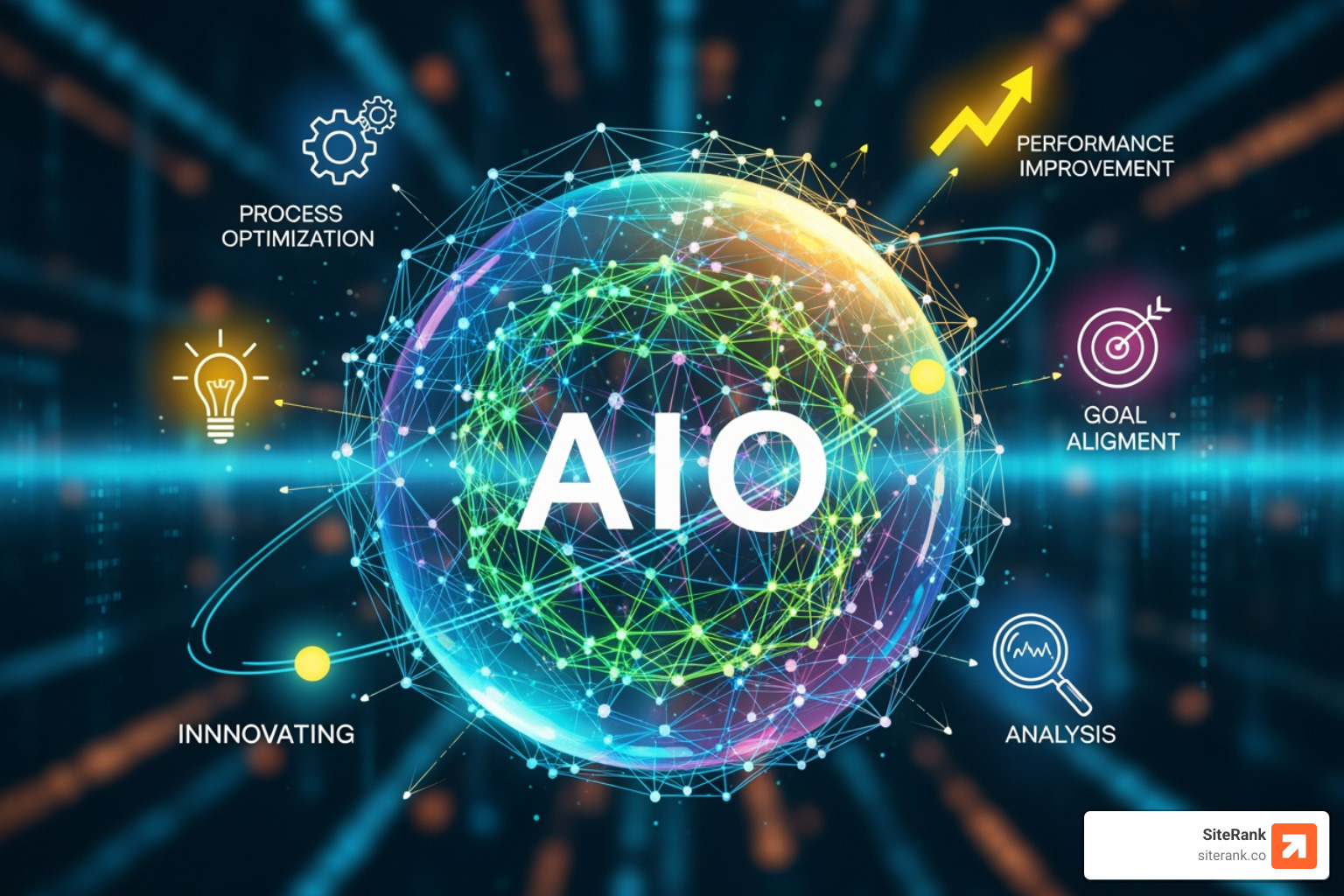
This process involves converting your content into numerical representations called vector embeddings, which capture semantic meaning. This allows AI to group information by concept, not just by words. Many AI systems also use Retrieval-Augmented Generation (RAG). With RAG, the AI first retrieves relevant, optimized content from its knowledge base and then generates an answer based on that information. Your content must be easily retrievable and clearly structured to be selected.
The focus has shifted from keyword density to providing valuable, well-structured information that AI can trust.
Optimizing for AI Interpretation, Not Just Keywords
Effective aio optimization requires focusing on AI interpretation. Here are the critical elements:
- Structured Data and Schema Markup: Use Schema.org markup to explicitly tell AI what your content is (e.g., FAQPage, Product, Organization). This is essential for accurate categorization and retrieval.
- Natural Language Understanding (NLU): Write in a clear, conversational tone that mirrors how people ask questions. Avoid jargon and organize information logically for both humans and machines.
- E-E-A-T Signals: Experience, Expertise, Authoritativeness, and Trustworthiness are vital. AI prioritizes credible sources, so demonstrate expertise through author credentials, citations, and factual accuracy.
Creating content that is both human-readable and machine-digestible is key. Learn more in our guide on Mastering Content for SEO: A Quick Guide.
The Role of AIO in AI Safety and Minimizing Hallucinations
Aio optimization is crucial for AI safety by reducing AI hallucinations—when an AI generates plausible but false information. This is a serious risk, especially in fields like healthcare and law, where legal AI models can hallucinate in 1 of 6 queries.
AIO combats this by providing AI with clear, authoritative, and factually consistent source material. By prioritizing content fidelity (accuracy) and reducing ambiguity (clarity), we create content that AI can reliably use. This boosts your content’s Trust Integrity Score (TIS), signaling to AI that your brand is a trustworthy source. As detailed in the Artificial Intelligence Optimization (AIO) – A Probabilistic Framework, these principles are foundational to a responsible AI content strategy.
The Tangible Benefits and Applications of AIO Optimization
Implementing aio optimization delivers measurable improvements and a significant competitive advantage. At SiteRank, we see these tangible benefits firsthand.

When AI systems trust and cite your content, you gain an improved user experience, as users get direct, clear answers. This leads to increased brand authority, positioning you as the go-to source in your field. The business impact is clear: traffic from AI recommendations arrives with higher intent, leading to higher conversion rates. Most importantly, AIO creates a future-proof content strategy, ensuring your brand remains visible as AI technology evolves.
Enhancing Site Speed and User Experience
The technical side of aio optimization is transformative for site speed and user experience. While traditional tactics like caching are still important, AI introduces new capabilities like predictive loading, which preloads pages users are likely to visit next. This can cut load times in half.
AI-powered systems continuously monitor and adjust performance in real-time, optimizing for changing network conditions and traffic patterns. This has a dramatic impact on Core Web Vitals. For example, prerendering pages can improve Largest Contentful Paint (LCP) by 85% and Cumulative Layout Shift (CLS) by 80%. These technical gains lead to better engagement, lower bounce rates, and higher search rankings. Our Technical SEO Services integrate these AI-driven optimizations to deliver exceptional user experiences.
Key Applications and Use Cases Across Industries
Aio optimization is versatile and delivers value across many sectors:
- Enterprise Knowledge Systems: AIO helps internal AI assistants instantly surface the right policies, guides, and training materials for employees, boosting productivity.
- Healthcare and Regulated Professions: It ensures provider credentials and service details are structured for accurate retrieval by AI, which is critical for patient trust. Our Healthcare SEO Services address these specific needs.
- Legal and Compliance: AIO reduces ambiguity in legal content, helping AI-powered research tools provide correct interpretations and mitigating the risk of hallucinations.
- E-commerce and Product Findability: It structures product data so AI can accurately answer comparison queries, directly driving sales. Our Ecommerce SEO Services help retailers optimize for AI shopping assistants.
In every industry, AIO ensures your information is found, understood, and trusted by the AI systems your customers use.
Frequently Asked Questions about AIO
Here are answers to the most common questions about aio optimization.
Is AIO replacing SEO?
No, aio optimization is not replacing SEO; it’s evolving it. Traditional SEO is the foundation for visibility in search engines like Google. AIO builds on that foundation to ensure your brand appears in AI-generated answers and recommendations. While SEO targets rankings in a list of links, AIO aims to make you the answer itself. You need both complementary strategies to achieve maximum visibility across the modern digital landscape, from search bars to AI assistants.
What tools are needed to implement AIO?
There is no single “AIO button.” Implementation involves a combination of content strategy and technical setup, building on familiar SEO practices. Key elements include:
- Structured Data: Using Schema.org markup to explicitly define your content for AI.
- Semantic Content Optimization: Focusing on topical authority, factual consistency, and clear language that AI can interpret.
- Technical Health: Ensuring your site is fast, mobile-friendly, and crawlable. This can include advanced techniques like AI-powered predictive loading.
- Internal Knowledge Graphs: For larger organizations, this helps AI understand the relationships between your content assets.
All of these advanced strategies can be supported by SiteRank’s comprehensive SEO services. We provide custom solutions custom to your business goals, ensuring increased clicks and engagement without the complexity.
How do I measure the success of AIO?
Measuring aio optimization success requires looking beyond traditional SEO metrics. While rankings and traffic are still important, focus on these key indicators:
- Citation Rate in AI Results: How often is your brand cited as a source in answers from ChatGPT, Perplexity, or Google’s AI Overviews?
- Traffic from AI Recommendations: Monitor direct and organic traffic from users who were sent to your site by an AI. This traffic often has higher intent and conversion rates.
- Performance on Conversational Queries: Track your visibility for the long-tail, natural language questions people ask AI assistants.
- AI Search Share: Measure the percentage of AI-generated answers in your industry that feature your brand.
- Factual Consistency: Ensure your brand’s key information is consistent across all digital touchpoints to build trust with AI systems.
Success is about steady improvement in how AI understands, trusts, and cites your content. At SiteRank, we help you track these metrics to make data-driven decisions.
Conclusion: Embracing the Future of Search
The shift to AI-driven search is here. Aio optimization is not just another technical update; it’s a fundamental reimagining of how we create and structure content for a world where AI is the bridge between people and information.
Businesses relying solely on traditional SEO are using an outdated map. Your customers are already asking AI assistants for recommendations and getting answers from AI Overviews. If your content isn’t optimized for AI to understand, trust, and cite, you are becoming invisible.
This is an opportunity. By focusing on clarity, authority, and structure, you can position your brand as a trusted source for the next generation of search. The principles of aio optimization are about creating valuable, well-organized content that serves both humans and the AI systems that help them.
At SiteRank, our AI-powered strategies are designed to increase your clicks, boost engagement, and ensure your brand remains visible as the digital landscape evolves. We avoid cookie-cutter solutions, focusing on what moves the needle for your business.
The future of search is now. The question is how quickly you will adapt. Ready to future-proof your digital strategy? Explore our comprehensive SEO Services and let’s build a dominant presence in the AI-first world together.