Why Local Citation Backlinks Drive Results for Local Businesses
Local citation backlinks are online mentions of your business that include your Name, Address, and Phone number (NAP), often with a clickable link to your website. These citations act as trust signals to Google and help your business appear in local search results and Google Maps.
Quick Answer: What are Local Citation Backlinks?
– Citation: Any online mention of your business NAP information
– Backlink: A clickable link from another website to yours
– Local Citation Backlink: A citation that includes both NAP data AND a link
– Purpose: Boost local search rankings and Google Maps visibility
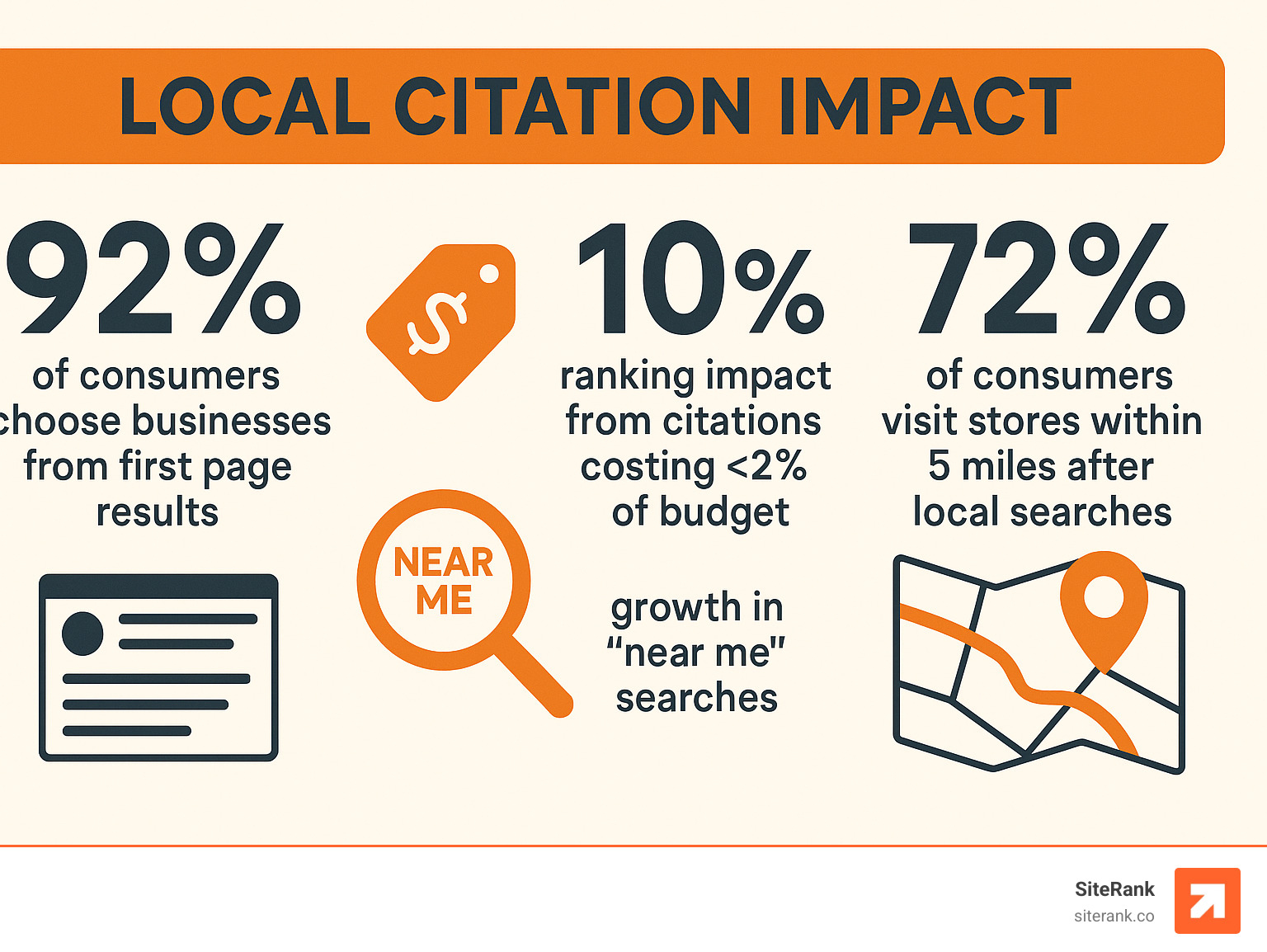
– Value: Account for 10% of local ranking impact while costing less than 2% of marketing budget
If you’ve ever wondered why some local businesses dominate Google’s “map pack” while others remain invisible, the answer often lies in their citation strategy. Research shows that 92% of consumers choose a business from the first page of local search results, making local visibility crucial for growth.
The relationship between citations and backlinks isn’t always clear-cut. While traditional backlinks focus on domain authority, local citations prioritize geographic relevance and NAP consistency. Some citations include clickable links (making them backlinks), while others are simple text mentions that still carry SEO value.
I’m Craig Flickinger, founder of SiteRank, and I’ve spent over 15 years helping businesses steer the complex world of search optimization. Through my work with local businesses, I’ve seen how strategic local citation backlinks can transform a company’s online visibility and drive measurable growth in just months.
What Are Local Citation Backlinks?
Local citation backlinks are online mentions of your business that include your complete NAP information (Name, Address, Phone number) plus a clickable link back to your website. Think of them as digital vouchers that tell Google “Hey, this business is real and trustworthy.”
Regular backlinks focus on passing authority from one website to another. But local citation backlinks do double duty – they verify your business exists while also boosting your website’s credibility in Google’s eyes.
Google’s Knowledge Graph acts like a fact-checker, cross-referencing your business information across multiple sources. When it finds consistent NAP details paired with quality links, it gains confidence in your business. This confidence translates directly into better local search rankings and more visibility in Google Maps.
Full citations contain your complete business information and pack the most SEO punch. Partial citations might be missing your phone number or have incomplete address details. While partial citations can still help, full citations deliver maximum impact.
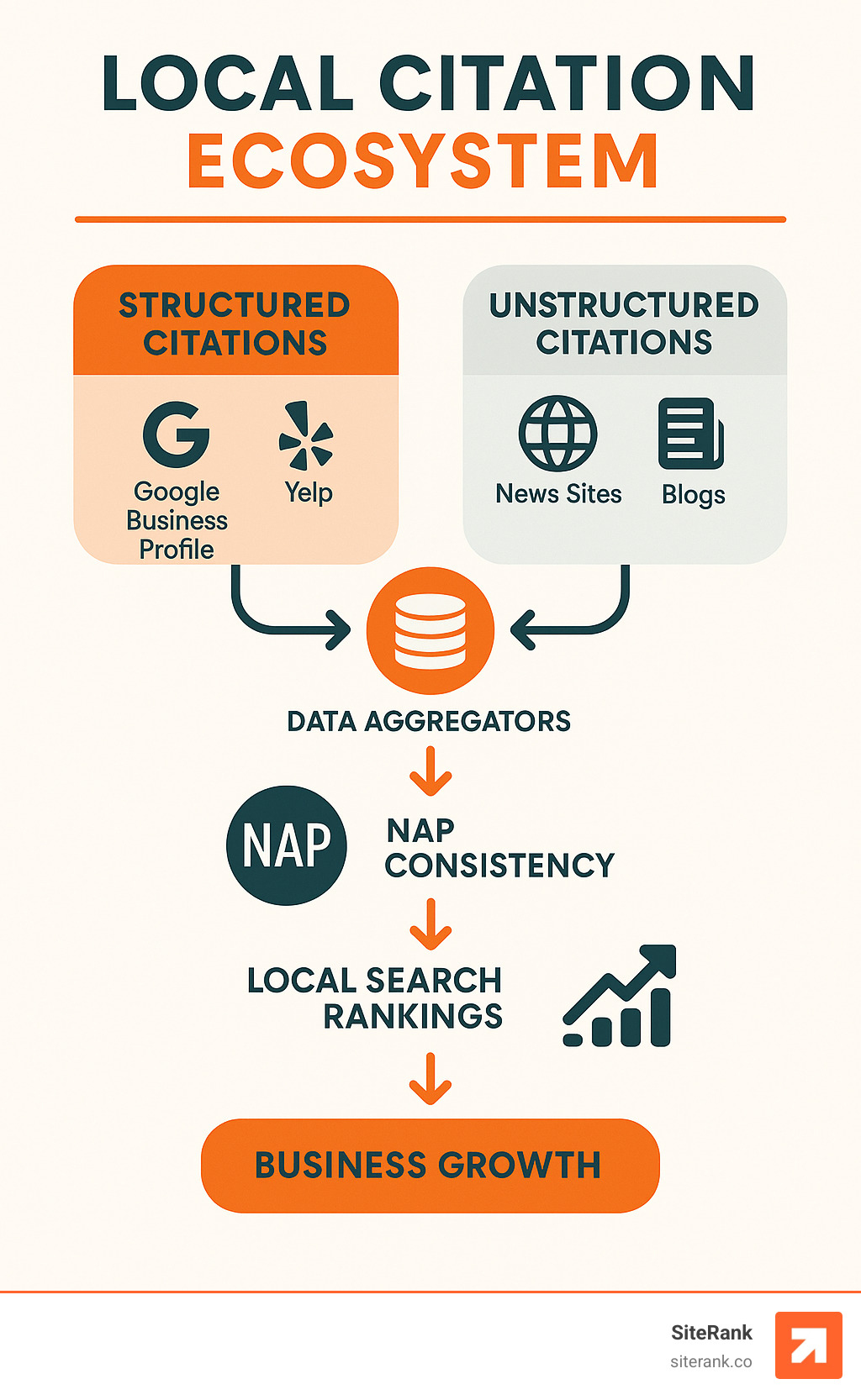
Structured Citations (Directories & Aggregators)
Structured citations live on business directories where everything follows a neat, organized format. These platforms are built specifically for business listings, making them natural homes for local citation backlinks.
Google Business Profile tops the priority list – it’s not optional if you want local visibility. Apple Business Connect comes next, especially important as more people use Apple Maps. Facebook Business Pages bring both high domain authority and social signals that Google values.
Yelp remains a powerhouse for local businesses, particularly restaurants and service companies. Don’t overlook Bing Places for Business either – while Bing has smaller market share, it often faces less competition.
Data aggregators work like citation distributors. Companies such as Express Update, Neustar Localeze, and Factual push your business information to hundreds of smaller directories automatically. Getting listed with these three main aggregators can generate 25 to 100+ backlinks each.
Secondary directories add valuable diversity. The Better Business Bureau provides a premium trust signal. Yellow Pages and SuperPages still carry weight. Chamber of Commerce listings connect you with local business networks.
Industry-specific directories often provide the most targeted value. A contractor benefits more from an Angi listing than a generic directory. Hotels and restaurants see better results from TripAdvisor.
Unstructured Citations (News, Blogs, Social)
Unstructured citations appear naturally within regular content – blog posts, news articles, social media updates, and editorial pieces. These mentions don’t follow rigid formats, but they often carry more SEO weight because they represent genuine editorial endorsements.
Local newspaper coverage of your business creates premium unstructured citations. Blog reviews of your services work similarly, especially when the blogger includes your business details naturally within their content.
Social media mentions create valuable signals too. Press releases distributed through news services can generate dozens of unstructured citations across media websites.
Community event listings offer another goldmine. When you sponsor local events or participate in community activities, these listings often include your business information and website link.
Brand mentions without clickable links still contribute to your SEO success. Google’s sophisticated algorithms can connect plain-text mentions of your business to your website, treating them as implied links.
Citations vs. Backlinks vs. Brand Mentions – Key Differences & Overlaps
Let me clear up the confusion between these three terms, because understanding their differences will help you build a stronger local citation backlinks strategy.
| Feature | Citations | Backlinks | Brand Mentions |
|---|---|---|---|
| Primary Purpose | Verify business location/legitimacy | Pass link authority and traffic | Build brand awareness and E-A-T |
| NAP Required | Yes (core component) | No | Optional |
| Link Required | No (can be text-only) | Yes (must be clickable) | No |
| Geographic Focus | Always local/regional | Can be global | Can be local or global |
| SEO Value | Local ranking signals | Domain authority and traffic | Trust and relevance signals |
The sweet spot happens when all three elements combine. Picture this: a local newspaper writes about your grand opening, mentions your business name and address, and includes a link to your website. That single mention is simultaneously a citation (has your NAP), a backlink (clickable link), and a brand mention (editorial context).
Scientific research on local ranking factors confirms that citations contribute heavily to Google’s “prominence” factor by proving your business has an established presence in your community.
Why All Backlinks Aren’t Citations (and Vice Versa)
Not every link pointing to your website counts as a citation, and not every citation includes a clickable link. This distinction matters more than you might think.
A national trade publication linking to your website in an industry roundup is a valuable backlink that could boost your domain authority, but it’s not a citation because it doesn’t include your NAP information.
Conversely, a local blog mentioning your business name, address, and phone number without including a link is still a valuable citation because it helps Google verify your business information.
Many business directories use nofollow links, which don’t pass traditional link equity. But they still count as citations and can drive referral traffic. Local citation backlinks that include both complete NAP information and followed links give you the best of both worlds.
How Brand Mentions Support Local Citation Backlinks
Brand mentions work behind the scenes to amplify your citation strategy. When local newspapers, bloggers, or customers talk about your business online, they create trust signals that support your formal directory citations.
Think of brand mentions as character references for your business. The more people talk about you positively, the more Google trusts that you’re a legitimate, established business worth showing in local search results.
Modern monitoring tools can track these mentions across the web, helping you identify unlinked mentions that could become backlinks and spot new citation opportunities from sites already discussing your business.
SEO Benefits & Ranking Impact of Local Citation Backlinks
Local citation backlinks deliver one of the best returns on investment in digital marketing. Research from BrightLocal reveals that citation building accounts for less than 2% of most businesses’ annual marketing spend, yet it delivers a solid 10% impact on local search rankings.
The magic happens through multiple channels working together. When you build consistent citations across the web, you’re sending trust signals to Google that validate your business as legitimate and established. These geographic proximity signals help search engines understand exactly where you serve customers.
Well-placed citations drive direct visitors to your website through referral traffic, while the link equity from authoritative local sources boosts your overall SEO power. The visibility benefits compound over time, creating a snowball effect that can transform your local presence.
You don’t need hundreds of citations to see meaningful results. Quality beats quantity every time. Most businesses see significant ranking improvements with about three dozen well-chosen, consistent listings.
92% of consumers choose a business from the first page of local search results, which means that citation-driven visibility improvements translate directly into phone calls, website visits, and walk-in customers. For businesses serious about comprehensive local SEO, our Off-Page SEO Services include strategic citation building as part of a complete optimization approach.
Google Maps & Voice Search Advantages
The rise of voice search has made local citation backlinks more valuable than ever before. Voice searches using “near me” variations have exploded by 400%, and these queries rely heavily on citation data to serve up relevant results.
When someone asks their phone “Where’s the nearest pizza place?” or “Find a dentist near me,” Google instantly scans citation information to verify which businesses actually exist at their claimed locations and determine proximity to the searcher.
This mobile-first reality is reshaping local commerce. 72% of consumers visit a store within five miles after conducting a local search, making Google Maps visibility absolutely crucial for driving foot traffic and phone calls.
Multi-Location & Small Business ROI
Small single-location businesses often achieve dramatic results with focused citation building on 30-50 high-quality platforms. The investment is modest, but the impact on local visibility can be transformative.
Multi-location businesses face more complex challenges but also open up greater opportunities. Each location needs its own citation profile, but the work can be systematized and scaled efficiently. Data aggregators become particularly valuable here.
Citation building can cost as little as $1 per citation, and unlike paid advertising, most citations don’t need annual updates. The ranking impact often persists for years with minimal maintenance, making the long-term ROI exceptional.
For small businesses competing against larger companies, citations provide a genuine opportunity to level the playing field. A local bakery with strong citation consistency can outrank a national chain that hasn’t invested in local SEO optimization.
How to Build & Manage Local Citation Backlinks
Building effective local citation backlinks requires the right foundation, consistent care, and patience to see results. Once you establish a solid system, the process becomes much more manageable.
Start by auditing your current citations to see what’s already out there and identify any inconsistencies that might be confusing Google about your business details. Search for your business name and address on Google to find existing citations and verify they all match your current NAP information.
The foundation of your citation strategy should focus on the platforms that pack the biggest punch. Google Business Profile is your absolute must-have. From there, expand to Apple Business Connect, Facebook Business Pages, and Bing Places for Business.
Once you’ve secured these heavy hitters, branch out to directories that your actual customers use. A local restaurant should prioritize food and travel directories, while a plumbing contractor might focus on home improvement platforms.
For businesses wanting professional help with this process, our Local Citation Building Services can handle the heavy lifting while you focus on running your business.
Step-by-Step Citation Building Checklist
Building local citation backlinks works best when you follow a logical sequence.
Start with your foundation by auditing existing citations and standardizing your business information format. Decide exactly how you’ll write your business name, address, and phone number everywhere. Claim and fully optimize your Google Business Profile, then verify it through whatever method Google offers.
Build your core presence by creating profiles on major review platforms like Yelp and Better Business Bureau. Submit to data aggregators like Express Update, Neustar Localeze, and Factual – these services distribute your information to dozens of smaller directories automatically.
Expand strategically by researching industry-specific directories and local community sites. Join your local Chamber of Commerce and submit to your city’s business directory.
Quality control everything by verifying all submissions were accepted and published correctly. Set up Google Alerts for your business name and address so you’ll know when new mentions appear online.

Combining Citation Building with Local Link Building Strategies
Local citation backlinks work much better when they’re part of a bigger local SEO strategy. Community engagement creates some of the most powerful citation opportunities. When you sponsor a local little league team or charity event, you often get mentioned on community websites that naturally include your business details and a link back to your site.
Building relationships with local journalists and bloggers can pay dividends over time. Offer expert commentary when local news relates to your industry, or share genuinely newsworthy business developments.
Don’t overlook partnerships with other local businesses. When you refer customers to a complementary business and they do the same for you, these relationships often lead to website mentions that include citation information.
Creating locally relevant content also attracts natural links while establishing your local expertise. Neighborhood guides, local market reports, or coverage of community events show Google that you’re deeply connected to your service area.
For a comprehensive approach to building local authority, check out our guide on Local Link Building Strategies.
Tracking, Updating & Scaling Efforts
Managing local citation backlinks is an ongoing relationship, not a one-time transaction. Your citations need regular check-ups to stay healthy and effective.
The key metrics that actually matter include citation accuracy (what percentage of your citations have correct information), citation volume (how many verified citations you have), and the authority of sites hosting your citations. Most importantly, track how your local search rankings improve as your citation profile strengthens.
Professional tools like Whitespark, BrightLocal, and Semrush can automate much of this monitoring work. They’ll alert you when inconsistencies pop up and help identify new opportunities.

Multi-location businesses face more complex challenges but also greater opportunities. Each location needs its own citation profile, but the work can often be systematized. Data aggregators become particularly valuable here.
Scientific research on citation ROI shows that consistent monitoring and updating provides better returns than one-time submission campaigns, but the maintenance requirements are relatively light compared to other SEO strategies.
Set up a simple system to review your citations quarterly or whenever you make business changes like moving locations or changing phone numbers.
Measuring ROI & Avoiding Common Mistakes
Tracking the success of your local citation backlinks requires patience – citation benefits build slowly over months. But the wait is worth it when you see your business climbing those local search rankings.
The key is knowing what to measure. Local search rankings are your north star – track where you appear for your main keywords like “dentist near me” or “plumber in downtown.” Watch your Google Maps visibility too, because showing up in that coveted local pack can transform your business overnight.
Organic traffic tells a deeper story. When your citations start working, you’ll see more people finding you through local searches. Your phone calls will increase, especially from mobile users who spot you on Google Maps and dial immediately.
Use UTM tracking codes on your citation links. This simple step reveals which directories actually send you customers versus those that just look impressive on paper.
The math on citation ROI is compelling. Most businesses spend less than 2% of their marketing budget on citations but see a 10% impact on local rankings.
Inconsistent NAP information kills citation effectiveness faster than anything else. Even tiny differences – like “St.” versus “Street” or missing suite numbers – confuse Google’s algorithms.
Duplicate listings create another headache. When the same business appears twice on Yelp or Google, it splits your authority and confuses customers. Set up Google Alerts for your business name to catch duplicates early.
Don’t forget about reviews on your citation platforms. A listing without reviews looks abandoned, reducing its SEO value. Actively encourage customers to leave feedback, especially on major platforms like Google and Yelp.

Tools & Automation vs. Manual Oversight
Automated platforms like Yext handle the heavy lifting. They’ll distribute your information to hundreds of directories simultaneously and monitor for changes. This approach works beautifully for multi-location businesses that need consistency across dozens of listings.
Manual submission gives you complete control. You can craft customized descriptions, choose the perfect business categories, and build relationships with directory owners. It’s time-intensive but often produces higher-quality results.
Most successful businesses use a hybrid strategy. Let automation handle the data aggregators and major directories, then manually tackle niche platforms and local opportunities that require a personal touch.
Quality control remains essential regardless of your method. Even the best automated tools need human oversight to catch errors and identify new opportunities.
For businesses wanting professional help with this process, our Local Business SEO Services include comprehensive citation management alongside other local SEO strategies.
Common Pitfalls to Dodge in Local Citation Backlinks
Spam directories top my list of citation killers. These low-quality sites promise quick results but deliver nothing except potential penalties. Stick to directories you recognize or that rank well for your target keywords.
Mismatched business categories confuse Google about what you actually do. A restaurant listed as “Food Service” on one platform and “Italian Restaurant” on another sends mixed signals. Standardize your categories based on your Google Business Profile selections.
Citation neglect hurts long-term results. Business information changes, directories update policies, and links break over time. Set calendar reminders to audit your citations quarterly.
Over-submission wastes time and money. Focus on quality over quantity. Thirty well-chosen citations often outperform 200 random submissions.
Ignoring local opportunities represents a huge missed opportunity. While you’re chasing national directories, your competitors might be dominating local chamber websites and community organization listings.
Citation building is a marathon, not a sprint. Focus on consistency, quality, and patience. The businesses that succeed are those that treat local citation backlinks as a long-term investment rather than a quick fix.
Frequently Asked Questions about Local Citation Backlinks
Do all citations include backlinks?
No, not all citations include clickable backlinks – and that’s actually perfectly fine for your SEO strategy.
Citations exist on a spectrum. On one end, you have simple text mentions that include your business name, address, and phone number without any hyperlinks. These might appear in local newspaper articles, blog posts, or community websites. While they don’t provide traditional link juice, they still carry significant value.
Google’s sophisticated algorithms can recognize these text-only citations as “implied links.” The search engine understands that when a trusted local source mentions your business details, it’s essentially vouching for your legitimacy and local presence.
Local citation backlinks that combine both NAP information and clickable links represent the gold standard. They satisfy Google’s need for consistent business information while also passing traditional link equity.
How often should I audit my citations?
I typically recommend a comprehensive review every 6-12 months for most businesses. Your business information doesn’t change frequently enough to justify monthly audits, but waiting longer than a year can allow problems to compound.
However, certain situations call for immediate citation audits. If you’ve recently moved locations, changed your phone number, or rebranded your business, you need to update your citations right away. Inconsistent NAP information can seriously hurt your local search rankings.
I also recommend quarterly spot-checks where you verify your most important citations – Google Business Profile, Apple Business Connect, and your top 10-15 directories.
For proactive monitoring, set up Google Alerts for your business name and address variations. This free tool will notify you when new citations appear or when existing ones change.
Are paid citation sites worth it?
Paid citation opportunities can absolutely be worth the investment – if you choose them strategically.
The key is evaluating each paid directory based on real value rather than just collecting citations for quantity. I look at several factors: Does the site have genuine domain authority? Do your potential customers actually use this platform? Are your competitors listed there?
Some paid directories justify their costs by providing access to highly targeted audiences. A premium industry-specific directory might charge $200 annually, but if it connects you with qualified leads and includes a followed link from a high-authority domain, that’s often a smart investment.
Avoid directories that exist solely to sell listings without providing real value to users. Your citation budget is better spent on established platforms that combine authority with genuine user traffic.
Most successful local businesses use a hybrid approach – securing free citations for volume and investing selectively in paid platforms for authority and niche relevance.
Conclusion
Building effective local citation backlinks isn’t just another SEO tactic – it’s one of the smartest investments you can make for your local business. Citations deliver about 10% of your local ranking power while typically costing less than 2% of your marketing budget.
What makes citations so powerful is their compounding effect. Unlike paid advertising that stops working the moment you stop paying, well-built citations continue delivering value for years. They’re working for you 24/7, helping customers find your business when they’re ready to buy.
The businesses winning in local search aren’t necessarily the biggest or the ones with the deepest pockets. They’re the ones who understand that consistency beats volume every time. A bakery with 50 accurate, well-maintained citations will often outrank a chain store with 200 messy, inconsistent listings.
At SiteRank, we’ve watched small businesses completely transform their online presence through strategic citation building. The dental practice that went from invisible to fully booked. The restaurant that started getting calls from three towns over. The contractor who finally stopped relying on expensive lead generation services.
The beauty of citation building is that it’s never too late to start, but it’s also never too early. Every month you wait is another month your competitors might be building their local authority while you’re standing still.
Here’s what works: start with the foundation (Google Business Profile, Apple Business Connect, major directories), maintain ruthless NAP consistency, and think long-term. Citations aren’t a sprint – they’re a marathon that rewards patience and persistence.
Whether you tackle this yourself or work with professionals, the important thing is taking that first step. Your future customers are out there searching right now. Make sure they can find you.
Ready to dominate your local market? Our comprehensive link building services combine strategic citation building with advanced local SEO techniques to help you capture more customers and grow your business through local citation backlinks.