

Why Most Contractors Miss Out on Local Leads (And How to Fix It)
Service area pages for contractors are dedicated website pages that target specific cities or regions where you work — even if you don’t have an office there.
Here’s a quick breakdown of what they do and why they matter:
- What they are: Individual pages on your website focused on a specific city, town, or region you serve
- Who needs them: Plumbers, roofers, HVAC techs, electricians, remodelers, landscapers — any contractor who drives to the customer
- Why they work: They give Google a reason to show your business in city-specific searches, even without a local address
- What they include: City-specific content, services offered in that area, local reviews, a map, and a clear call to action
- How fast they work: Most contractors see measurable improvements within 3 to 6 months
Most homeowners and businesses start with a location-based search when they need a contractor. If your website doesn’t have a page targeting their city, you’re invisible — and your competitor gets the call.
The problem is that most contractors either skip these pages entirely or copy the same page for every city with just the name swapped out. Both approaches fail. The first leaves money on the table. The second can actually hurt your rankings by triggering Google’s doorway page filters.
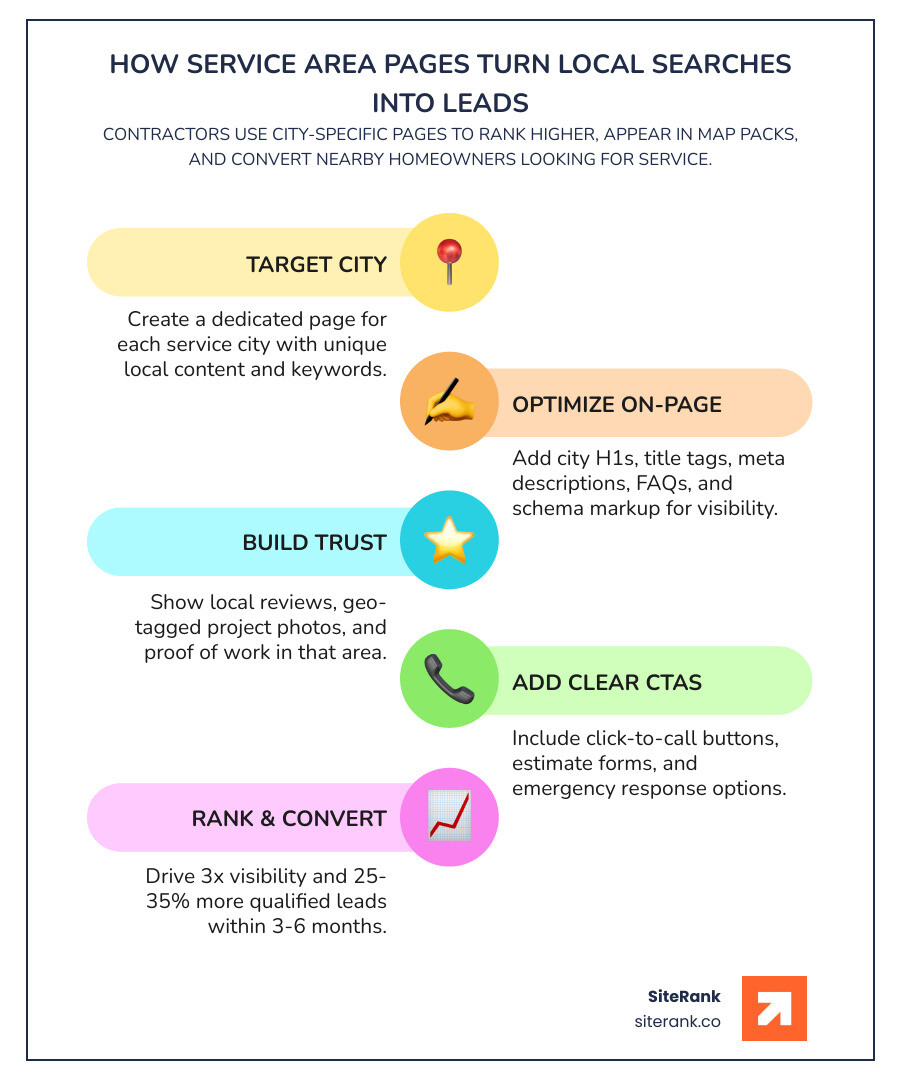
Done right, service area pages can deliver up to 3x more local search visibility and a 25–35% increase in qualified leads within just a few months.
I’m Craig Flickinger, founder of SiteRank and a digital marketing specialist with over 15 years of SEO experience — including building and optimizing service area pages for contractors across highly competitive local markets. In this guide, I’ll walk you through exactly how to build pages that rank, convert, and scale.
What Service Area Pages for Contractors Are and Why They Matter
A service area page is a local landing page for a city, town, county, or region you serve. It tells both Google and real humans, “Yes, we work here, and here’s why we’re a fit for this area.”
For contractors, this matters because many businesses are service-area businesses, or SABs. You may work from a home office, warehouse, or rented garage. Customers don’t visit you. You travel to them. That creates a local SEO challenge: how do you show up in searches for nearby cities where you don’t have a storefront?
That is exactly what service area pages for contractors help solve.
They improve:
- Relevance for city-specific keywords
- Organic visibility in surrounding markets
- Lead quality from nearby searches
- User trust with local proof
- Conversion rates from location-focused visitors
And in 2026, that matters more than ever. Local searches lead to purchases about 50% of the time, and more than 70% of local searches result in a business being contacted within 24 hours when the site includes optimized local content. If you want the job, you need the page.
For broader strategy help, see our local business SEO services.
Service area pages for contractors vs traditional location pages
These two page types sound similar, but they are not the same.
A traditional location page is for a physical office or storefront. A service area page is for a place you serve without a customer-facing office there.
| Page type | Best for | Physical address in city | Main goal |
|---|---|---|---|
| Service area page | Contractors who travel to customers | No | Rank and convert in service cities |
| Location page | Businesses with real offices customers can visit | Yes | Support local visibility for that office |
For service-area businesses, Google Business Profile rules often require hiding the address. That means you usually have less local pack advantage than a storefront business. Service area pages help make up for that gap by improving organic rankings and reinforcing local relevance.
Who needs service area pages most
If your team gets in a truck and goes to the customer, you probably need them.
That includes:
- Roofers
- Plumbers
- HVAC contractors
- Electricians
- Remodelers
- Landscapers
- Paving contractors
- Tree service companies
- Pest control companies
- Any mobile home service business
These pages are especially useful when you serve multiple cities from one main office. An HVAC company may need separate pages for Tampa, St. Pete, and Clearwater. A roofer may target nearby counties. A remodeler may need pages for affluent suburbs with different project types and budgets.
Why they are essential for local visibility in 2026
Google still relies heavily on relevance, proximity, and prominence for local results. If you don’t have a physical office in a target city, you need another way to prove relevance. Service area pages do that.
Well-optimized pages can help you:
- Rank for “service + city” searches
- Capture organic clicks below the local pack
- Support map visibility indirectly through stronger local signals
- Convert visitors searching with urgent local intent
- Build topical authority across your metro area
Businesses with unique, localized service area content can improve rankings for city-specific keywords by 40% to 60%. That is not magic. It is just better matching of search intent.
How Service Area Pages for Contractors Help You Rank and Convert
These pages are not just SEO filler. When built properly, they help both rankings and revenue.
Google looks for signals that your page is relevant to a place and a service. Users look for proof that you actually work in their area and can solve their problem fast. Great pages do both.
How Google connects area relevance to your pages
Google uses page-level signals to understand where and what you serve. That includes:
- URL slug
- Title tag
- Meta description
- H1
- Body copy
- Internal links
- FAQs
- Schema markup
- Crawlable site structure
If someone searches “roof repair in Plano” and you have a well-built Plano roof repair page, Google has a clear asset to rank. If your only page says “we serve all of North Texas,” Google has to guess. Google is smart, but we still should not make it play detective.
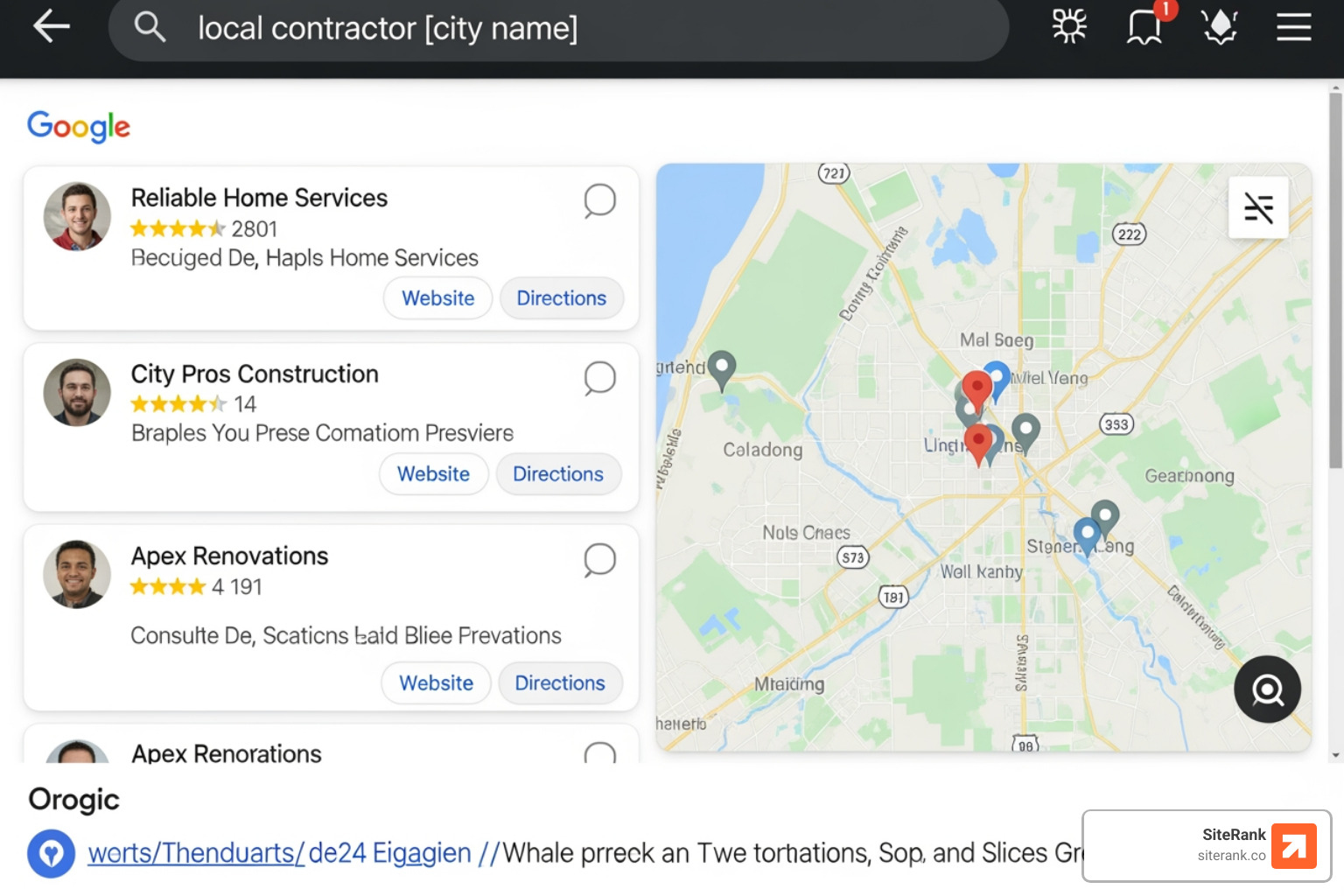
A solid page usually includes the city name naturally in the title tag, headline, intro, CTA, and FAQ section. Not twenty-seven times. We are optimizing a page, not summoning Beetlejuice.
Why service area pages improve leads instead of just traffic
The best local pages do not pull in random visitors. They attract people who need help in a specific place now.
That is why contractors often see a 25% to 35% lift in qualified leads within 3 to 6 months after rolling out strong service area pages.
Why the lift happens:
- Search intent is more specific
- The visitor sees their city mentioned
- The page confirms you serve their neighborhood
- Reviews and project photos reduce doubt
- Click-to-call and quote forms create an easy next step
A page that says “Emergency Plumbing in San Diego” or “AC Repair in Scottsdale” is far more likely to convert than a generic services page. It matches what the searcher already wants.
Where Google Business Profile, reviews, and schema fit in
Service area pages work best when they are connected to the rest of your local SEO setup.
Your Google Business Profile should clearly define service areas, categories, hours, and services. Reviews help reinforce trust and can even strengthen relevance when customers mention specific cities or jobs. Schema markup helps search engines understand your business and page content more clearly.
Key supports include:
- Google Business Profile service area settings
- Consistent name, address, and phone details
- Reviews from customers in target areas
- LocalBusiness schema
- Service schema
- FAQ schema where appropriate
For a stronger foundation, read our guides on home service SEO and local SEO for home services.
The Must-Have Elements on Every High-Performing Service Area Page
A good page is not just “keyword + city + contact form.” It should feel useful, trustworthy, and local.
Essential on-page elements that belong on every page
Every service area page should include these basics:
- A unique city-focused title tag
- A clear H1 with service and location
- A short intro written for that area
- A list of services offered in that market
- Local FAQs
- Testimonials or review snippets tied to that region
- Contact details
- Click-to-call buttons
- A quote or booking form
- Internal links to related service pages
- A map or service area visual
- Licensing, insurance, or certification trust signals
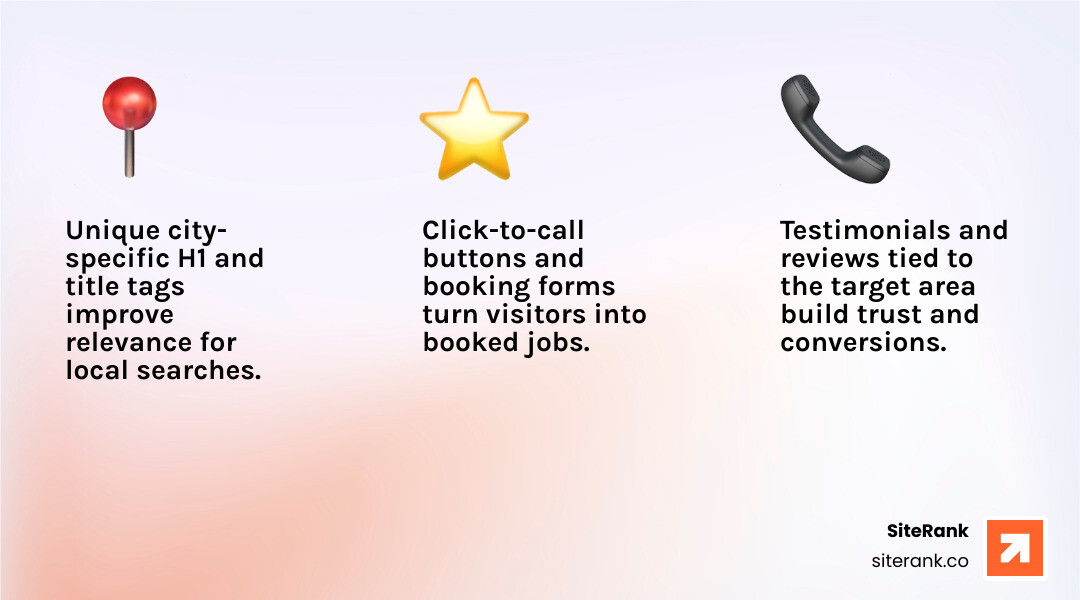
A strong title tag is usually around 55 to 70 characters. A solid meta description is often around 150 to 160 characters. These are not ranking cheat codes, but they do improve click-through rate.
Local content ideas that make each page unique
This is where most contractors either win big or faceplant.
To avoid thin or duplicate content, each page needs real local detail. Useful ideas include:
- Neighborhoods you commonly serve
- Local weather issues affecting the service
- Common housing stock or building types
- Permit or inspection notes
- Local building code considerations
- Nearby landmarks or service zones
- Photos from projects in that area
- Geo-tagged images where appropriate
- Video testimonials from local customers
- Area-specific service advice
For example, a roofing page can mention hail patterns, lake-effect weather, coastal salt exposure, or freeze-thaw cycles. A plumbing page can reference hard water, older galvanized pipes, or slab leak risks in a specific market.

These details tell Google the page is unique, and they tell users you actually know the area.
Strong UX and conversion elements contractors often miss
Even a well-written page can underperform if the user experience is clunky.
Common misses we see:
- No sticky phone button on mobile
- Slow page load
- Tiny forms nobody wants to complete
- Weak or generic CTA text
- Missing financing or emergency callouts
- No visible hours or response windows
- Trust badges hidden at the bottom
- No proof of license or insurance
In home services, many visits happen on phones, often when the customer is stressed. Make it easy to tap, call, and book. Fast beats fancy.
How to Structure Service Area Pages Without Triggering Doorway Page Problems
This is the part everyone worries about, and for good reason.
Yes, Google can view low-quality multi-city pages as doorway pages. But no, that does not mean you should avoid service area pages entirely. It means you should build them like real destinations, not cookie-cutter doorways.
The safest site structure for multi-city contractor SEO
A clean structure helps both rankings and usability.
A common pattern looks like this:
- Main service pages
- Service area hub page
- Individual city or county pages
- Supporting blog or case study content
- Internal links between related pages
- Breadcrumbs and HTML sitemap if coverage gets large
Example structure:
- /roof-repair/
- /service-areas/
- /service-areas/plano/
- /service-areas/frisco/
- /service-areas/mckinney/
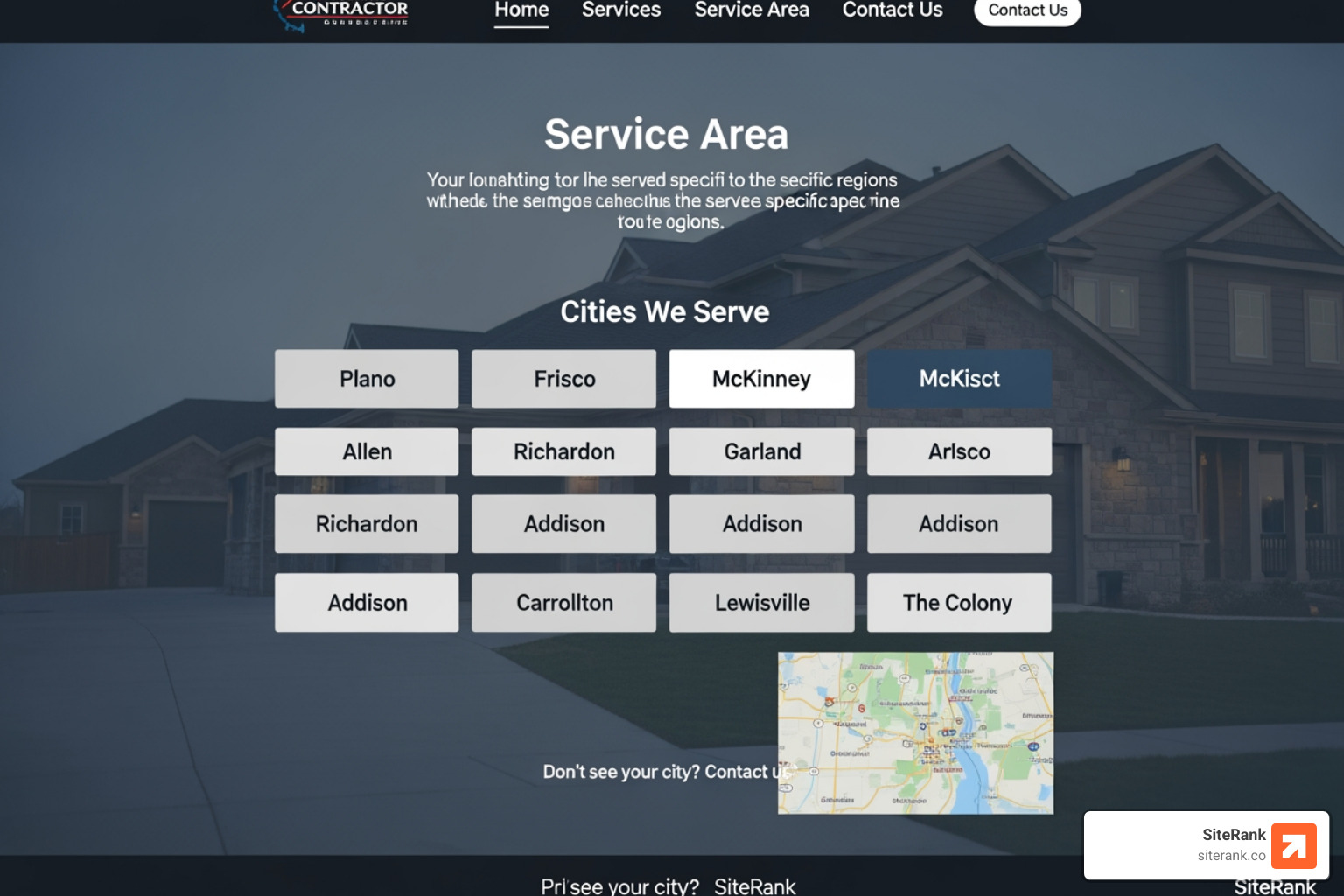
This makes the relationship between services and locations obvious. It also helps search engines crawl deeper pages more efficiently.
For more on contractor site strategy, read How to Rank Your General Contractor Business Without Losing Your Mind.
How to avoid duplicate and thin content across cities
The biggest mistake is using the same page ten times and swapping city names.
That creates pages with no unique value, which is exactly what Google dislikes.
Instead, vary:
- Intro paragraphs
- Local challenges discussed
- FAQs
- Photos
- Testimonials
- Nearby neighborhoods
- Response times
- Service emphasis
- Project examples
- CTA wording
As a practical benchmark, many strong service area pages land in the 500 to 800+ word range, but quality matters more than word count. If the page is helpful and distinct, it has a chance. If it reads like a robotic city swap, it does not.
How many pages should you build first
Do not launch 87 weak pages because your truck could technically drive there.
Start with priority markets:
- Top revenue cities
- Closest high-value suburbs
- Areas with proven demand
- Cities where competitors rank strongly
- Places within your realistic service radius
A phased rollout usually works best. Build your top 5 to 10 markets first. Make those pages great. Then expand.
That approach is usually more affordable too. For budgeting context, see The Real Cost of Contractor SEO Optimization.
Real Examples and SEO Patterns Worth Modeling
We always recommend learning from what works without copying it.
What strong contractor service area pages tend to include
When we review strong service area pages in industries like plumbing and roofing, we often see the same winning patterns:
- A coverage map
- Clear city or county breakdowns
- Linked service pages
- Strong estimate CTA
- FAQs
- Reviews or local proof
- Emergency service notes
- Local expertise content
These patterns tend to appear on high-performing contractor websites across many markets and trades. For a neutral reference on how Google defines service-area businesses, see Google Business Profile guidance for service-area businesses.
Lessons from regional pages in roofing, paving, and remodeling
Different trades often emphasize different local signals.
Roofing pages often highlight weather patterns, storm damage, and neighborhood housing types. Paving pages often organize by county and city while reinforcing full-service coverage. Remodeling pages often combine area info with FAQs about permits, climate, timelines, and project types.
The key takeaway is not the brand behind the page. It is the structure: clear coverage, useful local detail, and a simple path to request an estimate.

What to borrow without copying competitors
Borrow the pattern, not the prose.
Safe things to model:
- Good page structure
- Logical CTAs
- Map placement
- FAQ formatting
- County and city hierarchy
- Internal linking strategy
- Trust signal placement
- Image variety
Do not copy:
- Their wording
- Their testimonials
- Their page layout exactly
- Their city list if you do not actually serve it
- Their claims about response times or expertise
Your goal is to publish a better, more helpful version for your real service area.
Measuring ROI and Fixing Common Mistakes
If you cannot measure the pages, you cannot improve them. Or justify them. Or stop arguing about whether SEO “works.”
KPIs that show whether your pages are working
Track page performance by city, not just sitewide.
We recommend watching:
- Impressions in Google Search Console
- Clicks and click-through rate
- Rankings for city keywords
- Phone calls
- Form submissions
- Booked estimates
- Close rate by city
- Revenue by service area page
- Engagement metrics in GA4
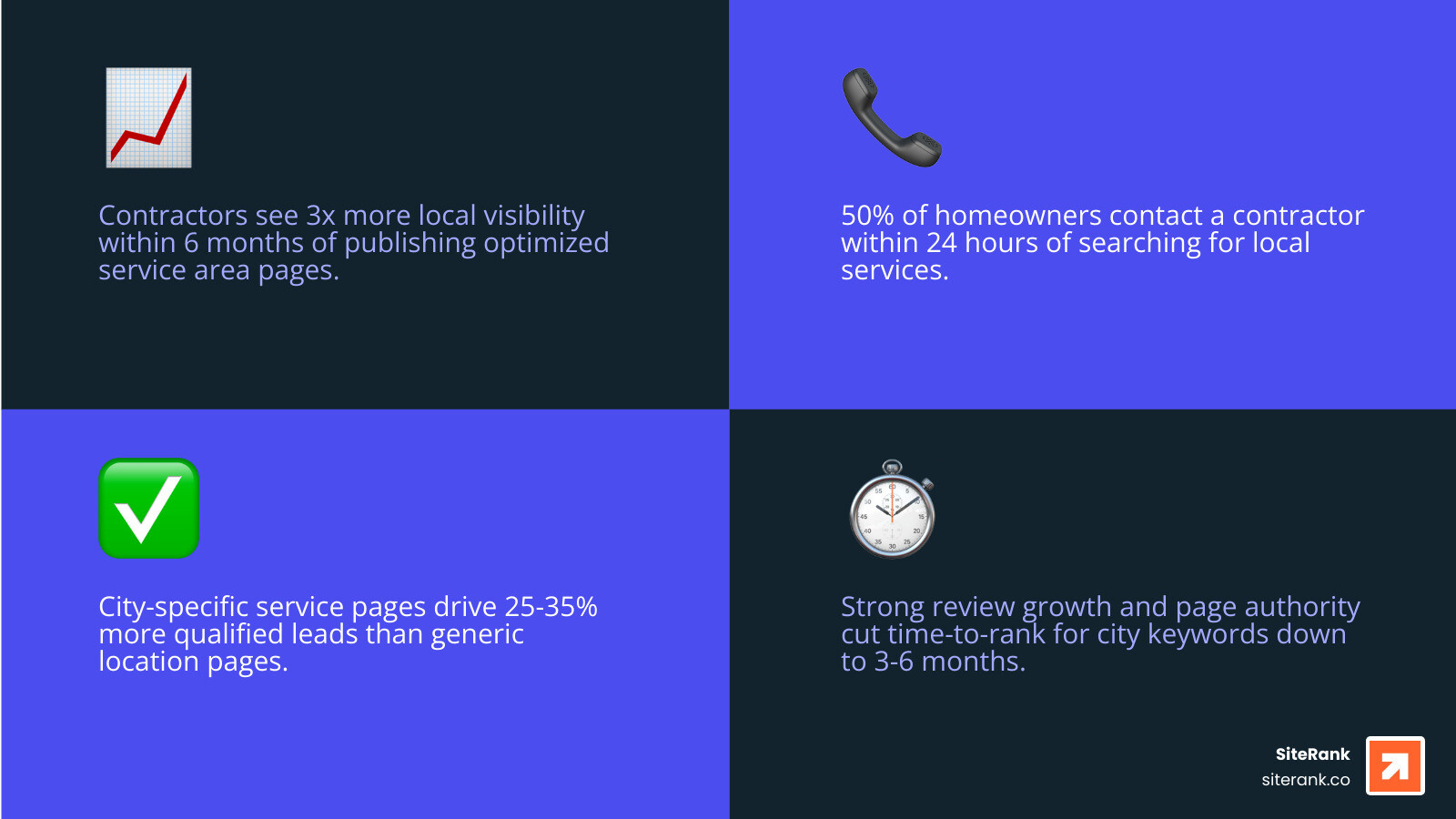
Most contractors start seeing movement within 3 to 6 months, though timing depends on competition, authority, review growth, and site quality.
Common mistakes that hold contractor pages back
We see the same problems over and over:
- Keyword stuffing
- Copy-paste city pages
- Huge lists of cities with no dedicated content
- Missing internal links
- Weak or hidden CTAs
- No schema markup
- Inconsistent contact information
- No location-specific reviews
- No original photos
- Publishing pages and never updating them
Another mistake: trying to rank everywhere at once. More pages do not automatically mean more rankings. More useful pages do.
How to improve underperforming service area pages
If a page is indexed but weak, do not delete it right away. Improve it.
Try this:
- Rewrite the intro with a stronger local angle.
- Add FAQs based on real customer questions.
- Include local photos or project examples.
- Add better internal links from service pages and blog posts.
- Refresh testimonials or proof points.
- Improve the CTA and mobile call button.
- Add or fix schema.
- Update your map or service area visual.
- Build local backlinks to the page where relevant.
For more lead-focused strategy, see Stop Chasing Ghosts and Start Getting Real Construction Leads and our Local SEO Backlinks Guide 2025.
Frequently Asked Questions about Service Area Pages for Contractors
Can contractors rank in cities where they do not have an office?
Yes, in organic search. That is one of the main reasons service area pages exist.
For the local pack, businesses with physical addresses in the searched city often have an advantage. But strong service area pages can still help you rank below the map pack and support your overall local presence. They also give customers a relevant page to land on after clicking from search, ads, or listings.
Are service area pages for contractors considered doorway pages?
They can be if they are thin, duplicated, or built only to funnel users to one generic page.
They are usually fine when each page is genuinely helpful, unique, and specific to the area. If your page answers local questions, highlights local experience, includes local proof, and serves as a useful destination on its own, you are in much safer territory.
How long does it take service area pages for contractors to show results?
Most contractors see measurable gains in about 3 to 6 months. Some pages move faster in lower-competition markets. Others take longer if your domain is weak, your city is competitive, or the page lacks supporting signals like reviews and backlinks.
SEO is rarely instant, but strong pages compound. One good city page can become a template for ten more profitable ones.
Conclusion
Service area pages for contractors are one of the clearest ways to grow local visibility without opening physical offices all over your region. They help you rank in more cities, attract better leads, and give homeowners a page that actually matches what they searched.
The keys are simple:
- Build pages for real priority markets
- Make each page unique and useful
- Connect them to your services, reviews, and GBP
- Track results and keep improving
If you want help scaling location-focused SEO the smart way, start with our guide to AI search visibility for contractors and learn more about our local SEO services for home service businesses.
At SiteRank, we build tailored SEO strategies without fluff or unnecessary deliverables. Just smarter local targeting, better pages, and more qualified clicks that turn into real jobs.