

Why Most Contractors Are Invisible Online (And How to Fix It)
Contractor local SEO is the process of optimizing your online presence so homeowners in your area find your business first when they search for services like yours on Google.
Here’s what actually moves the needle:
- Optimize your Google Business Profile – choose the right primary category, add real project photos, and collect fresh reviews consistently
- Build dedicated service and location pages – one page per service-per-city, not a single generic “Services” page
- Keep your NAP consistent – your Name, Address, and Phone must match exactly across every directory
- Earn local reviews steadily – recency and velocity matter more than total review count
- Add LocalBusiness schema – roughly 70% of independent contractors skip this entirely, handing an easy win to competitors
- Build local authority – citations, trade association links, and supplier partnerships signal trust to Google
If you do great work but your phone isn’t ringing from Google, you’re not alone. An informal audit of roofing and HVAC sites across major metros found that independent contractors average just 9 pages on their websites, while franchise competitors average 74 pages. Some independents have 300-500 Google reviews and still have near-zero organic visibility. That gap isn’t about the quality of your work. It’s a process problem.
The good news? The contractors dominating their local markets aren’t doing anything exotic. They’re just doing the basics consistently – while most of their competitors ignore them entirely.
I’m Craig Flickinger, founder of SiteRank and an SEO specialist with over 15 years of experience helping service businesses grow through search – including deep work in contractor local SEO. I’ll walk you through exactly what works in 2026, without the fluff.
Why Contractor Local SEO is the Ultimate Growth Lever in 2026
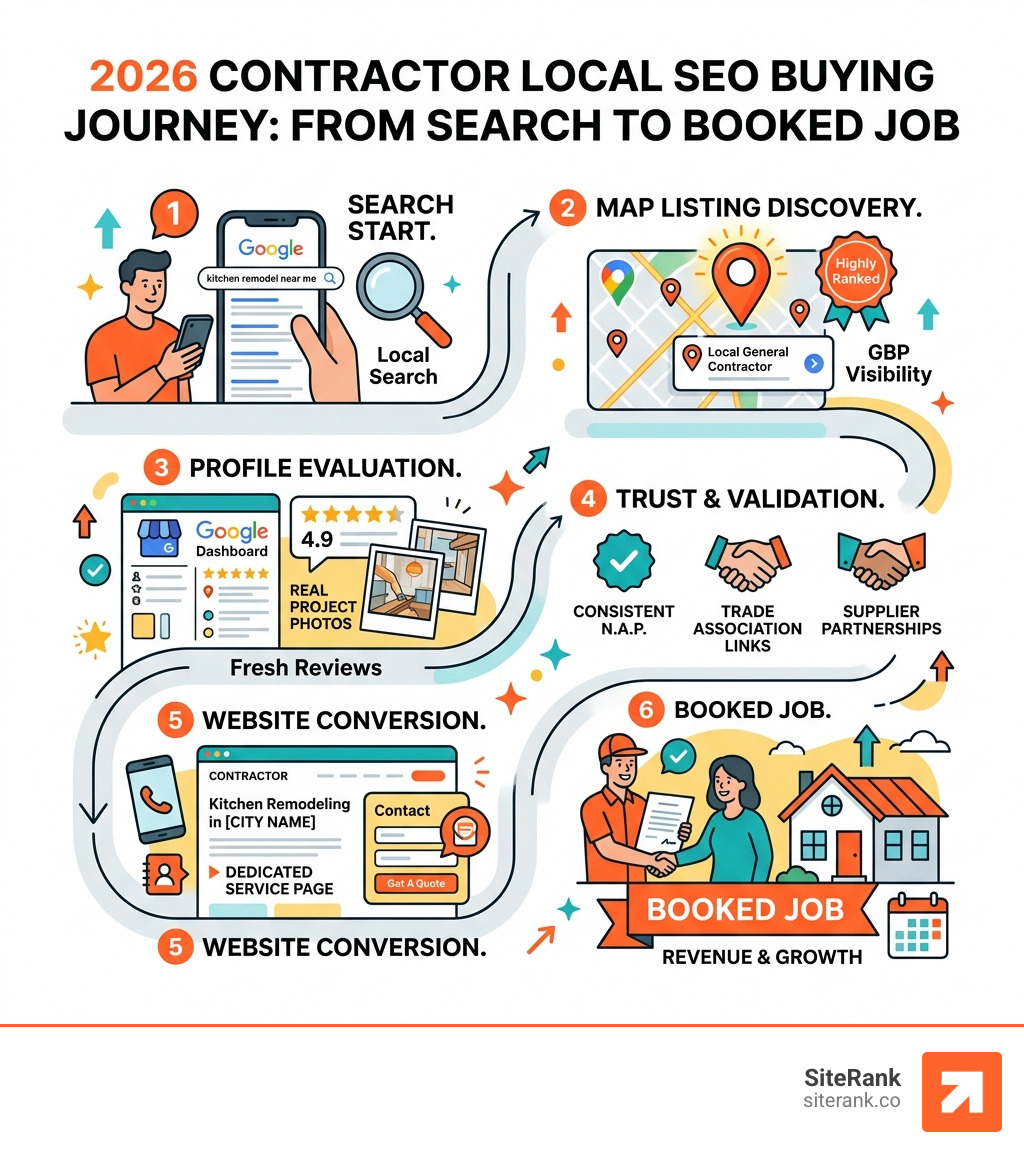
In April 2026, the digital landscape for home services has shifted. We are seeing over 5 trillion searches on Google annually, and a massive 87% of consumers start their buying journey online. For a general contractor, visibility is quite literally your currency. When a homeowner searches for “kitchen remodel near me” or “emergency roof repair,” they aren’t looking for a national brand; they are looking for a trusted local expert.

Unlike a retail store where someone might browse, contractor searches are high-intent and money-driven. These users have a specific problem and a budget ready to spend. If you aren’t in the “Local Pack”—those top three map results—you are essentially invisible to the most profitable leads in your service area.
A critical insight from a 2025 Yext study shows that active engagement with reviews consistently drives Local Pack visibility across all industries. For contractors, this means responding to every compliment and concern isn’t just polite—it’s a ranking signal. To dive deeper into how this fits into a broader strategy, check out our guide on Home Services SEO.
Why Independent Operators Struggle with Contractor Local SEO
The biggest hurdle for independent contractors isn’t a lack of skill; it’s a lack of “digital real estate.” While a local plumber might have a simple 5-page website, their franchise competitors are blanketing the web with dozens of targeted pages.
| Feature | Independent Contractor | Franchise Competitor |
|---|---|---|
| Average Page Count | 9 Pages | 74 Pages |
| LocalBusiness Schema | ~30% usage | ~95% usage |
| City-Specific Pages | Rarely used | 10+ per region |
| Review Strategy | Passive/Bursts | Consistent/Automated |
This disparity is why franchises often dominate the search results even if the local guy has better craftsmanship. Most independents have “near-zero” organic visibility because they lack dedicated service-location combo pages. They treat their website like a brochure rather than a lead-generation engine. This makes the trades one of the most underserved niches in SEO today—and a massive opportunity for you to step up.
Optimizing Your Google Business Profile for Maximum Calls
Your Google Business Profile (GBP) is your digital jobsite sign. In 2026, it is often more important than your actual website for generating immediate phone calls.

The first step is your Primary Category. This is the #1 ranking factor for local search. If 70% of your revenue comes from roofing, your category should be “Roofing Contractor,” not just “Contractor.” Be as specific as possible.
Next, define your Service Areas. Many contractors make the mistake of selecting a radius that is too large (e.g., the entire state). In reality, Google prioritizes proximity. Aim for a 20–30 mile radius where you actually want to work. For more niche-specific tips, see our HVAC SEO Services breakdown, which applies many of these same principles to specialized trades.
Managing Reviews and Project Proof
Reviews are the deal-breakers for homeowners. However, it’s not just about the total number; it’s about velocity and recency. A competitor with 150 reviews—where 5 are from last week—will often outrank a veteran with 600 reviews who hasn’t received a new one in six months.
- Strike while the paint is drying: Ask for the review during the final walkthrough. Send a direct text link before you leave the driveway.
- Use customer language: Encourage clients to mention the specific service and neighborhood (e.g., “Great deck build in Springfield!”).
- Project Photos: Upload 3-5 new photos weekly. Real, unedited photos of your team, branded trucks, and before-and-after shots build more trust than any stock photo ever could.
For a deep dive into these map-pack wins, our HVAC Local SEO Complete Guide offers a masterclass in profile management.
Building a High-Conversion Website: Service Pages and Local SEO
If your website is just a homepage and a “Contact Us” page, you are leaving money on the table. To win at contractor local SEO, you need a “Service Silo” architecture.
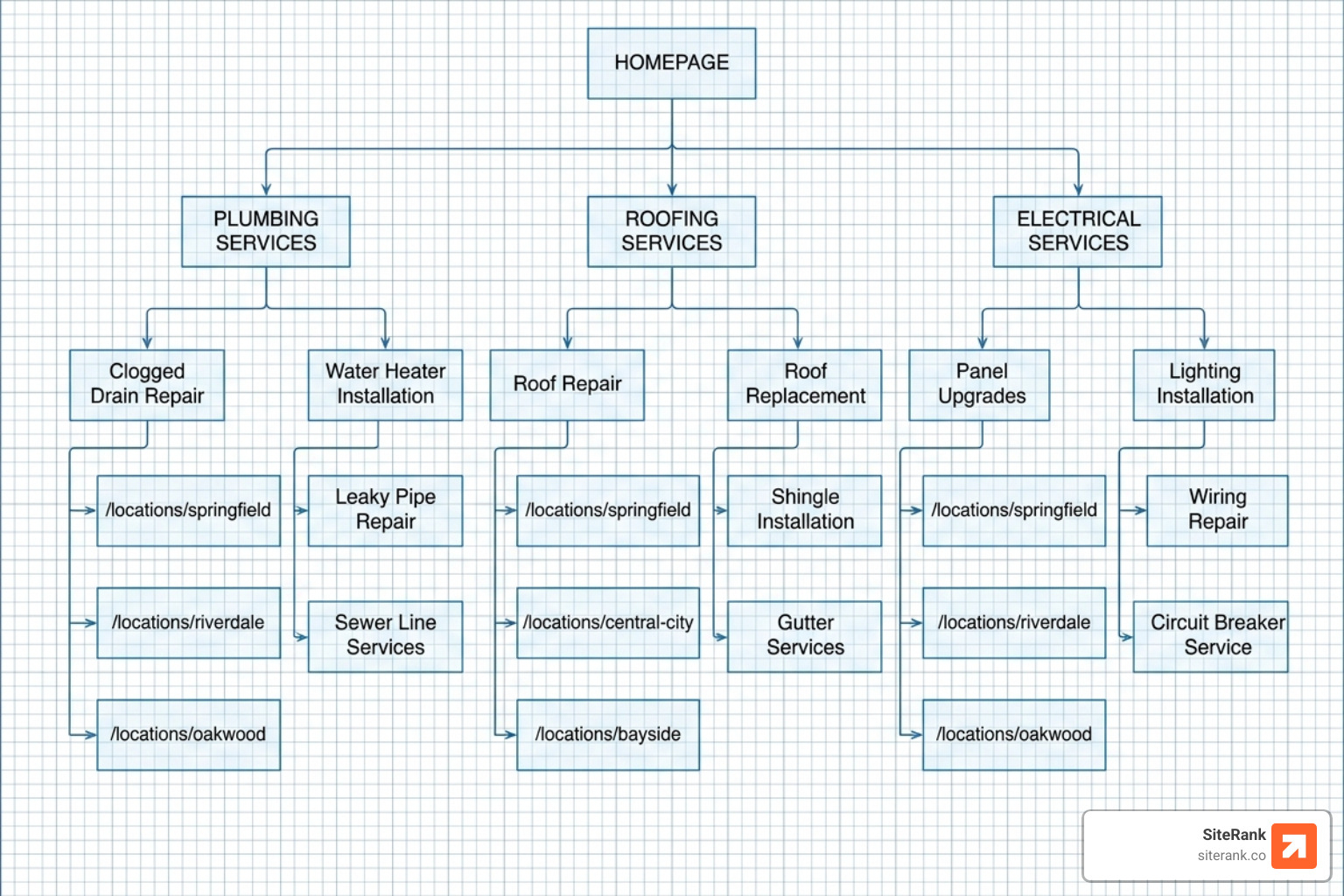
Instead of one page listing “Plumbing, Heating, and Cooling,” you need:
yoursite.com/services/clogged-drain-repairyoursite.com/services/water-heater-installationyoursite.com/locations/city-name
Franchises win because they create a page for every service in every suburb. You can beat them by making your pages better. Include local landmarks, mention local building codes, and embed a Google Map of your service area. This builds the “Relevance” and “Prominence” Google craves. Learn more about our Local Business SEO Services to see how we build these high-performing structures.
Technical Foundations for Contractor Local SEO
Technical SEO sounds scary, but for contractors, it boils down to a few essentials. First is LocalBusiness Schema. This is a piece of code that tells Google exactly what you do, where you are, and what your hours are. Shockingly, ~70% of independents have no LocalBusiness schema at all. Adding this is like giving Google a high-resolution map of your business.
Second is Mobile Responsiveness and Speed. Over 70% of local searches happen on mobile devices—often while a homeowner is standing in a flooded basement or looking at a fallen tree limb. If your site takes more than 3 seconds to load, they are clicking the next result. We recommend modern frameworks (like Astro) that can achieve PageSpeed scores of 95+, far outperforming old, bloated WordPress sites. For more on the basics, visit our guide on Home Service SEO.
Advanced Contractor Local SEO: AI Search and Authority Building
As we move through 2026, we have to talk about AI Overviews and LLMs (Large Language Models). AI search engines like ChatGPT and Google’s Gemini are now recommending contractors directly.
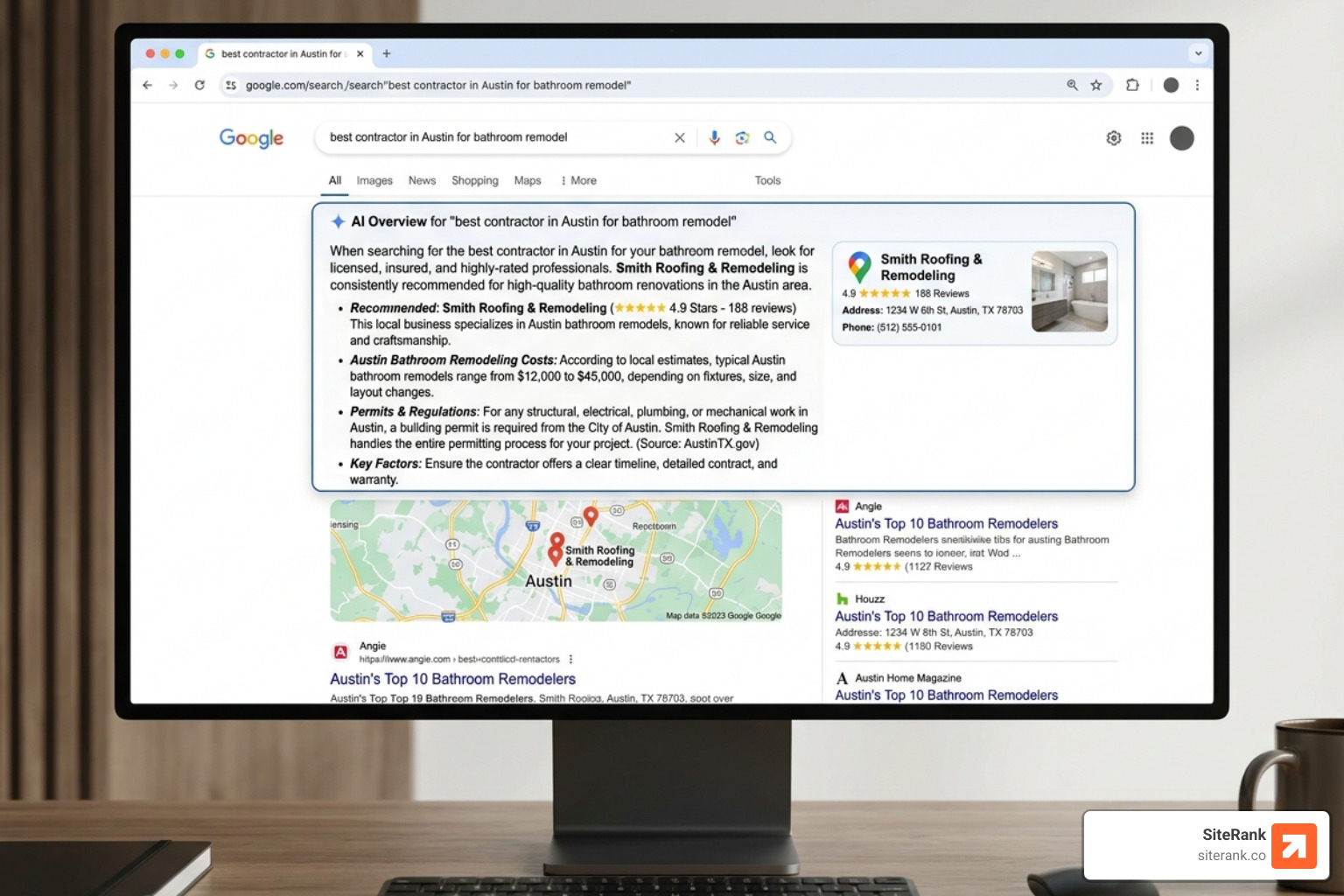
To be the contractor the AI recommends, you need to publish authoritative local content. This means answering the questions homeowners actually ask:
- “How much does a bathroom remodel cost in [City]?”
- “Do I need a permit for a deck in [County]?”
- “What are the best materials for roofing in our local climate?”
By using question-based headings and providing direct 40–60 word answers, you increase your “AI extractability.” This positions you as the local authority. For building the necessary link juice to support this, check out our Local SEO Backlinks Guide 2025.
Building Local Prominence and Citations
Prominence is Google’s way of measuring how much the “internet” talks about you. This starts with NAP Consistency (Name, Address, Phone). If you are “Jones Construction” on Yelp but “Jones Construction LLC” on your website, Google gets confused.
Beyond standard directories like Yelp, Angi, and the BBB, you need Local Backlinks. These are “votes of confidence” from other local entities.
- Supplier Partnerships: Ask your local lumber yard or HVAC supplier to link to your site as a preferred installer.
- Trade Associations: Join the local Chamber of Commerce or NARI chapter.
- Local Sponsorships: Sponsoring a Little League team or a local charity event often earns you a high-value local link.
Our Local Citation Building Services can help you manage these listings without the headache of manual entry.
The 6-Month Roadmap to Dominating Contractor Local SEO
Success in contractor local SEO doesn’t happen overnight, but it is incredibly predictable if you follow a roadmap.

- Month 1: The Foundation. Audit your site, fix technical errors, and claim your Google Business Profile. Conduct keyword research focusing on “transactional intent” (e.g., “roof replacement cost”) rather than just “informational” (e.g., “how to fix a shingle”).
- Month 2: The Content Push. Build out your core service pages. If you serve multiple cities, start creating those location-specific landing pages.
- Month 3: Review & Citation Engine. Standardize your NAP across the “Core 20” directories and implement an automated review request process.
- Month 4: Authority Building. Reach out for local backlinks and start posting weekly project updates to your GBP.
- Month 5: Optimization. Use heatmaps and call tracking to see where people are dropping off. Refine your calls-to-action (CTAs).
- Month 6: Scaling. If you have multiple locations, replicate the strategy for each one. By now, you should see a significant decrease in your cost-per-lead compared to paid ads.
To understand how this fits into your total marketing budget, read about Digital Marketing for Home Services.
Tools and Measurement for Success
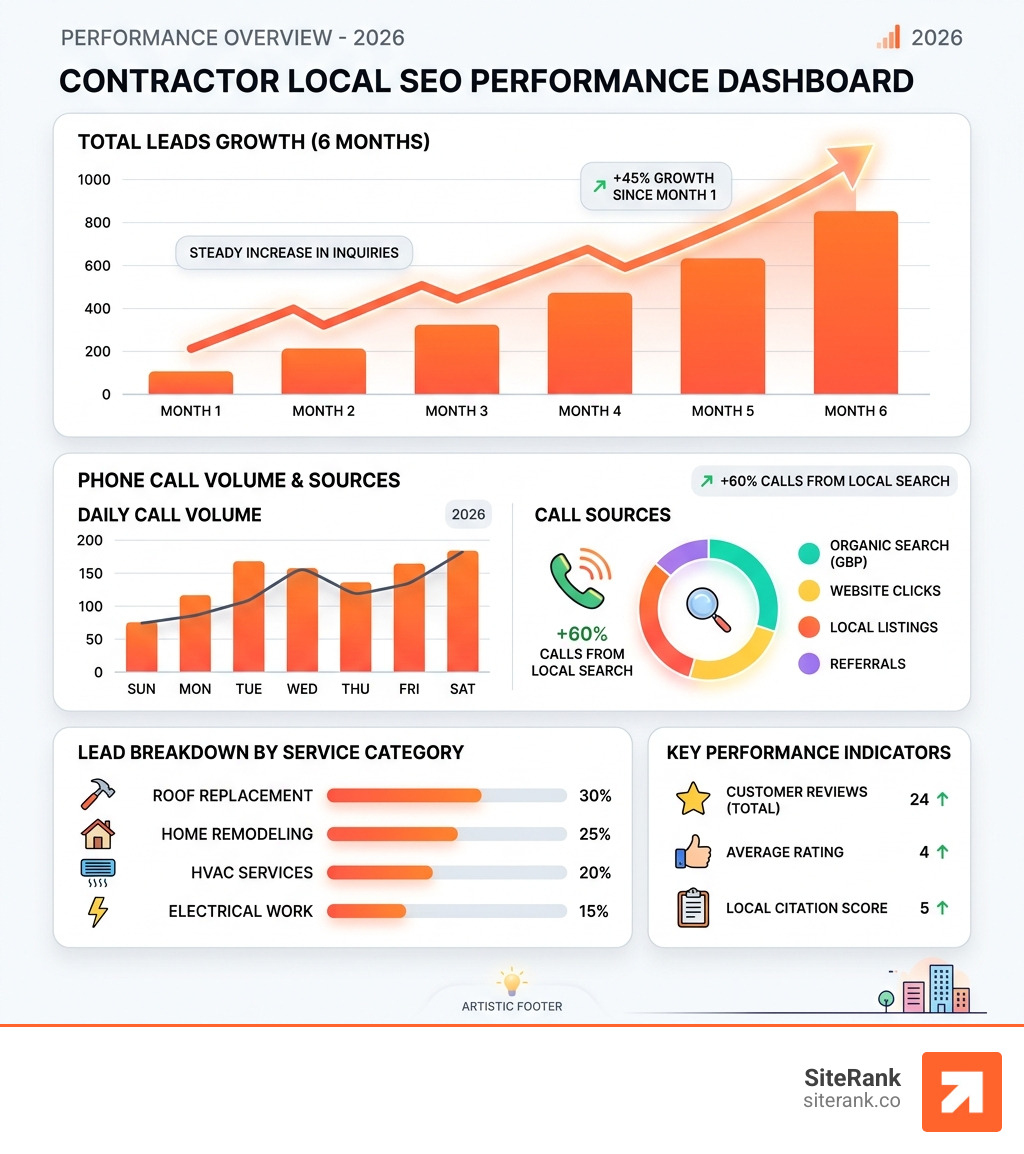
You can’t manage what you don’t measure. In 2026, you should be looking at more than just “rankings.” You need to track outcomes.
- Google Search Console: To see which keywords are actually driving clicks.
- Call Tracking: Use a unique number for your website to see exactly how many jobs started with an organic search.
- GMB Insights: Track how many people asked for directions or clicked “Call” directly from the Map Pack.
- Conversion Rate: If 100 people visit your site but only 1 calls, you have a website problem, not an SEO problem.
For more on tracking and measurement, see our insights on Home Services Online Marketing.
Frequently Asked Questions about Contractor Local SEO
Why is local SEO more important for contractors than other businesses?
Unlike e-commerce businesses that can sell anywhere, contractors are geographically bound. You only make money within a specific radius. Furthermore, contracting is a high-trust industry. Homeowners are inviting you into their private space for a high-ticket project. Local SEO signals—like reviews and local project photos—build that trust before you even pick up the phone.
How long does it take to see a return on investment from local SEO?
Typically, you will see early movement in rankings within 3 months. By month 6, most contractors see a consistent flow of leads that often allows them to reduce or eliminate their spend on expensive lead-gen sites or PPC ads. One contractor we studied sold a year’s worth of revenue ($300k) in just two months after their SEO strategy fully kicked in.
Do I need a physical office address to rank in the Map Pack?
While Google prefers a physical address with signage, you can rank as a Service Area Business (SAB). You will need to verify your business at your home or a warehouse but can choose to hide the address from the public. However, having a physical, staffed location within the city you want to target is still the strongest ranking signal for the Map Pack.
Conclusion
At SiteRank, we know that for a general contractor, a “ranking” is useless unless it turns into a booked estimate. Our AI-powered contractor local SEO strategies are designed to cut through the noise, focusing only on the tactics that drive phone calls and revenue. We don’t believe in unnecessary deliverables—we believe in customized SEO that makes your phone ring.
Ready to dominate your local market and stop losing jobs to the franchise down the street? Let us help you build a digital presence that works as hard as you do. Explore our Home Services SEO solutions today.