

Why Perplexity Search Engine Optimization Is Changing How Businesses Get Found Online
Perplexity search engine optimization is the practice of structuring your content so that Perplexity AI cites your website in its AI-generated answers — instead of just listing your page as a link.
Here’s what that looks like in practice:
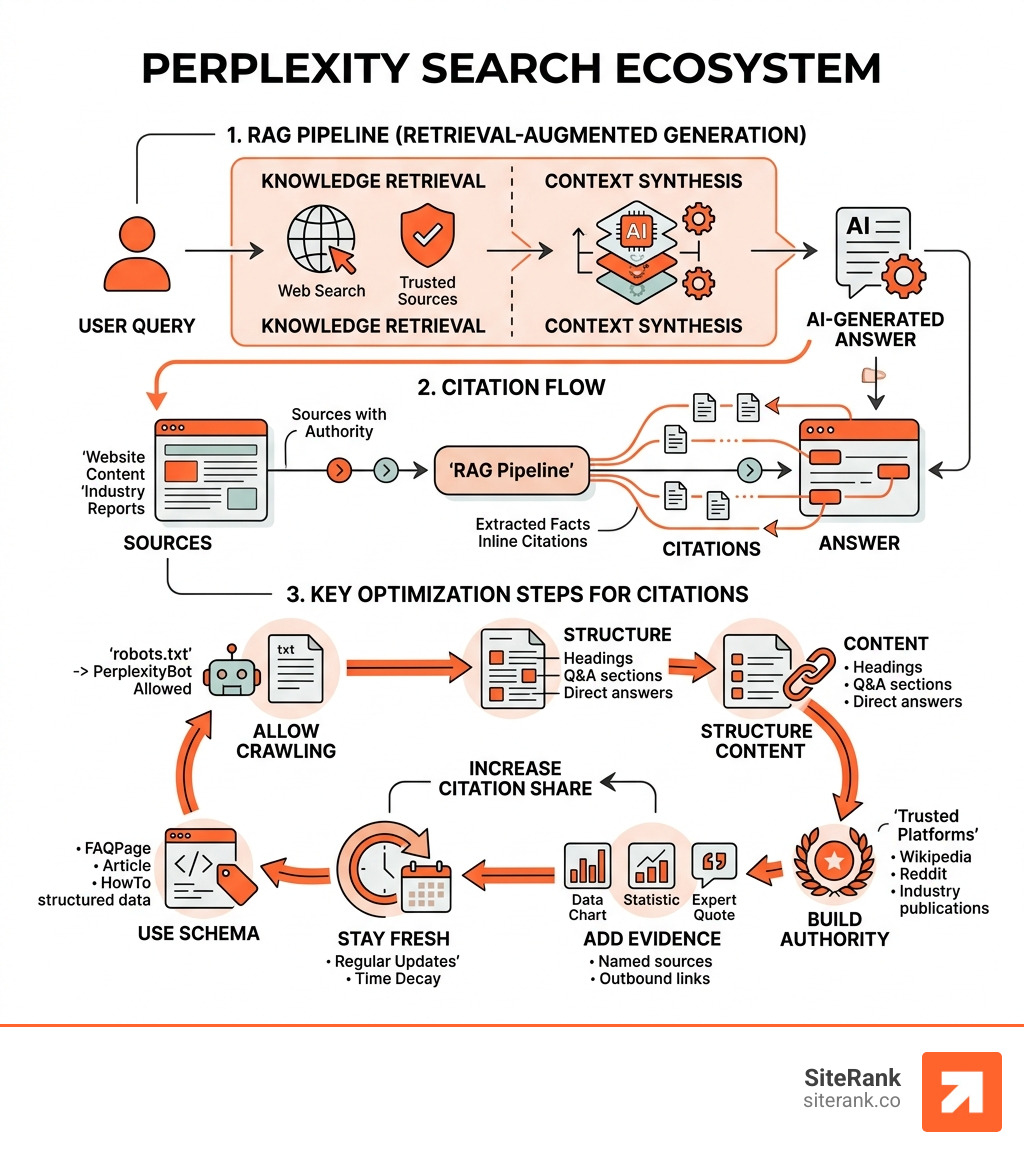
| Step | What to Do |
|---|---|
| 1. Allow crawling | Make sure PerplexityBot is not blocked in your robots.txt file |
| 2. Structure content | Use clear headings, Q&A sections, and answer questions directly at the top |
| 3. Build authority | Get cited on trusted platforms like Reddit, Wikipedia, and industry publications |
| 4. Add evidence | Include named statistics, expert quotes, and outbound links to credible sources |
| 5. Stay fresh | Update key pages regularly — Perplexity applies aggressive time decay to older content |
| 6. Use schema | Add FAQPage, Article, and HowTo structured data so AI can parse your content easily |
Perplexity is not your typical search engine. Instead of returning ten blue links, it reads multiple sources and synthesizes a single, cited answer. For your business, that means ranking matters less than being cited.
The numbers make this hard to ignore. Perplexity now handles over 250 million queries per month, has crossed 100 million weekly searches, and is growing at 40% month over month. More importantly, users who land on your site via an AI citation convert at nearly nine times the rate of traditional search traffic.
This is not a future trend to watch from the sidelines. It is a channel that is already driving high-intent visitors — and most businesses have not optimized for it yet.
I’m Craig Flickinger, founder of SiteRank and a digital marketing practitioner with over 15 years of SEO experience, including hands-on work in Perplexity search engine optimization and AI-driven content strategy. In this guide, I’ll walk you through exactly what it takes to get your content cited — not just indexed.
Understanding the Perplexity Search Engine Optimization Framework
As we move deeper into 2026, the digital landscape has shifted from a “link-first” world to an “answer-first” world. At SiteRank, we view Perplexity search engine optimization as the cornerstone of Generative Engine Optimization (GEO). Unlike Google, which focuses on a massive index of pages, Perplexity acts as a research assistant. It uses Retrieval-Augmented Generation (RAG) to find the best information in real-time and package it for the user.
To win here, we have to stop thinking about keywords and start thinking about “Citation Share.” If five sources are cited in an answer, we want our clients to be one of them. This requires a deep understanding of how AI synthesizes information and what makes a source “trustworthy” enough to be extracted.

The Shift from Blue Links to Synthesized Answers
Traditional search engines give users a list of options and say, “Good luck, go find the answer yourself.” Perplexity does the heavy lifting for the user. It looks at the conversational flow and the specific user intent to provide a direct attribution to the facts it presents. This is why understanding the Meaning of AIO and Generative Engine Optimization is so vital; the “win” isn’t just a click—it’s becoming the authoritative voice the AI trusts.
| Feature | Traditional Google Search | Perplexity AI Search |
|---|---|---|
| Interface | Ten Blue Links | Synthesized Paragraphs |
| Source Selection | Backlink-heavy PageRank | Semantic Relevance & RAG |
| User Intent | Keyword Matching | Conversational Research |
| Freshness | 2-4 week crawl cycles | Daily Indexing / Real-time |
| Conversion | Standard Organic CTR | ~9x higher for AI Citations |
For more on this evolution, check out our AI Search Engine Optimization Guide.
Why Perplexity Search Engine Optimization is Critical in 2026
If you aren’t optimizing for AI, you are missing out on the most qualified traffic on the web. Statistics show that 17% of respondents from billion-dollar companies are already exploring Perplexity’s capabilities. With a 40% month-over-month growth rate, it is no longer a niche tool.
At SiteRank, we’ve seen that visibility in Perplexity acts as a massive endorsement of authority. Because Perplexity is ad-free and relies on premium subscriptions, its users trust the results more than sponsored links. This leads to higher brand recall and superior conversion rates. This is the heart of AIO Optimization: being the answer to the user’s problem at the exact moment they ask.
Technical Requirements for PerplexityBot and Indexing
Before you can be cited, you must be crawled. Perplexity uses its own crawler, PerplexityBot, to navigate the web. If your technical foundation is shaky, the AI will simply skip over your site for a faster, cleaner competitor.

Optimizing Site Architecture for Perplexity Search Engine Optimization
We recommend a “fragment-friendly” architecture. This means your site should be easy for an AI to parse into small, usable chunks.
- robots.txt: Ensure you aren’t blocking PerplexityBot or its upstream partners like Bingbot.
- llms.txt: This is a new standard in 2026. By placing a
llms.txtfile in your root directory, you provide a roadmap specifically for AI agents, highlighting your most authoritative pages. - Server Response Time: AI crawlers are “impatient.” If your server takes too long to respond, the bot moves on. We focus on server-side rendering and clean HTML to ensure zero barriers to extraction.
For a deeper dive into the tools that help with this, see our AI SEO Tool Guide 2025. You should also follow the official Best Practices – Perplexity to stay compliant with their API and search standards.
Structured Data and Schema Markup for AI Extraction
Schema markup is the “secret language” we use to talk to AI. While humans see a beautiful blog post, PerplexityBot sees JSON-LD.
- FAQPage Schema: This is gold for Perplexity. It maps out questions and answers in a format the AI can easily digest.
- Article and HowTo Markup: These help the engine understand the sequence of events or the depth of an analysis.
- Organization Entities: Clearly defining who you are helps build the E-E-A-T signals that Perplexity craves.
Check out our Tag AI SEO section for specific code examples on implementing these markups.
Content Strategies to Increase Citation Frequency
The best Perplexity search engine optimization doesn’t feel like SEO at all—it feels like high-quality journalism. Perplexity favors content that is dense with information but simple to read.
Mastering Conversational Queries in Perplexity Search Engine Optimization
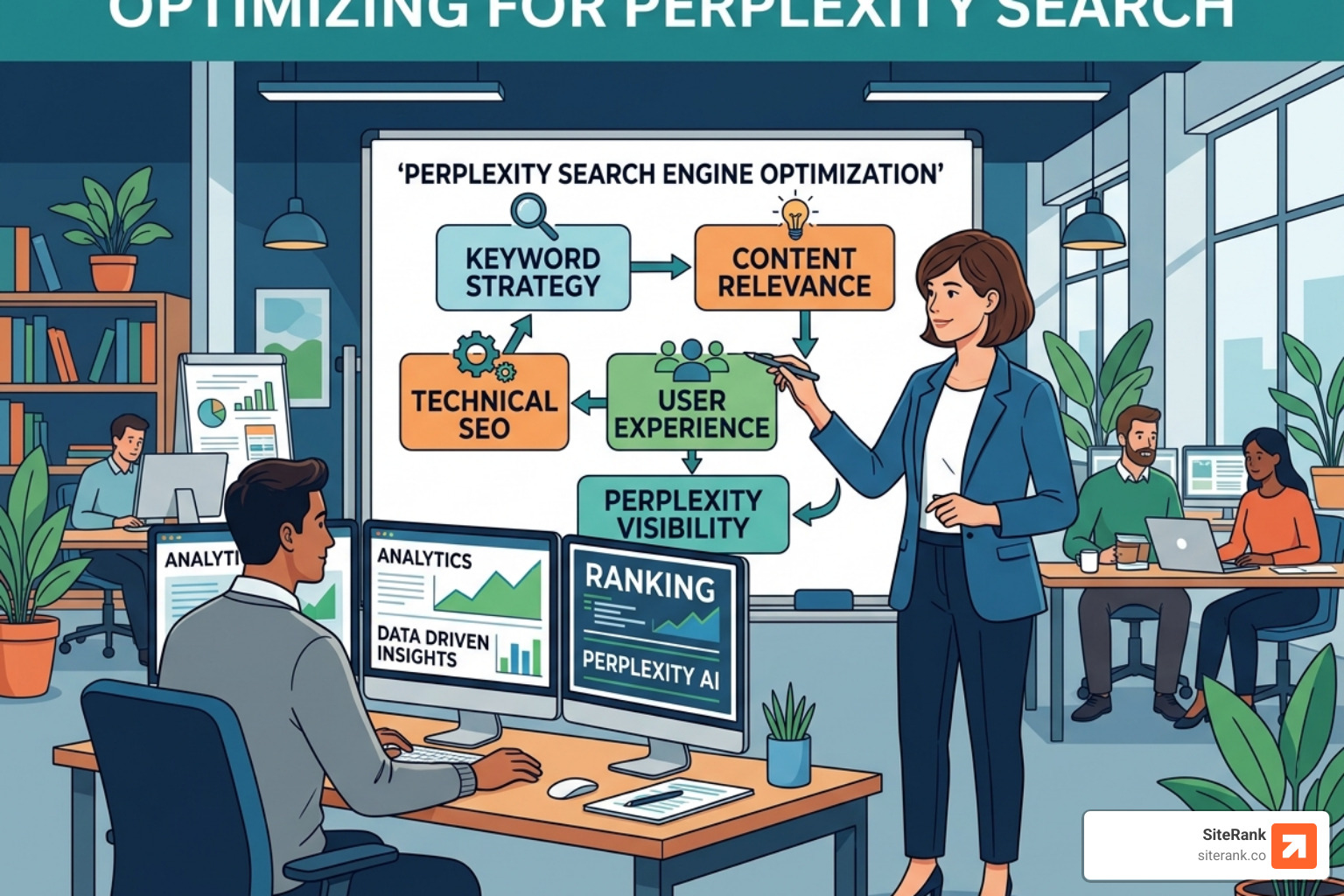
Users search Perplexity differently than they do Google. The average Perplexity query is 10 words long. They aren’t typing “best coffee,” they are asking, “What is the best way to store cold brew so it stays fresh for two weeks?”
To capture these:
- Use BLUF (Bottom Line Up Front): Answer the question in the first sentence.
- Named Statistics: Don’t say “sales grew.” Say “sales grew by 34% according to the 2025 Retail Report.” Research shows adding statistics can boost visibility by 41%.
- Expert Quotations: Include quotes from named experts with their titles. This adds “entity weight” that AI models prioritize.
- Combat Time Decay: Perplexity updates its index daily. Content that is older than 90 days sees a significant drop in citation frequency. We recommend a monthly “freshness audit” for your top-performing pages.
Our AIO Services Complete Guide provides a roadmap for executing this at scale.
Multimedia Integration and Visual Search
Perplexity is becoming increasingly multimodal. This means it doesn’t just look at text; it looks at images and video.
- Branded Infographics: If Perplexity uses your chart in its “Discover” section, you’ve won the ultimate authority signal.
- Video Transcripts: Perplexity often cites YouTube. By providing clear, keyword-rich transcripts on your site, you help the AI connect your video content to your written content.
- Alt Text: Use descriptive, context-heavy alt text for every image. Don’t just say “chart,” say “Infographic showing Perplexity monthly growth rates from 2024 to 2026.”
See how these elements impact AI Rankings to better understand the weight of multimedia.
Building Authority Through Third-Party Platforms
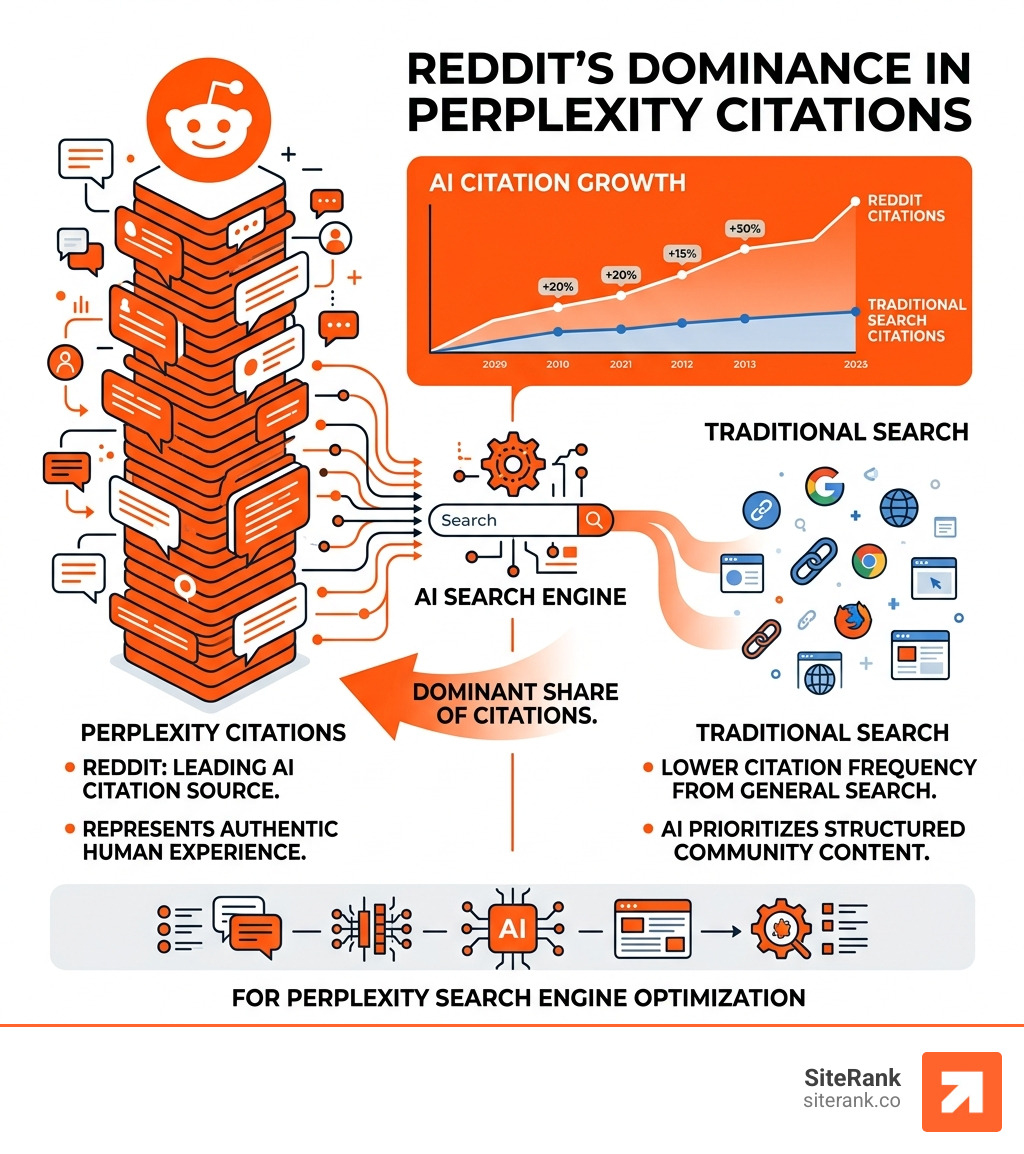
One of the most unique aspects of Perplexity search engine optimization is that the AI trusts what others say about you more than what you say about yourself. Perplexity has a “manual domain boost” for sites like Reddit, LinkedIn, and Wikipedia.
Leveraging Industry-Specific Domains for Trust Signals
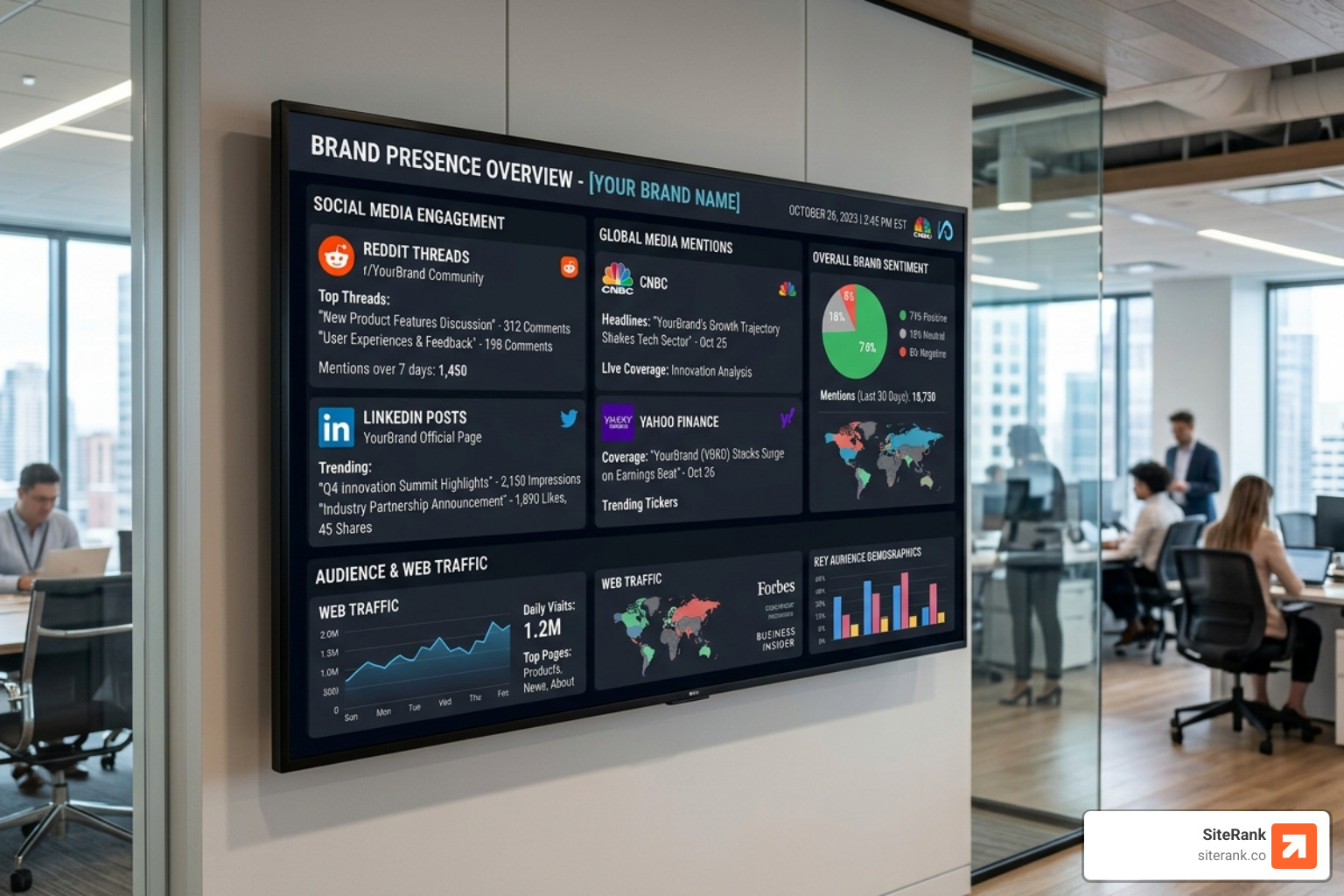
If you are in finance, being cited by Yahoo Finance or MarketWatch is more valuable than 100 low-tier backlinks. Perplexity uses these “trust anchors” to validate information.
- Reddit: This is huge. Reddit accounts for a massive portion of Perplexity’s citations because it represents real human experience. We advise our clients to engage in community discussions authentically—not just for the link, but for the “unlinked brand mention.”
- Co-citations: If your brand is mentioned in the same paragraph as your top competitors on a site like CNBC, Perplexity learns that you are a relevant player in that “entity space.”
- GitHub & Academic Sources: For B2B and tech companies, being referenced in technical documentation or research papers provides an massive boost in the AI’s “retrieval confidence.”
Frequently Asked Questions about Perplexity SEO
How does Perplexity select and cite its sources?
Perplexity uses a three-layer reranking system. First, it retrieves candidate documents (often using Bing’s index). Then, an L3 XGBoost Reranker filters these based on semantic relevance and a quality threshold (usually around 0.7). Finally, it extracts the most “quotable” fragments to build the answer. If your content is clear, factual, and front-loaded, you clear these gates easily.
Is traditional SEO still relevant for AI search engines?
Absolutely. Roughly 60% of Perplexity citations also appear in Google’s top ten organic results. Technical foundations like site speed, mobile-friendliness, and a strong backlink profile (which builds Domain Authority) still serve as the “entry fee” for being considered by PerplexityBot.
How can I track my visibility and performance in Perplexity?
Standard rank trackers are still catching up, so we recommend a three-layer approach:
- Manual Testing: Use conversational prompts related to your core business and see if you are cited.
- Referral Traffic: Monitor
perplexity.aireferrals in your analytics. While click-through rates might be lower than Google, the conversion rate is often 4-5x higher. - Branded Search Lift: As you get cited more in AI answers, you should see an increase in people searching for your brand name directly in Google.
Conclusion
The future of search is no longer about a single destination; it’s about “Search Everywhere.” Whether a user is asking a question on their phone, via a voice assistant, or through a research tool like Perplexity, your brand needs to be the answer they find.
As we’ve seen, Perplexity search engine optimization is a blend of technical precision, high-quality journalism, and broad authority building. It requires moving away from keyword stuffing and moving toward factual density and conversational clarity.
At SiteRank, we specialize in helping businesses navigate this transition. We don’t just optimize for bots; we optimize for the trust that drives conversions. If you’re ready to stop chasing links and start owning the answers, we’re here to help.