

Why AI SEO Tools Are Reshaping Digital Marketing in 2025
AI SEO tools are platforms using artificial intelligence to automate and improve tasks like keyword research, content creation, and technical audits. The main categories for 2025 include:
- All-in-One Platforms – Comprehensive tools that handle everything from rank tracking to content optimization.
- AI Content Writers – Tools that generate and optimize SEO content.
- GEO & AI Search Trackers – Platforms that monitor brand visibility in AI search engines like ChatGPT and Perplexity.
- Technical SEO Tools – Solutions that automate site audits and fix technical issues.
The search landscape has fundamentally changed. About half of US consumers now use AI-powered search, yet only 16% of brands systematically track their AI search performance. This gap represents a massive opportunity.
Traditional SEO focused on ranking in Google’s top 10. Today, your content also needs to appear in ChatGPT answers, Perplexity citations, and Google’s AI Overviews. AI tools can help you compete on both fronts, and with platforms like Reddit appearing in over 40% of AI-generated answers, optimizing for AI search is no longer optional.
The debate on AI-generated content continues, but research shows quality matters more than the creation method. What matters is whether your content satisfies search intent, demonstrates expertise, and provides genuine value.
I’m Craig Flickinger, and with over 15 years in SEO at SiteRank, I’ve tested dozens of ai seo tools. I’ll share my practical experience to help you understand which ones deliver real results.
Key Features to Look for in an AI SEO Tool
Shopping for an AI SEO tool can be overwhelming, but the best platforms solve real problems and save time. Let’s walk through the capabilities that truly matter.
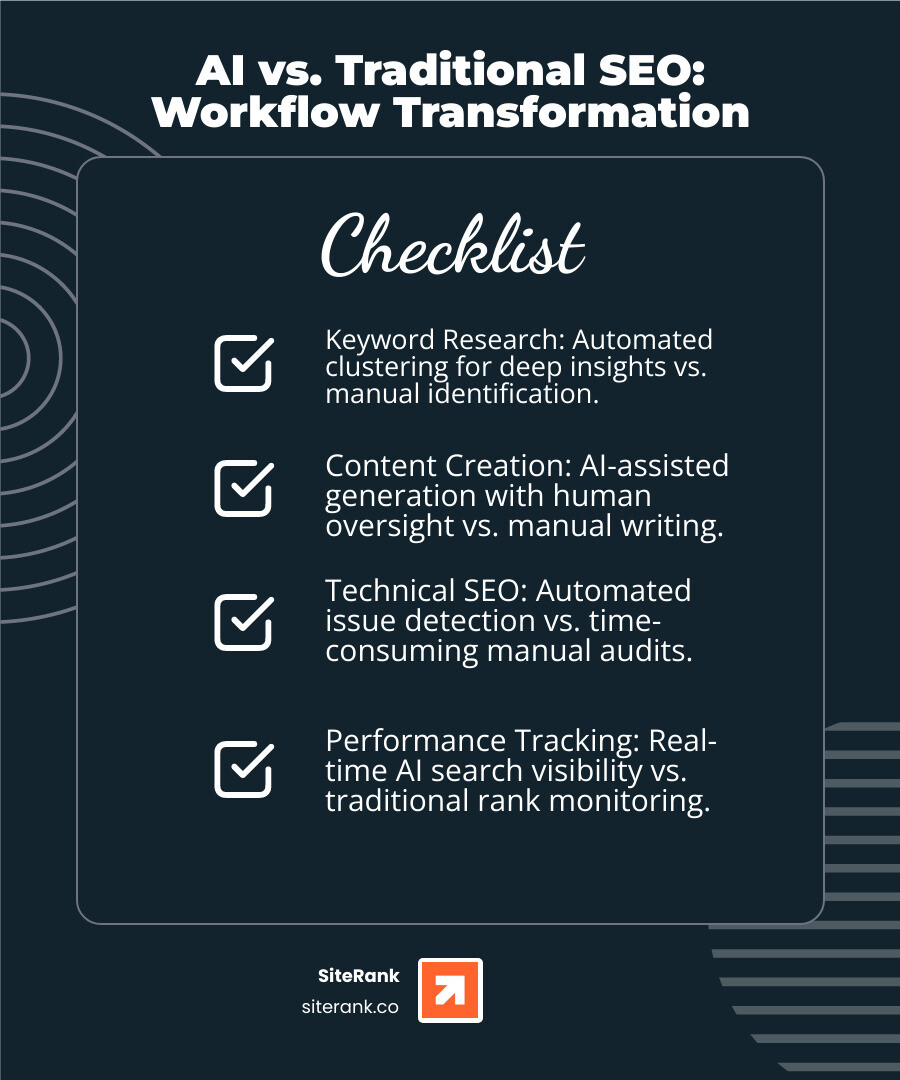
Content generation has advanced significantly. Modern AI writers can produce complete articles and blog posts that sound human, generate outlines, and adapt to a brand’s voice. While impressive, this is just the starting point.
What really matters is content optimization. This is where AI analyzes your draft against top-ranking competitors to find gaps. These tools recommend relevant keywords, suggest internal links, and ensure your content aligns with searcher intent, making it both comprehensive and competitive.
A critical new feature is AI search visibility tracking and LLM tracking. Ranking on Google’s first page is no longer enough; your content must also appear in ChatGPT answers, Perplexity citations, and Google’s AI Overviews. The most forward-thinking ai seo tools track how your brand appears in these AI-generated responses. This is the core of Generative Engine Optimization (GEO), and if your tool doesn’t track it, you’re flying blind. For more context, see this article on how AI search is reshaping SEO.
Technical SEO audits are where AI truly shines. These tools crawl your site to spot broken links, schema errors, and Core Web Vitals issues, then prioritize fixes that will have the biggest impact.
Automated reporting features pull data from various platforms into clean dashboards. The AI generates summaries and highlights trends, with some agencies saving 100 hours per month by automating client reports.
Competitor analysis goes deeper than just keywords. AI tools dissect rivals’ backlink profiles, content performance, and AI search visibility, helping you spot gaps in your own strategy.
Finally, keyword research and topic clustering have evolved. AI tools can brainstorm ideas, find long-tail variations, and group related keywords into topic clusters to help you build topical authority.
To maximize your chances of appearing in AI-generated answers, structure your content with Q&A sections, lists, and tables, as recommended by Microsoft’s guide to optimizing for AI search. The right AI SEO tool multiplies your team’s effectiveness while keeping up with the evolution of search.
A Curated List of Top AI SEO Tool Categories for 2025
The world of AI SEO tools is vast, but understanding the categories helps you find the right fit for your specific challenges. We’ve organized them based on practical use cases for different scales of operation.

Small businesses and bloggers need user-friendly platforms with solid core features, while enterprise solutions offer heavy-duty capabilities for managing multiple sites and deep analytics. Free AI SEO tools are great for initial brainstorming, but paid subscriptions open up comprehensive audits, advanced features, and deeper insights. Most paid tools offer free trials, so you can test them before committing.
The All-in-One AI SEO Tool: A Central Hub for Your Strategy
All-in-one platforms consolidate multiple SEO functions into a single dashboard, creating one source of truth for your strategy. They act as an SEO command center, handling comprehensive rank tracking, in-depth site audits, backlink analysis, and content strategy and planning. These tools bring together keyword research, topic clustering, and content generation. Some claim to automate up to 90% of manual SEO tasks, freeing your team to focus on strategy. While powerful, they often have steeper learning curves and are most valuable for agencies or dedicated SEO teams. The efficiency gains, however, can easily justify the investment. If you’re curious about how comprehensive SEO services can transform your business, check out more info about comprehensive SEO Services.
AI Content Creation & E-E-A-T Optimization Tools
AI SEO tools for content don’t just write—they write strategically. Modern AI writers can generate complete articles and blog posts from simple prompts, turning week-long projects into afternoon tasks. Beyond generation, content brief generation features analyze competitors to create detailed outlines. On-page optimization tools then scan your drafts in real-time, suggesting improvements to keyword usage and readability. With Google’s focus on Experience, Expertise, Authoritativeness, and Trustworthiness, E-E-A-T alignment features help by suggesting author bios and reputable sources. The best approach combines AI efficiency with human insight—let AI handle the heavy lifting while you add your expert perspective and ensure search intent matching. This allows you to produce high-quality, SEO-friendly content at scale. If you’re looking for help, explore our Content Writing Services.
Generative Engine Optimization (GEO) & AI Search Trackers
Search has shifted. It’s no longer enough to rank in Google’s top ten; you must also be the answer in ChatGPT, Perplexity, or Google’s AI Overviews. This is Generative Engine Optimization (GEO). The new SEO is GEO, and specialized AI SEO tools are essential for navigating it. AI Overviews monitoring tracks how your content appears in Google’s AI answers. ChatGPT and Perplexity visibility tracking shows if your brand appears for key terms on these platforms. Brand mention monitoring and competitor benchmarking provide insights into brand perception and opportunities. A new field, prompt research, analyzes user questions to AI models, helping you tailor content to what people actually ask. These tools provide the data needed to adapt and grow your visibility in this critical new environment.
Technical SEO & Indexing Automation Tools
Technical SEO is the foundation of performance, and AI SEO tools automate these complex tasks. Automated site audits crawl entire websites to identify issues like broken links and duplicate content, saving countless hours. Schema markup generation and validation helps search engines and AI understand your content’s context by creating and checking structured data. Indexing automation tools identify unindexed URLs and submit them to search engines, getting your content finded in days instead of weeks. Site health monitoring provides real-time alerts for critical errors, while Page speed and Core Web Vitals tools analyze performance and offer actionable recommendations. Some innovative tools even track how AI crawlers interact with your site, providing insights into your visibility in AI search. Leveraging these tools ensures your site is optimized for both traditional and AI-driven search. For professional help, explore our Technical SEO Services.
How to Integrate an AI SEO Tool into Your Workflow
Integrating an AI SEO tool into your workflow is like hiring an efficient assistant. The goal isn’t to replace human expertise but to free you from tedious tasks, allowing you to focus on high-level strategy.

The magic happens when AI’s processing power is paired with human creativity. Let an AI tool brainstorm keywords or draft an article, then step in to refine the ideas, add your unique perspective, and inject your brand’s voice. At SiteRank, we use this approach to let our experts focus on strategic tasks like Advanced Keyword Research for Blog Posts.
Automation is your friend for repetitive work like daily rank tracking, technical audits, or generating meta descriptions. This saves time and gives your team the mental space to tackle bigger challenges.
However, never blindly trust AI output. Treat AI-generated material as a first draft that needs human validation. Review facts, ensure brand voice, and watch for biases, especially for Your Money Your Life (YMYL) topics where human expertise is non-negotiable.
Fact-checking is essential. AI can present outdated or incorrect information. Before publishing, verify all statistics and sources to align with E-E-A-T factors, as outlined in Google’s quality rater guidelines.
AI can also boost your creativity. By handling manual tasks, it frees you to explore innovative angles and strategies. It can act as a brainstorming partner, surfacing unexpected connections and ideas.
The best workflow follows a “human-in-the-loop” approach. Leverage AI for speed and data processing, but maintain ultimate control to ensure your content is valuable, accurate, and upholds your brand’s integrity.
Frequently Asked Questions about AI and SEO
The world of AI and SEO is evolving fast. Here are answers to some of the most common questions.
Is AI-generated content bad for SEO?
No, AI-generated content isn’t inherently bad for SEO. According to Google’s guidance on AI-generated content, quality and helpfulness are what matter, not the creation method. Using AI to create helpful, original content is fine; using it for spam is not. The focus should be on content quality, user value, and search intent. However, the human element is essential for E-E-A-T (Experience, Expertise, Authoritativeness, and Trustworthiness), especially for YMYL topics like health or finance, where content must come from certified experts. A study of 600,000 pages confirmed that well-executed AI content does not hurt Google rankings.
What are the limitations of using an ai seo tool?
While powerful, AI tools have limitations. Generic output is a common issue, as AI often produces bland text without a unique voice. Data accuracy can also be a concern, as models may use outdated information, so always fact-check. AI also lacks genuine creativity and empathy, which are needed to create truly resonant content. There’s an over-reliance risk where teams stop thinking strategically, and we must be mindful of bias in training data. For YMYL topics, AI cannot replace the required level of verifiable expertise. Finally, the cost of powerful ai seo tools can be a barrier for smaller businesses. Understanding these limits helps you use AI more effectively.
Can AI tools help improve rankings in AI search engines?
Yes, and this is the new frontier of Generative Engine Optimization (GEO). Instead of just ranking in a list of links, the goal is to become the trusted source an AI model cites. GEO strategies focus on different signals. Content formatting and structure are key; AI models prefer clear, digestible information in lists, tables, and Q&A sections. Structured data implementation (Schema markup) explicitly tells AI what your content is about, making it easier to cite. AI tools can help identify “citation gaps” where competitors are cited but you are not. Answering questions directly is also crucial, as AI search is conversational. Finally, AI visibility tracking tools are essential for measuring what’s working and adapting your strategy based on real data.
Conclusion: Partnering for Future SEO Success
The world of SEO isn’t standing still—it’s sprinting forward, powered by AI. In 2025, we’re witnessing something bigger than just another algorithm update. This is a fundamental change in how people search for information and how brands get finded online. AI SEO tools have moved from “nice to have” to absolutely essential for anyone who wants to compete in this new digital landscape.
Throughout this guide, we’ve explored how these tools can handle the heavy lifting: automating tedious technical audits, generating content at scale, tracking our brand’s presence across ChatGPT and Perplexity, and keeping our websites running smoothly. They give us back something precious—time. Time to think strategically, time to be creative, time to build genuine relationships with our audience.
But here’s the thing: AI is incredibly powerful, yet it’s not the whole story. The real magic happens when we combine AI’s computational muscle with human insight and creativity. The winning SEO strategies of 2025 accept a human-in-the-loop approach. We let AI do what it does best—processing massive datasets, spotting patterns, and executing repetitive tasks. Meanwhile, our human teams bring what AI can’t: strategic thinking, empathy, ethical judgment, and that spark of creativity that makes content truly resonate.
This balance matters more than ever. We need humans to validate what AI produces, to inject authentic experience and expertise (that crucial E-E-A-T), and to adapt strategies as search algorithms evolve. Following Google’s quality rater guidelines on E-E-A-T isn’t just about checking boxes—it’s about building trust with both search engines and real people.
At SiteRank, we live and breathe this philosophy. We’ve built our approach around the importance of a custom strategy that combines cutting-edge AI tools with deep SEO expertise. We don’t believe in cookie-cutter solutions or bloated deliverables you’ll never read. Instead, we focus on what actually moves the needle: increased clicks, better engagement, and measurable growth. Our AI-powered services are designed to steer both traditional search and the emerging world of GEO, turning the complexity of modern SEO into your competitive advantage.
The search ecosystem will keep evolving—that’s the only certainty we have. As AI search engines gain traction and user behavior shifts, having a partner who understands both the technology and the timeless principles of good SEO becomes invaluable. We’re not just keeping up with change; we’re helping businesses stay ahead of it.
Future of SEO isn’t about choosing between AI and human expertise—it’s about AI integration that amplifies what makes us human. It’s about building strategies that are both data-driven and genuinely helpful. It’s about creating content that AI engines want to cite and people want to read.
Ready to transform your digital presence with a strategy built for the AI era? Explore our AI-powered SEO Services and let’s build something remarkable together. Your future SEO success starts with the right partnership—and we’re here to make it happen.