

Why AI Rankings Matter More Than Ever
AI Rankings are the new scorecards determining which artificial intelligence models dominate the digital landscape—and they’re changing how we search, work, and find information. As of October 2025, ChatGPT leads with 769.14 million monthly active users, but raw user numbers tell only part of the story.
Here’s what you need to know about AI Rankings right now:
Top AI Models (August 2025)
- GPT-5 (OpenAI) – 26% lower hallucination rate than GPT-4o
- Grok 4 (xAI) – Trained on 200,000 GPUs
- Gemini 2.5 Pro (Google) – Multimodal processing capabilities
- DeepSeek R1 0528 – Open-weight model with 685B parameters
- Claude 4 Opus (Anthropic) – Best for complex, high-stakes tasks
How Rankings Are Determined
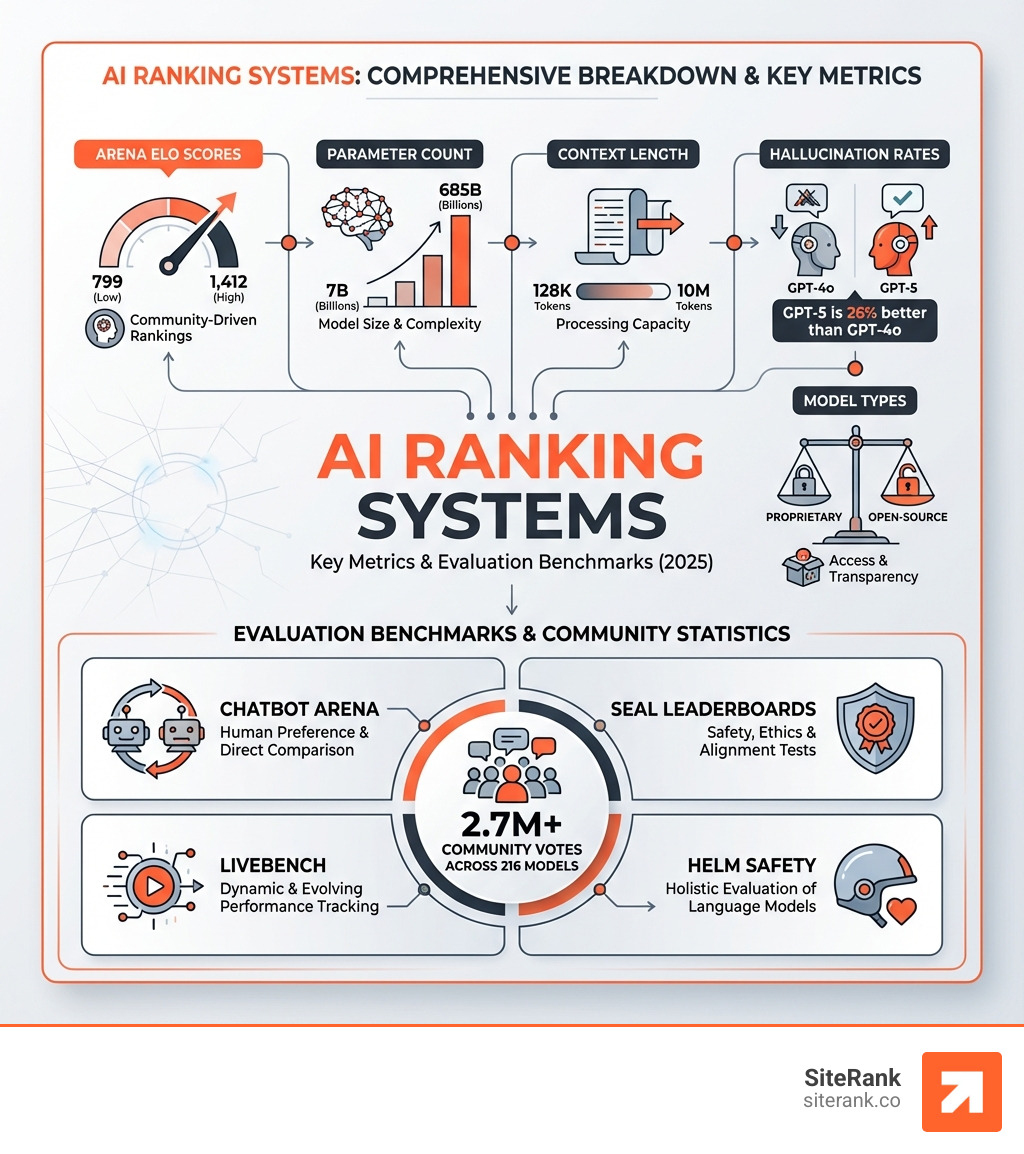
- Chatbot Arena uses community voting with 2.7+ million votes across 216 models
- Arena Elo Scores range from 799 to 1,412
- Specialized benchmarks like HELM Safety, LiveBench, and SEAL Leaderboards
- Key metrics include context length, hallucination rates, and task-specific performance
The stakes are high. In 2024 alone, over 4,000 new AI apps launched, generating 1.49 billion downloads. The mobile AI market now stands at $2 billion. For businesses, understanding these rankings isn’t just about following trends—it’s about knowing which tools deliver results and how to optimize your content so AI models find and cite your brand.
I’m Craig Flickinger, founder of SiteRank.co. With over 15 years of experience, I’ve helped businesses steer search engine evolution, from traditional SEO to today’s AI-driven landscape. I guide clients in optimizing for both search engines and the new LLM-powered tools changing how people find information.
The August 2025 AI Model Power Rankings
The AI world moves at lightning speed, with new models emerging constantly. Tracking top performers is crucial for business and personal use. In August 2025, a few models stand out for their groundbreaking capabilities and performance, setting the pace for the industry.
1. GPT-5 (OpenAI)
OpenAI’s flagship model, GPT-5, has established itself at the pinnacle of AI Rankings. It represents a significant leap forward in reliability and understanding complex instructions. GPT-5 is the company’s top-performing model for coding and agentic tasks, making it an invaluable tool for developers.
A key advancement is its 26% lower hallucination rate than GPT-4o, increasing output reliability and reducing fact-checking. GPT-5 also offers better control over response detail and can ask clarifying questions for more precise interactions.

2. Grok 4 (xAI)
xAI, founded by Elon Musk, has pushed boundaries with Grok 4. This model is designed for real-time data processing and analysis, providing insights at high speed. Its power comes from being trained on xAI’s supercomputer, Colossus, which is equipped with a staggering 200,000 GPUs.
Grok 4’s ability to analyze images and video, combined with its capacity to use external tools like search engines, makes it incredibly versatile. For anyone needing an AI that can keep up with breaking news or process vast amounts of dynamic information, Grok 4 is a strong contender in the AI Rankings.

3. Gemini 2.5 Pro (Google)
Google’s Gemini 2.5 Pro is their most advanced AI model to date. Its standout feature is its truly multimodal capabilities, allowing it to seamlessly process information across text, audio, images, video, and code repositories.
Imagine an AI that can review a video, listen to its audio, read the transcript, and then generate code based on the content. Gemini 2.5 Pro makes this a reality, offering unparalleled versatility for complex tasks. Its context length of 1 million tokens further improves its ability to handle extensive inputs.

4. DeepSeek R1 0528 (DeepSeek)
DeepSeek R1 0528 is a remarkable entry in the AI Rankings, especially for open-source champions. This open-weight model has an impressive architecture with 685 billion parameters, with about 37 billion active at inference time, balancing power and efficiency.
DeepSeek R1 0528 offers advanced reasoning features, making it a robust alternative to proprietary models. Its accessibility and capabilities make it a favorite for researchers and developers seeking powerful, transparent, and customizable AI solutions.

5. Claude 4 Opus (Anthropic)
Anthropic’s Claude 4 Opus is designed for the most demanding AI challenges. It stands out in the AI Rankings as Anthropic’s most advanced AI model, excelling in complex, long-running tasks like deep research, intricate coding, and high-stakes conversations where nuanced understanding is paramount.
For critical applications where accuracy and sophisticated reasoning are non-negotiable, Claude 4 Opus provides the necessary depth and reliability. It’s built for environments where the cost of error is high, offering a level of performance that instills confidence.
Other Notable Models
Beyond the top five, the AI landscape is full of innovation. Other models are also making waves in the AI Rankings, each with unique strengths:
- Qwen3-235B-A22B-Thinking-2507 (Alibaba): An open-source model for advanced reasoning, supporting a native context length of 262,144 tokens, making it great for long documents.
- Claude Sonnet 4 (Anthropic): A mid-sized model balancing performance and efficiency, excelling in high-volume applications like code generation, data analysis, and search.
- Llama 4 Scout (Meta AI): A powerful open-source contender with a 10 million token context length and 17 billion active parameters for handling extensive data.
- GPT-4.5-Preview (OpenAI): A strong performer with an Arena Elo Score of 1411, demonstrating its continued relevance.
- Gemini-2.0-Flash-Thinking-Exp-01-21 (Google): With an Elo Score of 1384, this model showcases Google’s advancements in the Gemini series.
- ChatGPT-4o-latest (OpenAI): The latest iteration of ChatGPT-4o remains a highly capable and widely used model with an Elo Score of 1377.
- Hunyuan-Large-2025-02-10 (Tencent): Tencent’s entry demonstrates the global competition in developing advanced LLMs.
- Llama-3.1-405B-Instruct-bf16 (Meta): Another strong open-source offering from Meta, highlighting the power of the Llama ecosystem.
- Deepseek-v2.5-1210 (DeepSeek): This iteration continues to offer cutting-edge performance, especially for those seeking open-source options.
The diversity of these models illustrates that the “best” AI depends on your specific needs, from general-purpose powerhouses to specialized tools for coding or research.
How AI Models Are Evaluated: A Look Under the Hood
Understanding AI model rankings is crucial for making informed decisions. It’s about rigorous testing and transparent methodologies to identify true capabilities, not just flashy names.
Understanding AI Rankings Methodologies
Evaluating AI models is multifaceted, combining automated benchmarks with human assessments. The Chatbot Arena is a popular, community-driven platform where models compete in head-to-head comparisons. Users vote for the best response without knowing the model’s identity.
The results are analyzed using the Bradley-Terry model to derive an Arena Elo Score, reflecting a model’s relative performance. As of early 2025, the leaderboard features 216 models and over 2.7 million votes, providing a robust measure of user preference. You can explore these rankings on platforms like the LLM Leaderboard and the Open LLM Leaderboard .
Key Performance Metrics and Benchmarks
Formal benchmarks objectively measure AI capabilities, providing quantitative data on their strengths and weaknesses.
Key performance metrics include:
- Context Length: How much information an AI can process in one interaction. Larger context windows are crucial for tasks like deep research.
- Parameter Count: Often an indicator of a model’s complexity and learning capacity. Models like DeepSeek R1 0528, with 685 billion parameters, show immense scale.
- Hallucination Rate: A critical reliability metric measuring how often an AI generates incorrect information. GPT-5’s 26% lower hallucination rate is a significant improvement.
- Task-Specific Benchmarks: Specialized tests for particular domains, such as:
- MMLU (Massive Multitask Language Understanding): Assesses general knowledge.
- HumanEval: Measures code generation capabilities.
- Coding and Reasoning Scores: Evaluate logical thinking and coding skills.
- Multimodal Capabilities: Assess how models integrate data like text, images, and audio.
These metrics combine to give a detailed picture of where each model excels.
The Role of Specialized and Responsible AI Benchmarks
As AI becomes more integrated into daily life, the need for responsible evaluation frameworks has grown. Standardized benchmarks are crucial for ensuring safety and fairness.
- LiveBench: This benchmark provides a challenging, contamination-free evaluation, meaning the test data is new to the models, ensuring a more accurate measure of their capabilities.
- HELM Safety: An initiative to evaluate AI models for safety and ethical considerations, assessing factuality and potential biases.
- SEAL LLM Leaderboards: Provided by Scale AI, these leaderboards evaluate models on specific dimensions like agentic capabilities, safety, and public sentiment. They use complex scenarios to expose model failures and prevent benchmark saturation.
The responsible AI ecosystem is evolving unevenly. While AI-related incidents are rising, standardized evaluations for responsible AI are still rare among many developers, highlighting a critical gap that these specialized benchmarks aim to fill.
Ranking the New Gatekeepers: AI Search Engines
The way we search is changing radically. Traditional search engines are integrating AI for more direct, conversational answers. These new “AI search engines” are the new gatekeepers of information, and understanding them is key for users and creators.
How We Tested the Top AI Search Engines
We tested leading AI search engines to gauge their performance, focusing on:
- Accuracy: How reliable were the answers?
- User Experience: How intuitive was the interface?
- Depth of Information: Did it provide comprehensive answers?
- Transparency: Did it cite its sources clearly?
- Adaptability: How well did it handle follow-up questions?
We tested prominent players like ChatGPT, Google’s AI Mode, Sigma Chat, and Microsoft Copilot with real-world research and shopping prompts.
AI Search Engine Strengths and Weaknesses
Our testing revealed that each AI search engine excels in different areas. There’s no one-size-fits-all “best,” but rather a “best for your specific need.”
| AI Search Engine | Strengths | Weaknesses | Ideal Use Case |
|---|---|---|---|
| ChatGPT | Excellent balance of accuracy, depth, and organization; good for comparison tables. | Can be too agreeable, occasionally providing slightly inaccurate details; overwhelming for broad, open-ended queries. | Comprehensive research, detailed comparisons, generating content ideas. |
| Google AI Mode | Quick product searches with real buyer reviews; visually appealing; good for pricing info. | Lacks deep comparisons or the ability to build on previous questions; sometimes too surface-level. | Fast product findy, checking reviews, quick shopping decisions. |
| Sigma Chat | Exceptional for deep research, building on previous questions and refining topics. | Weak in product presentation; often lacks direct pricing or purchase links; less visual. | In-depth academic research, iterative problem-solving, exploring complex topics. |
| Microsoft Copilot | Fast answers in clean, skimmable formats; good for summarizing information. | Often too surface-level for commercial searches; lacks shoppability features like direct links or detailed pricing. | Quick facts, summarization, understanding basic concepts in a hurry. |
These differences mean your choice of AI search engine will vary depending on your task.
The Exploding Popularity of AI Apps
The rise of AI search engines is part of the explosive growth of AI applications. The numbers paint a clear picture of AI’s rapid adoption:
- As of October 2025, ChatGPT is the king of AI apps, with 769.14 million monthly active users worldwide, five times more than any other AI app.
- The mobile AI apps market is now valued at $2 billion.
- In 2024, over 4,000 new AI apps were released, with downloads reaching 1.49 billion.
- ChatGPT led global downloads in 2024 with 250.1 million installs.
- In the US, ChatGPT secured 31 million downloads in 2024, with 1.4 million downloads in the App Store in its first 18 days.
This popularity signifies a fundamental shift in how people access information. For businesses, the battle for visibility is expanding from traditional search results to these AI-powered interfaces.
Optimizing for AI: Your Guide to AIO
With AI models and search engines becoming primary information gateways, optimizing your content for them is essential. This new frontier requires a fresh approach: AI Optimization (AIO).
What is AIO (AI Optimization)?
AI Optimization, or AIO, is the strategic process of preparing your digital content to be easily findable, understandable, and cited by AI models like LLMs and AI search engines. It’s the next evolution of SEO for the generative AI era.
At its core, AIO is about ensuring your brand gets mentioned and cited in LLM answers, a strategy also known as Generative Engine Optimization (GEO). Just as we optimize for Google’s algorithms, we now need to optimize for the AI’s understanding. This means focusing on clarity, credibility, and context. For more on this, check out our insights on the Meaning of AIO and how it relates to AI SEO.
How to Optimize Content for AI Visibility
How can you make your content shine in the eyes of AI? Here are actionable steps for AIO:
- Structured Data and Schema Markup: This is a critical step. Implementing structured data (schema markup) helps AI models understand the context of your content, making it easier for them to extract and cite accurate information.
- Build Topic Clusters and Content Hubs: AI models thrive on comprehensive, organized information. Create topic clusters around main subjects to signal that your site is an authoritative source, increasing the likelihood of being cited.
- Clear and Credible Content: AI prioritizes clear, concise, and factually accurate information. Write in a straightforward manner and ensure your content is well-researched and credible.
- Directly Answer User Questions: Anticipate audience questions and provide clear, direct answers. If an AI can find a definitive answer on your site, it’s less likely to use less authoritative sources.
- Optimize for Visuals and Comparisons: Many AI search engines prioritize visuals, comparison tables, and clear specifications for product queries. Ensure your product pages feature these elements.
- Cultivate Positive Reviews: AI search engines often pull from user-generated content like reviews. Focus on getting detailed, positive reviews, as these signals influence AI-generated results.
By implementing these AIO strategies, you can proactively shape how AI models understand and present your brand and content.
The Bigger Picture: Trends and the Future of AI Rankings
AI’s rapid evolution involves more than just faster models; it’s about shifting industry dynamics, ethics, and the future of evaluating intelligence.
Open-Source vs. Proprietary Models
A significant trend in AI Rankings is the competition between open-source and proprietary models.
- Proprietary Models: Developed by giants like OpenAI, Google, and Anthropic, these models often lead in performance due to massive resources and exclusive data. They typically have licensing fees and limited transparency.
- Open-Source Models: Projects like DeepSeek R1 0528 and Meta’s Llama series are powerful, accessible, and cost-effective alternatives. They allow developers to inspect and build upon their foundations, and they are rapidly closing the performance gap.
The choice between them is a trade-off: cutting-edge performance (proprietary) versus flexibility and transparency (open-source). As open-source models improve, they democratize AI, making advanced capabilities more widely available.
The Evolving Landscape of Responsible AI
As AI’s capabilities grow, so does the need for responsible development. The responsible AI ecosystem is evolving, but with uneven progress.
- Ethical Considerations: Issues like bias, privacy, and transparency are at the forefront. Developing fair and accountable AI is a complex challenge.
- AI Governance Frameworks: Governments and international bodies like the OECD and EU are developing regulatory frameworks focused on transparency and trustworthiness.
- Challenges in Standardized Evaluations: Standardized evaluations for responsible AI (RAI) remain rare among developers. There’s a gap between recognizing risks and taking action. Benchmarks like HELM Safety and LiveBench are critical tools for more rigorous ethical assessments.
The future of AI Rankings will increasingly incorporate these metrics, moving beyond raw performance to evaluate societal impact.
The Future of AI Rankings and Evaluation
The future of AI Rankings and evaluation will be characterized by:
- Agentic Task Evaluation: Benchmarks will focus on AI’s ability to perform complex, multi-step tasks autonomously.
- Multimodal Benchmarks: Evaluations will demand tests that assess how AIs integrate and reason across text, images, audio, and video.
- Real-World Performance Testing: The emphasis will shift to evaluating AI in practical, dynamic scenarios rather than isolated academic tests.
- Industry Implications: These advancements will have profound implications for every industry, as AI continues to automate and innovate, redefining job roles and business processes.
Conclusion
The world of AI Rankings is a dynamic landscape demanding constant adaptation. Leading models like GPT-5 and Gemini 2.5 Pro are pushing boundaries, while evaluation methods like Chatbot Arena offer crucial insights into their capabilities.
The growth of AI apps and search engines marks a fundamental shift in digital findy. For businesses, this means mastering AI Optimization (AIO). By structuring content, using schema, and providing clear answers, brands can ensure they are cited by the AI models shaping our digital future.
The rapid pace of AI development, the rise of open-source alternatives, and the evolution of responsible AI practices point to a challenging but exciting future. Navigating this new terrain requires a forward-thinking approach.
At SiteRank, we specialize in helping businesses thrive in this evolving digital ecosystem. Our AI-powered SEO strategies are designed to boost your visibility in traditional search and the generative AI landscape. Don’t get left behind in the AI revolution.
Partner with an AI-powered SEO agency to boost your visibility.