

Understanding the Many Faces of AIO
The meaning of aio changes dramatically based on where you encounter it. This three-letter acronym has become one of the most context-dependent terms in modern digital communication, spanning everything from computer hardware to artificial intelligence to internet slang.
Quick Answer: What Does AIO Mean?
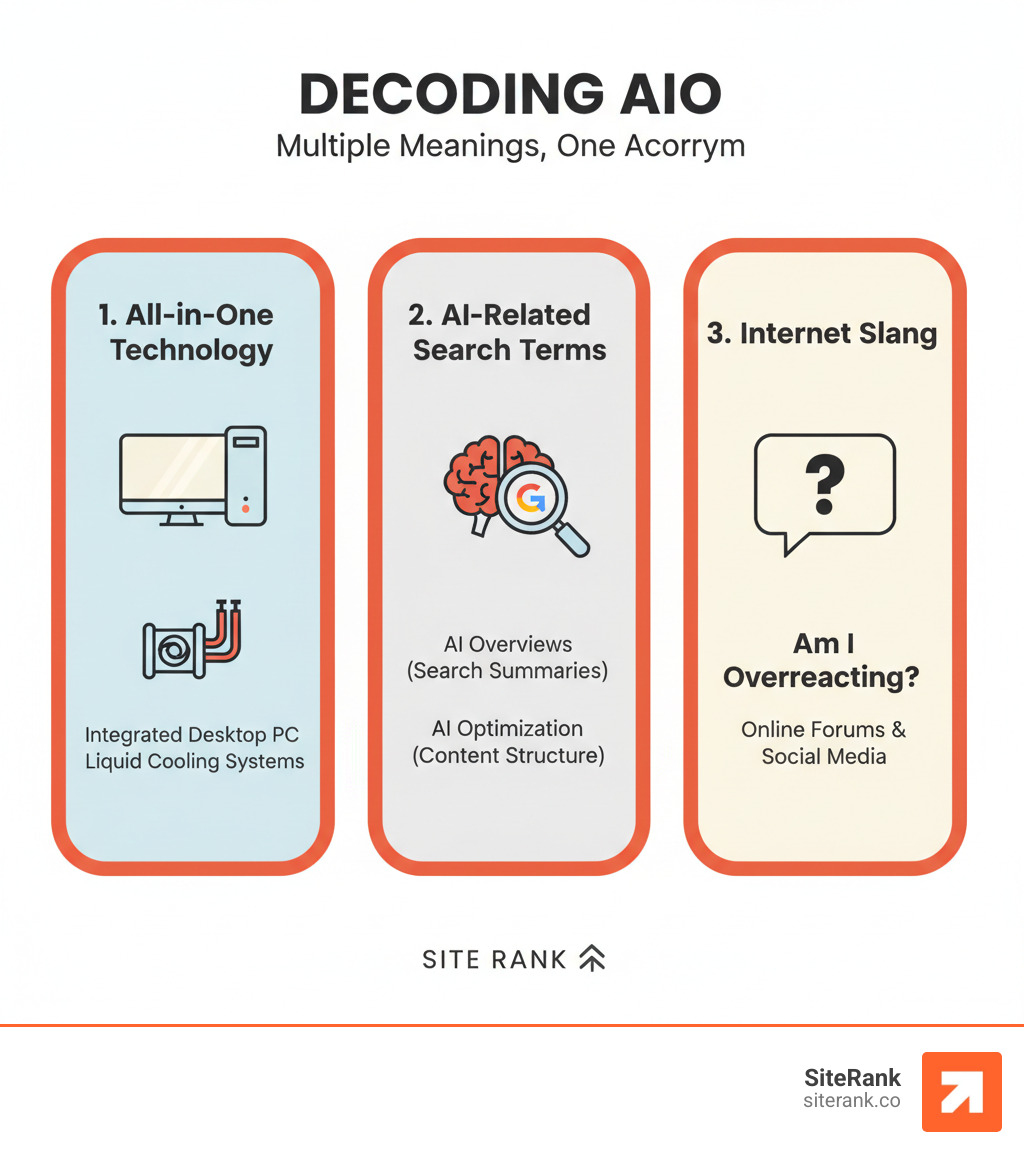
AIO stands for different things depending on the context:
- All-In-One – Integrated computer hardware (desktop PCs or liquid CPU coolers)
- AI Overview – Google’s AI-generated search result summaries
- Artificial Intelligence Optimization – The practice of optimizing content for AI systems and large language models
- “Am I Overreacting?” – Popular internet slang used in online forums and social media
The confusion around AIO isn’t surprising. As Harvard Professor Latanya Sweeney notes, we’re entering an era where 90% of online content creation may no longer be by humans – meaning AI-related acronyms are multiplying rapidly across digital spaces.
Why This Matters for Your Business
If you’re trying to understand what AIO means in a specific context – whether you’re shopping for computers, trying to get your content visible in search results, or simply decoding online conversations – knowing the right definition matters. Each version of AIO has different implications for your digital presence and business strategy.
I’m Craig Flickinger, founder of SiteRank, and over my 15 years in digital marketing and SEO, I’ve watched the meaning of aio evolve from a simple hardware term to encompass some of the most important concepts in modern search and artificial intelligence. Understanding these distinctions has become crucial for businesses navigating today’s digital landscape.
AIO in the Tech World: All-In-One Hardware Explained
In the technology world, the meaning of aio usually points to “All-in-One” – a design philosophy that bundles multiple components into a single, integrated unit. Instead of dealing with separate pieces scattered across your desk, everything works together in one sleek package.
This approach has transformed two major areas of consumer computer hardware: desktop computers and liquid cooling systems. Both share the same goal of making technology more accessible and less intimidating, while saving precious desk space.
All-In-One (AIO) Desktop Computers
Picture a desktop computer where everything – the processor, memory, storage, and even the screen – lives inside one compact unit. That’s an AIO desktop in a nutshell. It’s like someone took a traditional desktop tower and tucked it neatly behind the monitor, eliminating that bulky box sitting under your desk.

The Apple iMac probably popularized this concept, but you’ll find AIO desktops everywhere now. The Microsoft Surface Studio can fold down into a massive touchscreen for designers and artists. The Lenovo 24 All-In-One sits on countless reception desks and home offices. They’re especially popular in schools, offices, and with anyone who’d rather avoid the complexity of building a traditional PC.
The appeal is obvious: cleaner workspace, simpler setup, and way less cable chaos. Many models cost under $1,000, making them budget-friendly for families or small businesses. You can literally unbox one, plug it in, and start working within minutes.
But here’s the trade-off – that beautiful integration comes with some limitations. Want to upgrade your graphics card in a few years? Good luck. The compact design makes swapping components difficult or downright impossible. This can mean lower performance for demanding tasks like video editing or gaming, and you might need to replace the entire system sooner than you’d like. Repairs can also be trickier since everything’s squeezed together.
| Advantages | Disadvantages |
|---|---|
| Space-saving design | Limited upgradeability |
| Simplified setup & less cable clutter | Potentially lower performance |
| Sleek, modern aesthetic | More difficult to repair |
| Often more affordable than custom builds | Higher initial cost than basic towers |
For businesses and beginners who value simplicity over raw power, AIO desktops hit the sweet spot. Just like optimizing your website structure makes it easier for visitors to steer, these computers make technology more approachable. Speaking of structure, our guide on On-Page SEO for Beginners can help you create a cleaner, more organized web presence.
All-In-One (AIO) Liquid Coolers
Now let’s talk about a completely different meaning of aio in the PC building world – All-in-One liquid coolers. These clever devices keep your CPU from overheating, especially when you’re pushing it hard with gaming or video rendering.

Traditional air coolers use metal heatsinks and fans to blow hot air away from your processor. They work fine, but they’re bulky and can struggle with high-end CPUs. Custom liquid cooling loops offer incredible performance, but they’re expensive, complex, and require constant maintenance. One mistake and you could have coolant leaking all over your expensive components.
AIO coolers give you the best of both worlds. They arrive pre-filled, sealed, and ready to install. No mixing coolant, no worrying about leaks, no maintenance needed. The system circulates liquid (usually water with some additives) through a loop that pulls heat away from your CPU and releases it through a radiator.
Here’s how the magic happens: The cold plate sits directly on your CPU, absorbing heat. The pump pushes the heated liquid through flexible tubes to the radiator, where fans blow the heat out of your case. The cooled liquid then flows back to start the cycle again. Radiators come in different sizes – 120mm, 240mm, 360mm – depending on how much cooling power you need and how much space your case has.
The results can be impressive. AIO coolers often run quieter than air coolers because the fans don’t need to spin as fast. They can handle higher temperatures, keeping your CPU cooler under stress. And let’s be honest – they look fantastic, especially with RGB lighting that makes your build glow like something from a sci-fi movie. Check out r/battlestations to see what PC enthusiasts are creating with these coolers.
Installation is usually straightforward too. Mount the radiator to your case, attach the cold plate to your CPU, and you’re done. Sometimes it’s actually easier than wrestling with a massive air cooler that blocks access to other motherboard parts.
Just like how quality backlinks strengthen your website’s authority and performance, a good AIO cooler strengthens your PC’s ability to handle demanding tasks. Learn more about building strong foundations in our article on Why Backlinks Are Important for SEO.
The Evolving Meaning of AIO in AI and Search
If you thought AIO was confusing before, buckle up. The meaning of aio has taken a dramatic turn with the rise of Artificial Intelligence, and these new definitions are reshaping how we find information online and how businesses need to think about their digital presence.
We’re watching search engines transform before our eyes. Large Language Models (LLMs)—the technology behind tools like ChatGPT—are now powering the search results you see every day. This shift has created entirely new interpretations of AIO that anyone working with digital content needs to understand.
AI Overviews (AIO) in Google Search
Here’s where things get really interesting for your business. When someone talks about AIO in the context of search results, they’re increasingly referring to “AI Overview”—Google’s AI-generated summaries that now appear right at the top of search results pages.

Google officially launched AI Overviews for all U.S. users in May 2024, though they’d been experimenting with them since May 2023. This wasn’t just a minor tweak to search—it fundamentally changed what people see when they search for information.
Think about how search used to work. You’d type a question, and Google would show you a list of websites. Maybe you’d get a featured snippet—a quick excerpt pulled from one webpage. Simple enough.
AI Overviews work completely differently. Instead of pulling from a single source, Google’s AI reads through multiple websites, synthesizes the information, and writes a custom summary answering your question. It’s like having a really smart assistant who reads several articles and gives you the highlights in a conversational way.
These summaries can be substantial—sometimes taking up over 1,000 pixels of screen space. That means traditional search results get pushed way down the page, below the fold where many users never scroll.
We’ve noticed AI Overviews appear most frequently for complex, multi-part questions, especially in industries like healthcare, education, B2B technology, and insurance. Google triggers them when it thinks users need comprehensive answers that draw from multiple perspectives.
For anyone trying to get their content seen, this changes everything. The old playbook of ranking for keywords isn’t enough anymore. Your content needs to be structured clearly enough and authoritative enough that Google’s AI wants to include it in these summaries. You need to answer questions directly and make your expertise obvious. As Martech Zone explains, we’re in a new era of search optimization.
If you’re wondering how to adapt your content for this AI-powered landscape, our Content Marketing Strategy: Complete Guide walks you through the practical steps.
The Meaning of AIO as Artificial Intelligence Optimization
The meaning of aio doesn’t stop at Google’s search feature. There’s a broader movement happening called Artificial Intelligence Optimization—or AIO for short. Some people call it Answer Engine Optimization (AEO), but the goal is the same: making your content work better with AI systems.
Traditional SEO taught us to optimize for search engines and human readers. We focused on keywords, backlinks, and making content easy to scan. That still matters, but AI systems like LLMs process information in fundamentally different ways.
These AI models don’t just match keywords—they understand meaning, context, and relationships between concepts. They break text into “tokens” (roughly equivalent to words or parts of words) and convert everything into mathematical representations called embeddings. When you ask an AI a question, it’s searching through these mathematical patterns to find the best match.
Artificial Intelligence Optimization means adapting your content to work with these AI mechanisms. It focuses on several key principles that make your content more “AI-friendly.”
First, there’s token efficiency—writing in a way that’s clear and concise without unnecessary repetition. AI systems process information in chunks, so tighter, more precise writing helps them understand faster. Then there’s semantic clarity, which means making sure your content’s meaning is crystal clear and topically focused, so the AI can properly categorize and understand it.
Contextual authority matters too. When your content demonstrates consistent expertise within a specific topic area, AI systems recognize it as a reliable source. Using precise terminology and avoiding ambiguous phrasing helps prevent AI hallucinations—those moments when an AI confidently states something completely wrong because it misinterpreted the source material.
Perhaps most importantly, AIO considers prompt compatibility—how real people actually phrase their questions to AI systems. The language patterns of voice search and AI queries differ from traditional typed searches, and optimizing for these patterns increases the chances your content gets retrieved.
This isn’t just theoretical. Businesses are using AIO principles to optimize their internal knowledge bases, ensure medical information appears accurately in AI-powered health tools, and make academic research more findable. The Wikipedia article on artificial intelligence optimization offers a deeper academic perspective if you’re interested in the technical details.
The foundation for all of this is a technically sound website. If you want to make sure your site is ready for AI-powered search, our Technical SEO Services can help you build that solid foundation.
AIO in Culture: From Internet Slang to Ancient Roots
The meaning of aio isn’t confined to hardware specs and search algorithms. This versatile acronym also pops up in everyday online conversations and, surprisingly, has roots stretching back thousands of years through human language history.
The Meaning of AIO in Online Slang
If you’ve spent any time scrolling through Reddit or social media, you’ve probably encountered AIO used in a completely different way: “Am I Overreacting?” This casual internet shorthand has become the go-to phrase when someone needs a reality check about their emotional response to a situation.

Picture this: someone’s roommate ate their labeled leftovers for the third time this week, and they’re absolutely fuming. Before sending that angry text, they post to an online forum: “My roommate ate my lunch again and I’m ready to move out. AIO?” They’re essentially asking the internet to be their emotional barometer—to tell them if their frustration is justified or if they need to take a breath and calm down.
This usage thrives in relationship advice forums and conflict-resolution communities, particularly on Reddit. You’ll find it frequently in spaces like the popular AITA (Am I The Asshole?) subreddit, where people dissect interpersonal dramas and seek validation or constructive criticism from strangers. It’s a beautiful example of how digital communication creates space for vulnerability and collective wisdom, all wrapped up in three simple letters.
The meaning of aio in this context reflects something deeply human: our need for reassurance and perspective when emotions run high. It’s also a testament to how internet culture constantly evolves its own linguistic shortcuts to facilitate quick, honest exchanges.
Historical and Etymological Roots of “Aio”
Now here’s where things get fascinatingly old-school. While our modern interpretations of AIO are decidedly 21st century, the word “aio” itself has been kicking around human languages for millennia. The meaning of aio in historical contexts reveals a surprisingly rich mix of linguistic evolution.
In Latin, “aiō” was a verb meaning “to say” or “to assert.” Roman poets and writers used it regularly, though it was what linguists call a “defective verb”—meaning it was missing many of the standard grammatical forms. The poet Horace, for instance, wrote “servus, ‘habēs pretium, lōrīs nōn ūreris,’ aiō,” which translates to something like “to the slave, ‘There’s your reward: you aren’t being flogged,’ I reply.” This Latin verb traces its lineage back even further to Proto-Italic and ultimately to the Proto-Indo-European root “*h₁eǵ-,” connecting it to ancient Greek and Armenian words with similar meanings. You can explore these fascinating linguistic origins of ‘aio’ in detail on Wiktionary.
In Galician and Portuguese, “aio” (sometimes spelled “ayo”) took on a completely different meaning: a tutor or governor of a child. Scholars debate whether this came from the Latin “avia” (grandmother) or the Gothic “*hagja” (protector), but either way, it represented someone responsible for a young person’s education and upbringing.
The word appears in dozens of other unrelated languages with wildly different meanings. In Abau, spoken in Papua New Guinea, “aio” means “my father” or “my paternal uncle.” The Khoekhoe people of Southern Africa use “aio” to mean “to thank.” In Mokilese and Pohnpeian, languages from Micronesia, “aio” serves as an adverb meaning “yesterday.” Meanwhile, in Rotokas (another Papua New Guinea language), “aio” means “to eat,” and in the Ondo dialect of Yoruba (West Africa), it refers to a “chameleon.”
Beyond vocabulary, “Aio” has appeared as a name throughout history. There was Aio, son of Agilmund, a leader among Germanic tribes, and Aio of Friuli, a duke from northeast Italy. There’s even mention of a (likely fabricated) monk of Crowland Abbey named Aio.
The point? While our modern acronyms and tech jargon feel cutting-edge, the sequence of letters “aio” has been part of human communication across continents and centuries. It’s a humbling reminder that language constantly reinvents itself while carrying echoes of the past.
Frequently Asked Questions about the Meaning of AIO
Given the many faces of AIO we’ve explored, it’s natural to have some lingering questions. Let’s tackle the most common ones we hear from clients and readers.
What is the most common meaning of AIO?
Here’s the honest answer: there isn’t one. The meaning of aio shifts dramatically depending on where you encounter it, and no single definition dominates across all contexts.
If you’re browsing computer hardware reviews or shopping for a new desktop, you’re almost certainly looking at “All-in-One” references—whether that’s an integrated desktop PC or a liquid cooling system. If you’re reading digital marketing blogs or Google’s latest search updates, “AI Overview” or “Artificial Intelligence Optimization” are the interpretations you’ll encounter most frequently. And if you’re scrolling through Reddit or social media discussions, “Am I Overreacting?” is the slang version that’s probably in play.
The key takeaway? Context is everything. Always consider the industry, platform, or conversation you’re in to decode which meaning applies. When in doubt, look at the surrounding words and topics—they’ll usually give you the clues you need.
What’s the difference between an AIO (AI Overview) and a featured snippet?
Both appear at the top of Google search results, but they work in fundamentally different ways. Featured snippets pull a direct excerpt from a single webpage that Google considers most relevant to your query. Think of it as Google highlighting someone else’s answer and putting it front and center—it’s still their exact words, just displayed prominently.
AI Overviews, on the other hand, are generated by artificial intelligence that synthesizes information from multiple sources across the web. Rather than quoting one page, Google’s AI reads through numerous websites (sometimes beyond the first page of results) and writes a new, cohesive summary in its own words. This allows AI Overviews to tackle more complex, multi-part questions with a conversational, integrated response that can span several paragraphs.
So while a featured snippet is essentially a curated quote, an AI Overview is more like an AI-written research summary. For content creators and businesses, this distinction matters enormously—getting cited in an AI Overview requires different optimization strategies than ranking for a featured snippet.
Is an AIO computer good for gaming?
The short answer: it depends on what kind of gaming you’re doing, but for serious gamers, probably not.
For casual gaming—think indie titles, older games, or less demanding titles—many AIO desktop computers work just fine. They’ll handle these games without breaking a sweat, and you’ll appreciate the clean, space-saving setup.
For high-performance gaming, though, most AIO desktops fall short. The integrated design that makes them so sleek also creates three significant limitations. First, they typically use less powerful, laptop-grade components (especially graphics cards) because of space and heat constraints. Second, upgrading is extremely difficult or impossible—you’re essentially stuck with whatever GPU and CPU came with the system. Third, thermal management becomes a real challenge when you’re pushing hardware hard during intense gaming sessions.
Here’s where things get confusing: an AIO liquid cooler is actually excellent for gaming PCs. These cooling systems help keep powerful CPUs running at optimal temperatures, which is crucial for gaming performance. So you might use an AIO cooler inside a traditional gaming tower, but you’d typically avoid an AIO computer if gaming is your primary focus.
If you’re serious about gaming, we’d recommend building or buying a traditional desktop tower that gives you the power, upgradeability, and thermal headroom that modern games demand.
Conclusion: Why Understanding AIO Matters
We’ve traveled quite a journey to unpack the meaning of aio, haven’t we? From ancient Latin verbs meaning “to say” to sleek desktop computers sitting on office desks, from liquid cooling systems keeping gaming PCs frosty to AI-generated summaries appearing at the top of your Google searches—this tiny three-letter acronym carries an impressive amount of weight.
But here’s what really matters: context is everything. When someone mentions AIO, they could be talking about hardware that saves desk space, Google’s new AI-powered search features, a sophisticated approach to content optimization, or simply asking their online community if they’re overthinking something. The meaning shifts completely depending on where the conversation is happening.
For anyone running a business or managing an online presence today, understanding these distinctions isn’t just interesting trivia—it’s becoming essential knowledge. The rise of AI-related terms, particularly around search and content optimization, is fundamentally changing how we think about digital marketing. When Google’s AI Overviews can pull information from dozens of sources to answer a single query, or when Large Language Models process content in entirely new ways, the old playbook needs updating.
This is where staying informed makes all the difference. Whether you’re deciding if an All-in-One computer fits your office needs, or you’re strategizing how to make your content visible in an AI-dominated search landscape, knowing which AIO you’re dealing with helps you make smarter decisions.
At SiteRank, we’ve spent years helping businesses steer exactly these kinds of shifts in the digital world. We’ve watched search evolve from simple keyword matching to complex AI-generated summaries, and we’ve adapted our strategies right alongside it. Our approach focuses on understanding not just how search engines work today, but where they’re headed tomorrow. If you’re looking to build a stronger foundation in these areas, our collection of articles on SEO Fundamentals offers practical insights you can actually use.
The future of search is here, and it’s powered by artificial intelligence. The businesses that thrive will be the ones that understand how to create content that resonates with both human readers and AI systems—content that’s clear, authoritative, and genuinely helpful.
Ready to make sure your business stays visible in this evolving landscape? Explore our expert SEO services and let’s build a strategy that works for the search engines of today and tomorrow. Because understanding the meaning of aio is just the beginning—what really counts is knowing how to use that knowledge to grow your online presence.