

Why AI Search Is Changing Everything for Business Owners
Generative Engine Optimization (GEO) is the practice of optimizing your content to appear in AI-generated responses from platforms like ChatGPT, Perplexity, and Google’s AI Overviews. Unlike traditional SEO, which focuses on ranking in a list of links, GEO aims to get your brand mentioned, cited, or recommended directly within the AI’s answer.
Key Differences at a Glance:
| Traditional SEO | Generative Engine Optimization |
|---|---|
| Goal: Rank in top 10 links | Goal: Get cited in AI response |
| Measure: Click-through rate | Measure: Brand mention frequency |
| Focus: Keywords and backlinks | Focus: Context and authority signals |
| Result: User clicks to your site | Result: AI recommends or mentions you |
This shift is happening fast. Over 100 million people use ChatGPT weekly, and research shows 67% of users now start their research on AI platforms instead of Google. This creates the “AI Dark Funnel”—an analytics blind spot where customers research your brand through AI conversations you can’t track.
Your brand might be invisible during these crucial research phases, even with strong SEO. AI search queries are longer and more conversational, averaging 23 words, and users spend an average of 6 minutes per session. These are deep research sessions, not quick lookups.
The good news is that early adopters see 3.2x more citations than competitors who ignore GEO, and many GEO principles build on solid SEO foundations.
I’m Craig Flickinger, founder of SiteRank. For over 15 years, I’ve helped businesses steer major search shifts. At SiteRank, we’ve been refining GEO strategies since ChatGPT’s launch, integrating them with proven SEO to keep our clients visible wherever their customers search.
What is Generative Engine Optimization (GEO)?
When you ask ChatGPT a question or see an AI-generated answer on Google, do you notice the sources it mentions? That’s Generative Engine Optimization in action. GEO is the practice of structuring your content so AI systems use it when answering questions. It’s about making your expertise so clear and credible that Large Language Models (LLMs) naturally choose to cite you.
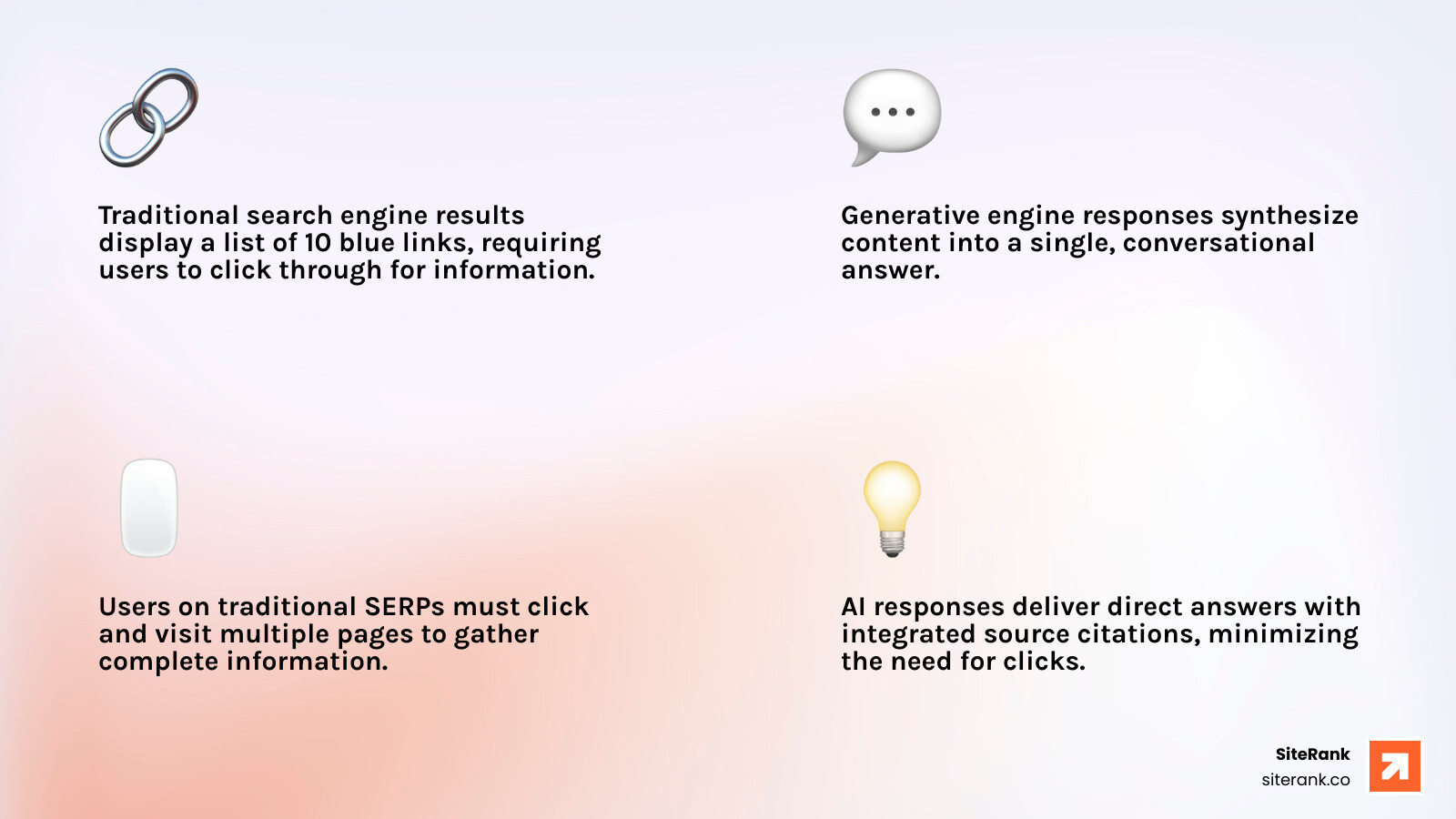
Unlike traditional search engines that provide a list of links, generative engines like Google’s AI Overviews, ChatGPT, and Perplexity read multiple sources and synthesize the information into a single, conversational answer. This can lead to “zero-click searches,” where the user gets their answer without visiting your website. The opportunity lies in being the brand cited in that AI response, building authority and trust at a massive scale.
The academic paper “GEO: Generative Engine Optimization” formally introduced this concept in 2023, documenting a fundamental shift in how people find information.

The Origin and Rationale Behind GEO
GEO emerged because users grew tired of sifting through search results to find answers. Researchers from Princeton University and other institutions observed that people preferred having conversations with AI to get complete, personalized answers without opening ten browser tabs.
Generative engines eliminate this friction by doing the synthesis work for you. This convenience is disrupting the $80 billion SEO industry, with the GEO sector projected to reach nearly $850 million this year. The goal is no longer just to “rank #1” but to “be the #1 cited source” in AI responses.
How Generative AI Engines Work
To optimize for generative engines, you must understand their process:
- Interpret Conversational Queries: AI understands full sentences and paragraphs, not just keywords. Queries average 23 words, seeking nuanced answers.
- Contextualize: The engine considers conversation history and user preferences to personalize responses.
- Synthesize Information: The AI searches and reads content from hundreds of sources (web pages, databases, forums) and combines the insights into a single, coherent narrative.
- Cite Sources: Most engines show where their information came from. These citations are your new form of visibility, building authority and driving high-intent traffic.
- Enable Interaction: Users spend an average of 6 minutes per session asking follow-up questions. Each interaction refines the AI’s understanding, making your initial citation even more valuable.
Understanding this process is the foundation of every effective GEO strategy we build at SiteRank.
SEO vs. GEO: Navigating the New Digital Frontier
For decades, SEO has been about climbing search rankings on Google or Bing. Generative Engine Optimization changes the game. Traditional SEO is like getting listed in a phone book; GEO is like having a trusted friend personally recommend you.
The core shift is where the conversation happens. SEO drives clicks to your website, measured by traffic and rankings. GEO gets your brand cited, mentioned, or recommended directly within AI responses, often without a click. This creates the “AI Dark Funnel”—an analytics blind spot where customer research happens outside of your view.
While SEO targets algorithms that index pages, GEO targets AI models that understand context and synthesize information. These models value factual accuracy, comprehensive coverage, and citation-worthiness over simple keyword density. As a result, metrics are evolving from rankings to share of AI voice, citation frequency, and attribution rate.
The good news is that GEO doesn’t replace SEO—it extends it. The foundational work of building authority, creating quality content, and ensuring technical soundness still matters enormously. In fact, many SEO Fundamentals form the bedrock of effective GEO strategies.
Why GEO is Crucial for Modern Marketers
If you’re not thinking about GEO, you’re already behind. The implications are profound:
- Untrackable User Journeys: Your audience is researching and making decisions in AI conversations you can’t see. Your analytics show nothing, yet customers appear ready to buy, and you don’t know how they got there.
- Referral Traffic Loss: AI Overviews and direct answers intercept clicks, meaning the traffic you worked to earn may never reach your site.
- Brand Narrative Control: GEO allows you to proactively feed AI systems authoritative and accurate information, guiding how your brand is presented.
- High-Intent Buyers: Users engaging with AI are often closer to conversion. When they do click through from an AI referral, they are typically more qualified leads.
Optimizing for GEO is about future-proofing your visibility. With 65% of organizations now using generative AI, this behavior is mainstream. Getting ahead of the curve establishes your authority before the space becomes saturated.
Understanding the “AI Dark Funnel”
The AI Dark Funnel is the analytics blind spot where the critical awareness and research stages of the buying journey now take place. Instead of clicking through search results, a customer asks ChatGPT or Perplexity a question like, “What’s the best SEO strategy for small e-commerce businesses?” The AI provides a comprehensive, synthesized answer, and the user’s entire research process may occur within that chat interface—no website visits, no trackable data.
As explained in “The ‘AI Dark Funnel’ Is Silently Killing Your Marketing ROI”, this blind spot can devastate marketing ROI by obscuring the top of your sales funnel.
However, you’re not powerless. Generative Engine Optimization provides strategies to influence these conversations. By creating authoritative, well-structured content, you increase the likelihood that AI platforms will cite and recommend you. The new playbook requires shifting focus from tracking every click to building a presence so strong that AI systems naturally gravitate toward your expertise. At SiteRank, we combine proven SEO with new GEO approaches to ensure our clients remain visible across all platforms.
Core Principles and Strategies for GEO
Effective Generative Engine Optimization is about earning the trust of AI models so they want to cite your content. This comes down to content structure, brand narrative, and technical soundness. If you’re already doing solid SEO, you’re halfway there. For more guidance, our 10 Content Optimization Tips for SEO offers a great foundation.

Structuring Content for AI Parsability
AI models need well-organized content to process information effectively.
- Use Clear Headings: H1, H2, and H3 tags act as a roadmap. Use question-based headers like “How does X improve Y?” to mirror user queries.
- Create Digestible Chunks: Bullet points and numbered lists perform exceptionally well, as AI can quickly scan and extract information. Adding FAQ sections can boost citation rates by up to 35%.
- Prioritize Accuracy: Back up every claim and statistic with a source. AI prioritizes trustworthy information, and studies show that adding statistics can increase AI visibility by 32.7%.
- Write Conversationally: Use natural language and short paragraphs. Answer questions directly in the first sentence or two before providing details.
- Implement Schema Markup: This structured data acts as a translator, helping AI understand the context and type of your content (e.g., FAQ, review).
Integrating GEO with Your Existing SEO Strategy
Generative Engine Optimization builds on your existing SEO efforts; it doesn’t replace them. Technical SEO fundamentals like fast load times and clean site architecture are crucial. If AI crawlers can’t easily access your site, they won’t cite it. Our On-Page SEO Optimization Techniques guide covers this essential groundwork.
Your keyword research must evolve to target long-tail, conversational queries that people ask AI. On-page optimization should focus less on keyword density and more on contextual depth and citation-worthiness.
E-E-A-T (Experience, Expertise, Authoritativeness, Trustworthiness) is critical. AI models prefer credible sources. Brands that rank highly for core industry topics often appear as top recommendations in AI assistants—this is E-E-A-T in action. Strengthening these signals for GEO improves traditional SEO, creating a win-win.
Common Mistakes to Avoid in Your Generative Engine Optimization Efforts
Learning from common pitfalls can save you months of trial and error.
- Skipping Structured Data: Schema markup is essential for helping AI understand your content. Don’t make AI work harder than it has to.
- Keyword Stuffing: This is still a bad practice. AI models are trained on natural language and can spot artificial text, which harms your authority.
- Neglecting Source Credibility: Content without proper citations or from questionable sources will be ignored by AI in favor of more authoritative alternatives.
- Using a Blanket Approach: Different AI platforms have different preferences. Tailor your strategy for ChatGPT, Perplexity, and Google AI Overviews.
- Failing to Monitor: GEO requires active tracking. Regularly test how your brand appears in AI responses to see if your efforts are working.
Measuring GEO Success: New Metrics for a New Era
Traditional SEO metrics like rankings and click-through rates don’t work for Generative Engine Optimization. When AI answers questions directly, valuable interactions like brand recommendations and research citations don’t appear in Google Analytics. We need new metrics that measure influence, not just traffic.

Key Performance Indicators (KPIs) for GEO
Instead of obsessing over rankings, track whether AI engines consider you authoritative enough to cite.
- Brand Mentions & Share of AI Voice: How often does your brand appear in AI responses for relevant topics compared to competitors?
- Generative Appearance Score: Measures the frequency and prominence of your mentions. Are you a passing reference or a featured recommendation?
- Attribution Rate: Tracks how often AI answers that use your content properly cite you as the source.
- Referral Traffic from AI: While clicks are fewer, referral visitors from AI platforms often have remarkably high intent and higher conversion rates.
- Sentiment Analysis: Understand how your brand is being mentioned. Is the context positive, negative, or neutral?
- Visibility for Target Prompts: Actively test how your content performs for key questions and prompts your audience might ask.
Tools for Monitoring GEO Performance
The GEO tool landscape is evolving rapidly.
- AI Search Graders: Emerging tools provide a snapshot of your generative search performance, analyzing visibility and content strength.
- Brand Monitoring Tools: Established SEO platforms are adapting, adding features to track brand mentions and perception in AI Overviews.
- Specialized GEO Platforms: A new category of tools is emerging, built specifically to analyze appearance in AI responses, track sentiment, and identify influential sources.
- Manual Testing: Don’t underestimate the power of querying ChatGPT, Perplexity, and Google AI Overviews yourself. Create a spreadsheet of important queries and check them weekly to document citations and brand portrayal.
At SiteRank, we combine automated monitoring with strategic manual testing to give our clients a complete picture of their AI visibility. While measuring GEO requires more effort, the businesses that invest in it now will dominate AI-driven search.
The Future of AI Search and GEO
Generative Engine Optimization is still a young discipline, but its direction is clear: AI is becoming the new search for millions. With 65% of organizations now using generative AI, the demand for effective GEO strategies and tools is exploding. What began as manual testing is maturing into a sophisticated practice. At SiteRank, we are constantly testing new approaches to keep our clients ahead of the curve. But today’s changes are just the beginning.
Future Trends in Generative Engine Optimization
The next wave of AI will reshape GEO even further.
- Agentic AI: AI will evolve from an information retriever to an action-taker, booking reservations or making purchases on a user’s behalf. GEO will need to optimize for facilitating these AI-driven transactions.
- Predictive Search: AI will anticipate user needs based on context and past behavior, suggesting information or products proactively. This requires creating content that is relevant to anticipated needs, not just explicit queries.
- Multimodal Search: Search is no longer just text. It includes images, video, and audio. All content formats must be optimized for AI understanding and citation.
- Ethical Considerations: As AI’s influence grows, questions of bias, misinformation, and attribution become critical. Effective GEO must align with responsible AI practices, focusing on providing genuinely helpful and accurate information.
- Technical Standards: New standards like llms.txt are emerging to help guide AI crawlers, similar to how
robots.txtworks for traditional search. While adoption is still developing, it signals the maturation of the field.
The future of search is something we are all actively shaping. The mindset of testing, learning, and adapting is what will lead to success.
Frequently Asked Questions about Generative Engine Optimization
What is the main difference between GEO and AEO (Answer Engine Optimization)?
Answer Engine Optimization (AEO) focuses on providing a single, direct answer to a specific question, like for a featured snippet. Generative Engine Optimization (GEO) is broader. It’s about optimizing your content to be synthesized by AI models that pull from multiple sources to create a comprehensive, narrative response.
In short, AEO is for winning a trivia question. GEO is for being the trusted expert an AI consults to write an entire article.
Can I use AI-generated content for my GEO strategy?
Yes, as long as the content is high-quality, accurate, and valuable. AI engines don’t penalize AI-generated content, but they do penalize low-quality content. Well-structured, fact-checked content created with AI assistance can be ideal for Generative Engine Optimization because it often has the clear headings and logical flow that AI models favor. Use AI as a powerful assistant, not a replacement for quality control.
How long does it take to see results from GEO?
Results can be quicker than with traditional SEO, often appearing within a few weeks to a couple of months. AI models constantly process new information, so well-optimized content can gain visibility fast. However, GEO is an ongoing strategy. You must continuously monitor your presence and refine your content to build long-term authority. At SiteRank, we find that clients who start early see faster initial wins and stronger long-term positioning.
Conclusion: Accept the Future of Search
The digital world moves fast, and generative AI represents one of the most significant shifts we’ve seen in how people find information online. Generative Engine Optimization isn’t a passing trend or optional add-on—it’s quickly becoming essential for businesses that want to stay visible where their customers are actually searching.
Throughout this guide, we’ve explored how AI is fundamentally changing the game. The “AI Dark Funnel” means potential customers are researching products and services in ways we can’t track with traditional analytics. Users are having deep, conversational interactions with AI that last an average of 6 minutes, compared to the seconds they spend on a traditional Google search. These aren’t just quick lookups—they’re meaningful research sessions where purchase decisions are being shaped.
But here’s what really matters: GEO and SEO work together, not against each other. Everything we’ve learned about creating quality content, building authority, and demonstrating expertise still applies. The technical foundations of good SEO—fast load times, mobile responsiveness, clear site structure—remain just as important. What’s changing is that we now need to structure this content so AI can easily understand, synthesize, and cite it. When we do this right, we win twice: ranking well in traditional search and getting recommended by AI.
Early adopters are already seeing the benefits. Companies optimizing for GEO now are seeing 3.2x more citations than competitors who haven’t adapted. They’re being mentioned when AI answers questions about their industry. They’re building authority in a space that’s still relatively open, before it becomes crowded and competitive.
At SiteRank, we’ve been working with generative AI since ChatGPT’s launch, testing strategies and refining approaches for our clients. Over my 15+ years in digital marketing, I’ve guided businesses through major search shifts before—from mobile-first indexing to voice search—and this transition to AI-powered search is perhaps the most exciting yet. The businesses that adapt now, rather than waiting to see what happens, will have a significant advantage.
The future of search is already here. It’s conversational, synthesized, and increasingly personalized. Users are asking AI for recommendations, comparisons, and advice—and AI is answering with specific brands and sources. The question isn’t whether your business should optimize for this new reality, but how quickly you can adapt.
Generative Engine Optimization gives you the playbook. By structuring content for AI parsability, building strong authority signals, and actively monitoring your presence in AI responses, you can ensure your brand isn’t just found—it’s recommended, cited, and trusted by the AI tools your customers rely on every day.
The digital marketing landscape will keep evolving, but the principles remain constant: provide genuine value, build real expertise, and meet your customers where they are. Today, that means showing up not just in search results, but in AI conversations.
Ready to make sure AI knows about your business? Let’s build a strategy that works for both traditional search and the AI-powered future.