

Why AI Search Engine Optimization Matters Now
AI search engine optimization is changing how content gets finded online. Here’s what you need to know:
Quick Answer: AI Search Engine Optimization in 2025
- E-E-A-T Signals – Demonstrate Experience, Expertise, Authoritativeness, and Trustworthiness
- Structured Data – Implement schema markup (FAQ, HowTo, Organization)
- Conversational Content – Answer natural language questions directly
- AI Crawler Access – Configure robots.txt for GPTBot, Claude-Web, and PerplexityBot
- Citation-Worthy Content – Create original research with statistics and real examples
The search landscape is experiencing its biggest change in decades. Over 700 million people use ChatGPT every week, and Google’s AI Mode has surpassed 100 million monthly active users. But here’s the challenge: 60% of Google searches in 2024 never left the search results page—users got their answers directly from AI-generated overviews without clicking through to websites.
This shift means traditional SEO tactics like keyword density and backlink counts are no longer enough. AI systems don’t just match keywords—they understand context, synthesize information from multiple sources, and generate comprehensive answers. Your content needs to be structured so AI can understand it, trust it, and cite it as a source.
The opportunity is real. Research shows that visitors who find your brand in an AI answer are 4.4 times more valuable than those from traditional search. Early adopters of AI optimization strategies see significantly more citations than competitors who stick to old-school SEO alone.
I’m Craig Flickinger, founder of SiteRank, and I’ve spent over 15 years helping businesses adapt to evolving search algorithms. My focus on ai search engine optimization has helped clients transition from traditional ranking strategies to being cited as authoritative sources across ChatGPT, Google AI Overviews, and other generative search platforms.
The Dawn of a New Search Era
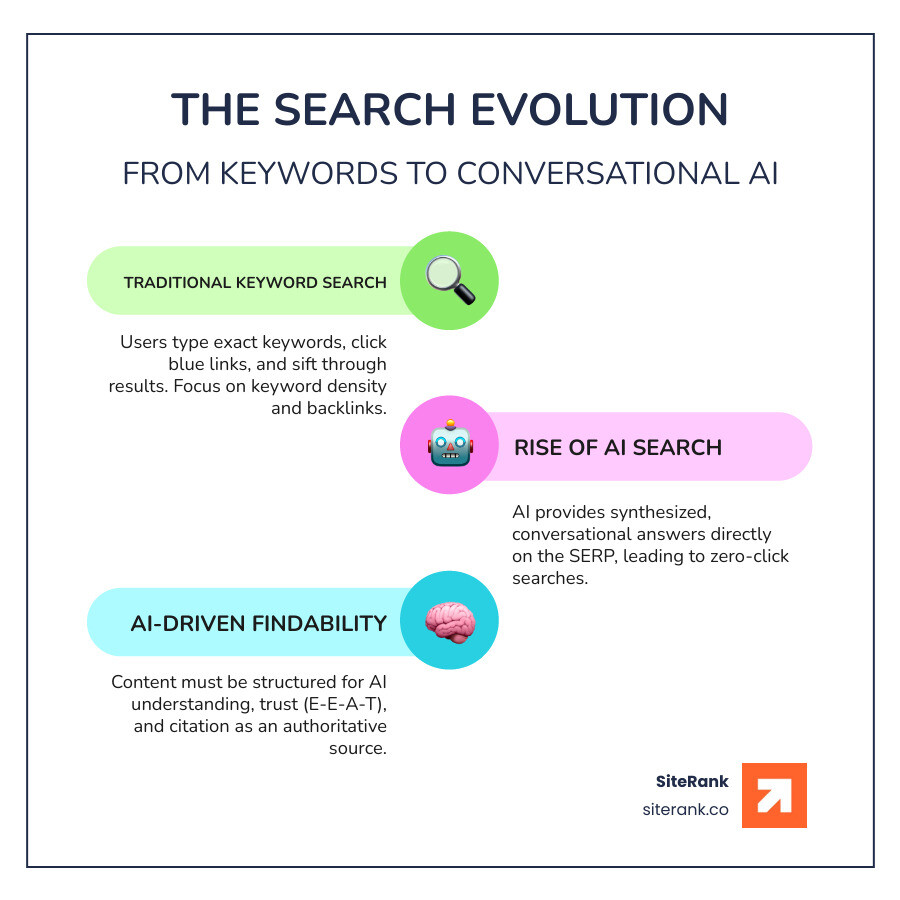
For decades, search has been defined by keywords and blue links. But that era is rapidly giving way to the dawn of a new search era, driven by artificial intelligence.
AI-powered search experiences like Google’s Search Generative Experience (SGE), Perplexity AI, and ChatGPT are reshaping information findy. Instead of just providing links, they deliver synthesized, conversational answers directly in the search results. This shift has given rise to new disciplines like Generative Engine Optimization (GEO) and Answer Engine Optimization (AEO).
The core idea is no longer just to rank content, but to ensure it is found, understood, and cited as a trusted source by AI tools. This is critical, as AI Overviews are expected to appear on 60% of search results pages by November 2025. This will increase “zero-click searches,” where users get answers without visiting a website.
The impact is profound. Gartner predicts traditional organic search traffic could decrease by over 50% as users adapt to AI-driven experiences. AI agents are evolving from information suggesters to decision-making assistants. At SiteRank, our mission is to prepare clients for this future, ensuring they understand the meaning of AI and remain visible as search evolves.
From Traditional SEO to AI-Driven Findy
Traditional SEO focused on ranking websites in search results using keywords, high-quality backlinks, and technical health to drive organic traffic.
While those elements remain important, the game has changed. With ai search engine optimization, the focus shifts to context, entities, and user intent. AI systems don’t just match keywords; they grasp the meaning behind a query and how different concepts connect. The goal is no longer just to rank, but to be understood and cited by AI.
The Core Differences Explained
The evolution from traditional to AI-driven SEO is clear when comparing their core components.
| Feature | Traditional SEO | AI-Driven SEO |
|---|---|---|
| Goal | Rank pages in SERPs for organic traffic | Be cited/featured in AI-generated answers |
| Focus | Keywords, backlinks, technical factors | Context, entities, user intent, E-E-A-T |
| Content Eval. | Keyword density, readability, link equity | Semantic understanding, factual accuracy, authority |
| User Output | List of blue links | Direct answers, summaries, conversational responses |
| Measurement | Rankings, organic traffic, CTR | AI visibility, citation rate, brand mentions |
| Tools | Keyword planners, backlink checkers | AI content analysis, LLM trackers, schema builders |
AI algorithms use Natural Language Processing (NLP) to understand context far beyond keyword matching. They recognize synonyms, related topics, and semantic relationships. This means we now craft content that AI can understand, trust, and cite in its generated answers.
AI’s analytical power can spot patterns in vast datasets, enabling precise content optimization. However, human specialists remain vital for strategy, creativity, and interpreting complex data. It’s a partnership where AI’s precision meets human expertise. To brush up on the basics, explore our guide on SEO Fundamentals.
Why User Intent is More Critical Than Ever
Understanding why a user is searching is essential in the AI era. AI engines are designed to provide the best answer to a user’s actual question, not just a list of pages with matching keywords. They excel at deciphering intent, whether it’s:
- Informational: Seeking knowledge (e.g., “how do bees make honey?”).
- Transactional: Looking to make a purchase (e.g., “best laptop deals under $1000”).
- Navigational: Trying to find a specific site (e.g., “Facebook login”).
As users adopt more conversational language, they ask detailed, long-tail questions like, “What’s the warmest jacket for Chicago winters under $300?” Your content must be structured to answer these specific, nuanced queries directly.
This requires a shift to semantic keyword integration. Instead of focusing on a single keyword, weave in related terms and phrases to provide richer context. This helps AI understand your content’s true subject matter. At SiteRank, we use advanced tools to analyze the real needs behind queries, ensuring our content is precisely targeted. To boost your content strategy, dive into our tips on keyword research for blog posts.
Crafting Content for AI: The E-E-A-T and Authority Blueprint

In ai search engine optimization, trust is paramount. AI systems prioritize trustworthy content, and that trust is measured by E-E-A-T: Experience, Expertise, Authoritativeness, and Trustworthiness.
These are not just buzzwords; they are the signals AI uses to determine if your content is a reliable source worthy of citation. While Google’s E-E-A-T guidelines have existed for years, AI has amplified their importance. AI actively seeks cues like clear authorship, cited sources, and structured data to verify credibility.
Building genuine authority is the foundation of mastering content for SEO. AI prioritizes first-party data—original research, personal experiences, and customer reviews—because it is unique and valuable. For “Your Money Your Life” (YMYL) topics like finance or healthcare, the standard is even higher, requiring content from certified experts.
Demonstrating Experience and Expertise
To prove your expertise to AI, make your credentials visible and verifiable. Detailed author bios should communicate qualifications and professional experience, with links to relevant profiles or publications. AI can follow these links to verify authority.
Beyond credentials, writing from first-hand experience is a powerful differentiator. Personal anecdotes and real-world examples provide unique context that AI values. Creating case studies and publishing original research with verifiable data creates citation-worthy content that establishes you as a thought leader. Consistently publishing high-quality, insightful content reinforces your expertise over time.
Building Authority and Trustworthiness
Authority and trustworthiness extend beyond a single article to your entire brand’s online reputation.
- High-quality backlinks from reputable sites act as votes of confidence that AI systems recognize. Our guide on creating backlinks for SEO can help you build a strong backlink profile.
- Brand mentions, even without links, contribute to entity recognition, establishing your brand as a legitimate industry player.
- Customer testimonials and reviews offer social proof and valuable first-party data that AI uses to assess trustworthiness.
- Factual accuracy is non-negotiable. AI cross-references information, and any errors will damage your credibility. Always fact-check and cite credible sources.
Consistently demonstrating E-E-A-T builds a foundation of trust, making your content a go-to source for AI-generated answers.
Technical and On-Page AI Search Engine Optimization

Authoritative content is useless if AI can’t find or understand it. The technical foundation of your website is crucial for ai search engine optimization, acting as a bridge between your expertise and the AI systems that want to share it. Optimizing for featured snippets and long-tail keywords is key, as these are often direct sources for AI Overviews. Our approach to on-page SEO optimization techniques has evolved for these new demands.
The Crucial Role of Structured Data in AI Search Engine Optimization
Structured data (schema markup) provides a universal language that helps AI understand your content’s context. Without it, AI has to guess; with it, your content’s meaning is explicit and unambiguous.
We implement structured data using JSON-LD, focusing on high-value schema types for AI search like FAQPage, HowTo, Person, and Organization to support E-E-A-T signals. Other types like Article, Product, and Review provide additional rich context. You can explore the full vocabulary at Schema.org and validate your implementation with tools like validator.schema.org. For a deeper understanding, check out our guide on what is schema markup.
Optimizing Content Structure for Snippets and Voice Search
Best practices for AI often improve the user experience. AI prioritizes clear, concise, and easily digestible content—just like human readers. The rise of conversational voice search means content must be structured to answer natural language questions directly.
- Clarity and Simplicity: Use short paragraphs, bullet points, and numbered lists to break down complex information.
- Conversational Language: Optimize for natural language queries by incorporating phrases people speak aloud.
- Direct Answers: Structure content with headings that ask user questions, followed immediately by a concise answer. This “fragment-friendly” format is ideal for featured snippets and AI Overviews.
By prioritizing these structural elements, you dramatically increase the chances of your content being cited. For more strategies, explore our 10 content optimization tips for SEO.
Key Technical Factors for AI Crawlers
Technical issues can block AI crawlers from accessing your content. Ensure your site is optimized for:
- Site Speed: Fast load times (ideally under 3 seconds) are critical. Use tools like Google’s PageSpeed Insights to identify bottlenecks.
- Mobile-First Indexing: A seamless mobile experience is non-negotiable, as most searches and AI crawls originate from mobile environments.
- URL Structure and Sitemaps: Use logical, descriptive URLs and maintain an up-to-date XML sitemap to guide crawlers.
- Robots.txt: Explicitly allow access for AI crawlers like GPTBot, Google-Extended, Claude-Web, and PerplexityBot. Check firewall settings to prevent accidental blocks.
- Semantic HTML: Use HTML5 tags (
<article>,<main>, etc.) to define the purpose of different content blocks. - Content Accessibility: Remove intrusive pop-ups or other barriers that hide your main content from crawlers.
A regular free SEO audit can identify and address these critical factors, ensuring your site is optimized for all forms of search.
The Future of Search: Adapting Your Strategy for 2025 and Beyond
The search landscape is undergoing a fundamental shift, with 2025 marking a pivotal moment. AI agents are becoming active decision-makers, changing the game for ai search engine optimization. Gartner predicts traditional search volume could drop by 25% by 2026. SEO isn’t dying; it’s evolving. The focus is shifting to “Relevance Engineering”—understanding how AI systems retrieve and present information.
Navigating the New AI Search Experience
Google’s AI-powered overviews, appearing in 60% of search results by November 2025, are the new reality. Users now see AI-generated summaries with embedded citations at the top of the page, increasing zero-click searches.
This creates a new opportunity. AI overviews cite multiple sources, many of which don’t rank on the first page of traditional results. The goal is to be citation-worthy by creating content that AI trusts enough to reference. At SiteRank, we focus on crafting clear, factual, and easily extractable statements that AI can confidently cite. We also contribute to community platforms like Reddit and Quora, which AI models frequently use as sources.
Early adoption is key. Once your content becomes a primary AI source, it tends to be reinforced over time. This makes implementing ai search engine optimization strategies now more valuable than ever.
Measuring Success in the New Era of AI Search Engine Optimization
Traditional metrics like traffic and rankings no longer tell the whole story. Success in AI search requires new measurements:
- AI Visibility Tracking: We monitor how often brands appear in AI-generated answers across platforms like Google AI Overviews, ChatGPT, and Perplexity AI, analyzing the context and authority of each mention.
- Featured Snippet Performance: Snippets are often the foundation for AI citations, so tracking their performance is crucial.
- Brand Mentions in AI Responses: When AI names your company as a source, it’s a powerful authority signal and the new currency of search visibility.
- Authority Metrics over Traffic Volume: Being cited as a definitive source in an AI answer that reaches millions is more valuable than high-volume, low-engagement traffic.
- User Engagement Signals: We track clicks, dwell time, and return visits from AI-driven contexts to measure genuine usefulness.
The goal remains the same: become the trusted resource for answers. We just track that trust through new channels and metrics that reflect how search works in 2025.
Frequently Asked Questions about AI SEO
Here are answers to the most common questions about this new approach to search optimization.
What are the core differences between traditional SEO and AI SEO?
Traditional SEO focuses on ranking pages for keywords to earn clicks from a list of blue links. The primary goal is driving organic traffic.
AI search engine optimization focuses on getting your content cited as a trusted source within AI-generated answers. The goal is to become the reference material for platforms like ChatGPT and Google AI Overviews. This requires a shift from keyword density to context and semantic understanding. E-E-A-T (Experience, Expertise, Authoritativeness, Trustworthiness) and structured data become critical for proving your content’s reliability to AI systems.
Can AI replace human SEO specialists?
No, AI cannot replace human SEO specialists. AI is a powerful tool for automating tasks like data analysis, keyword research, and technical audits. It acts as an incredibly efficient assistant.
However, AI lacks the strategic thinking, creativity, and nuanced problem-solving skills of a human expert. A human specialist is required to interpret data, develop overarching strategy, understand market context, and make ethical judgments. At SiteRank, we view AI as a collaborator that augments our expertise, freeing us to focus on the high-level strategy that drives results.
How do I start optimizing for AI search?
Getting started with AI SEO doesn’t require a complete overhaul. Focus on these foundational steps:
- Prioritize Content Quality and E-E-A-T: This is the most important step. Create content that demonstrates genuine, first-hand expertise. Use clear author bios, cite credible sources, and share original research or case studies.
- Implement Technical Basics: Add structured data (schema markup) to your site. Start with relevant types like FAQ, HowTo, Person, and Organization to give AI a clear map of your content.
- Structure Content for Clarity: Write in short paragraphs and use conversational language. Use headings to ask common user questions and answer them directly and concisely. Use lists and tables to make information easy for AI to extract.
These practices improve the experience for both AI crawlers and human readers, creating a win-win for your ai search engine optimization efforts.
Conclusion: Accept the AI Revolution in Search
The shift from keyword searches to conversational, AI-powered answers is redefining online visibility. This evolution isn’t replacing SEO; it’s creating new opportunities for brands that are ready to adapt.
AI search engine optimization is about preparing your content to be a trusted source for AI guides. A successful strategy combines strong technical foundations with authoritative, helpful content. By demonstrating E-E-A-T, using structured data, and answering questions clearly, you position your brand to be cited by AI systems, building authority and trust.
At SiteRank, we combine deep SEO experience with cutting-edge AI optimization. We understand how AI interprets information and help businesses turn this technological shift into measurable results. Early adopters are already seeing the benefits of higher engagement from users who find them through AI answers.
The future of search is here. Ready to ensure your content thrives in this new landscape? Explore our advanced SEO Services and let’s build a strategy that puts you at the forefront of the AI revolution.