

Why Every Contractor Needs a Location Page SEO Strategy That Actually Works
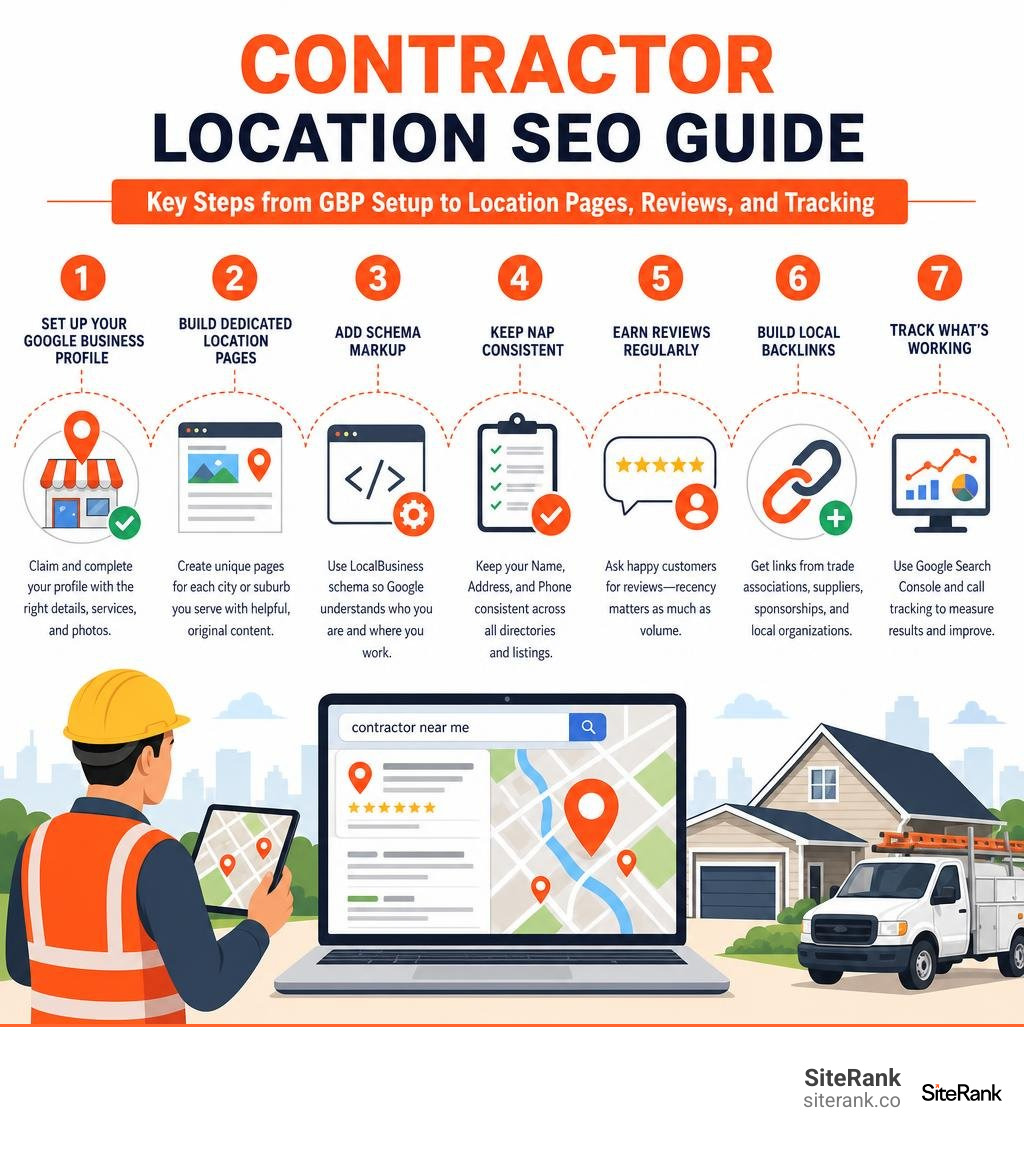
This contractor location SEO guide covers exactly how to build location pages that rank on Google and bring in real local leads. Here’s the short version:
- Claim and complete your Google Business Profile with the right trade category, service areas, and photos
- Build dedicated location pages for each city or suburb you serve — with unique content, not copy-paste text
- Add LocalBusiness schema markup to every location page so Google understands who you are and where you work
- Keep your NAP consistent (Name, Address, Phone) across every directory and listing
- Earn reviews regularly — recency matters as much as volume
- Build local backlinks from trade associations, suppliers, and community sponsorships
- Track what’s working using Google Search Console and call tracking tools
Most contractors do great work. But when a homeowner nearby searches “roofing contractor near me” or “kitchen remodeler in [city],” a competitor shows up first — and gets the call. You get silence.
That gap isn’t about the quality of your work. It’s about visibility.
With nearly 2.9 million nonemployer construction businesses competing for local jobs across the U.S. (U.S. Census Bureau, 2022), showing up in local search results isn’t a nice-to-have. It’s how you stay in business.
The problem most contractors run into is this: they build a website, maybe claim a Google profile, and then wait. But local SEO — especially for service-area businesses that travel to customers — requires a specific, ongoing strategy built around location pages, reviews, and consistent signals across the web.
This guide walks you through all of it, step by step.
I’m Craig Flickinger, founder of SiteRank.co, and over 15 years of hands-on SEO work I’ve helped businesses across competitive local markets turn weak online presences into steady lead engines — exactly the kind of results this contractor location SEO guide is designed to deliver. Let’s get into the framework that actually moves the needle.
Contractor location SEO guide terms simplified:
Understanding Local Search Factors: The Core of Any Contractor Location SEO Guide
When homeowners in your area face a burst pipe, a leaking roof, or a desired kitchen remodel, they do not flip through paper phone books. They pull out their smartphones. In fact, over 70% of Google searches originate on mobile devices, and a staggering 78% of local mobile searches result in an offline purchase or contract.
To capture these high-intent prospects, we need to understand how Google evaluates local service providers. Google relies on three primary pillars to determine local search rankings: Relevance, Distance, and Prominence.
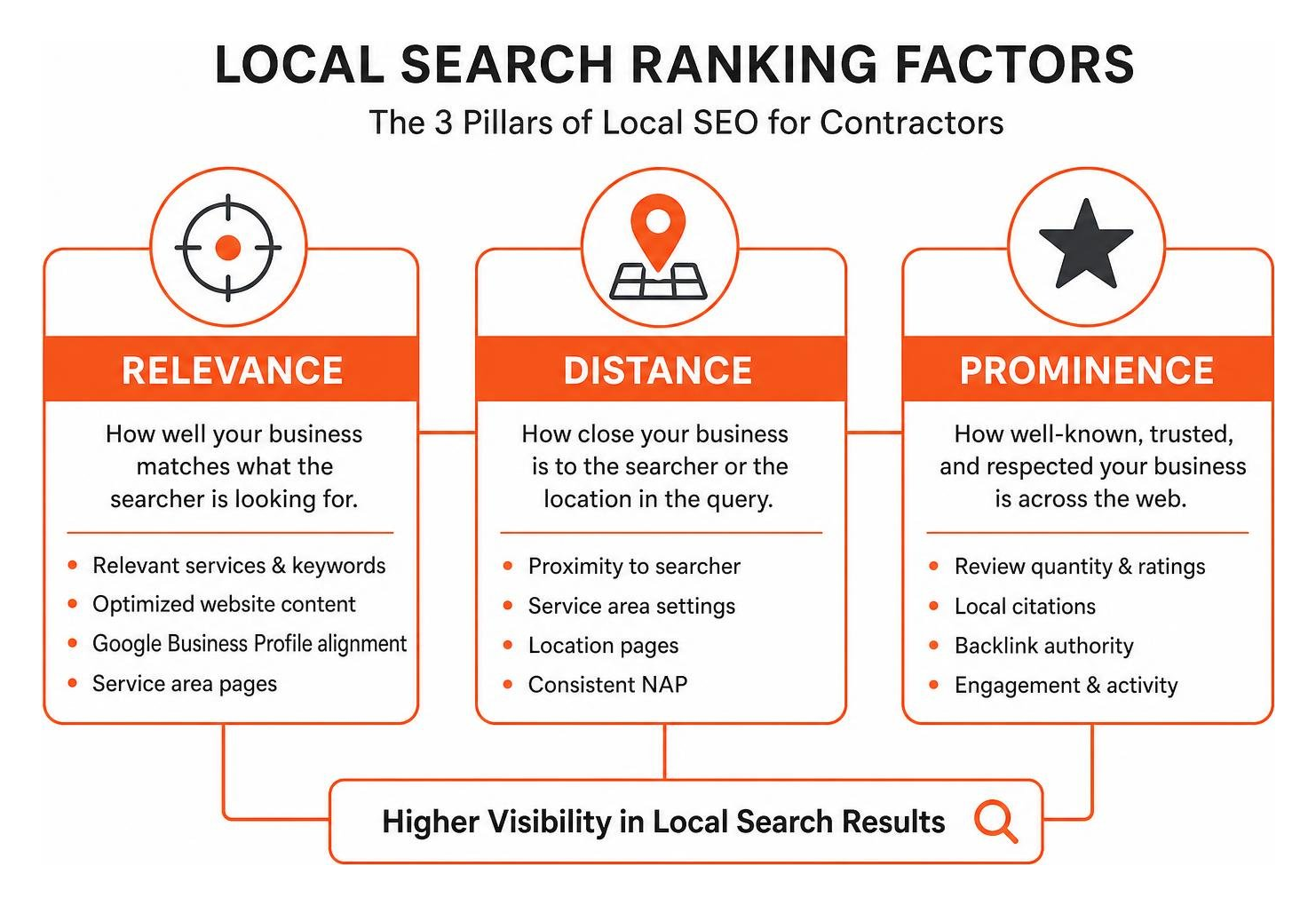
- Relevance: How closely your business profile and website content match what the homeowner searched for. If someone searches “emergency drain cleaning,” Google checks if your pages explicitly highlight drain cleaning services.
- Distance: How close your business is geographically to the user or the location specified in their query. While distance is mostly fixed based on where the search occurs, proper service area configuration helps optimize your geographic reach.
- Prominence: How well-known, trusted, and respected your business is across the web. Google measures prominence through review counts, star ratings, local citations, backlink authority, and active engagement.
If you want to dive deeper into structuring your overall operational footprint, check out our guide on How to Map Out Your Home Service Location Strategy Without Losing Your Mind.
Key Local Ranking Signals in a Contractor Location SEO Guide
Google uses distinct algorithms to power two separate organic search areas: the Local 3-Pack (the map block at the top of local search engine results pages) and traditional Organic Search Results (the traditional website listings below the map).
According to recent 2026 industry benchmarking data:
- Google Business Profile (GBP) Signals represent roughly 32% of the ranking weight in the Local Map Pack.
- Review Signals (volume, rating, velocity, and recency) contribute 20% of Map Pack ranking power.
- On-Page SEO Signals (keyword usage, site structure, and localized content) drive 15% of Map Pack rankings and form the foundation for standard organic blue links.
Homeowners search with varying intent. A transactional query like “roof replacement cost in Dallas” requires a clear service landing page with pricing estimates and scheduling tools. Conversely, an urgent query like “24/7 electrician near me” requires prominent phone numbers and immediate service verification.
Overcoming Geographic Constraints for Service Area Businesses
Unlike retail stores or coffee shops, contractors are Service Area Businesses (SABs). You do not expect clients to visit your shop or residential home office; your technicians drive out to the customer’s address.
This creates a unique SEO challenge: How do you rank in surrounding towns where you do not maintain a physical storefront?
- Hide Your Residential Address on GBP: If you operate from a home office or workshop without public storefront hours, set your Google Business Profile as an SAB to conceal your street address while highlighting designated service areas.
- Set Specific Service Boundaries: Google permits up to 20 service areas per profile (specified by city, zip code, or county). Keep these zones realistic—generally within a 2-hour driving radius from your base of operations.
- Build Geo-Targeted Website Landing Pages: Since your GBP address is fixed, your website’s location pages serve as your primary tool to capture search traffic in adjacent suburbs and neighboring municipalities.
Architecting Suburb and City Location Pages Without Duplicate Content
The biggest mistake contractors make when expanding into surrounding markets is creating duplicate “cookie-cutter” landing pages. Copying identical text across 15 suburban landing pages and simply swapping out the city name triggers search engine filters for thin, low-quality content.
To build city pages that consistently rank on page one, every location page must provide genuine, hyper-local value. Research shows that pages featuring more than 300 words of geo-specific content rank 2 to 3 positions higher than thin pages.
For a complete step-by-step framework on building these assets, refer to The Ultimate Blueprint for Home Services Geo Pages.
Local Case Studies and Geotagged Project Photos
The most direct way to prove local authority to both Google and potential clients is by documenting actual work performed in that specific community.

To turn a standard service page into a high-ranking local asset, include:
- Real Jobsite Photos: Upload authentic images of your crew working on site, complete before-and-after transformations, and local home styles typical of that city.
- Neighborhood Context: Reference specific local developments, municipal building code requirements, common architectural styles (e.g., historic Victorian roofs vs. modern suburban builds), or climate factors (such as coastal humidity or freeze-thaw cycles).
- Localized Client Proof: Display testimonials and verified reviews from homeowners residing in that specific suburb or neighborhood.
Structuring Multi-Location Expansion
When managing a contractor website targeting multiple cities, clear URL hierarchy and site architecture are essential. We recommend adopting a logical, clean folder structure:
/locations/city-name/
/locations/city-name/service-name/
For instance, a general contractor serving the greater Austin area might structure their pages as:
/locations/round-rock/(City Overview Page)/locations/round-rock/kitchen-remodeling/(Service + City Page)
If you are expanding across regional borders or managing multiple crews, read our guide on Wiring for Growth with a Multi-Location Strategy.
On-Page and Technical SEO Elements for Service Area Landing Pages
Having great content isn’t enough if your technical web foundation is slow or broken. Google prioritizes sites that load quickly and deliver exceptional user experiences, measured through Core Web Vitals.
Key performance thresholds for 2026 include:
- Largest Contentful Paint (LCP): Main page content must load in 2.5 seconds or faster.
- Interaction to Next Paint (INP): Visual feedback from user clicks or taps must occur in under 200 milliseconds.
- Cumulative Layout Shift (CLS): Visual page stability score must stay below 0.1.
For a detailed breakdown of structuring high-converting local landing pages, explore Local SEO Landing Pages: The Secret Sauce for Local Dominance.
Implementing LocalBusiness Schema: Essential Step in Your Contractor Location SEO Guide
Structured data (schema markup) acts as a direct translator for search engines. By embedding LocalBusiness schema (or trade-specific schema types like GeneralContractor, RoofingContractor, Plumber, or HVACBusiness) into your page code, you tell search engines exactly what services you offer and where you provide them.
Pages featuring properly formatted local schema show up to 25% higher visibility in rich search results. Yet, studies indicate that only 30% to 40% of contractors implement schema correctly, presenting an immense competitive advantage for your business.
Internal Linking and Google Maps Embedding
Smart internal linking guides visitors smoothly through your booking funnel while helping search engines distribute page authority across your site.
- Descriptive Anchor Text: Avoid generic phrases like “click here.” Instead, use targeted anchor text such as “view our Dallas roof replacement services.”
- Embedded Google Maps: Embed a customized Google Map on your contact and location pages to reinforce physical location signals.
- Conversion-Focused CTAs: Position sticky “Click-to-Call” buttons and simple instant estimate forms above the fold on mobile views to maximize lead conversions.
Optimizing Google Business Profile and Harnessing the Local 3-Pack
The Google Local 3-Pack is the ultimate prize in local contractor SEO. Securing one of these top three map spots puts your phone number and star rating directly in front of homeowners at the exact moment they need your services.
To learn how to rank your business without getting overwhelmed by technical jargon, check out How to Rank Your General Contractor Business Without Losing Your Mind. You can also review Google’s official guidance in the Google Business Profile help documentation.
Category Selection and Services Alignment
Selecting the correct Primary Category on your Google Business Profile is the single most influential individual ranking factor for map searches.
- Be Specific: If your primary revenue comes from roofing, select “Roofing Contractor” as your primary category rather than a broad label like “General Contractor” or “Construction Company.”
- Utilize Additional Categories: Add up to 4 relevant secondary categories (e.g., “Gutter Cleaning Service”, “Waterproofing Contractor”) to expand map coverage. Data shows profiles using additional categories achieve optimal map ranking distributions.
- Detail Your Services List: Fill out every service entry in your GBP dashboard, adding keyword-rich descriptions up to 300 characters. In recent Google algorithm updates, the services list signal jumped 75 positions in ranking weight.
Google Posts and Ongoing GBP Activity
Google favors active, updated profiles. Publishing regular Google Posts keeps your profile fresh and builds dual-relevance signals between your Google listing and website landing pages.
| GBP Post Type | Key Focus & Media | Call-to-Action (CTA) | Target Conversion Impact |
|---|---|---|---|
| Project Showcase | High-res jobsite photo + 150 words on a completed local job | “Learn More” (Link to City Page) | High conversion from research-phase buyers |
| Special Offer / Promotion | Seasonal discount image + clear expiration dates | “Book Online” | Immediate conversion for price-sensitive searchers |
| Emergency Service Announcement | Urgent repair messaging + availability hours | “Call Now” | High-volume immediate call generation |
| Educational / FAQ Tip | Problem-solution graphic explaining a common home repair | “Read More” (Link to Blog) | Top-of-funnel trust building |
Building Local Prominence: Citations, Reviews, and Authority Backlinks
Prominence reflects your brand’s authority and reputation across the web. A contractor with 250 positive reviews and strong local links will consistently outrank a competitor with a neglected profile and zero backlinks.
Review Velocity and Automated Reputation Workflows
Over 97% of consumers read online reviews before hiring a local service provider, and 72% specifically use Google reviews as their primary decision factor. However, volume alone isn’t enough-74% of consumers look specifically for reviews written within the last 3 months.
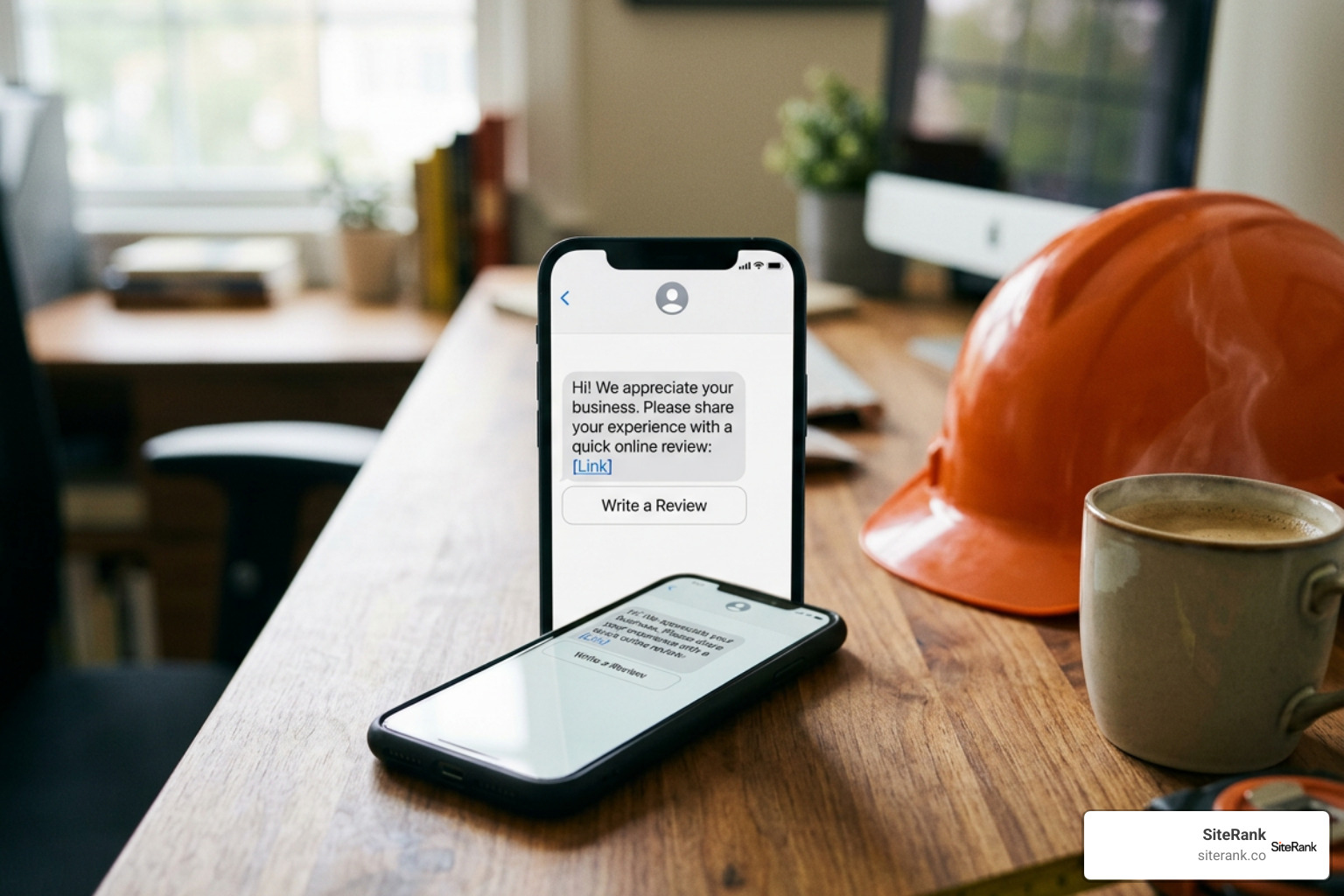
To maintain a steady review velocity (the consistency with which new reviews are published):
- Automate SMS Requests: Send automated text messages with a direct Google review link within 2 to 4 hours of job completion while client satisfaction is highest.
- Respond to Every Review: Respond to 100% of reviews-both positive and negative-within 48 hours. Personalized responses referencing the specific service rendered (e.g., “Thanks John, glad our team could fix your tile roof in Plano!”) naturally reinforce relevant local keywords.
- Avoid Buying Fake Reviews: Google aggressively penalizes accounts with artificial or paid reviews, which can result in listing suspensions. Review requests should also align with Google’s Maps user-generated content policy.
Directory Citations and Local Link Outreach
A citation is any online mention of your business Name, Address, and Phone number (NAP). Ensuring 100% NAP consistency across local directories, trade portals, and social channels establishes trust with search algorithms.
To build local authority beyond basic directory citations, contractors should aim for 30 to 50 quality backlinks. High-leverage local link strategies include:
- Supplier & Manufacturer Directories: Get listed as an authorized installer or certified dealer on your material suppliers’ official websites.
- Local Chamber of Commerce: Join regional business associations to secure high-authority
.orgor local commercial backlinks. - Community Sponsorships: Sponsor local youth sports teams, charity events, or community centers in exchange for linked logo placements on their sponsor pages.
Adapting to AI Search, Tracking Leads, and Maintaining Local Rankings
Search is evolving rapidly. AI-driven platforms like Google AI Overviews, ChatGPT, Perplexity, and Gemini are transforming how homeowners discover home service professionals.
For a broader foundation on how Google evaluates web content for search visibility, review the official Google Search Central documentation.
Optimizing Content for AI Engine Answer Snippets
AI search engines pull data directly from Google Business Profiles, structured schema markup, and concise web content to deliver direct recommendations.
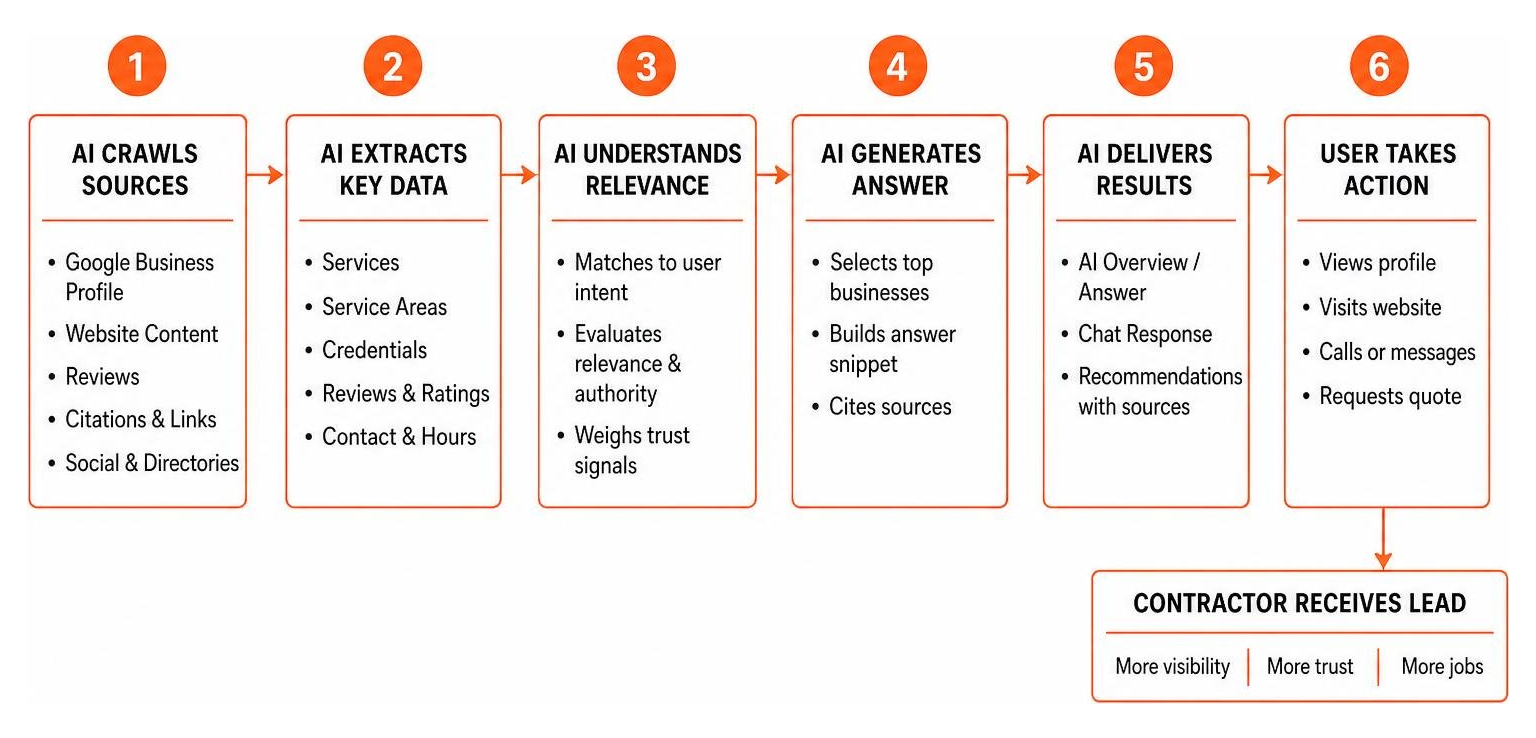
To ensure AI engines cite and recommend your contracting business:
- Provide Clear Direct Answers: Place concise 1 to 2 sentence direct summaries at the beginning of content sections and FAQ blocks.
- Implement FAQ Schema: Format key service questions and answers using structured
FAQPagemarkup. - Maintain Cross-Platform Consistency: Ensure your operational details, licensing, and trade credentials match perfectly across Google, Yelp, Houzz, Angi, and your official website.
Measuring Local SEO Success and Preventing Performance Decay
SEO is an ongoing business process rather than a static, one-time task. To accurately evaluate your return on investment, track metrics that connect directly to signed contracts and revenue:
- Organic Phone Calls: Use dynamic call tracking numbers to separate website and map pack leads from direct referrals.
- Form Submissions & Quote Requests: Track completed estimate requests in Google Analytics.
- Geo-Grid Map Rankings: Utilize local rank tracking software to visualize your Map Pack rankings across individual neighborhood coordinates.
To better understand budgeting and resource allocation, check out The Real Cost of Contractor SEO Optimization.
Frequently Asked Questions About Contractor Location SEO
Can contractors rank in cities where they do not have a physical office?
Yes! Service Area Businesses can rank in cities where they lack physical storefronts by creating dedicated, high-quality city location pages. These pages must feature authentic project photos, localized customer reviews, trade-specific schema markup, and unique jobsite case studies from those specific areas.
How many reviews do contractors need to appear in the Local 3-Pack?
While there is no fixed magic number, top-performing contractors in competitive markets typically maintain 50+ total reviews with an average star rating of 4.5 or higher. More importantly, search engines prioritize review recency and velocity—earning 4 to 10 new genuine reviews per month carries significantly more algorithmic weight than having a stale block of older reviews.
What is the most common local SEO mistake contractors make?
The most frequent mistake is treating local SEO as a one-time technical project rather than an ongoing operational routine. Neglecting your Google Business Profile, letting review collection fall by the wayside, publishing thin duplicate location pages, or allowing inconsistent NAP information across online directories will quickly erode your local rankings.
Conclusion
Building location pages that rank isn’t about gaming the system or pasting the same text across dozens of suburban pages. It’s about demonstrating real local proof, maintaining complete consistency across the web, and serving search engines and homeowners the precise information they need.
By combining an optimized Google Business Profile, fast mobile-friendly landing pages, trade-specific schema markup, and a steady review collection process, your contracting business can establish dominant local visibility that generates qualified leads for years to come.
At SiteRank, we specialize in helping home service contractors scale their digital footprints through custom, data-driven organic strategies. Explore our specialized Home Services SEO solutions today to discover how we can help you outrank competitors and book more jobs.