

What is a Local Landing Page and When Do You Need One?
A local SEO landing page (often called a location page or city page) is a dedicated web page designed to target searchers in a specific geographic area. Unlike a general homepage, its sole purpose is to connect a specific service with a specific location, satisfying both search engine crawlers and users with immediate local intent.
When search engines like Google detect local intent—such as “emergency plumber” or “landscaping near me”—they bias search results toward the searcher’s physical location. If your website only has a single, generic page trying to cover ten different cities, search engines struggle to understand your geographic relevance for each individual town. A dedicated local landing page acts as your digital storefront for that specific community.
To understand where these pages fit in your digital marketing strategy, let’s look at how they differ from standard service pages:
| Feature | Standard Service Page | Local Landing Page |
|---|---|---|
| Primary Target | Broad service details (e.g., “Water Heater Repair”) | Specific service + location (e.g., “Water Heater Repair in Phoenix”) |
| Search Intent | Informational or general transactional | Immediate geographic and transactional intent |
| Content Focus | Features, technical specs, pricing, and process | Local proof, service area boundaries, regional reviews, and local contact info |
| GBP Integration | Rarely linked to a Google Business Profile | Often used as the primary landing page link for a specific GBP listing |
| Conversion Rate | Moderate (7% on average for non-local searches) | High (18% of local smartphone searches lead to a purchase within 24 hours) |
Local Landing Pages vs. Standard Service Pages
While standard service pages explain what you do, local landing pages explain where you do it and prove that you are a trusted local authority.
When we design standard service pages, we focus on service intent—the technical details of the work, the equipment used, and the general benefits. However, when users land on a local landing page, they already know what service they need. Their primary questions are: Do you work in my area? Are you trusted by my neighbors? How fast can you get here?
For a deeper dive into how this fits into your overall local strategy, take a look at The Ultimate Guide to Local SEO for Home Services. Local landing pages bridge the gap between service expertise and geographic proximity, offering a tailored user experience that standard service pages simply cannot match.
When to Build Dedicated Local SEO Landing Pages
We are often asked: “Should we build a page for every single town in our state?”
The short answer is no. Creating pages for areas you do not genuinely serve is a quick way to get penalized by search engines. However, you should absolutely build dedicated local SEO landing pages under the following scenarios:
- Multi-Location Brands: If you have physical offices, clinics, or storefronts in multiple cities, each location requires its own dedicated page.
- Service Area Businesses (SABs): If you operate without a physical storefront but travel to customers (like plumbers, electricians, or roofers), you should create pages for your primary, high-value service areas.
- Strategic Location Expansion: If you are actively expanding your business into a neighboring market and want to establish organic search footprint before opening a physical office.
- High Search Volume Hubs: When your keyword research shows significant search volume for “[service] + [city]” in specific municipalities. Even targeting niches with 50–100 monthly searches can yield highly profitable leads.
If you want to read more about how to structure these pages for maximum visibility, check out this comprehensive Local Landing Page SEO Guide: Create Better Location Pages.
Anatomy of High-Performing Local SEO Landing Pages
Many businesses treat local landing pages as an afterthought, throwing up a block of text and a contact form. But because many users land directly on these pages from organic search results without ever visiting your homepage, your local landing pages must serve as credibility powerhouses.
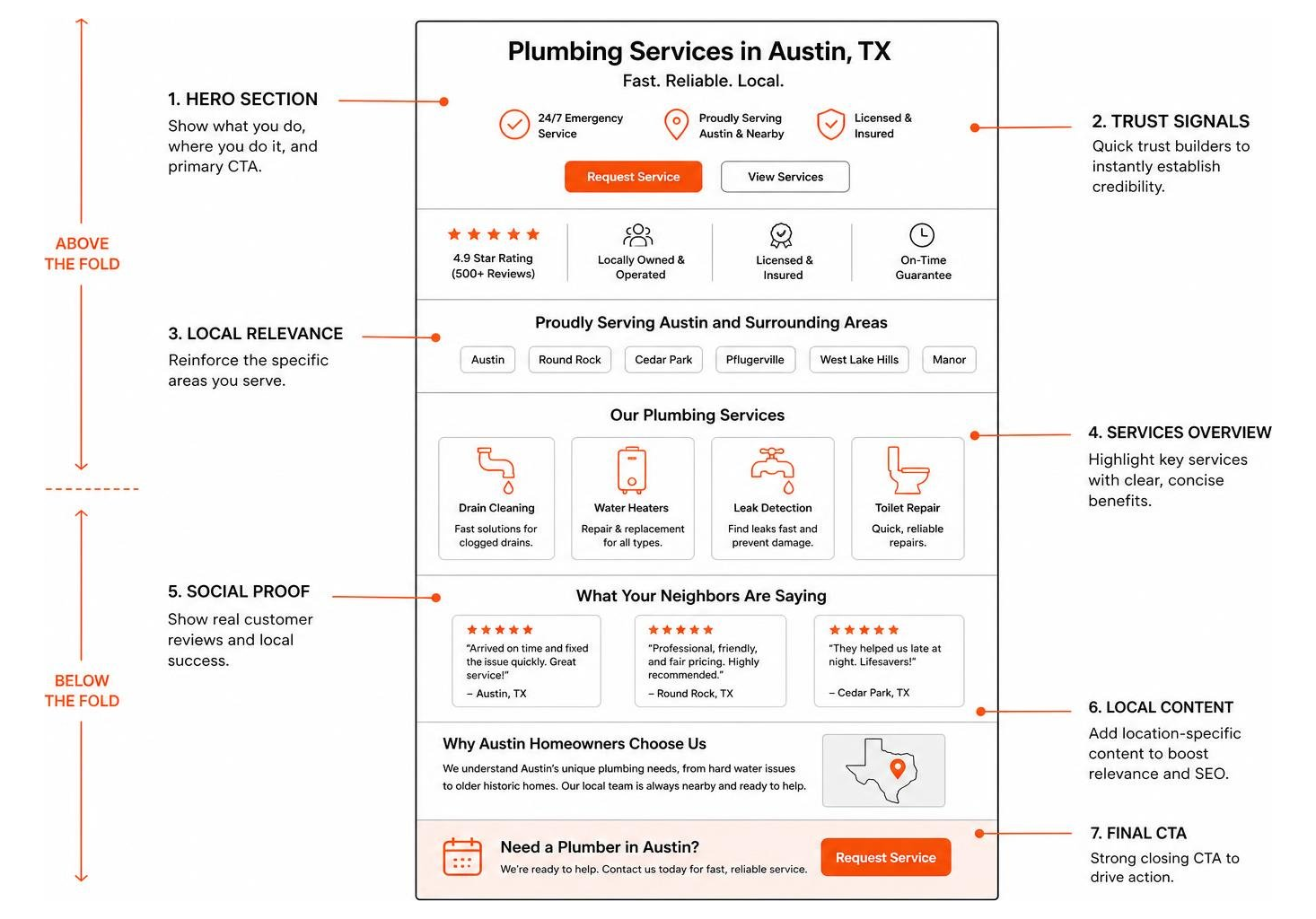
To convert high-intent local searchers, your pages must be optimized both above and below the fold. Let’s break down the essential elements that turn local traffic into paying customers.
Essential On-Page Elements for Conversions
When a user lands on your page, they should immediately see three things above the fold: what you do, where you do it, and how to contact you.
- Conversion-Optimized Hero Section: Lead with a strong heading that combines your primary service keyword and the location (e.g., “Trusted HVAC Repair in Denver”).
- Tap-to-Call Buttons: Over 70% of local searches happen on mobile devices. A prominent, thumb-friendly tap-to-call button is non-negotiable.
- Clear NAP & Hours: Display your Business Name, Address, Phone Number (NAP), and operating hours clearly.
- Interactive Maps: Embed an interactive Google Map showing your physical office location or highlighting your service area boundary. This visually reassures the user that they are in your service zone.
To see how these conversion elements work in action for home service providers, read our guide on Home Service SEO.
Leveraging Reviews, Social Proof, and Local Backlinks
Trust is the currency of local search. Users want to know that their neighbors trust you before they invite you into their homes or offices.
- Third-Party Reviews: Showcase aggregated reviews from platforms like Google, Yelp, or Facebook. According to industry statistics, 99% of your audience reads reviews, and 92% consider business owner responses to reviews to be a vital part of modern customer service.
- Local Project Photos: Replace generic stock photos with real, original photography of your team, branded vehicles, and completed jobs in that specific city. Stock photos are widely ignored by users and do nothing to build trust.
- Local Citations and Backlinks: Building links from local chambers of commerce, community blogs, and local business directories signals to search engines that your business is deeply rooted in the community.
For an in-depth strategy on earning these hyper-local links, check out our Local SEO Backlinks Guide 2025.
Crafting Unique Location Content Without Doorway Penalties
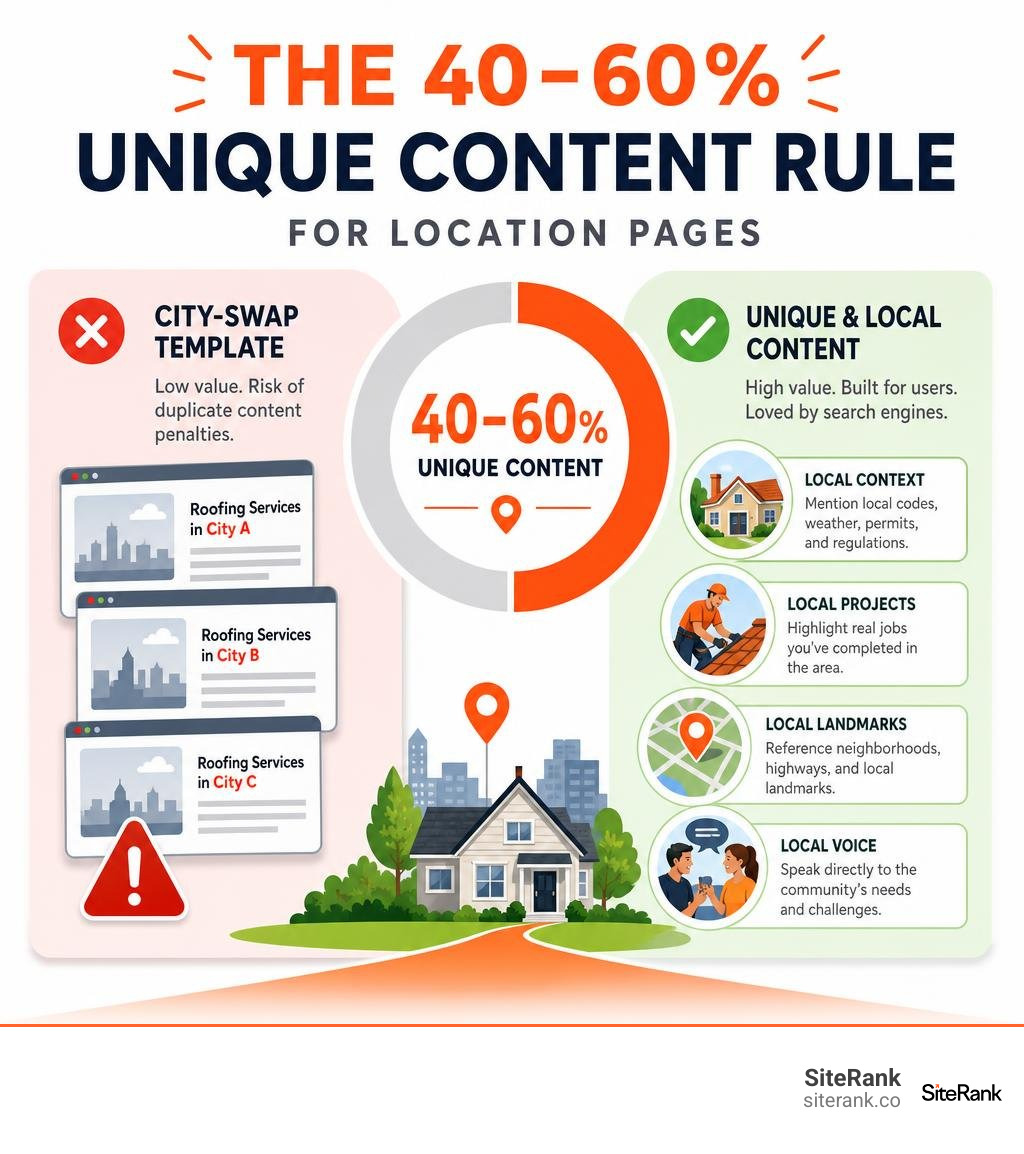
One of the biggest mistakes businesses make is cloning a single page, swapping out the city names, and publishing dozens of identical pages. Search engines are highly sophisticated; they easily recognize these duplicate patterns and categorize them as “doorway pages”—pages created solely to game search results without providing unique value.
To avoid duplicate content penalties, we recommend making each local landing page at least 40% to 60% unique.
Writing Real Local Context and Experience
To make your pages genuinely unique, you must write about real local context. This not only satisfies search engine quality guidelines but also builds instant rapport with local visitors.
- Highlight Local Regulations: Mention specific municipal building codes, regional weather challenges (such as humidity or heavy winters), or local permit requirements.
- Showcase Local Projects: Describe specific jobs you’ve completed in that neighborhood. For example, “We recently replaced a historic shingle roof on a home near the downtown park.”
- Reference Local Landmarks: Mentioning nearby neighborhoods, highways, or landmarks helps search engines build a stronger understanding of your geographic relevance.
For a practical example of how to execute this for a service business, refer to The Complete Local Search Optimization Guide for House Painters.
Avoiding the “City-Swap” Template Trap
Using rigid templates that only swap out the city name is a recipe for SEO failure. Instead, focus on building a smaller number of highly customized, high-quality pages.
When writing copy, prioritize Experience, Expertise, Authoritativeness, and Trustworthiness (E-E-A-T). You can read more about managing reviews and showcasing local trust signals in The Painters Guide to Review Management and Local SEO Success.
By creating content that addresses the unique needs of each community, you future-proof your website against algorithm updates targeting thin, automated content.
Technical SEO and Scalability for Multi-Location Brands
If you are managing a brand with multiple physical locations or dozens of service areas, your site architecture must be built for scalability and crawlability. If search engines can’t easily crawl your location structure, your pages won’t rank.
Technical SEO Foundations for Local SEO Landing Pages
Your technical setup is the foundation upon which your local rankings sit. If your technical SEO is broken, even the best copywriting won’t save your rankings.
- URL Structure: Avoid flat URL structures (e.g.,
domain.com/plumber-denver). Instead, use a clear parent-child hierarchy. For multi-city brands, use/locations/colorado/denver. For smaller, service-based businesses,/services/plumbing/denverworks beautifully. - Canonical Tags: Ensure each local landing page has a self-referencing canonical tag to prevent search engines from flagging them as duplicate content.
- Mobile Speed and Core Web Vitals: Since most local searches occur on mobile devices, keep your Largest Contentful Paint (LCP) under 2.5 seconds. Optimize your images, leverage browser caching, and eliminate render-blocking resources.
To understand how to wire your entire website’s architecture for scalable growth, explore our guide on Wiring for Growth with a Multi-Location Strategy.
Schema Markup and Internal Linking Strategies
To help search engines understand the exact relationship between your business services and your geographic locations, you must implement structured data and a smart internal linking strategy.
- LocalBusiness Schema Markup: Implement unique structured data on every location page. This schema should include your exact business name, address, phone number, operating hours, geo-coordinates, and links to your social profiles.
- Crawlable Internal Linking: Never let your location pages become “orphan pages” (pages with no internal links pointing to them). Link to your location pages from your main navigation, footer, or relevant service pages.
For a deep dive into how structured data and proximity signals impact your search visibility, read Map Pack SEO: The Proximity Cheat Code for Local Businesses.
Integrating Landing Pages with Google Business Profile and Map Packs
Your local landing pages do not exist in a vacuum; they are a critical component of your broader local SEO ecosystem, working hand-in-hand with your Google Business Profile (GBP) and Google Map Pack rankings.
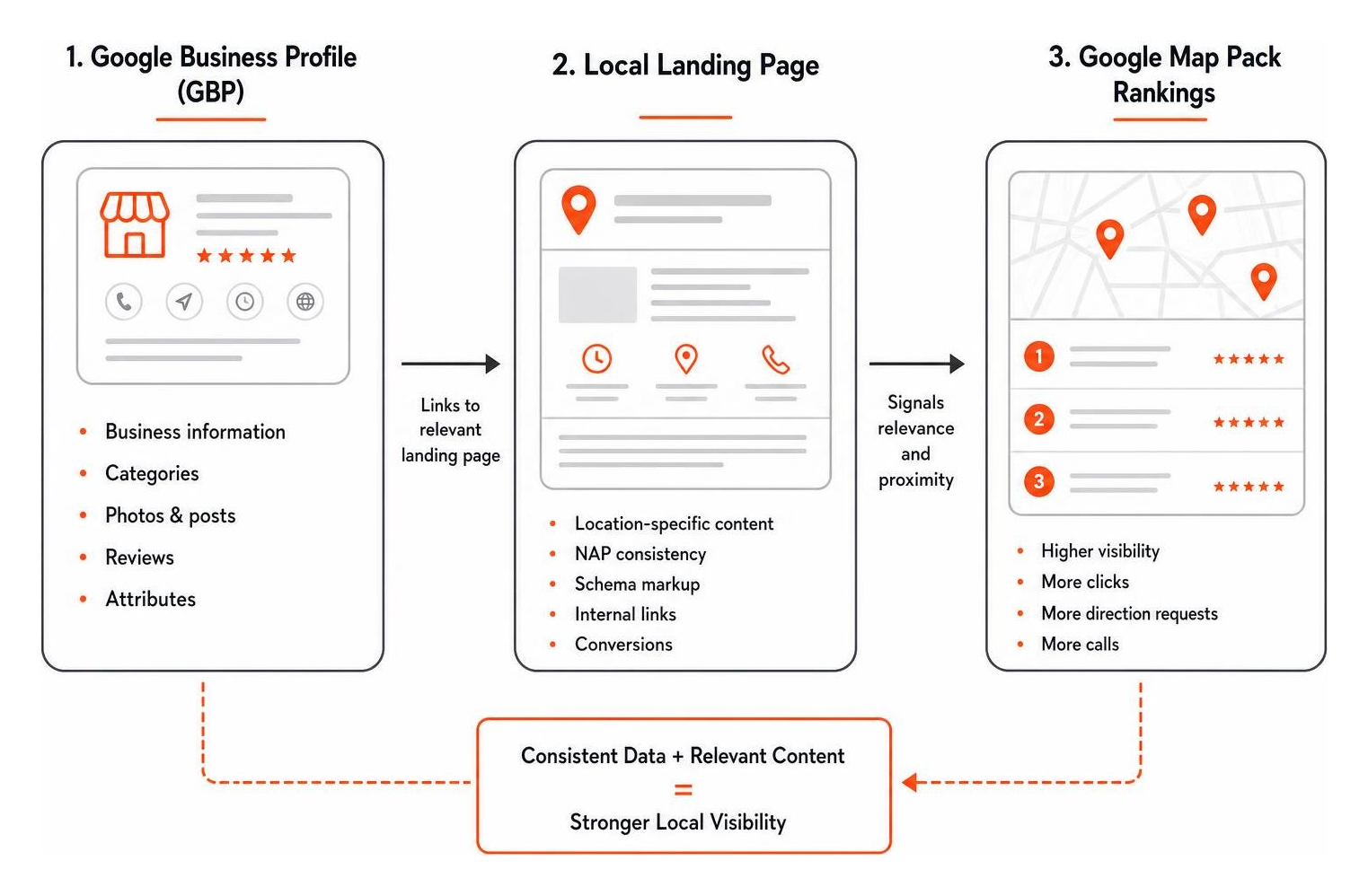
Aligning GBP Landing Page URLs
A common mistake is pointing every single GBP listing to the website’s homepage. If you have multiple physical locations, each GBP listing should point directly to its corresponding local landing page.
This alignment does two things:
- Improves User Experience: When a user clicks “Website” on your local GBP listing, they land on a page tailored to their specific city, complete with local phone numbers, reviews, and hours.
- Reinforces NAP Consistency: Ensuring that the name, address, and phone number on your landing page exactly match your GBP listing builds immense local authority with Google’s algorithm.
For a step-by-step optimization strategy, read The Lazy Marketers Guide to Google Business Profile Optimization.
Driving Map Pack and AI Search Visibility
Modern search engines and AI-powered search systems (like ChatGPT, Gemini, and Google’s AI Overviews) rely heavily on entity relationships and contextual relevance.
When your local landing pages contain structured data, geographic keywords, and localized reviews, AI search engines can easily connect your business entity to the searcher’s query. Furthermore, encouraging your customers to mention specific services and locations in their reviews helps your business surface in AI-generated summaries and local Map Packs.
Learn how to leverage these maps and proximity signals in Google Maps SEO for Landscapers: From Hidden Gem to Local Legend. For a broader perspective on how these pages should operate in today’s search landscape, we highly recommend reading How Local Landing Pages Should Work in 2026.
Common Mistakes and How to Measure Performance
Even with the best intentions, it is easy to fall into common local SEO traps. Let’s look at how to identify these mistakes and track your performance to ensure your landing pages are driving real business growth.
Fixing the Most Common Local SEO Mistakes
- Orphan Pages: If your location pages aren’t linked anywhere in your main navigation or footer, search engine bots won’t crawl them regularly.
- Inconsistent NAP: Having different addresses or phone numbers on your landing page compared to your GBP profile or local citations confuses search engines and hurts rankings.
- Keyword Stuffing: Repeating your city name dozens of times in the footer or text blocks makes your site look spammy. Write for humans first, search engines second.
If your local performance has stalled, read our analysis on Why Your Home Service Business Needs a Local SEO Overhaul to identify where your strategy might be falling short.
Tracking Progress and Measuring Local SEO Success
To ensure your local SEO landing pages are delivering a strong return on investment, you must track the right metrics.
- Organic Search Traffic: Monitor Google Search Console to see which location-specific keywords are driving clicks to your landing pages.
- Local Rank Tracking: Track your rankings in both the organic listings and the Google Map Pack for your target cities.
- Conversion Rate: Track how many visitors on each page take action, such as submitting a form or clicking a tap-to-call button.
For a complete guide on mapping out and tracking your geographic expansion strategy, explore How to Map Out Your Home Service Location Strategy Without Losing Your Mind.
Frequently Asked Questions about Local Landing Pages
How many local landing pages should my business create?
You should only create pages for locations where you genuinely have a physical presence or actively provide services. Quality beats quantity every time. Creating 5 to 10 highly customized, unique location pages will always outperform publishing 100 thin, cloned pages that offer no unique value.
Will Google penalize my site for having multiple location pages?
Google will not penalize your site for having multiple location pages as long as each page provides unique, valuable, and localized content. However, if you use automated tools to generate hundreds of identical “city-swap” pages with only the town names changed, Google may flag them as doorway pages and remove them from search results.
Do I need a physical address in a city to create a local landing page?
No, you do not need a physical address in a city to rank in local organic search results. Service Area Businesses (SABs) can successfully rank for neighboring cities by creating dedicated service area pages that showcase their geographic relevance, project history, and local customer reviews in those areas.
Conclusion
Building high-performing local SEO landing pages is the ultimate shortcut to local search dominance. By combining clear local intent, authentic trust signals, and clean technical SEO, you create a seamless bridge between local searchers and your business.
At SiteRank, we understand that every local market is unique. As an AI-powered SEO agency, we specialize in delivering tailored SEO strategies designed to drive clicks, engagement, and real leads without burying you in unnecessary deliverables.
Ready to put your business on the map and outrank your competition? Explore our specialized Home Services SEO solutions and let us help you build a high-converting local search engine presence that dominates your service areas.