

Why Your Business Lives or Dies by Local Map Pack Ranking
Improving your local map pack ranking is one of the highest-leverage moves a local business can make — and the steps to do it are more straightforward than most agencies want you to believe.
Here’s how to rank higher in the Google Map Pack:
- Claim and verify your Google Business Profile (GBP)
- Choose the right primary category — this is the single biggest ranking lever
- Keep your NAP consistent (Name, Address, Phone) across every directory
- Build review velocity — aim for 2-4 new reviews per week
- Use geo-grid tracking to find where you rank strong and where you’re invisible
- Optimize your website with local keywords and LocalBusiness schema markup
- Publish Google Posts weekly to signal an active, maintained profile
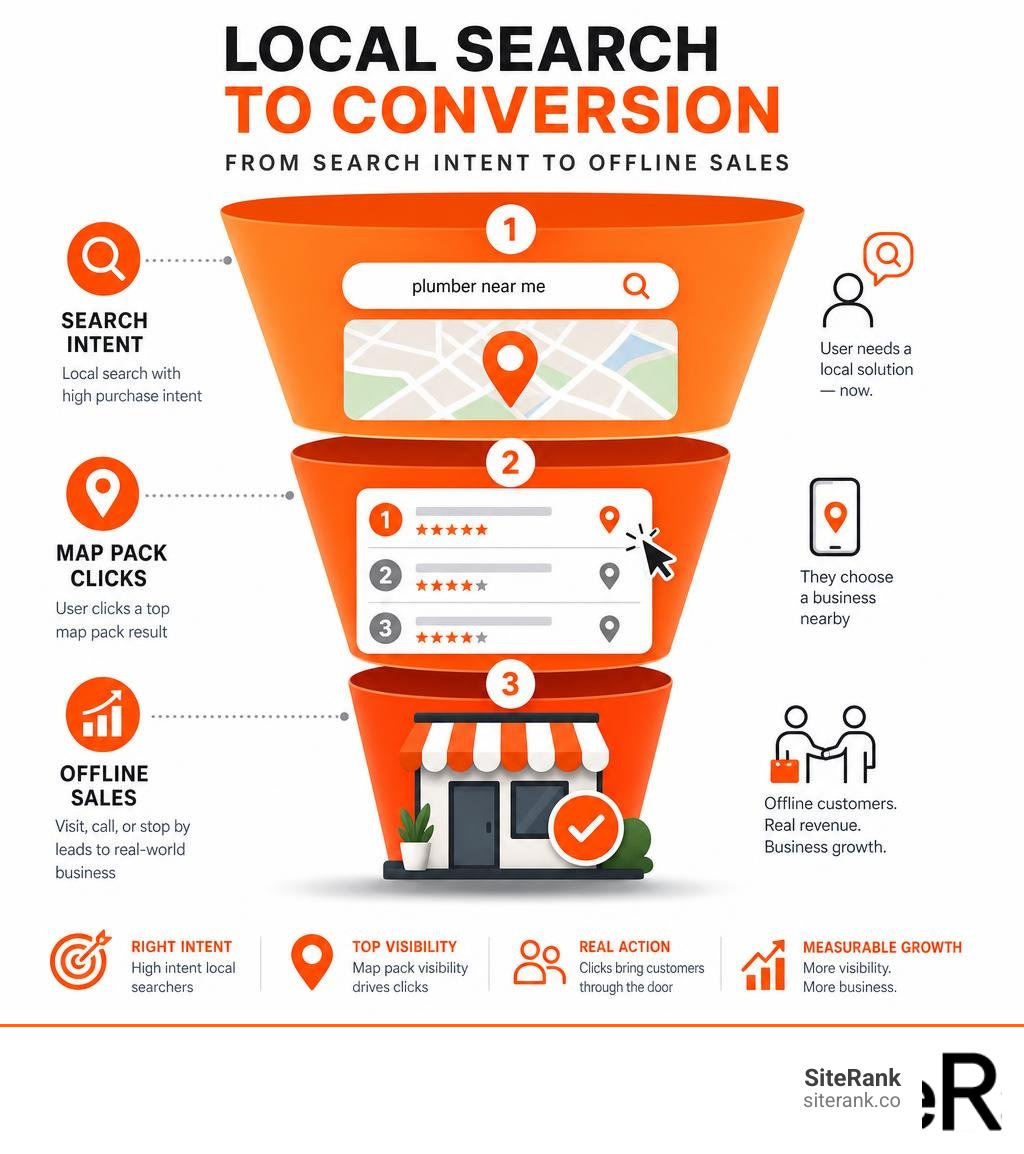
Think about the last time you searched “plumber near me” or “best HVAC near me.” You probably clicked one of the first three businesses that appeared in that map box at the top of the page — and never scrolled further. That’s the Google Local Map Pack (also called the 3-Pack or Snack Pack), and it sits above every organic result on the page.
The numbers tell the story clearly. 46% of all Google searches have local intent. Of those, 93% trigger a Map Pack result. And the #1 spot in that pack captures 44% of all clicks — while the #2 and #3 spots get 22% and 14% respectively. Drop to position 4? You see roughly a 7x drop in lead volume compared to position 3.
For a local business, this isn’t a nice-to-have. It’s survival.
I’m Craig Flickinger, founder of SiteRank and a local SEO specialist with over 15 years of experience helping businesses dominate their local map pack rankings in competitive markets. In this guide, I’ll walk you through exactly what drives those rankings — and what to fix first.
To help you navigate this landscape, here are some of our key resources on local search optimization:
The Mechanics of Local Map Pack Ranking
To climb to the top of Google’s local results, we first need to understand what we are actually optimizing for. The Google Local Pack is a highly specialized search engine results page (SERP) feature. It displays the top three local business listings alongside an interactive map, star ratings, contact details, and direct action buttons (like “Call” or “Directions”).
But how does Google decide who gets these three coveted slots?
According to the official documentation on What is the Local Pack?, Google’s local algorithm operates on a completely different set of rules than its traditional organic search algorithm. While organic search prioritizes domain authority, backlink profiles, and comprehensive content, the Map Pack runs on three core pillars: Relevance, Distance, and Prominence.
To visualize how these two search landscapes differ, let’s look at this comparison table:
| Feature | Local Map Pack | Organic Search Results |
|---|---|---|
| Primary Data Source | Google Business Profile (GBP) | Website HTML & On-Page Content |
| Primary Ranking Signals | Proximity, Category Match, Reviews | Backlinks, Content Depth, Technical SEO |
| Visual Elements | Map Pins, Star Ratings, Call Buttons | Blue Links, Meta Descriptions, Site Links |
| User Intent | Immediate Action (Visit, Call, Hire) | Information Gathering & Research |
| Geographic Sensitivity | Extremely High (Changes block-by-block) | Moderate (Changes city-by-city) |
Why Local Map Pack Ranking is Crucial for Home Services
For businesses in the trades—such as plumbers, electricians, roofers, and landscapers—ranking in the top three positions is the difference between a ringing phone and complete digital silence.
When homeowners experience an emergency, like a burst pipe or a failing air conditioner, they do not have the time to read long blog posts. They pull out their smartphones, search for a local provider, and click directly on the Map Pack results. In fact, mobile devices drive over 92% of all local searches, and nearly 50% of these users visit or contact a business within 24 hours.
If you are running a home service company, securing a top-3 spot is the ultimate shortcut to high-intent leads. We dive deep into these specific industry dynamics in our comprehensive guide on Local SEO for home services. When you rank in the Map Pack, you bypass the massive directory sites like Yelp and Angi that usually dominate the organic search results. You get to speak directly to the customer, capturing up to 340% more calls than paid local ads can deliver.
The Core Ranking Pillars: Relevance, Distance, and Prominence
Let’s break down the three algorithmic pillars Google uses to score your business:
- Relevance: How well does your business entity match the searcher’s query? This is determined by your primary GBP category, the services listed on your profile, and the semantic keywords on your website.
- Distance (Proximity): How close is your physical business location to the searcher? Since the landmark 2021 Vicinity update, Google has heavily weighted proximity to prevent businesses from dominating entire metro areas from a single office.
- Prominence: How popular, trusted, and well-known is your business? Google measures this using your review volume, review velocity, local citation consistency, and the overall organic authority of your website.
Behind the scenes, Google processes local queries using a strict two-stage sequence. First, it identifies the searcher’s location using Level-14 S2 cells (geographic boundary units used by Google Maps that cover a 1-to-2-mile radius) to generate a “candidate pool” of nearby businesses. Second, it applies its ranking filtration algorithms to select the top three businesses based on prominence and relevance.
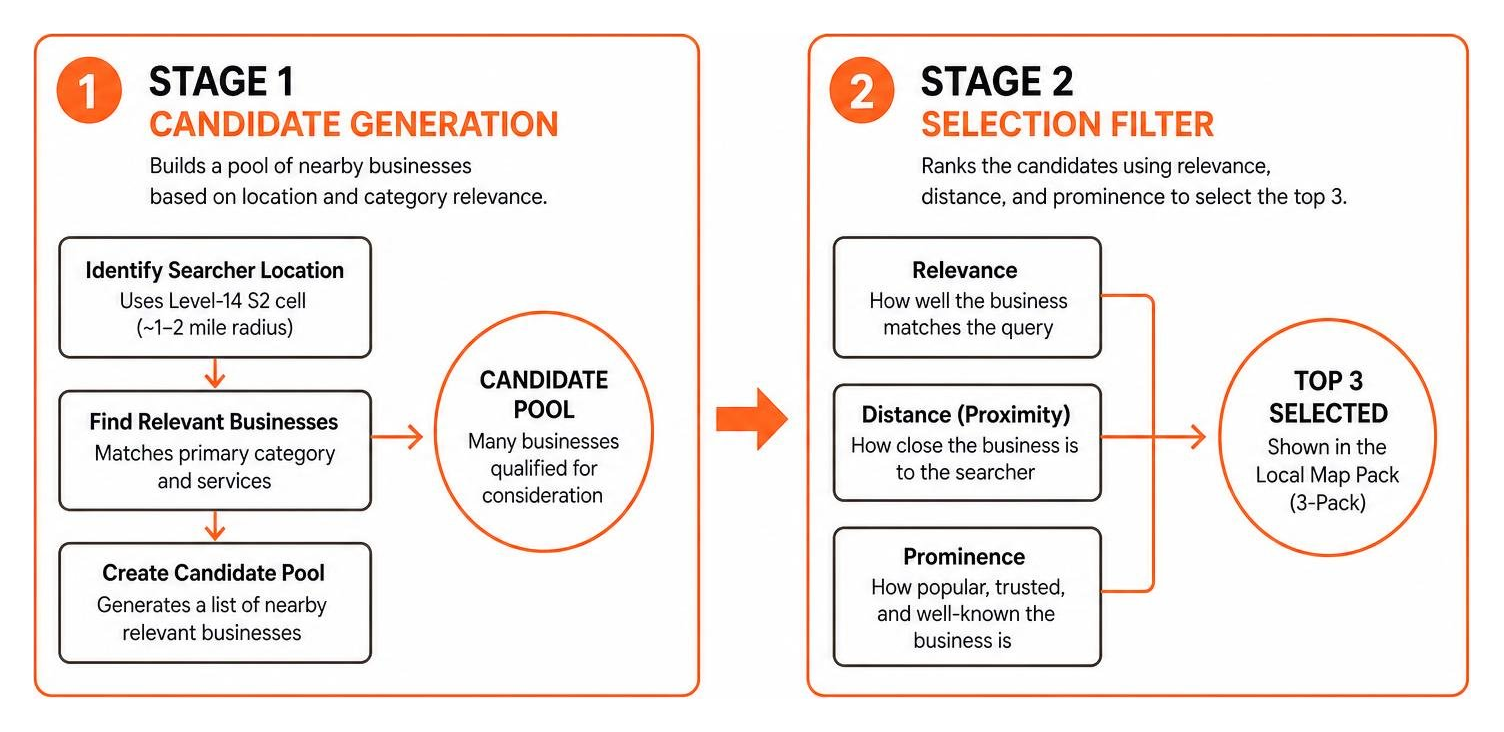
As outlined in the Google Local Pack 2026: 3-Pack Ranking Factors, if you want to pass Stage 2 and earn a seat in the 3-Pack, your business entity must have high trust signals. Let’s look at how to build those foundational signals.
Step-by-Step Guide to Claiming and Optimizing Your Google Business Profile
Your Google Business Profile (GBP) is the absolute foundation of your local SEO strategy. Think of it as your digital storefront. If your GBP is incomplete, inaccurate, or unverified, you are locked out of the candidate pool before the race even begins.
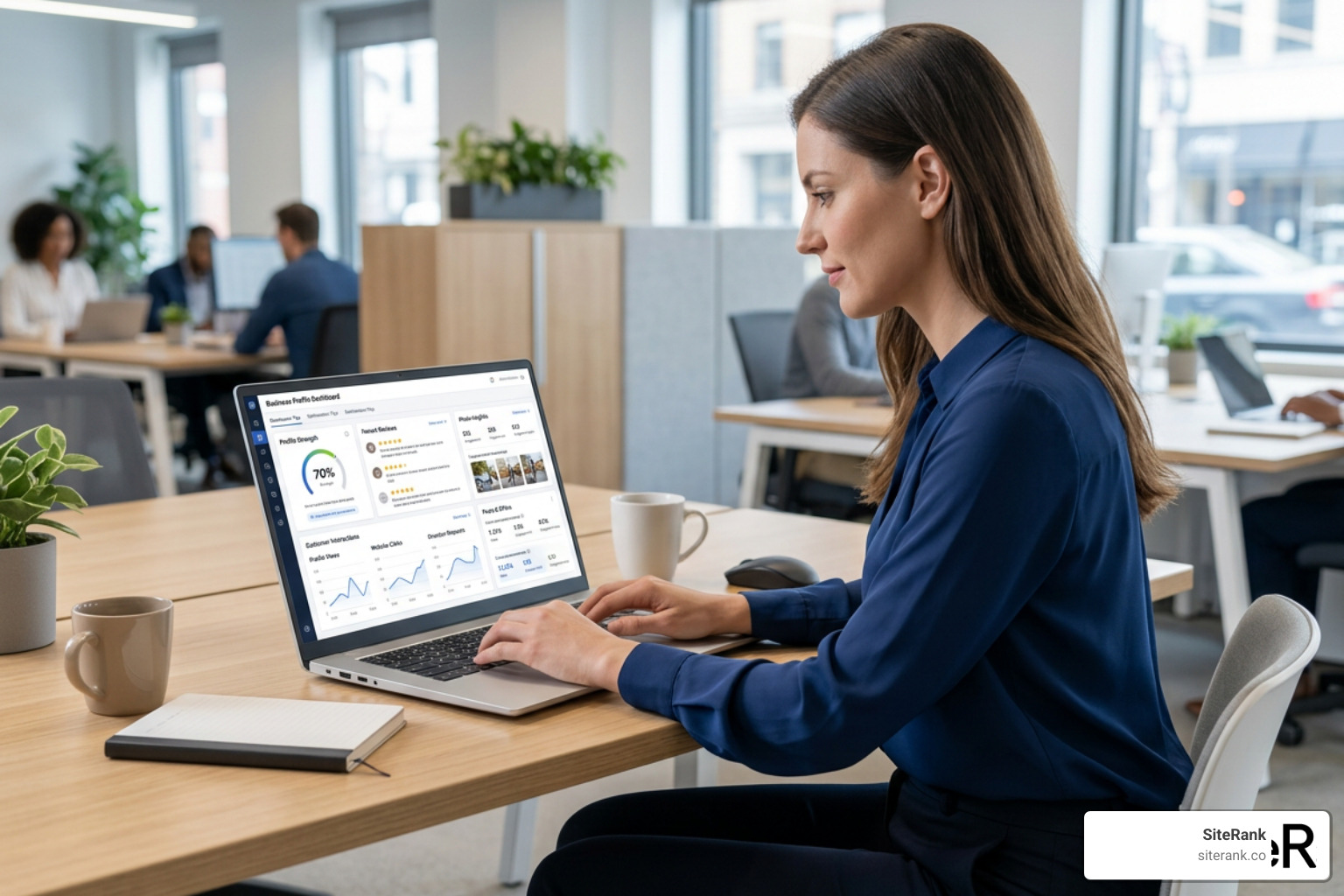
To get started, follow our step-by-step optimization blueprint to put your business on the map and leave your competitors in the dust:
- Claim and Verify Your Profile: Head to Google Business Profile, search for your business, and claim it. Google will require verification—typically via a postcard, phone call, or a short video recording showing your physical workspace, tools, and business registration.
- Write a Compelling Business Description: You have 750 characters to explain what you do. Do not stuff this with keywords. Instead, write a natural, high-converting description that states your primary services, the specific cities you serve, and why customers trust you.
- Upload High-Quality Visuals: Profiles with 100+ photos receive significantly more click-throughs. Upload at least 10 to 15 high-resolution photos of your team, your wrapped trucks, and your completed projects. Keep them fresh by adding 2 to 3 new photos every week.
- Maintain Accurate Operating Hours: Ensure your regular and holiday hours are always up to date. There is no quicker way to earn a 1-star review than having a customer drive to your shop only to find your doors locked.
Selecting the Right Categories and Attributes
Choosing your primary category is the single most important tactical decision you will make. Google relies heavily on this field to determine relevance. If you get this wrong, your chances of ranking in the Map Pack are practically zero.
Do not choose an aspirational category. If you are an electrical contractor, your primary category should be “Electrician,” not “Construction Company.” You can use free tools like the GMB Everywhere Chrome extension to spy on your top-ranking competitors and see exactly which categories they use. Once your primary category is set, add up to 10 highly specific secondary categories (e.g., “Air Conditioning Repair Service,” “Heating Contractor” for an HVAC business).
Additionally, fill out your GBP attributes. These are descriptive tags (like “Women-owned,” “Wheelchair accessible,” or “Emergency services offered”) that help Google match your business with highly specific, long-tail search queries.
Building Consistent Local Citations and NAP-W
A local citation is any online mention of your business’s Name, Address, Phone number, and Website (NAP-W). Google crawls the web to cross-reference your business information. If it finds conflicting data—such as a different phone number on Yelp, an old address on YellowPages, or a misspelled name on Facebook—it loses trust in your entity legitimacy and drops your rankings.
To build a flawless citation graph:
- Audit your existing directory listings to find and correct any discrepancies.
- Submit your business details to major data aggregators (like Foursquare and Neustar Localeze).
- Build citations on 20 to 50 trusted, industry-specific directories.
If you don’t have the time to clean up hundreds of listings manually, utilizing professional Local Citation Building Services is a smart way to ensure 100% consistency across the web.
How to Measure and Track Your Local Map Pack Ranking
If you are only tracking your rankings by sitting in your office and typing keywords into Google, you are flying completely blind.
Because Google’s local algorithm is highly sensitive to proximity, your search results change dynamically block-by-block. You might rank #1 when searching from your shop’s desk, but drop to #8 when a customer searches from a neighborhood just two miles down the road.
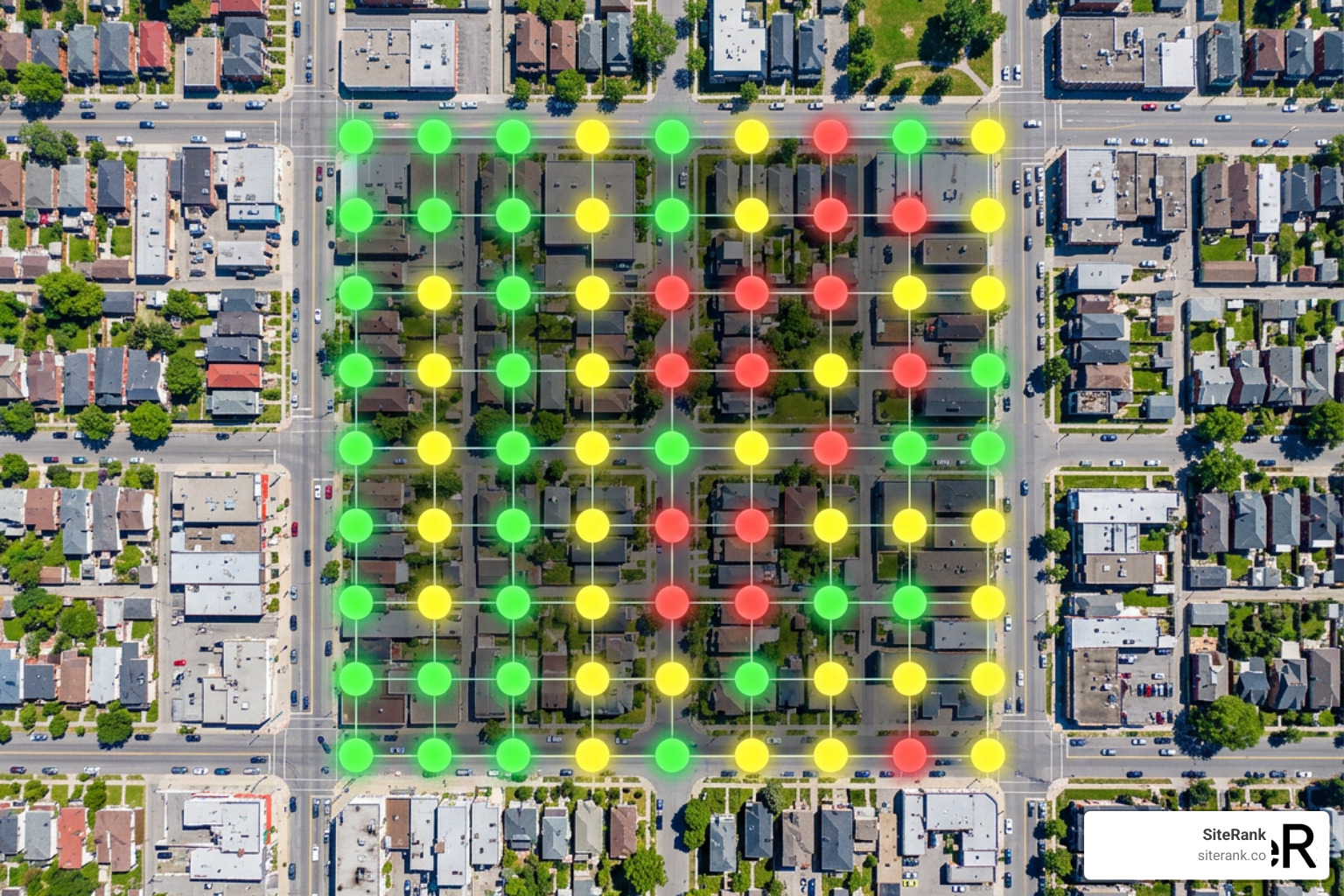
To solve this, modern local SEO relies on geo-grid tracking. A geo-grid tool runs automated search queries from a multi-point coordinate grid (like a 5×5, 7×7, or 9×9 grid) over your service area. It assigns a color-coded number to each node, showing your exact ranking position at that specific physical spot.
By analyzing these grids, we can calculate two critical performance metrics:
- Grid Rank: Your average ranking position across all coordinates in your target area.
- Visibility Score (Share of Local Voice): The percentage of search locations within your grid where your business ranks in the top three positions.
Why Single-Point Rank Tracking Fails
Traditional rank tracking tools check rankings from a single static IP address or a broad ZIP code level. This is highly inaccurate for local search.
Google uses the exact GPS coordinates of a mobile user or the precise location of a desktop’s internet service provider to serve results. Single-point tracking misses this geographic variation entirely. It cannot tell you if your local reach is expanding into neighboring suburbs or if a competitor is eating away at your market share just a few streets over.
Benchmarking Your Local Map Pack Ranking Across Your Service Area
To get a true picture of your business’s health, you must run regular geo-grid scans across your entire service area. This allows you to identify “proximity gaps”—areas where your relevance signals are strong but your proximity drops off.
If you notice your rankings are solid within a one-mile radius of your office but completely disappear beyond that, it is a clear sign that your business needs a local SEO overhaul. We explain how to diagnose and fix these geographic coverage issues in our guide on Why Your Home Service Business Needs a Local SEO Overhaul. By deploying localized content and building localized prominence signals, you can push your green “ranking bubbles” further out into the suburbs where your target customers live.
Advanced Strategies: Reviews, Backlinks, and AI Search Optimization
Once you have optimized your GBP and cleaned up your citations, it is time to deploy advanced strategies to outpace your competitors and secure long-term prominence.
Managing Review Velocity and the 5-Star Trap
Reviews are one of the most powerful prominence signals in Google’s local algorithm. However, many business owners fall into the “5-star trap.” They believe that having a perfect 5.0 rating is the ultimate goal. In reality, Google’s algorithm (and savvy consumers) treats a perfect 5.0 rating with skepticism, often suspecting review manipulation. The sweet spot for conversion and ranking is actually between 4.5 and 4.9 stars.
Furthermore, raw review volume is no longer the only metric that matters. Google evaluates:
- Review Velocity: The steady, natural cadence of incoming reviews. Getting 50 reviews in one weekend and then zero for three months looks unnatural. Aim for a steady flow of 2 to 4 reviews every week.
- Review Diversity & Semantics: Google’s Gemini AI reads the actual words in your reviews. Encourage your customers to mention the specific service they received and the neighborhood they are in (e.g., “The crew did an amazing job with our roof replacement in North Dallas“). This feeds semantic signals directly into Google’s search engine.
Always respond to 100% of your reviews within 7 days. This signals to Google that your business is highly active and engaged with its customers.
Local Link Building and On-Page Schema Markup
To boost your prominence beyond your immediate physical address, you must build local authority. This is achieved through a combination of local link building and technical on-page SEO.
Start by earning backlinks from locally rooted organizations, such as:
- Local chambers of commerce
- Neighborhood associations and community blogs
- Youth sports sponsorships
- Local charity events
These hyper-local links carry massive geographic weight. You can learn more about securing these high-value mentions in our Local SEO Backlinks Guide 2025 and our breakdown of Local Link Building Strategies.
On your website, you should implement LocalBusiness Schema Markup. This is structured data code that tells search engine crawlers exactly who you are, what services you offer, and where you are located. Additionally, deploy a “hub-and-spoke” content architecture by creating dedicated neighborhood landing pages for each key suburb in your service area. This helps you capture localized search traffic far beyond your physical office doors.
This structured approach is particularly effective for tradesmen looking to dominate their local markets. For industry-specific blueprints, check out our guides on:
- The Local SEO Blueprint for Tradesmen to Rank Number One
- HVAC Local SEO: Complete Guide
- Local SEO for Roofing Contractors: Raising the Roof on Your Revenue
Optimizing for AI Overviews and Ask Maps
The local search landscape is shifting rapidly in 2026. With the rise of AI-driven search features like Google’s AI Overviews and the newly rolled-out “Ask Maps” conversational AI assistant, the way consumers find local businesses is changing.
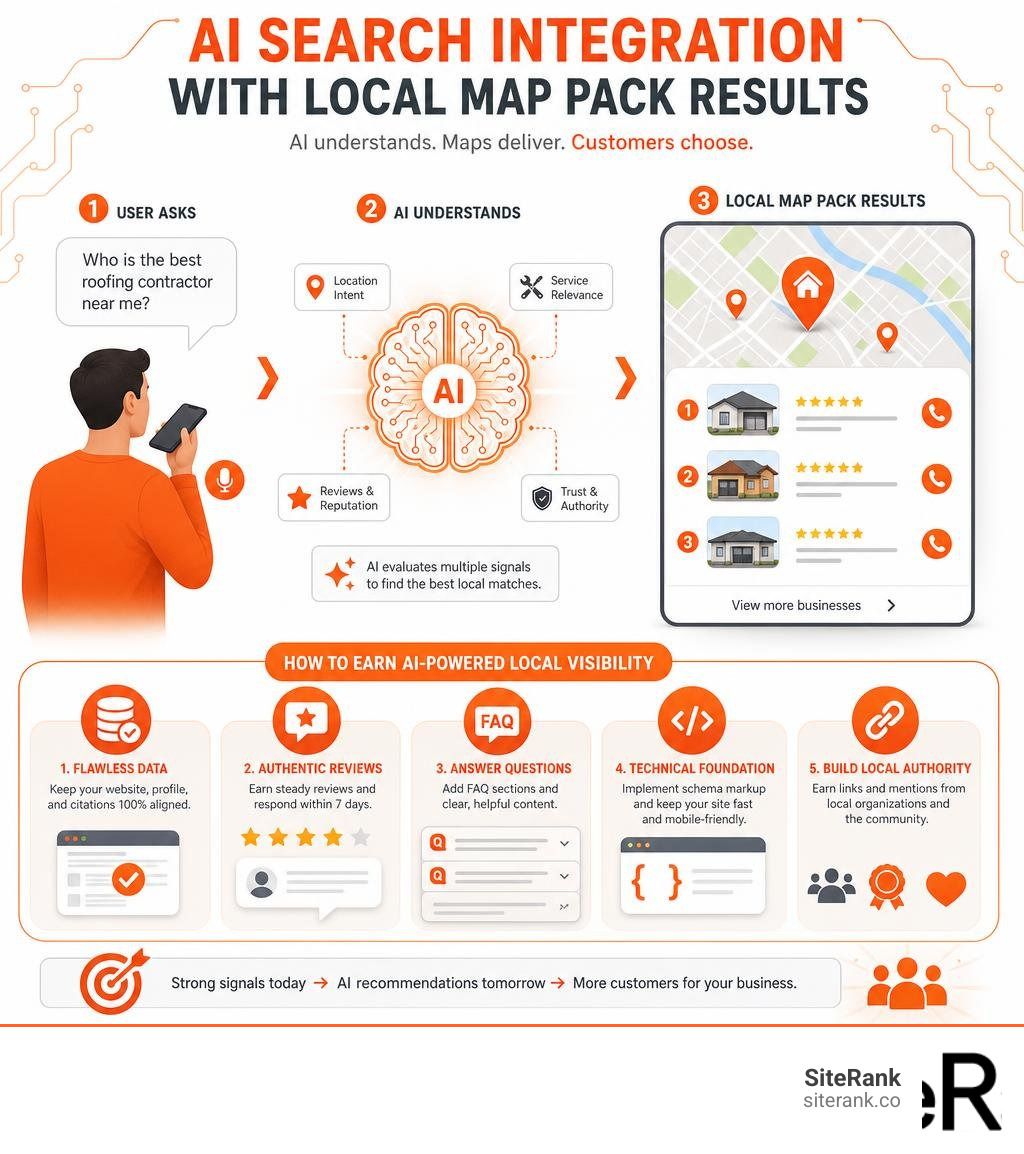
According to recent BrightLocal data, 45% of consumers now ask AI for local business recommendations, and 88% fact-check those answers. Furthermore, 58% of ChatGPT Search local-result citations come directly from business websites, while only 15% come from traditional directories.
To ensure your business is cited by AI search engines:
- Maintain flawless entity data: Ensure your website’s schema markup, GBP details, and citation graph are completely aligned.
- Answer customer questions directly: Create comprehensive FAQ sections on your service pages, answering common questions in a clear, definition-first format that AI crawlers can easily parse.
- Build semantic review depth: As mentioned earlier, rich, detailed customer reviews are the primary source of truth for AI recommendation engines.
Common Mistakes and How to Diagnose a Sudden Ranking Drop
Even the most optimized local campaigns can experience sudden drops in visibility. When this happens, it is critical not to panic, but to systematically diagnose the root cause.
Bypassing Google’s Proximity and Category Filters
One of the most common reasons a business struggles to rank—or suddenly disappears from the Map Pack—is Google’s local filter (often referred to as the Possum update filter).
To provide a diverse user experience, Google’s algorithm filters out highly similar listings that are in close physical proximity. If your business shares an office building, a business park, or is within 200 feet of a competitor who shares your primary GBP category, Google may suppress your listing in favor of the more established competitor.
To bypass this filter:
- Ensure category accuracy: Do not copy a competitor’s category structure exactly if you are sharing a building. Find a unique primary category that accurately reflects your niche.
- Build superior prominence: If you cannot change your physical location, you must out-review and out-link your immediate neighbors to signal to Google that your business is the dominant entity in that space.
- Avoid keyword stuffing: Never add descriptive keywords to your GBP business name unless they are part of your legal, registered name. Doing so triggers automatic algorithmic filters and profile suspensions.
Troubleshooting and Fixing Sudden Visibility Loss
If your Map Pack ranking drops off a cliff overnight, run through this diagnostic checklist:
- Check for a GBP Suspension: Log into your Google Business Profile dashboard. If you see a “Suspended” or “Action Required” notification, you have likely violated Google’s terms of service (often due to an address change, a category swap, or suspicious review activity).
- Audit Your Citations: Run a quick audit to see if a recent change to your website or phone system has introduced NAP inconsistencies across the web.
- Monitor Algorithm Updates: Google frequently rolls out local algorithm updates. Check major SEO forums and community boards to see if other local businesses are experiencing similar volatility.
If you are struggling to find the leak in your local funnel, we highly recommend getting a Free SEO Audit. A professional audit can pinpoint technical errors, schema mismatches, and citation gaps that are holding your business back.
Frequently Asked Questions about Local Map Pack Ranking
How long does it take to rank in the Google 3-Pack?
For most local businesses in moderately competitive markets, a professional, targeted optimization campaign will yield noticeable Map Pack improvements within 90 to 120 days. However, if you are operating in a highly dense metropolitan area with hundreds of established competitors, achieving a stable top-3 position can take anywhere from 6 to 12 months of consistent optimization.
Can I rank in the Map Pack if I don’t have a physical storefront?
Yes. If you run a Service Area Business (SAB)—such as a mobile plumber, locksmith, or carpet cleaner—you can verify your profile using your home address and then choose to hide your physical address from public view. You will then define your service areas by ZIP codes, cities, or counties. While proximity is still calculated from your verification address, you can absolutely rank in the Map Pack across your target service territory.
Do paid Google Ads impact my organic Map Pack rankings?
No. Paid Google Ads (including Local Services Ads and Google Maps sponsored pins) and organic Map Pack rankings run on completely independent algorithms. Running paid ads will not directly boost your organic positions. However, appearing in both the sponsored section and the organic 3-Pack is a highly effective way to dominate the SERP, build trust, and capture maximum click share.
Conclusion
Dominating your local map pack ranking is not a one-time set-it-and-forget-it task. It is an ongoing operational rhythm. It requires regular profile maintenance, a steady flow of fresh customer reviews, consistent local link building, and a close eye on geographic visibility trends.
At SiteRank, we understand that local business owners don’t have the time to spend hours managing spreadsheets and tracking algorithm updates. As an AI-powered SEO agency, we specialize in delivering tailored, high-impact local SEO strategies that eliminate unnecessary deliverables and focus on what truly matters: increasing your clicks, calls, and conversions.
Ready to claim your spot at the top of the map? Dominate Your Local Market with SiteRank and let our team build a high-converting local presence that leaves your competitors in the dust.