

Why Organic Traffic Is the Foundation of Sustainable Online Growth

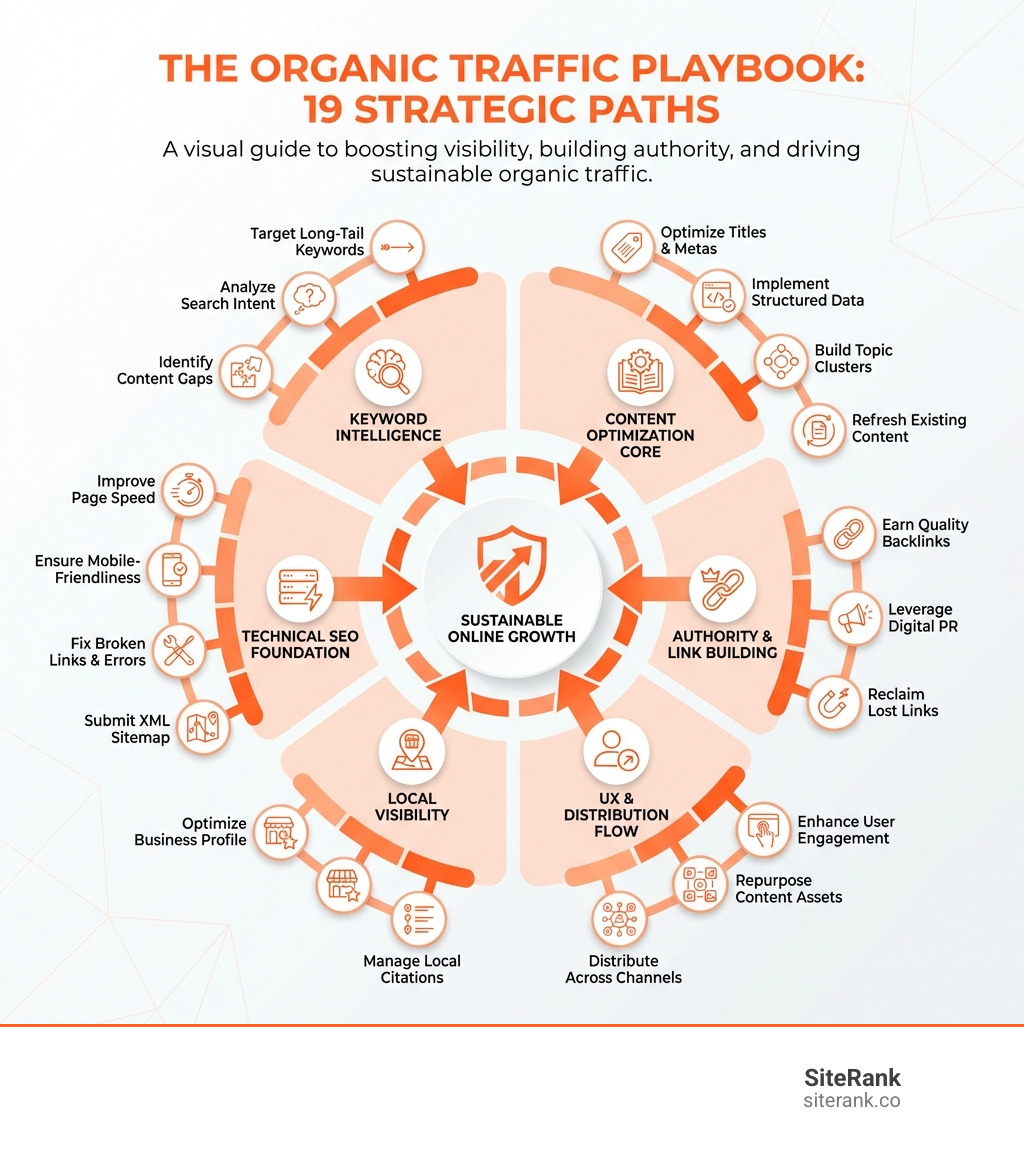
If you want to boost organic traffic, you need a clear roadmap. Here’s what works:
- Optimize for search intent – Match your content to what users actually want
- Fix technical issues – Ensure fast load times, mobile-friendliness, and proper indexing
- Target low-competition keywords – Start with long-tail terms you can realistically rank for
- Build quality backlinks – Earn links from authoritative, relevant sources
- Refresh existing content – Update old posts with current information and missing subtopics
- Create topic clusters – Build authority by covering subjects in depth, not breadth
Organic traffic—visitors who find your site through unpaid search results—represents the most valuable channel for sustainable growth. Unlike paid ads that stop delivering the moment you stop paying, organic traffic compounds over time. A well-optimized article can drive thousands of visitors month after month, building authority and generating leads while you sleep.
The numbers tell the story: organic search accounts for 48% of all web traffic, and businesses that prioritize it see significantly lower customer acquisition costs than those relying on paid channels. But achieving meaningful organic growth requires more than following outdated SEO checklists. Search engines like Google now evaluate content through AI-driven systems that prioritize user satisfaction, expertise, and comprehensive topic coverage.
I’m Craig Flickinger, and I’ve spent over 15 years helping businesses boost organic traffic through strategic SEO and content optimization. At SiteRank, we’ve guided hundreds of clients from page three obscurity to first-page visibility by combining technical precision with content that actually serves searcher intent.
Mastering Keyword Research and Search Intent to Boost Organic Traffic
At SiteRank, we often say that keywords are the “language” of your customers. But to boost organic traffic effectively, you have to look past the words and see the intent. Searcher intent is the “why” behind a query. Are they looking for a definition (Informational)? Are they trying to find a specific site (Navigational)? Or are they ready to pull out their credit card (Transactional)?
If you write a 3,000-word guide for a keyword where users just want a quick calculator, you won’t rank. We use Keyword Research for Blog Posts to align our topics with what users actually expect to see. A great place to start is Google’s Keyword Planner, which provides raw data on search volumes and competition levels.
One of the most powerful shifts in modern SEO is moving from single keywords to Topic Clusters. Instead of writing ten random posts, you create one “pillar” page that covers a broad topic and several “cluster” pages that dive into subtopics. This signals to Google that you have deep topical authority. This Blog Content Marketing Strategy helps search engines understand the semantic relationship between your pages, making you a “go-to” resource in your niche.
Using Long-Tail Keywords to Boost Organic Traffic
If you’re a small business, trying to rank for a head term like “shoes” is like trying to win a marathon against Olympic sprinters. Instead, we focus on long-tail keywords. These are longer, more specific phrases like “handmade vegan running shoes for flat feet.”
While these terms have lower search volume, they boast much higher conversion rates because the buyer intent is specific. They also mirror natural language, which is vital for voice search optimization. With the global market for voice recognition set to reach $83 billion by 2032, optimizing for how people actually speak to their devices is no longer optional—it’s a competitive necessity.
Creating High-Value Content and Leveraging E-E-A-T
Google doesn’t just want “content”; it wants helpful content. This is where E-E-A-T comes in: Experience, Expertise, Authoritativeness, and Trustworthiness. To boost organic traffic, your content must prove you know your stuff. This means including author bios, citing credible sources, and sharing first-hand insights.
We recommend focusing on “Cornerstone Content”—the most important, comprehensive articles on your site. But creating new content isn’t your only path to growth. Using historical optimization, companies have seen traffic increases of over 100% by simply refreshing old posts.
Check out these 10 Content Optimization Tips for SEO for quick wins. One of the biggest? Add visuals. Research shows that articles with images get 94% more total views than those without. Humans are visual creatures; a well-placed chart or infographic can keep a visitor on your page much longer, signaling to Google that your content is satisfying.
Technical SEO Foundations: Speed, Security, and AI Readiness
You can have the best content in the world, but if your site takes ten seconds to load, no one will read it. Nearly 47% of users expect a site to load in 2 seconds or less. If you’re slower than that, your bounce rate will skyrocket.

We suggest using a Website Performance Audit Tool to check your Core Web Vitals. These are Google’s metrics for speed, interactivity, and visual stability. Since Google favored mobile-friendly sites in its major algorithm updates, having a responsive design is mandatory. Mobile now accounts for roughly half of all global web traffic, so your “mobile version” is actually your “primary version” in Google’s eyes.
Security is another non-negotiable. HTTPS has been a ranking signal since 2014. If your site isn’t secure, browsers will warn users, destroying trust before they even read your first sentence. Finally, ensure your site is “crawlable” by using a clean site architecture and schema markup—code that helps search engines understand exactly what your data means.
Optimizing for GEO to Boost Organic Traffic in the AI Era
The world of search is changing with the rise of Generative AI. Google’s AI Overviews (AIOs) and tools like ChatGPT are now “assembling” answers rather than just listing links. This is where Generative Engine Optimization (GEO) comes in.
To boost organic traffic in this new era, your content needs to be conversational and authoritative. AI models look for “information gain”—unique data or perspectives they can’t find elsewhere. Our AI Search Engine Optimization Guide details how to structure your content so it’s easily summarized by these AI engines, ensuring your brand stays visible even in “zero-click” search environments.
Building Authority Through Strategic Link Building and Local SEO
Backlinks are like “votes of confidence” from other websites. They remain one of the top three ranking factors in Google’s algorithm. However, quality always beats quantity. One link from a high-authority news site is worth more than a thousand links from obscure, spammy blogs.
Understanding Why Backlinks Are Important for SEO is the first step to building a digital PR strategy. But don’t forget the power you already have: internal linking. This is a confirmed Google ranking factor. By linking from your high-authority pages to your newer ones, you distribute “link equity” and help users steer your site.
For businesses with a physical presence, Local SEO is your best friend. Roughly 30% of all mobile searches are related to location. Use our Local SEO Backlinks Guide 2025 to dominate your geographic area.
| Feature | Internal Links | External Backlinks |
|---|---|---|
| Source | Your own domain | Other websites |
| Control | Full control over anchor text | Low control |
| Primary Goal | Navigation & Equity distribution | Authority & Trust building |
| SEO Impact | Helps crawlability | Major ranking factor |
Maximizing Visibility with Advanced Distribution and UX Tactics
User Experience (UX) is no longer just for designers; it’s a critical SEO component. If users find your site hard to steer, they’ll leave—and Google tracks that. According to the Baymard Institute, the ideal line length for readability is 50-75 characters. If your text stretches across the whole screen, people will skim and skip.
Don’t wait for people to find you on Google; go where they are. Leverage LinkedIn and other social platforms to drive initial traffic to your posts. User-generated content (UGC), like reviews and comments, can also provide fresh, keyword-rich content that builds trust.
Finally, look at the “People Also Ask” (PAA) boxes on Google. These are a goldmine for understanding exactly what questions your audience has. Tools like Answer the Public can help you map these out so you can create content that answers these questions directly, often earning you a featured snippet at the very top of the search results.
Frequently Asked Questions about Organic Traffic
How long does it take to see results from organic traffic growth efforts?
SEO is a marathon, not a sprint. While you might see “low-hanging fruit” wins in a few weeks (like fixing technical errors), significant growth usually takes 4 to 6 months. This timeline depends on your industry competition and how consistently you publish high-quality content.
What is the difference between short-tail and long-tail keywords?
Short-tail keywords are broad, one or two-word phrases (e.g., “coffee”). They have high volume but massive competition. Long-tail keywords are specific phrases (e.g., “best organic fair-trade coffee beans for espresso”). They have lower volume but much higher conversion rates and are easier to rank for.
How does website security (HTTPS) affect search rankings?
HTTPS has been a confirmed ranking signal since 2014. Beyond the direct SEO boost, it protects user data and prevents “Not Secure” warnings in browsers. Without it, your bounce rate will likely increase as users flee unencrypted sites.
Conclusion
To boost organic traffic in 2025 and beyond, you need a holistic approach that balances technical health with human-centric content. It’s about building a sustainable asset that grows in value over time. By mastering keyword intent, staying ahead of AI trends, and building genuine authority, you create a digital presence that search engines—and users—love to visit.
At SiteRank, we specialize in cutting through the noise to deliver custom strategies that drive real results. Whether you need a technical overhaul or Quality Link Building Services, we’re here to help you achieve long-term, cost-effective growth. Ready to see your numbers climb? Let’s get to work.