

Why Blog Content Marketing Strategy Is Your Business Growth Engine
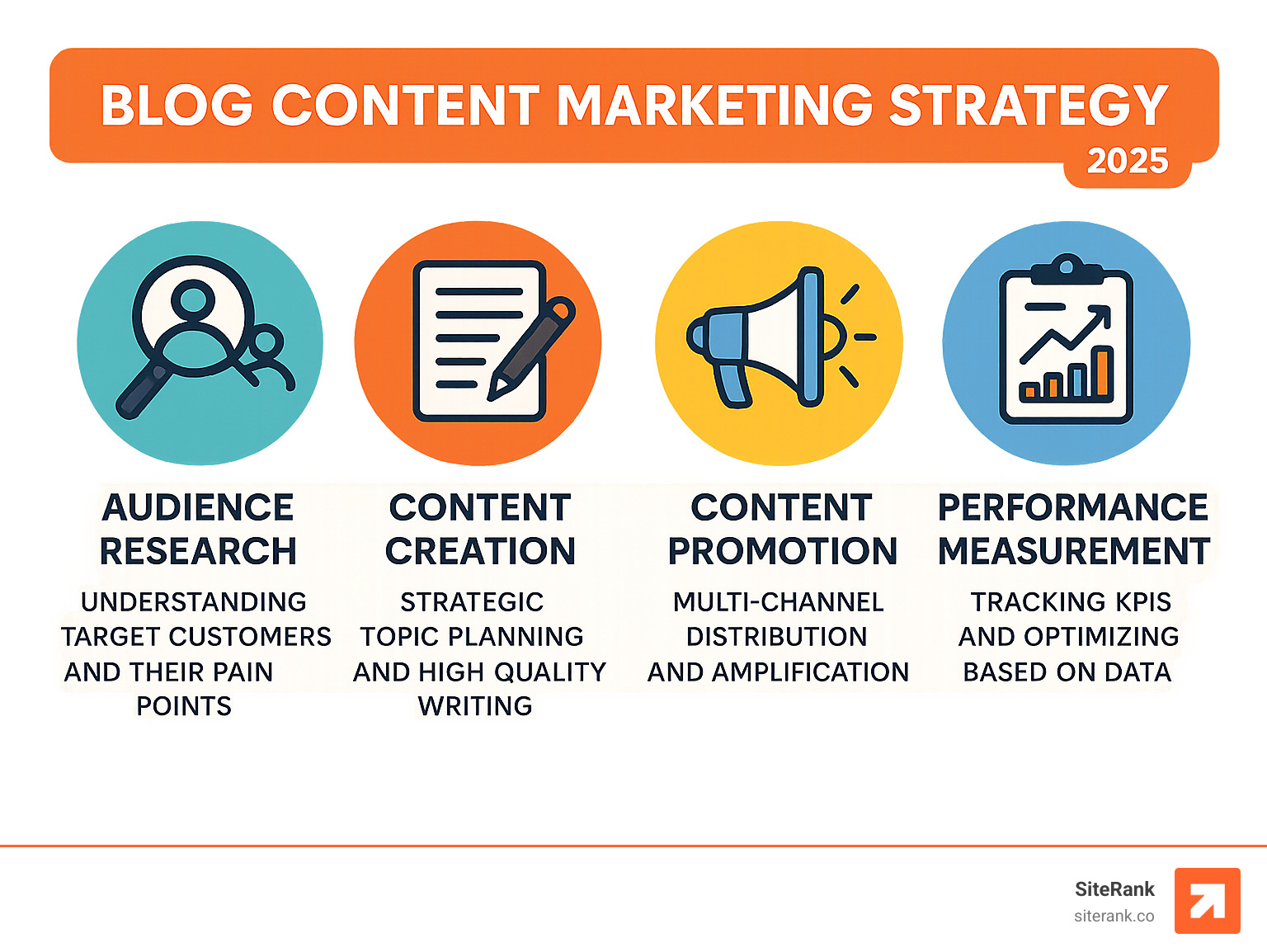
A Blog content marketing strategy is a documented plan for creating, publishing, and promoting blog content to attract your target audience and achieve specific business goals. An effective strategy includes:
- Business objectives: Clear goals like lead generation or brand awareness.
- Target audience research: Understanding your ideal customers’ needs and pain points.
- Content planning: Topic ideation, keyword research, and editorial calendars.
- Production workflow: Streamlined processes for creating and publishing content.
- Promotion tactics: Methods to amplify your content across multiple channels.
- Performance measurement: KPIs and analytics to track success and optimize.
The numbers speak for themselves: B2B companies with blogs generate 67% more leads than those without, and marketers who prioritize blogging are 13x more likely to achieve positive ROI. Yet, over 60% of marketers lack a documented content strategy, leaving opportunities on the table.
Your blog is a revenue-driving machine when done right. The challenge is that most businesses struggle with inconsistent posting, unclear messaging, or content that fails to convert visitors.
I’m Craig Flickinger, founder of SiteRank. For over 15 years, I’ve helped businesses transform their blog content marketing strategy from scattered efforts into growth engines using strategic AI and proven SEO methodologies.
Glossary for Blog content marketing strategy:
Laying the Foundation: Your Pre-Launch Checklist
Before creating content, you need a rock-solid foundation. A documented blog content marketing strategy is crucial, as marketers with one are nearly twice as likely to report success (60%) compared to those who don’t write it down (32%).

Define Your Business Goals and Blog Objectives
Your blog is a business tool that should directly support your company’s growth. Common goals include traffic growth, lead generation, customer acquisition, brand awareness, and thought leadership. B2B companies with blogs generate 67% more leads than those without.
However, vague goals like “more traffic” aren’t enough. You need SMART objectives—specific, measurable, achievable, relevant, and time-bound. For example, aim to “increase organic blog traffic by 25% over the next six months.” These specific goals become your KPIs, the metrics you’ll track to measure success.
Identify and Understand Your Target Audience
Many businesses skip this step and wonder why their content fails to connect. Your content isn’t for everyone; it’s for a specific audience. This is where buyer personas are crucial. These are detailed profiles of your ideal customers, including their pain points, challenges, goals, and buying journey.
Don’t guess. Conduct real audience research by surveying existing customers, exploring online forums where your audience gathers, and analyzing your website analytics to see what content already resonates. The goal is to understand what your audience needs from you so your content feels tailor-made. For deeper insights into this process, check out How to Use Audience Insights for Better Content Campaigns.
Establish a Consistent and Authentic Brand Voice
Your brand voice is your company’s personality on paper. Whether you’re a helpful expert or a friendly guide, consistency is key. A strong, consistent voice builds trust and helps your audience recognize your content instantly.
In an AI-powered world, authenticity is paramount. While AI can assist with research and drafting, genuine connection comes from a human touch. A style guide is your secret weapon for consistency, documenting your tone of voice, grammar rules, and terminology. Storytelling is also vital for connecting with your audience emotionally. For more guidance on maintaining this consistency while optimizing for search, our guide on Mastering Content for SEO: A Quick Guide offers practical tips.
The foundation you build here will support every piece of content you create. Take the time to get it right, and everything else becomes so much easier.
The Core of Your Blog Content Marketing Strategy: Ideation and Creation
With a solid foundation, it’s time to focus on the core of your blog content marketing strategy: ideation and creation. This stage transforms audience insights into compelling content that drives results. Brilliant writing is wasted on topics nobody cares about.

Mastering Topic Ideation and Keyword Research
Finding the right topics is often more important than the content itself. If your audience isn’t searching for your topic, even the best article will fail. Start by brainstorming topics connected to your audience’s pain points, using customer conversations and support tickets for ideas.
Use competitor analysis to find gaps and opportunities. When competitors rank for a topic, it proves there’s an audience for it. Your job is to create something better. Use keyword research tools to find opportunities, focusing on long-tail keywords that reveal user needs and often convert better.
Crucially, don’t forget search intent. Your content must match what the user wants to find, whether it’s a how-to guide, a comparison, or a product page. Organize your content with topic clusters and pillar pages to signal your authority to search engines. For expert help with finding these golden keywords, check out our Keyword Research Services.
Choosing Engaging Content Formats to Prioritize
Vary your content formats to keep your audience engaged. While 77% of internet users read blogs, mixing formats caters to different learning styles. Consider these options:
- How-to guides: Solve specific problems and attract users looking for solutions.
- Listicles: Scannable, digestible, and highly shareable.
- Case studies: Build trust with real-world examples of your success.
- Infographics: Make complex data understandable, as 90% of information transmitted to the brain is visual.
- Video content: Embed videos in your posts to tap into YouTube’s massive audience.
- Checklists and templates: Offer valuable content that also serves as a lead magnet.
- Interviews: Feature industry experts to bring fresh perspectives and borrowed authority.
Integrating AI While Maintaining Authenticity
AI is a powerful tool in content creation, with over 61% of marketers using it in campaigns. However, AI doesn’t replace human creativity; it improves it. We leverage AI for creating outlines and accelerating research.
The most critical step is human-in-the-loop editing. Our team thoroughly reviews, refines, and rewrites all AI-assisted content. We fact-check details and edit for brand voice to ensure an authentic, emotional connection with the reader.
In an age of AI-generated text, your content must offer genuine value and unique insights that only human expertise can provide. For help crafting content that truly connects with your audience, explore our Content Writing Services.
From Draft to Digital: The Content Workflow and Promotion Engine
Creating great content is only half the battle. Your blog content marketing strategy needs a robust workflow for production and a powerful engine for promotion to move content from idea to impact.

Building an Efficient Content Production Workflow
An efficient workflow separates thriving content teams from those constantly scrambling. The heart of this system is the editorial calendar, a detailed roadmap for all planned content. It includes topics, keywords, assignments, and deadlines to reduce stress and improve efficiency.
Before writing begins, create comprehensive content briefs containing keywords, audience details, search intent, and key messages. Our review process ensures quality through fact-checking and style editing. A consistent publishing schedule of high-quality posts is better than a daily scramble. Finally, collaboration tools keep the team aligned and on track.
Amplifying Your Content for Maximum Reach
Creating great content isn’t enough; you must promote it. Key tactics include:
- Social media sharing: Tailor messages to each platform and post when your audience is most active.
- Email newsletter: Segment subscribers and send targeted content to nurture relationships.
- Link-building: Create link-worthy content like guides and original research, then reach out to relevant sites.
- Content repurposing: Turn one blog post into a video, infographic, or social posts.
- Influencer outreach: Partner with authentic industry voices to share your content with their audiences.
Optimizing Every Post for On-Page SEO Success
On-page SEO should be baked into your blog content marketing strategy. Blogging can lead to 434% more indexed pages, and with the top search results getting most of the clicks, visibility is crucial.
- Meta titles and descriptions: Craft compelling, keyword-rich titles and descriptions to entice clicks.
- Header tags: Use headers (H2, H3) to structure content for search engines and make it scannable for readers, as 43% of people skim blog posts.
- Internal linking: Strategically link to related posts on your site to distribute authority and keep visitors engaged.
- Image optimization: Use descriptive file names and alt text for all images to improve SEO and accessibility.
For more detailed guidance, our On-Page SEO for Beginners guide covers everything you need to know.
Measuring What Matters: Analytics, KPIs, and Refinement
Creating great content is only the beginning of a successful blog content marketing strategy. The real magic happens when you dive into the data, understand what’s working, and continuously refine your approach. Without measurement, you’re just guessing.

Tracking KPIs for Your Blog Content Marketing Strategy
The goal isn’t just traffic; it’s the right traffic that leads to business outcomes. Key Performance Indicators (KPIs) are your North Star here.
- Organic traffic: This is qualified interest from people actively seeking solutions via search engines.
- Engagement metrics: Track bounce rate, time on page, and pages per session. High engagement signals that content is resonating.
- Conversion rate: This measures actions like lead magnet downloads or newsletter sign-ups, showing your content is persuasive.
- Leads generated and ROI: This is the ultimate measure. Marketers who prioritize blogging are 13x more likely to see a positive ROI.
Conducting Regular Content Audits and A/B Testing
Data is useless without action. Use insights to make your content smarter and more effective.
Content audits involve regularly reviewing your library to find top performers, underachievers, and content gaps. This process often reveals that updating old content with fresh stats and visuals can deliver better results than creating new posts.
A/B testing allows you to experiment with different headlines, CTAs, and layouts to see what works best. Small wins compound over time, dramatically impacting your overall results. For deeper insights into optimization, check out our guide on 10 Content Optimization Tips for SEO.
Essential Tools and Technologies to Power Your Strategy
You need the right toolkit to execute your blog content marketing strategy. Essential tools include:
- Analytics platforms (e.g., Google Analytics): To understand user behavior and conversion paths.
- SEO tools: For keyword research, competitor analysis, and backlink tracking.
- Content Management System (CMS): A platform like WordPress is the engine for publishing and organizing content.
- AI writing assistants: To speed up research, outlining, and drafting.
- Project management software: To keep your editorial calendar and team coordinated.
These tools create an efficient content machine, allowing you to focus on creating value for your audience.
Frequently Asked Questions about Blog Content Strategy
Here are answers to the most common questions we hear about blog content marketing strategy.
How often should I publish new blog posts?
Consistency beats frequency every time. While some studies suggest publishing 16+ posts a month can multiply traffic, this is often unsustainable. Instead, focus on quality over quantity.
We recommend starting with one high-quality post per week. This cadence is manageable, keeps you visible, and allows you to create in-depth content that truly helps your readers. Both Google and your audience prefer consistent, valuable content over daily fluff.
How long does it take for a blog content strategy to show results?
This is a hard truth: it typically takes 3-6 months for a content strategy to show meaningful results. It’s not an overnight process. Search engines need time to index your content, your domain authority needs to build, and your audience needs to find and trust you.
Think of it like planting a garden—the biggest payoffs come from sustained, patient effort. Businesses that stick with it are the ones who see the magic happen.
Is blogging still effective with the rise of video and social media?
Absolutely yes. While video and social media are popular, blogging remains crucial. Data shows 71% of B2B buyers consume blog content during their buyer journey. A blog drives sustainable organic search traffic that often converts better than social media traffic.
Think of your blog as the foundation of your content house. It’s where you build authority and capture long-term search traffic. Your blog posts can then be repurposed into videos, social media content, and podcast episodes. Unlike volatile social media reach, a top-ranking blog post works for you 24/7, often for years.
Conclusion
A successful blog content marketing strategy is more than a template; it’s about building a meaningful connection with your audience to drive real business results. Every post is a conversation starter. By combining strategic planning with an authentic audience focus, your blog becomes a magnet for attracting, educating, and converting loyal customers.
The journey requires patience and consistent execution. Stay committed to the process, and use performance measurement to understand what resonates with your audience so you can deliver more value.
A well-executed strategy becomes a powerful engine for sustainable growth, working 24/7 to attract qualified prospects. Unlike paid ads, great content delivers value for months or even years.
At SiteRank, we specialize in data-driven SEO strategies that turn content into a competitive advantage. We help businesses cut through the noise and connect with the customers who matter most.
Ready to turn your blog into a revenue-driving machine? Explore our SEO services to see how we can help you succeed.