

Taming the Content Chaos
Content calendar planning is the process of organizing, scheduling, and managing your content creation and publishing activities in a centralized system. It helps eliminate the chaos that often comes with content marketing by providing structure and accountability.
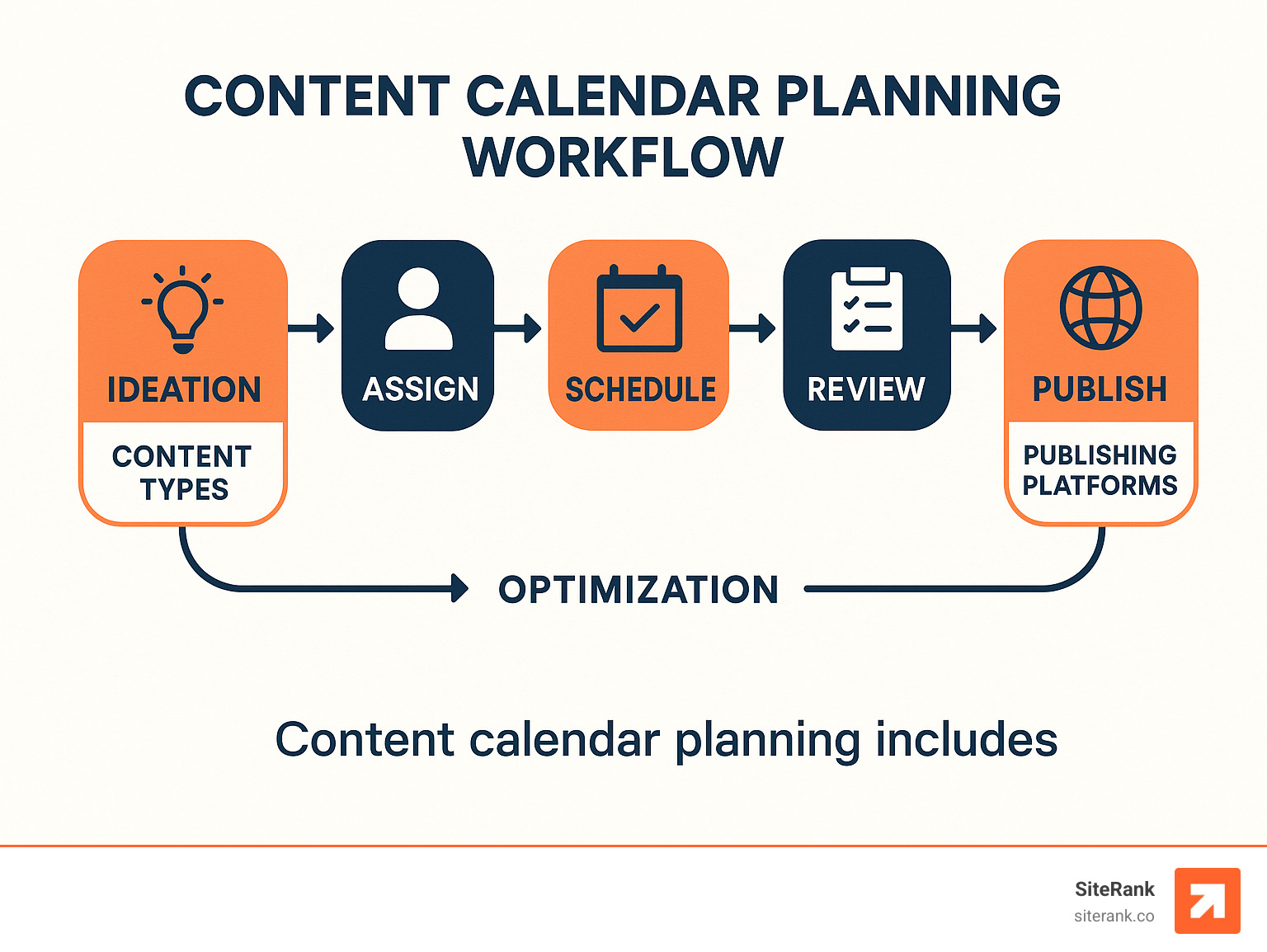
Here’s what effective content calendar planning includes:
- Clear publishing schedule – When and where content will be published
- Content types and themes – Blog posts, social media, videos, emails
- Assigned responsibilities – Who creates, edits, and publishes
- Production milestones – Draft dates, review periods, publish dates
- Promotion strategy – How content will be distributed after publishing
If you’ve ever found yourself scrambling to publish content at the last minute or struggling to maintain consistency in your marketing efforts, you’re not alone. One in eight social media marketers at small businesses report difficulty posting content consistently, while one in nine find it challenging to create the necessary content in the first place.
“One of the hardest things about publishing content is doing it consistently,” and that’s exactly where a well-structured content calendar comes to the rescue.
A content calendar isn’t just a nice-to-have—it’s the backbone of any successful content strategy. It transforms scattered ideas into an organized plan that aligns with your business goals, keeps your team on the same page, and ensures you’re consistently delivering value to your audience.
I’m Craig Flickinger, founder of SiteRank.co with over 15 years of experience implementing content calendar planning strategies that have helped businesses of all sizes organize their digital marketing efforts and achieve sustainable growth.
Why You Need a Plan
Without a proper content calendar, your marketing efforts can quickly become disjointed and ineffective. Think of it like cooking a complex meal without a recipe—you might have all the ingredients, but without proper timing and coordination, the result will likely be disappointing.
Improved Visibility: A content calendar gives you a bird’s-eye view of your entire content strategy. You can spot gaps, avoid overlaps, and ensure a balanced mix of content types and topics.
Team Alignment: When everyone can see the same calendar, communication improves dramatically. As one content marketer at Buffer notes, “Having direct access to these designs to easily edit and schedule posts on our social media accounts all in Canva is amazing.” This level of transparency eliminates confusion and keeps everyone moving in the same direction.
Stress Reduction: Perhaps the most underrated benefit is the peace of mind that comes with knowing what’s coming next. No more last-minute scrambles or missed deadlines. Over 300,000 companies already use content calendar templates to plan their schedules and reduce the anxiety of content creation.
Content Calendar Planning 101

Before diving into the nitty-gritty details of what to publish and when, let’s take a moment to build a solid foundation for your content strategy. Think of this as laying the groundwork for a house that won’t collapse when the marketing winds blow!
A thoughtful approach to content calendar planning starts with understanding the bigger picture. What are you really trying to achieve with your content? Is it to educate your audience, generate leads, or establish thought leadership? Your calendar should reflect these goals rather than just filling up empty slots on a schedule.
Your publication cadence needs to match both your team’s capacity and your audience’s expectations. I’ve seen large companies successfully maintain a rhythm of 3-4 weekly blog posts alongside daily social media updates, while smaller teams thrive with a more modest but consistent approach of one quality blog post per week. Consistency trumps frequency every time!
Getting to know your audience is where the magic happens. I always encourage our clients at SiteRank to develop rich audience personas that go beyond basic demographics. What keeps your ideal customers up at night? What language do they use? Where do they hang out online? These insights will transform your content from merely acceptable to genuinely resonant.
Keyword mapping isn’t just an SEO checkbox—it’s a strategic approach to ensuring your content meets real human needs while also satisfying search engines. By thoughtfully mapping relevant keywords to specific content pieces in your calendar, you’re essentially creating a roadmap for visibility in search results.
When setting goals for your content, make them SMART: Specific, Measurable, Achievable, Relevant, and Time-bound. Instead of vague aspirations like “increase traffic,” aim for something concrete like “grow organic traffic by 15% in Q3 through our how-to content series.”
Core Benefits of Content Calendar Planning
The beauty of a well-structured content calendar goes far beyond simple organization. One of my favorite success stories involves a marketing team that boosted their content production by 40% without hiring additional staff—simply by implementing a thoughtful calendar that eliminated decision fatigue and creative blocks.
Brand consistency becomes almost effortless when your calendar serves as the single source of truth. Your audience begins to recognize your voice, your style, and your publishing rhythm, building the kind of trust that turns casual readers into loyal followers.
The cross-channel synergy that emerges from comprehensive planning is truly powerful. Imagine launching a new service: your blog post explains the benefits in depth, your social posts tease key points with engaging visuals, your email campaign delivers personalized use cases, and your podcast discusses the story behind its development—all coordinated through your content calendar.
Never again will brilliant content ideas get lost in the shuffle of daily operations. Effective backlog management through your calendar ensures that every valuable concept gets prioritized based on strategic importance, not just recency or whoever shouted loudest in the last meeting.
Key Components Every Content Calendar Needs
After helping dozens of businesses implement effective content systems, I’ve found that certain elements are non-negotiable for success:
Content type identification helps everyone understand what’s being created—whether it’s a detailed guide, a quick social post, or an in-depth video. This clarity is essential for resource allocation and maintaining a healthy mix of formats.
Clear ownership prevents that terrible moment when everyone assumes someone else is handling a crucial piece of content. Defining who’s responsible for creation, review, and publication eliminates confusion and builds accountability.
Draft and publish dates create the backbone of your production timeline. I recommend working backward from publication dates to set realistic draft deadlines that account for review cycles and revisions.
A visual status tracker transforms your calendar from a static document into a living workflow tool. When everyone can see at a glance whether a piece is in ideation, drafting, review, scheduled, or published, collaboration becomes significantly smoother.
Centralized links to assets save countless hours of hunting through drives and messages for that perfect image or reference document. Your future self (and team) will thank you for this simple but powerful organizational step.
Finally, a thoughtful promotion plan ensures your content doesn’t just disappear into the void after publication. Deciding in advance how each piece will be amplified—through social sharing, email features, or paid promotion—maximizes its impact and lifespan.
Building Your First Content Calendar – Step-by-Step
Ready to bring order to your content chaos? Let’s roll up our sleeves and create your first content calendar together. I’ve helped dozens of businesses transform their scattered content efforts into strategic powerhouses, and the process is simpler than you might think.
Step 1: Create an Idea Backlog
Start by gathering all those brilliant content ideas floating around in your team’s minds. Host a relaxed brainstorming session where everyone can contribute without judgment. Draw inspiration from keyword research, customer questions, support tickets, industry trends, or even competitor content. The goal isn’t perfection—it’s abundance. Create a central repository where these ideas can live until they’re ready for prime time.
Step 2: Select Your Channels
Not all content belongs everywhere. Take a thoughtful look at where your audience spends their time and which platforms align with your business goals. Your blog might be perfect for in-depth guides, while Instagram could showcase your visual content, and LinkedIn might host your thought leadership pieces. Be strategic rather than spreading yourself too thin—it’s better to excel on three channels than to be mediocre on ten.
Step 3: Develop a Timing Strategy
How often should you publish? The answer varies widely based on your team’s capacity and your audience’s appetite. A small team might start with one quality blog post weekly and daily social updates, while larger organizations could aim for multiple pieces daily across channels. Consistency trumps frequency—your audience should know when to expect fresh content from you.
Step 4: Balance Evergreen and Timely Content
A well-rounded content calendar is like a good investment portfolio—diversified for long-term success. Evergreen content provides lasting value and continues to attract traffic months or even years after publication. Timely content captures seasonal interests or responds to current events. Aim for about 70% evergreen and 30% timely content to build a sustainable library while staying relevant and fresh.
Step 5: Incorporate Campaign Milestones
Your bigger marketing initiatives deserve special attention in your content calendar. Map out product launches, seasonal promotions, or special events, then surround these milestones with supporting content. This might include teaser posts, announcement pieces, how-to guides, and follow-up success stories—all carefully timed to maximize campaign impact.
Want to ensure your content performs well in search engines? Our guide on Mastering Content for SEO: A Quick Guide offers practical tips to boost your visibility.
Content Calendar Planning Step-by-Step Workflow
With your foundation in place, establish this ongoing workflow to keep your content calendar planning running smoothly:
Brainstorm regularly with diverse team members to generate fresh ideas. Marketing sees one perspective, but customer service, sales, and product teams bring invaluable insights about what your audience truly needs.
Prioritize your ideas based on alignment with business goals, audience interest, and resource requirements. Not every idea deserves immediate attention—focus on content that moves the needle for your business while solving real customer problems.
Assign clear responsibilities to team members based on their strengths. Be explicit about who writes, designs, edits, and approves each piece, with reasonable deadlines for each stage.
Schedule content with buffer time built in. If your blog post publishes on Wednesday, perhaps the first draft is due the previous Monday, edits by Tuesday, and final approval Wednesday morning. This breathing room prevents last-minute scrambles.
Review content thoughtfully against your quality standards. Does it deliver value? Is it accurate? Does it reflect your brand voice? A structured review process maintains consistency and excellence.
Approve final pieces through designated gatekeepers who understand both your brand standards and business objectives. This final checkpoint ensures nothing slips through that might undermine your reputation.
As one marketing director told me, “Our team meetings went from chaotic idea-tossing to focused discussions about performance and optimization once we implemented this workflow.” The difference is palpable.
Aligning Your Calendar With Business Goals
Your content calendar isn’t just an organizational tool—it’s a strategic business asset that should directly support your objectives:
OKRs (Objectives and Key Results) provide the perfect framework for content planning. If your objective is increasing qualified leads by 25%, your content calendar should include bottom-of-funnel assets like case studies, comparison guides, and demo videos, with clear paths to conversion.
Funnel Stages should be represented across your calendar. Top-of-funnel content educates and entertains, middle-of-funnel content demonstrates your expertise and solutions, while bottom-of-funnel content addresses objections and facilitates decisions. A balanced calendar nurtures prospects through their entire journey.
Lead Generation Targets deserve dedicated content types. At SiteRank, we help clients create high-converting assets like webinars, downloadable templates, and assessment tools—all strategically placed throughout the calendar to maintain a steady flow of new prospects.
The magic happens when your content calendar planning directly supports business outcomes. One e-commerce client saw a 32% increase in conversion rates after we realigned their content calendar to focus on addressing common purchase objections at precisely the right time in the buying cycle.
A great content calendar isn’t about filling slots—it’s about creating purposeful content that moves your business forward while genuinely helping your audience.
Tools & Templates to Streamline the Process

Let’s face it—even the best content calendar planning strategy needs the right tools to bring it to life. Think of these tools as the difference between trying to build furniture with a butter knife versus having a proper toolkit. Here’s what’s working for teams right now:
Most teams start with spreadsheets like Google Sheets or Excel. They’re the comfortable old sneakers of content planning—familiar, flexible, and free (or nearly so). I’ve seen small businesses run their entire content operation from a single well-organized spreadsheet, and it works beautifully for them.
As you grow, you might find yourself gravitating toward project management boards. Tools like Trello, Asana, and ClickUp offer that satisfying visual experience of moving content cards from “Brainstorming” to “In Progress” to “Published.” There’s something oddly satisfying about dragging that card into the “Done” column!
The real game-changers, though, are automation tools that handle repetitive tasks. Why manually post to social media when Buffer can schedule it for you? Why send endless “is this ready yet?” emails when your system can automatically notify the next person in line?
Smart integrations make everything flow more smoothly. When your calendar connects directly to WordPress, your social media scheduler, and your analytics platform, you create a seamless ecosystem where content moves effortlessly from conception to publication to measurement.
Two standout options worth exploring are Notion with its infinitely customizable workspace that functions like your team’s second brain, and good old reliable Google Sheets which continues to be the workhorse of content teams everywhere.
Comparing Spreadsheets and PM Tools
| Feature | Spreadsheets (Google Sheets, Excel) | Project Management Tools (Asana, Trello, ClickUp) |
|---|---|---|
| Cost | Free to low-cost | Free tiers to premium subscriptions |
| Learning Curve | Low – most people familiar | Moderate – requires some training |
| Collaboration | Good – comments, simultaneous editing | Excellent – built for team workflows |
| Visualization | Limited – mostly tabular | Strong – Kanban boards, Gantt charts |
| Automation | Limited – basic formulas | Extensive – workflows, triggers, integrations |
| Notifications | Basic – email notifications | Comprehensive – in-app, email, mobile |
| Customization | Moderate – formatting options | High – custom fields, views, workflows |
| Reporting | Basic – charts and pivots | Advanced – dashboards, analytics |
Choosing the Right Template for Your Team
Finding the perfect template is a bit like dating—what works beautifully for one team might be completely wrong for another. Here’s how to find your match:
For team size, think about communication needs. I’ve noticed our larger clients at SiteRank need templates with crystal-clear role assignments and approval pathways to prevent confusion. Meanwhile, smaller teams thrive with streamlined templates that don’t overwhelm with unnecessary fields.
Your content volume matters tremendously. If you’re publishing 30+ pieces monthly, you need a robust system that won’t buckle under pressure. Look for templates with strong filtering capabilities so you can focus on just today’s tasks or just the blog content when needed.
The approval layers in your organization should directly influence your choice. A template that works for a solo content creator who publishes directly won’t work for teams where legal, brand, and executive approvals are needed. As one of our clients memorably put it, “We need a template that shows exactly whose court the ball is in at all times.”
Don’t forget about analytics needs. The best templates include spaces to track performance after publication. This closes the loop on your content calendar planning and helps inform future decisions based on what actually worked.
I’ve heard countless testimonials about different systems, from “Trello’s template saved our social media team from certain doom” to “Asana’s task assignment feature eliminated our endless ‘who’s doing what’ meetings.” The right template isn’t just a productivity tool—it’s a sanity-saver.
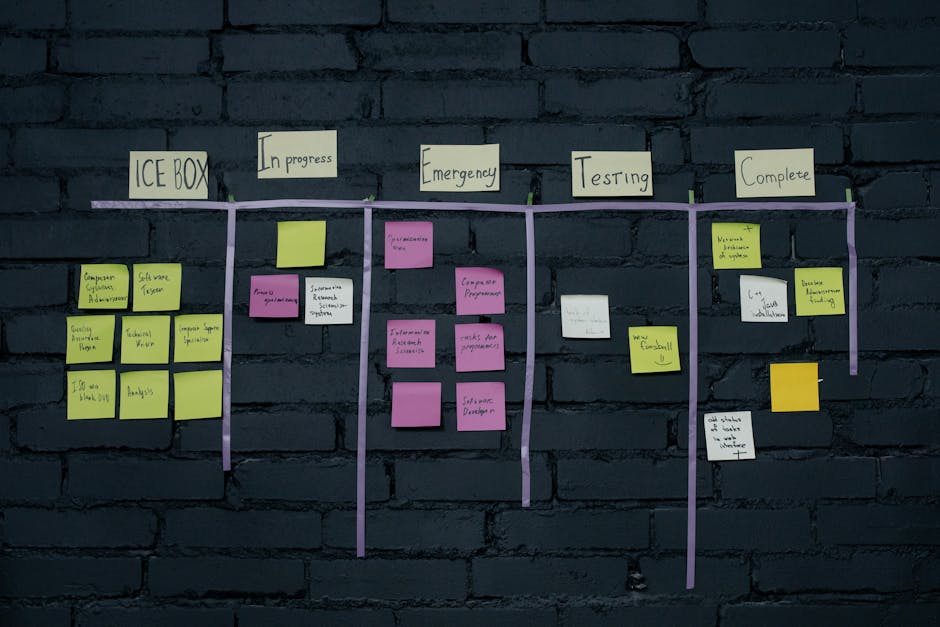
Kanban boards like this one have revolutionized how many teams visualize their content pipeline. The beauty lies in their simplicity—you can instantly see where bottlenecks are forming or which stages need attention.
The visual planning aspect helps team members grasp the big picture at a glance. Rather than scrolling through endless rows of a spreadsheet, you can see exactly what’s cooking in each stage of your process.
With drag-and-drop scheduling, updating status becomes almost fun. There’s something satisfying about moving a card from “In Progress” to “Published” that a simple checkbox can’t match. It creates a tangible sense of progress that keeps teams motivated.
The flexible organization options—color-coding by content type, campaign, or team member—allow for intuitive organization that makes sense to visual thinkers. One marketing director told me, “I finally understand our content pipeline now that I can see it all laid out this way.”
At SiteRank, we’ve guided dozens of clients through the tool selection process, and we’ve found that the best choice isn’t always the most sophisticated one—it’s the one your team will actually use consistently. Sometimes that’s a simple spreadsheet, and sometimes it’s a fully-featured project management system. What matters is finding the right fit for your unique workflow.
Measuring Success & Optimizing the Calendar

So you’ve built your content calendar – congratulations! But the journey doesn’t end here. In fact, this is where things get really interesting. The true power of content calendar planning emerges when you start measuring results and fine-tuning your approach.
Think of your content calendar as a living document that grows smarter over time. When we work with clients at SiteRank, we always emphasize that the initial calendar is just version 1.0 – it’s what you learn and how you adapt that creates lasting success.
Let’s talk about what to measure. Your KPIs should directly connect to your business goals. If you’re focused on brand awareness, metrics like page views and social shares matter most. For lead generation, you’ll want to track form completions and conversion rates. Revenue-focused teams should follow the money – actual sales attributed to content.
Engagement metrics tell you whether your content resonates with readers. Are they spending time with your articles, leaving thoughtful comments, or bouncing quickly? This feedback is gold for understanding what topics truly matter to your audience.
The SEO impact of your content deserves special attention. We’ve seen clients transform their traffic by consistently tracking keyword rankings and organic visibility. One e-commerce client finded that their how-to guides were driving more qualified traffic than their product-focused content – a revelation that completely reshaped their content calendar planning.
Regular content audits might sound tedious, but they’re actually quite revealing. Set a quarterly reminder to review what you’ve published and how it performed. This review often uncovers surprising patterns – perhaps your Tuesday posts consistently outperform Friday content, or video tutorials generate twice the engagement of text-only guides.
The beauty of a data-informed approach is that you can make iterative improvements. Small tweaks based on real evidence add up to significant gains over time. As one of our clients put it: “We stopped guessing what would work and started knowing.”
Don’t overlook the power of repurposing. Your best-performing assets deserve extended life. That comprehensive guide that readers love? Transform it into a webinar, an infographic, or a series of social posts. Smart repurposing stretches your resources while reinforcing key messages across channels.
Content Calendar Planning Optimization Loop
The most successful content teams accept a continuous improvement cycle that looks something like this:
Track everything that matters – not just vanity metrics, but indicators that connect to business outcomes. Use Google Analytics for website behavior, social platforms’ native analytics for engagement, and your CRM to connect content to conversions. The goal is to build a complete picture of how your content performs across the entire customer journey.
Analyze with curiosity and an open mind. Look beyond the obvious numbers to find meaningful patterns. We recently helped a B2B client find that their longest-form content (3000+ words) was actually generating the highest engagement rates, contradicting their assumption that busy professionals preferred quick reads.
Refine your content calendar planning based on these insights. This might mean adjusting your topic mix, experimenting with different formats, or shifting your publishing schedule to match your audience’s habits. One retail client found their weekend content consistently underperformed, so they reallocated those resources to Wednesday posts which showed higher engagement.
Scale what works by doubling down on proven winners. If your how-to videos consistently outperform your industry news roundups, the path forward is clear. This doesn’t mean abandoning experimentation, but rather making informed bets with your limited resources.
The performance dashboard shown above is the kind of visual tool that makes this optimization process more intuitive. At a glance, you can spot traffic trends that might correlate with specific content types or topics. Your top-performing assets become immediately apparent, providing clear direction for future planning. And conversion metrics keep your content strategy firmly connected to business outcomes.
At SiteRank, we’ve seen how this data-driven approach transforms content from a creative exercise into a business growth engine. The most successful teams treat their content calendar planning as an evolving practice – always measuring, learning, and improving. With each cycle, your content becomes more effective at reaching and resonating with the audiences that matter most to your business.
Frequently Asked Questions about Content Calendar Planning
What’s the difference between a content calendar and a social media calendar?
I get this question a lot, and it’s an important distinction to understand. While they might seem similar at first glance, these planning tools serve different purposes in your marketing ecosystem.
A content calendar casts a much wider net. It’s your master plan for all content across every channel—your blog posts, videos, downloadable guides, email newsletters, and yes, social media too. Think of it as the command center for your entire content operation.
In contrast, a social media calendar zooms in specifically on what you’ll post across platforms like Instagram, LinkedIn, Twitter, and Facebook. It’s more granular and platform-specific.
The metrics you track differ as well. With a comprehensive content calendar planning approach, you’re typically looking at broader business impacts: website traffic, lead generation, conversion rates, and revenue. Social calendars tend to focus on engagement metrics like likes, shares, comments, and follower growth.
As one social media strategist put it so well: “A general content calendar is your strategic overview of all content types across channels, while a social media calendar is your tactical playbook specifically for social platforms.”
How far in advance should you schedule content?
There’s no one-size-fits-all answer here, but I can give you some practical guidelines we use with our clients at SiteRank.
Lead time is your first consideration. Complex, research-heavy pieces or content requiring custom graphics and multiple approvals naturally need more runway than a quick social post. Be realistic about your production timeline.
Flexibility is equally important. The most effective content calendars leave breathing room for timely, responsive content. Many of our most successful clients aim for roughly 70% planned content and 30% reactive content that responds to industry news, trends, or opportunities.
Your industry’s trend-reactivity plays a role too. If you’re in fashion or tech where things change weekly, you’ll need more agility than, say, manufacturing or education where content can have a longer shelf life.
For most businesses, we recommend planning cornerstone content 3-6 months ahead (think major campaigns, seasonal content, and pillar pieces), with detailed scheduling for the upcoming 4-6 weeks. As one of our content strategists often reminds clients, “Six months is a useful planning horizon, but the best calendars have penciled-in flexibility.”
How can teams collaborate efficiently on one calendar?
Collaboration can make or break your content calendar planning efforts. Here’s how to keep everyone in sync without creating chaos:
Clearly defined roles are essential. Who’s responsible for strategy? Who creates, edits, designs, and publishes? When everyone knows their lane, the process flows much more smoothly.
Smart permissions settings prevent accidental changes while ensuring everyone can access what they need. Some team members might need full editing capabilities, while others just need viewing rights to stay informed.
Robust comments features create space for discussion without cluttering the calendar itself. This creates a valuable record of decisions and feedback that anyone can reference later.
I love Buffer’s approach to team collaboration: “We minimize meetings by holding bi-weekly editorial reviews and twice-monthly metric discussions. We use Slack threads for feedback and comment directly in our shared documents.” Their streamlined process shows how intentional communication channels can replace endless meetings.
At SiteRank, we’ve found that the right balance of structure and flexibility keeps teams aligned without restricting creativity. The best content calendars become living documents that teams actually use and trust, rather than rigid plans that get abandoned when reality intervenes.
Conclusion
Let’s face it – content marketing without a plan is like trying to build a house without blueprints. You might eventually get something standing, but the process will be chaotic and the results unpredictable. That’s why content calendar planning isn’t just a nice-to-have tool – it’s the foundation that transforms scattered content efforts into a cohesive strategy that actually moves the needle for your business.
Throughout this guide, we’ve explored how a well-structured content calendar does more than just organize your publishing schedule. It aligns your team, reduces stress, and ensures every piece of content you create serves a clear purpose in your marketing ecosystem.
The beauty of effective content calendar planning is that it’s not rigid – it’s a living system that grows and evolves with your business. Your calendar should have enough structure to provide clarity and consistency, while maintaining the flexibility to capitalize on timely opportunities and emerging trends.
The most successful content calendars share these qualities:
They’re directly tied to business objectives, ensuring every blog post, social update, and email contributes to your bottom line. They provide the perfect balance of structure and adaptability, with clear processes that still leave room for creativity. And most importantly, they’re continuously optimized based on performance data, getting more effective over time.
At SiteRank, we’ve helped businesses of all sizes transform their content marketing through strategic planning. We’ve seen how the right approach to content calendar planning can turn what was once a source of stress into a powerful engine for growth. Our clients often tell us the difference is night and day – moving from constant last-minute scrambles to a smooth, predictable content operation that delivers consistent results.
Ready to bring that same clarity and purpose to your content marketing efforts? Learn more about our services and find how we can help you develop a content calendar that turns planning into performance. ✨
Our team combines deep SEO expertise with practical content strategy to create customized calendars that align perfectly with your unique business goals. We don’t believe in one-size-fits-all templates or unnecessary deliverables – just practical, results-focused planning that empowers your marketing team to turn meticulous organization into measurable growth.