

Why Strategic Content Marketing Budget Planning Matters More Than Ever
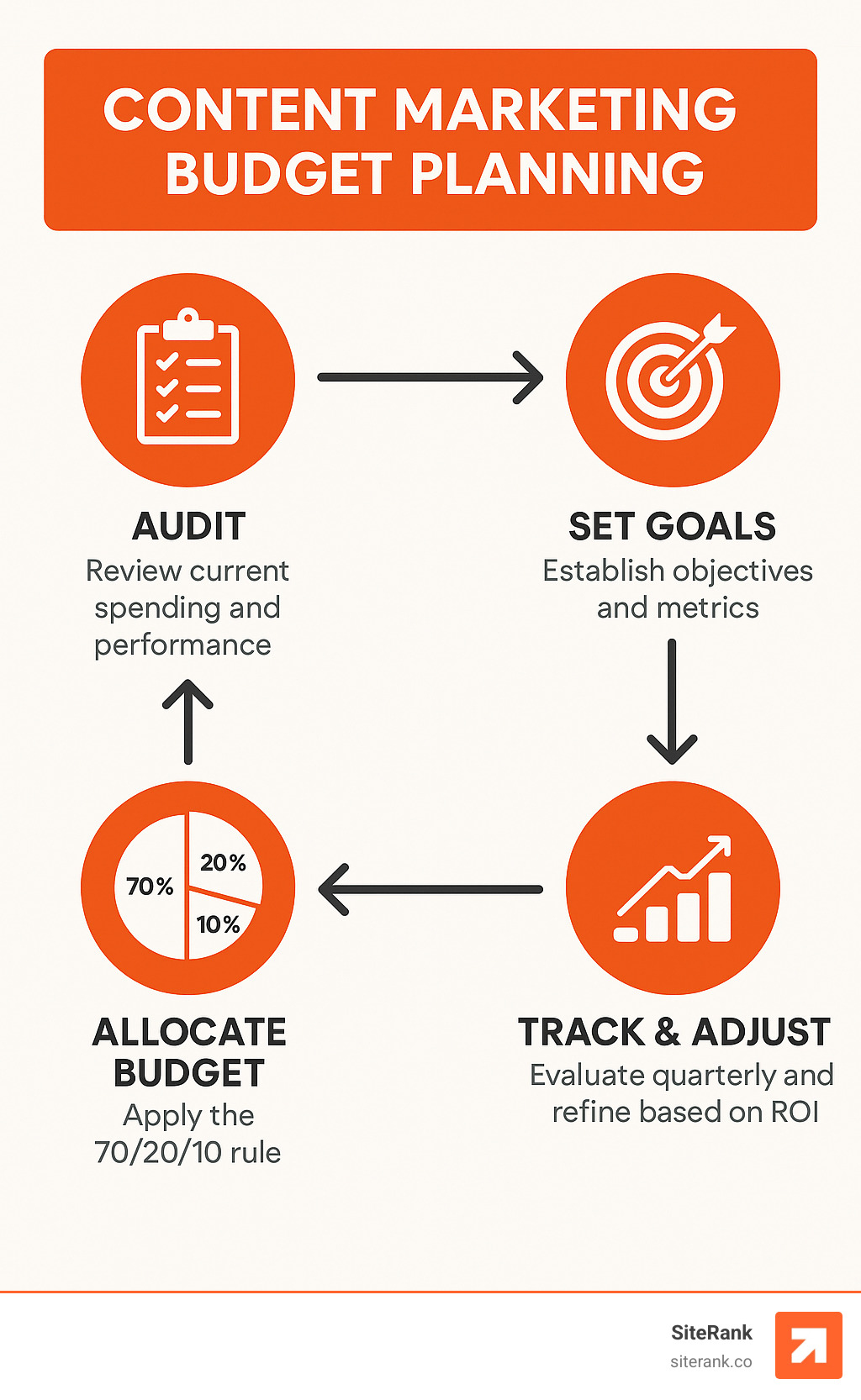
Content marketing budget planning is the strategic process of allocating your marketing dollars across content creation, distribution, and measurement to maximize ROI and achieve business growth.
Quick Budget Planning Framework:
• Set baseline: Audit current spend and identify gaps
• Define goals: Establish SMART objectives and success metrics
• Allocate wisely: Use 70/20/10 rule (proven/innovative/experimental)
• Track monthly: Monitor performance and adjust spending
• Measure ROI: Calculate cost per lead and customer lifetime value
If you asked marketers about their 2025 content marketing budget, you’d be hard-pressed to get a straight answer. The truth is, most businesses struggle with content marketing budget planning because they treat it as an afterthought rather than a strategic investment.
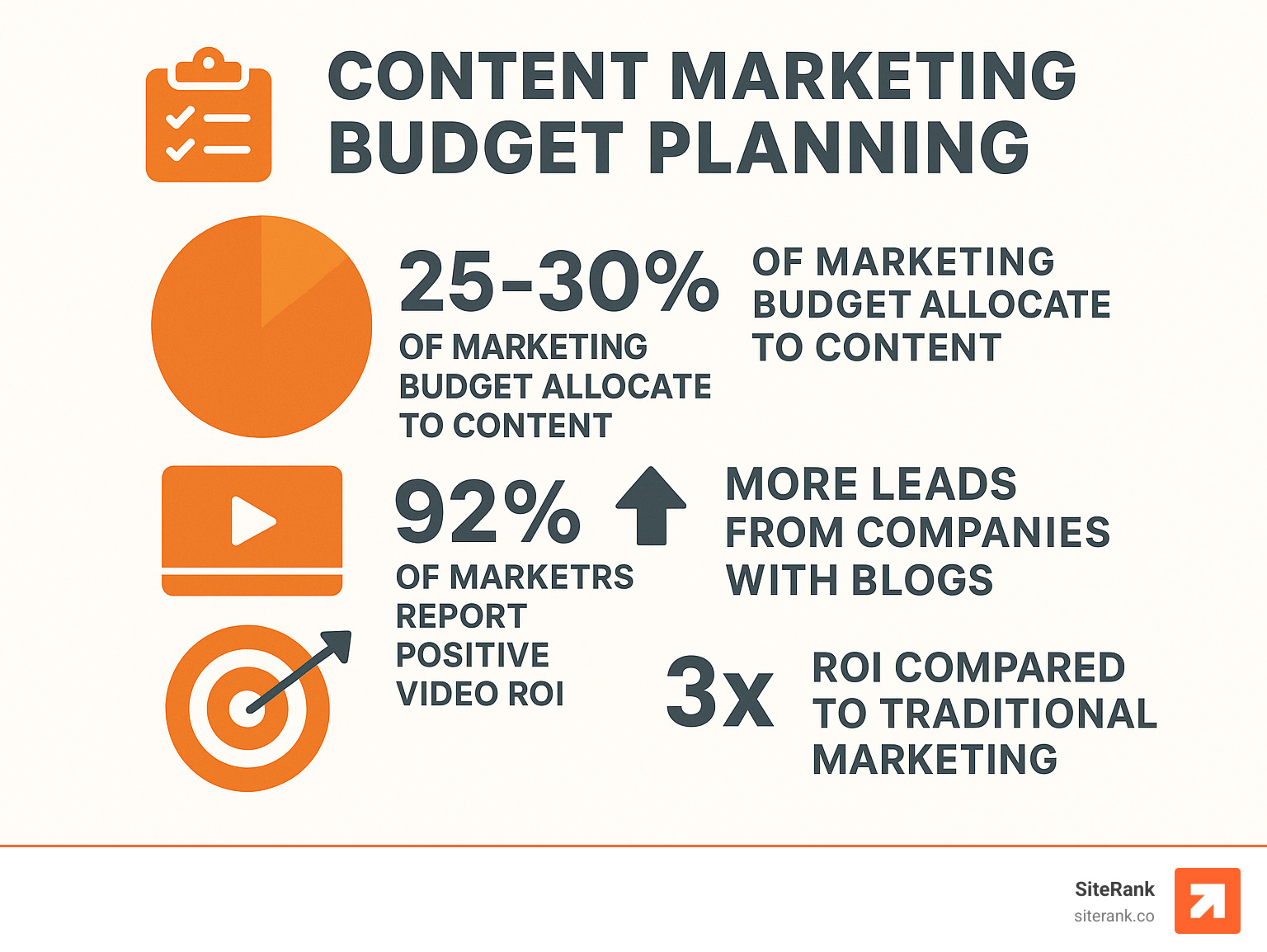
Recent data shows that companies allocate an average of 25-30% of their total marketing budget to content marketing, yet nearly half lack a scalable model for content creation. With 50% of companies planning budget increases in 2024 and marketing accounting for 10.1% of overall company budgets, getting your content spend right has never been more critical.
The challenge isn’t just setting a number—it’s creating a framework that adapts to changing platform algorithms, audience behaviors, and business priorities. Whether you’re a solopreneur starting with $1,000 per month or an enterprise investing $50,000+, the key is aligning your budget with measurable outcomes rather than hoping for viral success.
I’m Craig Flickinger, founder of SiteRank, and I’ve spent over 15 years helping businesses optimize their digital marketing investments through data-driven SEO and content strategies. My experience with content marketing budget planning has shown me that companies who treat content as a strategic investment—not a cost center—consistently outperform competitors who wing it.
Content Marketing Budget Planning 101
Here’s the truth about content marketing budget planning: it’s not about copying what your competitor spends or picking a random percentage. It’s about understanding what actually works and building a budget that makes sense for your specific business.
Think of it like planning a road trip. You wouldn’t just throw gas money at your car and hope for the best. You’d map out your route, calculate fuel costs, and budget for unexpected detours. Your content marketing budget deserves the same strategic thinking.
What Is a Content Marketing Budget and Why Does It Matter?
A content marketing budget is your financial game plan for creating, publishing, and promoting content that connects with your audience. It’s not just about blog posts or social media—it covers everything from video production to email campaigns to the tools that make it all happen.
Here’s what makes this investment so powerful: content marketing generates 3 times as many leads as traditional marketing while costing 62% less. Companies that blog consistently see 67% more leads each month compared to those that don’t.
But here’s where most businesses trip up. They either blow their budget on flashy campaigns that don’t convert, or they pinch pennies on high-impact activities that could transform their business. Without proper planning, you’re essentially throwing darts blindfolded.
The smartest approach treats your content budget as a living, breathing part of your business strategy. Platforms change, audiences evolve, and new tools emerge. Your budget needs to be flexible enough to adapt while staying focused on what actually drives results.
How Big Should Your Content Budget Be?
The “perfect” content marketing budget depends on three key factors: your business size, where you are in your growth journey, and what’s normal in your industry.
Industry spending varies wildly. Finance companies typically invest around 9.5% of revenue on marketing, while retail businesses might spend 14.5% and consumer goods companies can go as high as 25%. Technology companies usually stick to 6-10% of revenue, and healthcare or professional services often land between 12-15%.
Your growth stage matters just as much. High-growth startups often allocate 15-30% of projected revenue to marketing (sometimes 30-50% of funds raised). Moderate growth businesses typically spend 10-15% of revenue, while stable, mature companies usually invest 2-10% of revenue, with industry averages ranging from 6.4% to 9.5% according to recent research.
Now here’s the content-specific insight that might surprise you: top-performing B2B companies dedicate 40% of their marketing budget to content creation and promotion. High-performing B2C companies allocate 38%. Compare that to average performers who only spend 23% (B2B) and 27% (B2C) on content.
Let’s make this real with some examples. A business generating $3 million in revenue should budget roughly $210,000-$240,000 for marketing overall, with $52,500-$63,000 specifically for content marketing. That might sound like a lot, but consider that major companies like Salesforce spend 46% of revenue on marketing and achieve 25% annual growth as a result.
The uncomfortable truth? Most businesses dramatically underinvest in content marketing. If you’re allocating less than 25% of your marketing budget to content, you’re probably leaving money on the table.
Ready to get started with proper planning? Download free budget templates that include industry-specific benchmarks to guide your decisions.
Step-by-Step Framework to Set and Stick to Your Budget
Now let’s dive into our proven five-step framework for content marketing budget planning that actually works in the real world.
Step 1: Content Marketing Budget Planning—Setting Your Baseline
Before you can plan forward, you need to understand where you’re starting. This baseline audit reveals hidden costs and optimization opportunities most businesses miss.
What to audit:
– Current content spend: List all content-related expenses from the past 12 months
– Content inventory: Catalog existing assets and their performance metrics
– Team costs: Calculate full-time salaries, freelancer fees, and agency retainers
– Tool subscriptions: Add up all content creation, management, and analytics platforms
– Promotion spend: Include paid social, sponsored content, and influencer partnerships
Hidden costs to include:
– Content publishing administration time
– Internal approval workflows and management overhead
– Content storage and hosting fees
– Stock photos, graphics, and licensing
– Training and professional development
Most businesses find they’re spending 20-30% more on content than they realized once they account for these hidden costs. This baseline becomes your starting point for optimization.
Step 2: Define Goals, Personas, and Success Metrics
Your content budget should directly support measurable business outcomes. Vague goals like “increase brand awareness” lead to vague spending and disappointing results.
SMART Content Goals Examples:
– Increase organic traffic by 25% within 12 months
– Generate 100 qualified leads per month through content
– Achieve 15% email list growth quarterly
– Improve customer retention by 10% through educational content
Success Metrics by Funnel Stage:
– Top of funnel: Organic traffic, social shares, brand mention volume
– Middle of funnel: Email subscribers, content downloads, time on page
– Bottom of funnel: Content-attributed leads, sales-qualified opportunities, customer lifetime value
Research shows that 94% of marketers say personalization increases sales and 96% say it encourages repeat purchases. Your budget should reflect this by allocating funds for audience research, persona development, and content customization.
For more strategic guidance, check out our Content Calendar Planning resource.
Step 3: Allocate Funds Using the 70/20/10 Rule
This proven framework helps you balance proven tactics with innovation and experimentation:
70% – Proven Tactics:
– Blog content that drives consistent organic traffic
– Email newsletters with established engagement rates
– Social media posts on your highest-performing platforms
– SEO-optimized content targeting your best-converting keywords
20% – Innovative Strategies:
– New content formats (podcasts, interactive content, webinars)
– Emerging platforms where your audience is growing
– Advanced personalization and automation tools
– Strategic partnerships and co-marketing initiatives
10% – Experimental Initiatives:
– Trending platforms like TikTok or new social features
– AI-powered content creation and optimization
– Cutting-edge formats (AR/VR, interactive videos)
– Completely new audience segments or markets
This allocation ensures you maintain reliable results while staying ahead of industry changes. Companies that reserve budget for experimentation are better positioned to capitalize on new opportunities before competitors.
Step 4: Build Monthly & Quarterly Trackers
Content marketing budget planning requires ongoing monitoring, not annual “set it and forget it” approaches. Here’s how to build tracking systems that actually get used:
Monthly Budget Tracker Components:
– Planned vs. actual spend by category
– Content production costs per piece
– Promotion spend and reach metrics
– Tool and subscription expenses
– Freelancer and agency payments
Quarterly Performance Reviews:
– ROI analysis by content type and channel
– Cost per lead and customer acquisition costs
– Content performance trends and seasonal patterns
– Budget variance analysis and reallocation opportunities
Key metrics to track monthly:
– Cost per piece of content created
– Organic traffic growth and content attribution
– Social engagement rates and reach
– Email list growth and engagement metrics
– Lead generation and sales attribution
The most successful content marketers we work with review their budgets monthly and make quarterly adjustments based on performance data. This agile approach helps them reallocate funds from underperforming initiatives to high-ROI opportunities quickly.
Step 5: Agile Content Marketing Budget Planning & Adjustment
Your budget should evolve with your results. Here’s how to make data-driven adjustments without losing strategic focus:
Performance Review Questions:
– Which content types generate the highest ROI?
– What channels deliver the best cost per lead?
– Where are we overspending relative to results?
– What new opportunities should we test with experimental budget?
Reallocation Triggers:
– A content type consistently underperforms for 2+ months
– A new channel shows 50%+ better engagement than established ones
– Seasonal trends require temporary budget shifts
– Competitive landscape changes demand strategic pivots
Scenario Planning:
Build three budget scenarios—conservative, expected, and aggressive—so you can quickly adapt to changing business conditions or unexpected opportunities. This preparation prevents knee-jerk budget cuts that damage long-term content performance.

Smart Allocation Across Channels and Formats
With your framework in place, let’s dive into the tactical allocation decisions that separate successful content programs from expensive experiments.
Prioritize High-ROI Content Types
Recent data reveals clear winners in content ROI that should guide your content marketing budget planning:
Video Content: 92% of marketers report positive ROI from video, with 56% of content marketers prioritizing short-form video as their top investment trend. However, production costs vary dramatically:
– Simple social videos: $50-$500
– Professional explainer videos: $1,000-$10,000
– Animated content: $500-$1,000
Blog Content: Companies using blogs generate 67% more leads monthly. SEO-optimized blog posts cost $400-$1,000 but provide compound returns through organic search traffic. Our Mastering Content for SEO guide shows how to maximize this investment.
Email Marketing: Segmented emails achieve 30% more opens and 50% more clickthroughs. With 95% of marketers finding GenAI effective for email marketing, this channel offers both high ROI and efficiency gains.
Influencer Partnerships: 69% of consumers trust influencer recommendations over brand messages, and 36% of marketers say influencer content outperforms brand-created content. Budget $1,000-$10,000+ depending on influencer tier and campaign scope.
Balance Creation vs Promotion Spend
One of the biggest mistakes in content marketing budget planning is the 80/20 split favoring creation over promotion. The most successful programs flip this ratio or at least achieve 50/50 balance.
Creation Costs (40-50% of budget):
– Content strategy and planning
– Writing, design, and video production
– Editing and quality assurance
– Content management and publishing
Promotion Costs (50-60% of budget):
– Paid social media advertising
– Search engine marketing
– Influencer partnerships and sponsored content
– Email marketing tools and automation
– SEO tools and optimization
Why promotion matters: Over 90% of online content gets no organic traffic. Without dedicated promotion budget, even excellent content remains invisible. Plan to spend as much promoting your content as creating it.
According to scientific research on social media reach, organic reach continues declining across platforms, making paid promotion essential for content visibility.
Tools & Team: Where the Money Really Goes
Essential Tool Categories and Costs:
– Content management systems: $50-$500/month
– Analytics and reporting: $100-$500/month
– Design and video tools: $20-$100/month
– SEO and keyword research: $100-$400/month
– Social media management: $50-$300/month
– Email marketing platforms: $50-$500/month
Team Structure by Budget Level:
– $1,000-$5,000/month: Freelance writers and designers, basic tools
– $5,000-$15,000/month: Junior content manager, specialized freelancers
– $15,000-$50,000/month: Content team with manager, writers, designers
– $50,000+/month: Full content department with specialists and agencies
AI and Automation: 77% of marketers use GenAI to personalize content, and 71% say it improves customer understanding. Budget $50-$200/month for AI tools that can reduce content creation costs by 20-40% while maintaining quality.

Measuring ROI & Avoiding Budget Pitfalls
The ultimate test of your content marketing budget planning is measurable business impact. Here’s how to prove value and avoid common costly mistakes.
Proving Value to Stakeholders
Key ROI Metrics to Track:
– Customer Acquisition Cost (CAC) by content channel
– Customer Lifetime Value (LTV) from content-driven leads
– Revenue attribution to specific content pieces
– Cost per lead across content types
– Organic traffic value based on equivalent paid search costs
Executive Dashboard Elements:
– Monthly content-driven lead volume and quality scores
– Quarterly revenue attribution and ROI calculations
– Year-over-year organic traffic and ranking improvements
– Competitive content performance benchmarks
– Budget efficiency metrics (cost per result by channel)
Research shows that content marketing brings in 3 times as many leads as traditional marketing while costing significantly less. Use this benchmark to demonstrate your program’s efficiency relative to other marketing investments.
Common Budgeting Mistakes to Dodge
Mistake #1: Spreading Budget Too Thin
Trying to be everywhere at once dilutes impact. Focus on 3-4 high-performing channels rather than 8-10 mediocre ones.
Mistake #2: Under-funding Analytics
Only 51% of content marketers effectively measure performance. Allocate 5-10% of budget to measurement tools and analysis to optimize the other 90%.
Mistake #3: Ignoring Content Repurposing
Creating everything from scratch wastes budget. Plan 20-30% of content from repurposing existing high-performers into new formats.
Mistake #4: Treating Content Budget as “Leftovers”
Content should be a strategic priority, not what’s left after other marketing expenses. Successful companies budget content first, then allocate remaining funds.
Mistake #5: Annual Budget Rigidity
Platform algorithms and audience behaviors change quarterly. Build flexibility into your budget for rapid reallocation based on performance data.
Money-Saving Tactics Without Losing Impact
Evergreen Content Strategy: Invest 60% of creation budget in evergreen content that drives results for years. Our analysis shows evergreen pieces generate 10x more long-term value than trending content.
Content Repurposing System: Transform one comprehensive piece into 8-12 smaller assets:
– Blog post → Social media series → Email newsletter → Podcast episode → Video clips → Infographic → Case study → Webinar
AI-Powered Efficiency: Use AI for research, outlining, and editing to reduce content creation time by 30-50%. This allows the same budget to produce more high-quality content.
Batch Production: Create content in batches to reduce setup costs and improve consistency. Batch video shoots, photography sessions, and writing sprints to maximize time and budget efficiency.
For more optimization strategies, explore our 10 Content Optimization Tips guide.
Frequently Asked Questions about Content Marketing Budget Planning
Let’s tackle the most common questions I hear from business owners about content marketing budget planning. These are the real concerns that keep marketers up at night—and the practical answers that actually work.
How often should I review my budget?
Here’s what I’ve learned after years of helping businesses optimize their content spend: monthly check-ins and quarterly deep dives strike the perfect balance between staying responsive and avoiding analysis paralysis.
Your monthly reviews should be quick but focused. Look at your actual spending versus what you planned, check which content pieces are driving the best results, and spot any immediate opportunities to shift money around. Think of it like checking your bank account—you want to catch problems early, not find them months later.
Quarterly reviews are where the real magic happens. This is when you can step back and see the bigger picture. Which channels are consistently outperforming? Where are you throwing good money after bad? What market changes require a strategic pivot?
I’ve seen too many businesses stick with annual budget planning only to miss major opportunities or waste months on tactics that stopped working. The companies that win at content marketing treat their budgets like living documents, not stone tablets.
What percentage should go to paid promotion?
The old “build it and they will come” approach to content is dead. With organic reach declining across all platforms, you need to budget for promotion from day one.
Start with 20-30% of your content budget dedicated to paid promotion as your baseline. But here’s the key—this isn’t a magic number that works for everyone. Your ideal split depends on your specific goals and what you find through testing.
If you’re focused on brand awareness and reaching new audiences, consider bumping promotion to 40-50% of your budget. The investment in visibility often pays off through increased organic findy later. For lead generation campaigns, 30-40% promotion typically works well because you can directly measure the return on ad spend.
Companies prioritizing long-term SEO and organic growth might allocate just 20-30% to promotion, investing more heavily in creating comprehensive, search-optimized content that compounds over time.
The smartest approach? Start with 30% promotion budget, measure your results for three months, then adjust based on what delivers the best ROI for your specific business. I’ve seen companies find their sweet spot anywhere from 15% to 60% depending on their industry and goals.
How do I calculate content marketing ROI?
Calculating content marketing ROI feels complicated, but it doesn’t have to be. The basic formula is straightforward: take the revenue you can attribute to content, subtract your content costs, divide by those costs, then multiply by 100 for your percentage.
The tricky part isn’t the math—it’s the attribution. How do you know which content pieces actually drove sales? This is where most businesses get stuck, but there are practical ways to figure it out.
First-touch attribution gives all the credit to the first piece of content someone engaged with. It’s simple but often undervalues the content that actually closes deals. Last-touch attribution does the opposite—it credits whatever content someone consumed right before buying. This can make your bottom-funnel content look like superstars while ignoring the awareness-building work.
The most accurate approach is multi-touch attribution, which spreads credit across all the content touchpoints in someone’s journey. If that sounds too complex, try time-decay attribution—it gives more credit to recent content interactions while still acknowledging earlier touchpoints.
When calculating your costs, include everything: content creation, team salaries, freelancer fees, tool subscriptions, and all your promotion spending. Don’t forget about analytics tools and the time your team spends managing the process.
Track these numbers monthly but calculate ROI quarterly for the most meaningful insights. Content marketing often has a longer sales cycle than other channels, so quarterly reviews give you a clearer picture of what’s actually working.
The businesses I work with that excel at content marketing ROI don’t just measure it—they use it to make better decisions about where to invest next.
Conclusion
Building an effective content marketing budget planning strategy feels overwhelming at first, but it doesn’t have to be. The truth is, there’s no magic number that works for every business. What matters is creating a framework that grows with your company and consistently delivers results you can measure.
Think of your content budget as a living, breathing part of your business strategy. The most successful companies we’ve worked with treat content as a strategic investment that pays dividends over time, not just another expense to minimize. They understand that content marketing budget planning requires patience, testing, and continuous refinement.
Here’s what we’ve learned from helping hundreds of businesses optimize their content investments: start with solid benchmarks, then make them your own. Allocate 25-30% of your marketing budget to content if you want to stay competitive, or push it to 40% if you’re serious about outpacing your competition. Use the 70/20/10 rule to balance what’s working with what could work even better.
The 50/50 split between creation and promotion might feel counterintuitive, but it’s where most businesses find their sweet spot. Your amazing content can’t drive results if nobody sees it, and promotion ensures your investment reaches the people who matter most.
Remember to review your budget monthly and adjust quarterly. Markets change, platforms evolve, and what worked last quarter might not work next quarter. The businesses that thrive are the ones that stay nimble while keeping their eyes on long-term goals.
At SiteRank, we’ve seen how AI-powered SEO strategies can stretch content budgets further while delivering better results. Our approach focuses on the high-impact activities that move the needle for your specific business, eliminating the guesswork that drains budgets without delivering value.
Your content marketing doesn’t have to be perfect from day one. Start with these frameworks, measure what matters, and adjust based on real data from your real audience. Learn more about our services to find how our custom approach can help you maximize every dollar you invest in content.
The best content marketing budget is one that evolves with your business, adapts when opportunities arise, and consistently delivers measurable results. Start where you are, use what you have, and build something that grows stronger over time.