

Why Traditional Rank Tracking Fails: Shifting to Revenue-First Trades SEO Performance Tracking
Many trade business owners fall into the trap of viewing SEO as a standard monthly expense receipt rather than an appreciating revenue investment. They receive a 20-page monthly PDF from an agency showcasing arbitrary keyword rankings and total impression numbers. However, traditional rank tracking is fundamentally flawed for local home services.
Search results in 2026 are heavily dynamic, hyper-localized, and personalized. A customer standing three blocks away from your workshop using an iPhone sees a completely different search engine results page (SERP) than someone searching from a desktop ten miles away. Furthermore, relying on a single “average ranking position” is like trying to hit a moving target while wearing a blindfold.
| Vanity SEO Metrics (Expense Mindset) | Revenue-Generating Metrics (Investment Mindset) |
|---|---|
| Overall website impressions & clicks | Qualified organic phone calls & form fills |
| Generic average keyword position | Non-branded money keyword cluster rankings |
| Total raw website sessions | Conversion rate by high-intent landing page |
| National blog traffic (DIY queries) | Local Map Pack visibility in target service zip codes |
| Unqualified monthly lead counts | Total booked jobs and completed revenue |
When you treat digital marketing as an expense, you look for ways to cut costs. When you shift to an investment mindset, you track trades SEO performance tracking back to actual closed revenue, giving you the confidence to scale up what works.
Measuring Booked Revenue Over Keyword Positions
If your SEO efforts bring 10,000 visitors to a blog post titled “How to Bleed a Radiator Yourself,” but zero of those visitors live in your service territory or hire you, that traffic is practically worthless. Conversely, 500 local visitors landing on your emergency boiler repair page converting at 10% will transform your bottom line.
To tie organic search directly to closed sales, you must implement closed-loop lead attribution. Every incoming phone call and web submission needs a tracked lead status inside your CRM (e.g., Good Fit, Out of Area, Price Shopper, Spam, Booked Estimate, Completed Job).
By connecting search traffic to your CRM, you calculate true organic ROI:
$$text{SEO ROI} = frac{text{Organic Booked Revenue} – text{Total SEO Spend}}{text{Total SEO Spend}} times 100$$
To dive deeper into setting up a high-converting lead engine, check out The Ultimate Guide to Contractor Lead Gen Success.
Navigating AI Overviews and Zero-Click Searches in Trades SEO Performance Tracking
Google SERPs increasingly feature AI Overviews, interactive Map Packs, local ads, and “People Also Ask” accordions. This evolution has created a massive rise in zero-click searches—searches where the user gets their answer directly on the Google search results page without ever visiting your site.
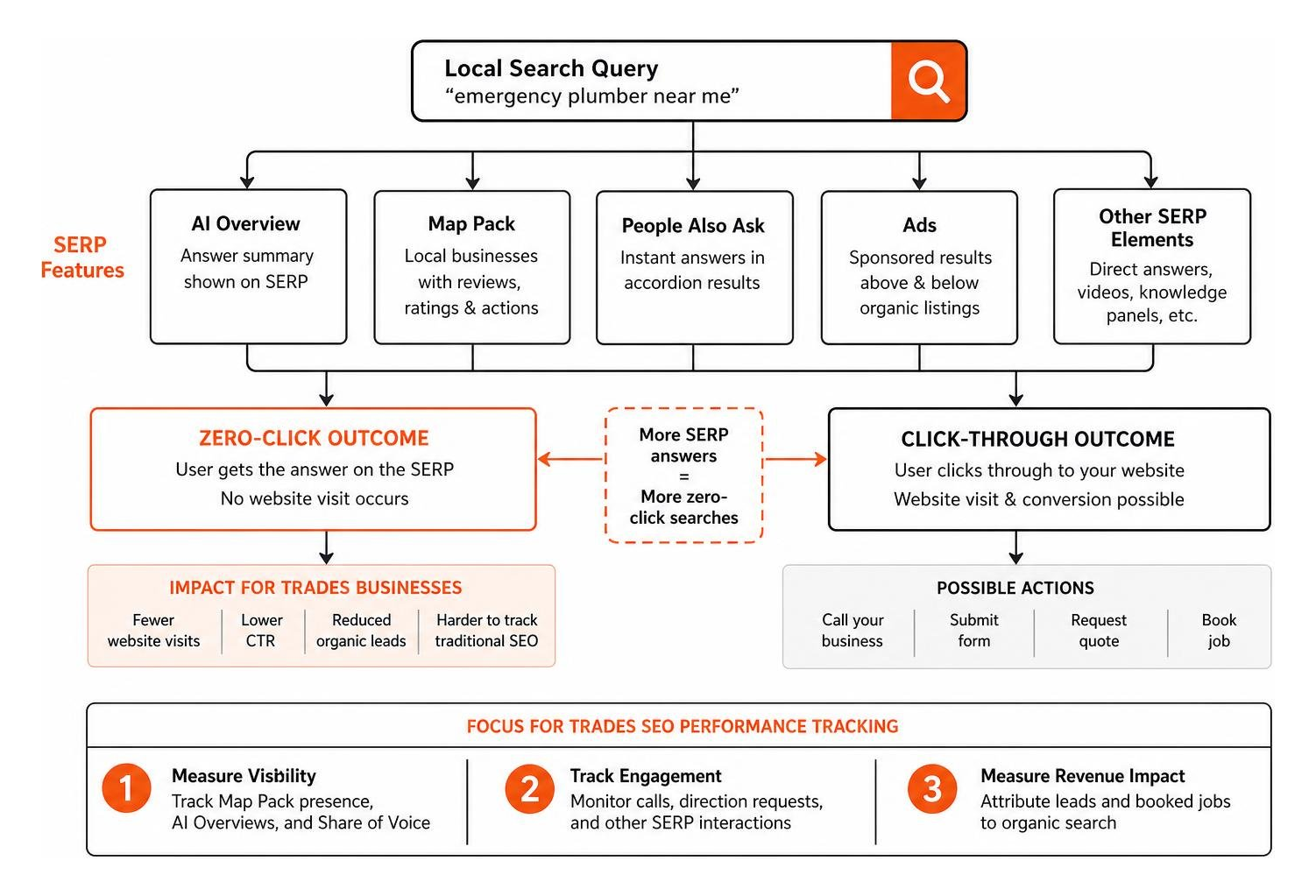
Furthermore, voice search through smartphones and smart home assistants continues to change how homeowners look for tradies. People do not speak in short keywords like “plumber Sydney”; they ask natural, conversational questions like “Who is the highest-rated emergency plumber near me open right now?”
To track performance accurately in an AI-driven environment, monitor:
- Organic Share of Voice (SoV): Your overall brand footprint across local map packs, direct search clicks, and featured snippets.
- Topical Keyword Clusters: Grouping 30 to 50 semantically related keywords (e.g., “burst pipe repair”, “fix broken water line”, “emergency pipe patch”) into a single cluster score rather than agonizing over one keyword.
- Conversational Queries in Search Console: Identifying long-tail voice queries to build conversational FAQ sections on your site.
Core Pillars of Trades SEO Performance Tracking: Website vs Google Business Profile
A critical mistake in trades SEO performance tracking is bundling your website analytics and your Google Business Profile (GBP) performance into one confusing number. Your website and your GBP serve different purposes in the customer journey and require distinct tracking strategies.
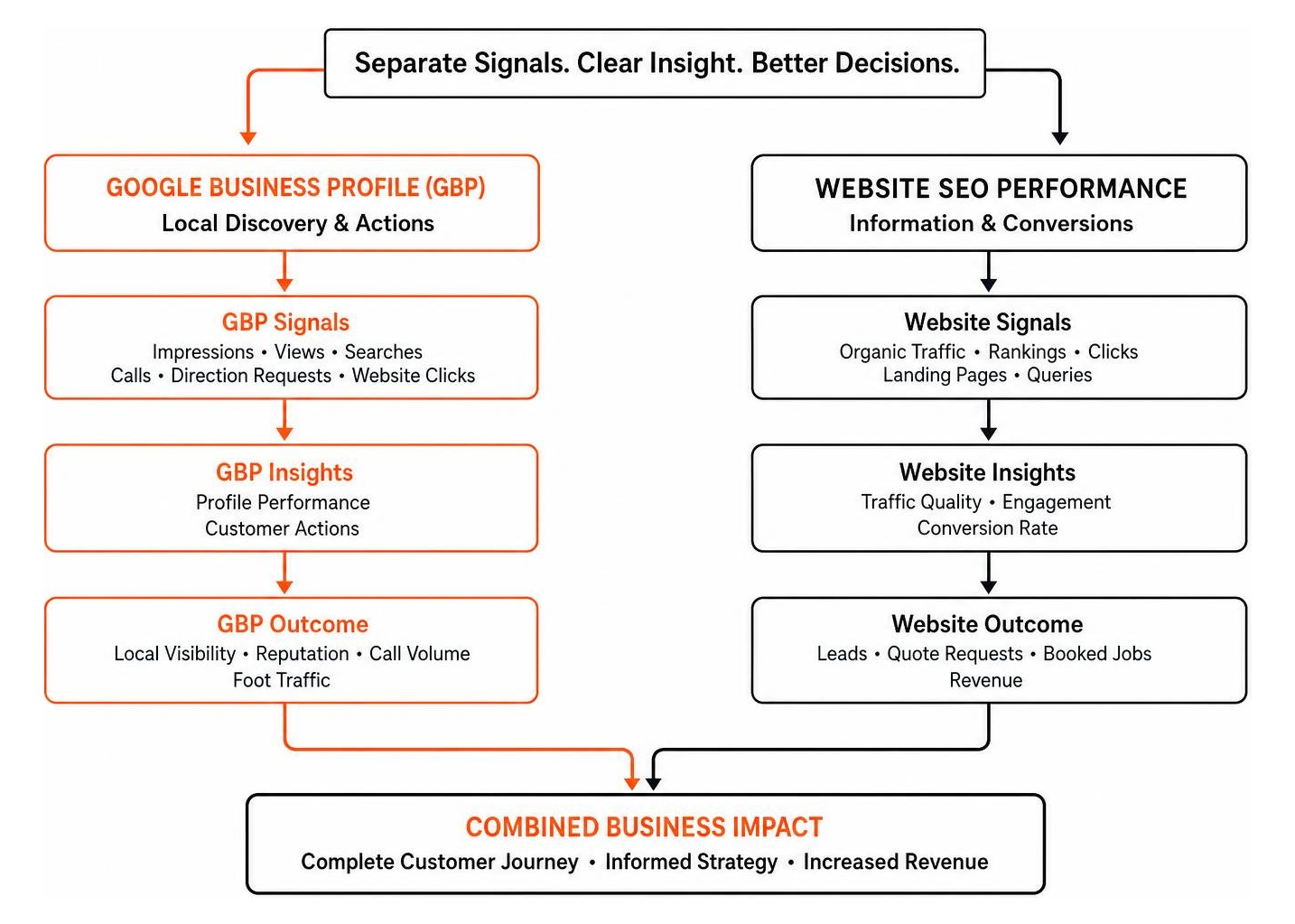
If your GBP generates dozens of calls every week, but your main website receives virtually zero quote form requests, your local reputation is strong, but your website conversion architecture is broken. Separating these channels highlights exactly where your sales pipeline is leaking. For a step-by-step breakdown on dominating local maps, read The Local SEO Blueprint for Tradesmen to Rank Number One.
Tracking Website SEO Metrics That Drive Quote Requests
Your website exists to educate prospective clients and convert organic traffic into actionable quote requests. When analyzing your website’s organic performance in Google Analytics 4 (GA4), concentrate on:
- Organic Landing Page Drop-offs: Identify which service pages lose traffic before users click your “Request an Estimate” button.
- Call-to-Action (CTA) Click Events: Track specific button taps, such as direct mobile tap-to-call buttons and form button submissions.
- Core Web Vitals: Monitor site speed metrics like Largest Contentful Paint (LCP) and Cumulative Layout Shift (CLS). A slow mobile site causes panicked homeowners with emergency repairs to hit the back button immediately.
Review our complete On Page SEO Activities List to optimize your service pages for higher conversion rates.
Monitoring Google Business Profile Actions and Local Proof Signals
For most local trades, your Google Business Profile acts as your primary digital storefront. Tracking GBP performance goes far beyond just looking at aggregate search views.
You must track local trust proof and map interactions monthly:
- Direct GBP Actions: Click-to-calls, direction requests, and direct website link clicks originating inside the Google Map Pack.
- Review Velocity & Sentiment: The number of new 5-star Google reviews acquired each month, along with review responses containing service keywords.
- Photo Upload Consistency: Highlighting job site photos, branded work trucks, and completed projects. Google rewards listings that regularly publish authentic local media.
- Local Citations & Geotagged Signals: Ensuring consistent Name, Address, and Phone number (NAP) details across directories.
Learn how to strengthen your regional authority with our Local SEO Backlinks Guide 2025.
How to Track Phone Calls, Quote Forms, and Revenue Attribution

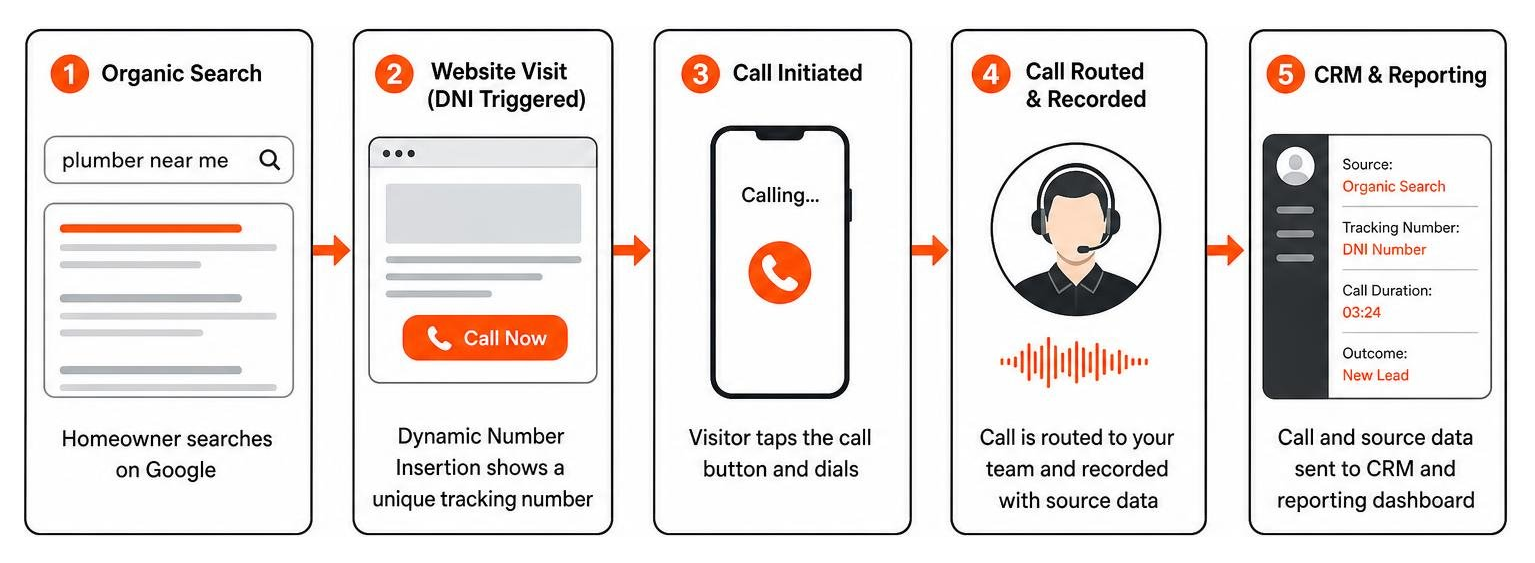
You cannot manage what you do not measure. For home service contractors, over 70% of high-intent organic leads occur via direct phone calls rather than text form submissions. If you only track form fills, you are ignoring the vast majority of your SEO results.
To solve this, implement call tracking software that uses Dynamic Number Insertion (DNI). DNI swaps out the phone number displayed on your website based on how the visitor arrived. When a user arrives via an organic Google search, they see a virtual tracking number that forwards directly to your dispatch team while recording the search channel source in your reporting dashboard.
Connecting Google Search Console and GA4 for Full-Funnel Attribution
Combining pre-click visibility data from Google Search Console (GSC) with post-click conversion metrics from Google Analytics (GA4) provides complete full-funnel attribution.
GSC shows you what keywords homeowners typed, how often your site appeared (impressions), and how many people clicked through (CTR). GA4 shows what those users did once they arrived on your landing page—which forms they submitted and which calls they initiated.
By connecting GSC and GA4, you quickly discover hidden conversion opportunities. For example, if GSC shows your “Heat Pump Replacement” page gets 3,000 impressions and sits at position 3, but GA4 shows zero form completions, you know your meta titles and page content need an immediate overhaul.
Essential Free Tools for Keyword and Visibility Tracking
You do not need an enterprise software budget to monitor your trades SEO metrics effectively. Tap into these powerful free tools:
- Google Search Console: The ultimate first-party source for exact search queries, indexing errors, and query-level impression data.
- Google Analytics: Essential for monitoring user engagement, event tracking, traffic sources, and conversion funnels.
- Google Keyword Planner: Excellent for checking local search volume trends and identifying intent-driven search phrases.
- AnswerThePublic: Great for discovering real questions homeowners ask online, ideal for writing targeted FAQ sections.
- Google PageSpeed Insights: Essential for testing how quickly your service pages load on mobile devices out in the field.
To discover step-by-step methods for researching low-competition keywords, read our guide on Keyword Research for Blog Posts.
Building an Actionable Monthly Trades SEO Reporting Cadence
Tracking data daily or weekly usually leads to analysis paralysis. Minor daily ranking fluctuations are normal search engine adjustments. Checking rank positions constantly will drive you crazy and lead to premature, poor tactical decisions.
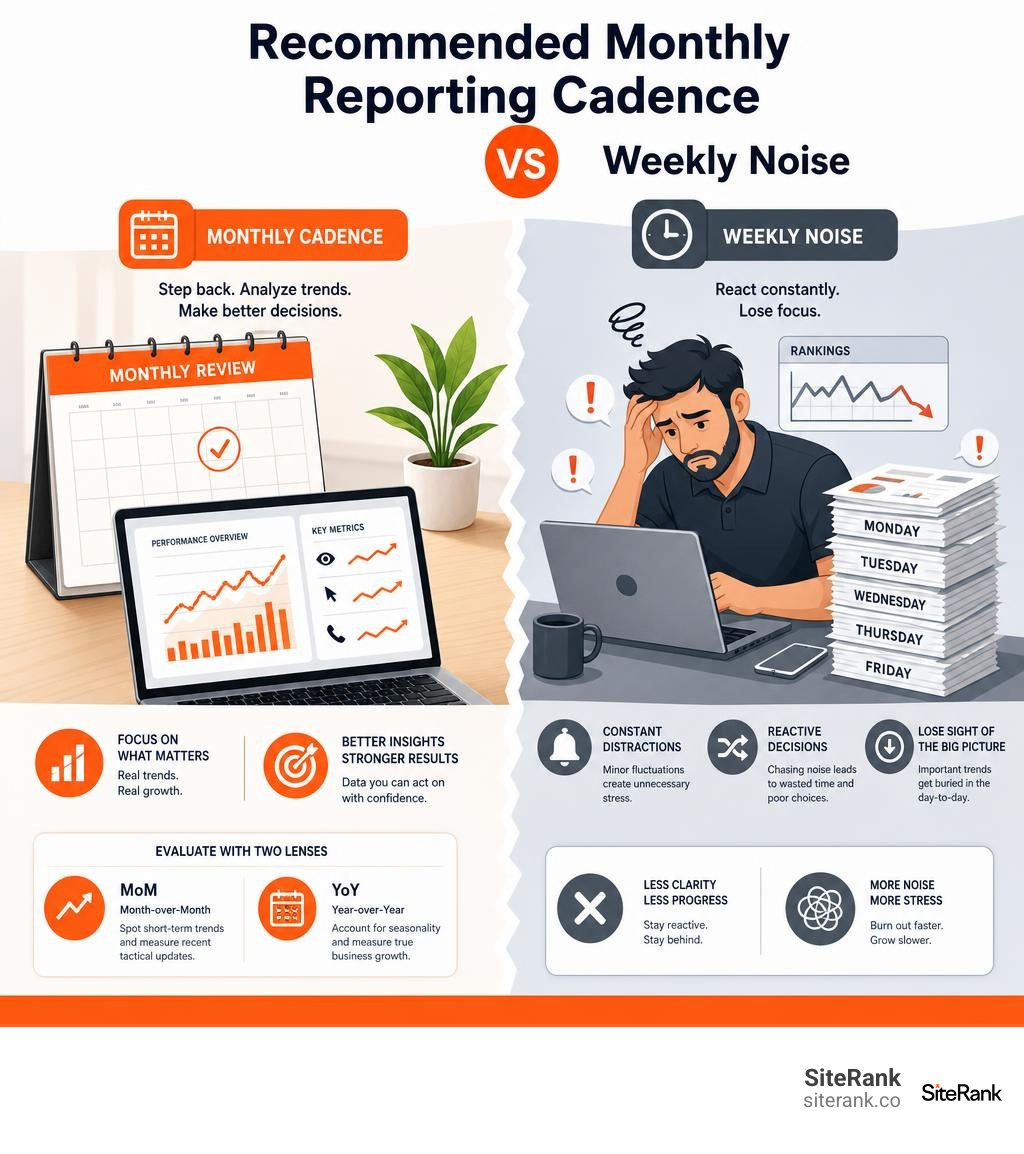
Instead, establish a steady monthly reporting cadence, paired with brief weekly checks reserved exclusively for catching operational fires (such as a broken estimate form or a sudden site outage).
When reviewing monthly performance, always evaluate data through two distinct lenses:
- Month-over-Month (MoM): Identifies immediate short-term trends, content indexing, and recent tactical updates.
- Year-over-Year (YoY): Accounts for industry seasonality. Comparing an outdoor landscaping company’s March lead volume directly to November data is misleading. Comparing March 2026 to March 2025 gives you an accurate measurement of real business growth.
Eliminating Common Bad Reporting Habits in Trades SEO Performance Tracking
Many agencies and internal marketing teams waste time on poor reporting habits that add noise without offering clarity.
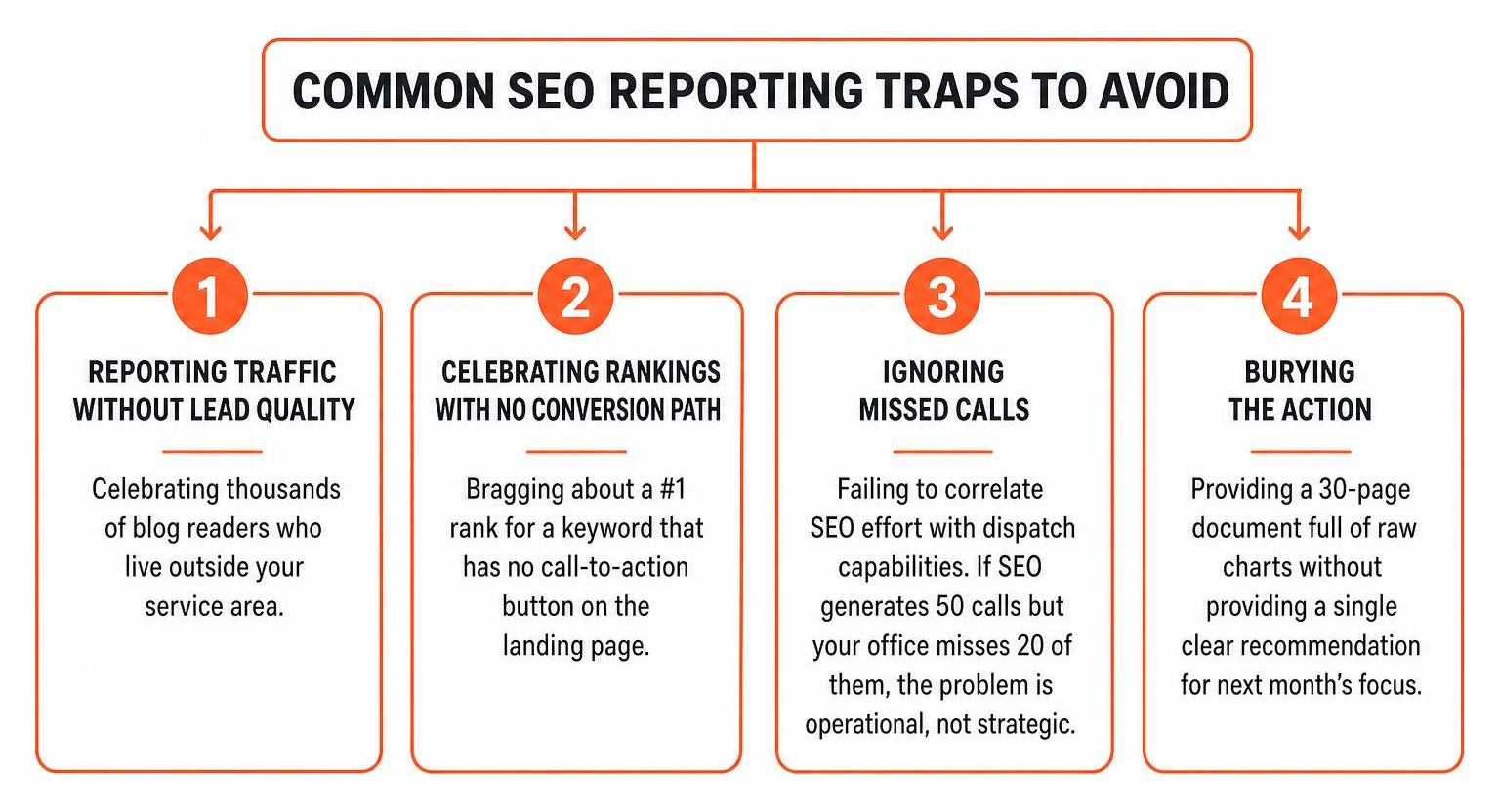
Be sure to eliminate these four destructive habits:
- Reporting Traffic Without Lead Quality: Celebrating thousands of blog readers who live outside your service area.
- Celebrating Rankings with No Conversion Path: Bragging about a #1 rank for a keyword that has no call-to-action button on the landing page.
- Ignoring Missed Calls: Failing to correlate SEO effort with dispatch capabilities. If SEO generates 50 calls but your office misses 20 of them, the problem is operational, not strategic.
- Burying the Action: Providing a 30-page document full of raw charts without providing a single clear recommendation for next month’s focus.
Structuring a One-Page Monthly SEO Summary for Tradies
As a busy business owner, you need actionable insights fast. Demand a streamlined, one-page monthly summary built around five core elements:
- Lead Scoreboard: Organic calls, form fills, and CRM-verified booked jobs (GBP vs. Website).
- Revenue Attribution: Estimated or recorded job revenue generated from organic channels versus total monthly SEO investment.
- Money Keyword Movements: Visibility trends for top-tier buyer intent keywords (e.g., “roof repair near me”).
- Local Proof Metrics: Volume of new Google reviews added, photos uploaded, and current Map Pack visibility status.
- Action Column: Three specific SEO tasks scheduled for completion next month based on this month’s data.
For practical advice on keeping your marketing simple while scaling operations, read How to Rank Your General Contractor Business Without Losing Your Mind.
Frequently Asked Questions About Trades SEO Performance Tracking
How often should trades business owners review their SEO performance reports?
Trades business owners should formally review their comprehensive SEO performance reports once per month. Monthly reviews provide enough data to filter out daily search engine fluctuations while keeping strategy aligned with business outcomes. Weekly checks should be limited to quick operational confirmation that call tracking lines and website quote forms are functioning properly.
What is the most critical metric for trades SEO success?
The single most critical metric is qualified organic leads that convert into booked revenue. While keyword rankings and site traffic serve as useful diagnostic tools, they do not pay the bills. The ultimate measure of SEO success is how many profitable jobs originate from organic search results relative to your marketing spend.
How do I separate phone calls coming from Google Maps versus website SEO?
To separate phone calls accurately, place a unique, dedicated call tracking number directly on your Google Business Profile listing (using dynamic swapping or virtual numbers). On your primary website, implement Dynamic Number Insertion (DNI) software. This automatically displays distinct tracking numbers to users visiting from organic search, guaranteeing clear attribution between Google Map Pack interactions and organic website visits.
Conclusion
Effective trades SEO performance tracking comes down to moving past simple keyword vanity metrics and tracking real business growth. By separating your Google Business Profile performance from your website analytics, tracking incoming phone calls and form submissions, and connecting search traffic directly to closed CRM revenue, you transform SEO from an uncertain expense into a reliable growth engine.
At SiteRank, we specialize in providing tailored, data-driven SEO strategies for trade contractors. We skip the fluff and eliminate unnecessary deliverables, focusing entirely on strategies that increase local visibility, drive qualified leads, and grow your bottom line.
Ready to stop guessing and start measuring true organic ROI? Explore our customized SiteRank SEO Services or claim your Free SEO Audit today!