

How Local SEO Turns Nearby Searches Into Landscaping Leads
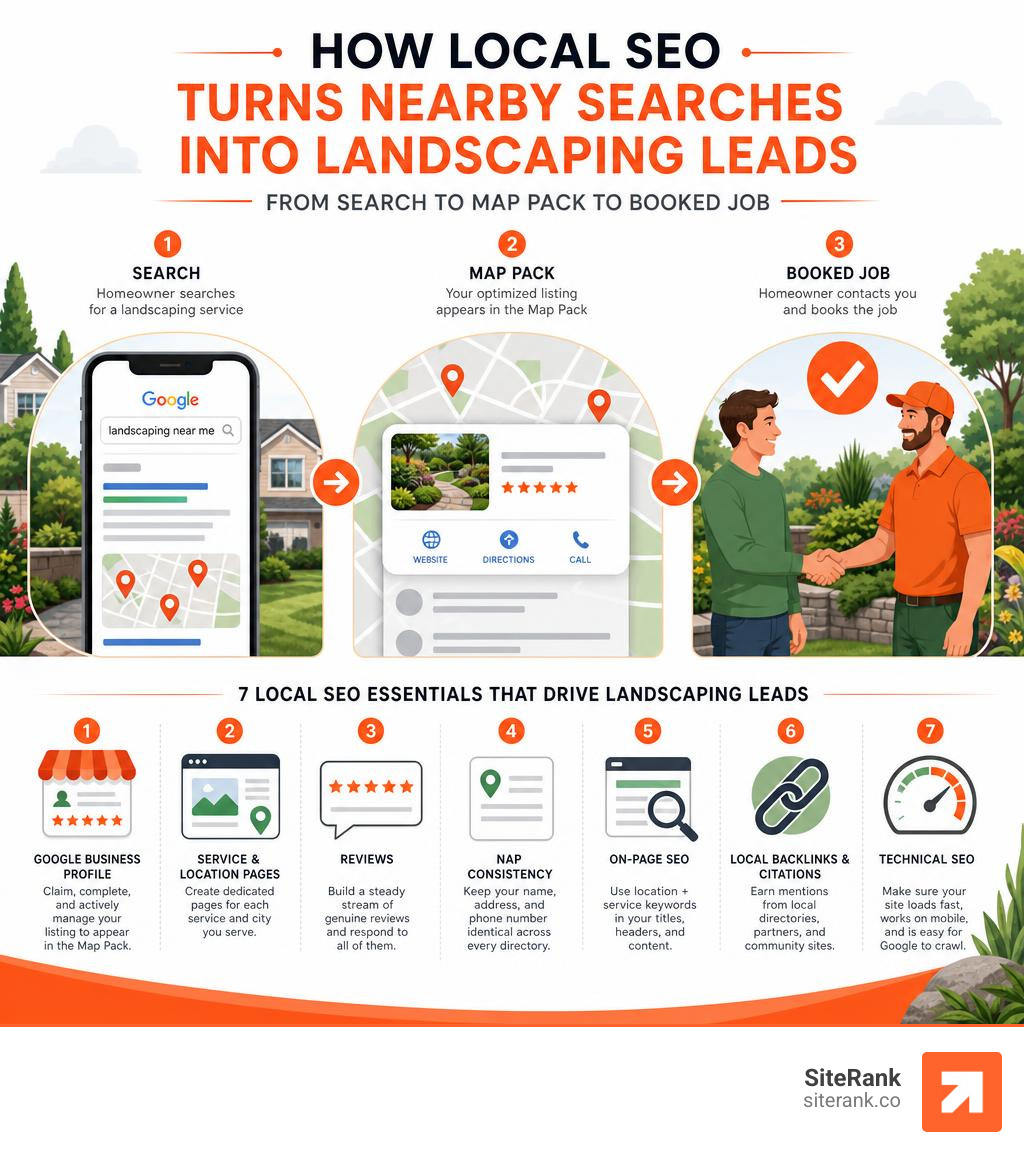
Landscaping local SEO is the process of optimizing your online presence so homeowners in your area find your business first when they search for services like yours on Google.
Here’s a quick snapshot of what it involves:
- Google Business Profile – Claim, complete, and actively manage your listing to appear in the Map Pack
- Service and location pages – Create dedicated pages for each service and city you serve
- Reviews – Build a steady stream of genuine reviews and respond to all of them
- NAP consistency – Keep your name, address, and phone number identical across every directory
- On-page SEO – Use location + service keywords in your titles, headers, and content
- Local backlinks and citations – Earn mentions from local directories, partners, and community sites
- Technical SEO – Make sure your site loads fast, works on mobile, and is easy for Google to crawl
Over 97% of consumers use the internet to find local businesses. And 72% search for local services within just three miles of where they are. For a landscaping company, that means the homeowner who needs a patio installed or a lawn cleaned up is already searching — the only question is whether they find you or your competitor.
The good news? Most landscaping businesses have not invested seriously in local SEO. That gap is your opportunity.
I’m Craig Flickinger, founder of SiteRank and a digital marketer with over 15 years of SEO experience helping local service businesses — including landscaping companies — dominate their local search results through landscaping local SEO strategies that drive real leads, not just rankings. In this guide, I’ll walk you through exactly what works, what doesn’t, and how to build a local SEO foundation that compounds over time.
Why Landscaping Local SEO Beats National SEO for Local Leads
National SEO is about ranking for broad topics across a wide geographic area. Local SEO is about showing up when someone nearby is ready to call, request a quote, or compare providers.
For landscaping companies, local wins almost every time.
Why? Because landscaping is tied to a service radius. A homeowner in one city does not care if a landscaping company ranks nationally for “best backyard ideas” if that company cannot visit their property, understand local soil conditions, install drainage, or maintain their lawn.
Local SEO focuses on the places where leads actually happen:
- The Google Map Pack
- Google Maps
- Local organic search results
- City and neighborhood service pages
- Review sites and local directories
- Mobile “near me” searches
Google generally evaluates local results through three big ideas: proximity, relevance, and prominence. In plain English: Are you close enough? Do you offer what the searcher needs? Does Google trust you?
If you want a broader foundation for service businesses, our local SEO guide for home services is a useful companion to this landscaping-specific playbook.
What Local SEO Means for Landscapers
For landscapers, local SEO means improving every digital signal that helps Google and homeowners understand:
- What services you offer
- Where you offer them
- Whether you are trustworthy
- Whether other customers recommend you
- Whether your website is helpful and easy to use
That includes your Google Business Profile, website pages, reviews, citations, backlinks, photos, NAP consistency, and technical website health.
A strong landscaping local SEO system helps you appear for searches like:
- “landscaper near me”
- “lawn care in [city]”
- “patio installer [city]”
- “drainage contractor near me”
- “landscape design [neighborhood]”
- “retaining wall contractor [city]”
Why National SEO Usually Misses the Mark
National SEO can bring traffic, but not always the right traffic.
A blog post ranking nationally for “backyard landscaping ideas” may attract readers from every state, province, or country. That sounds impressive until you realize most of those visitors will never become customers.
Local landscaping leads are different. They are usually looking for:
- A company nearby
- A fast response
- Proof of similar local work
- Reviews from other homeowners
- A quote or consultation
If your SEO strategy ignores location, you may get traffic without calls. That is like mowing a lawn no one owns. Looks productive, but it does not pay the bills.
How Homeowners Search for Landscaping Services
Homeowners search in different ways depending on urgency and project type.
Some searches are short and urgent:
- “landscaper near me”
- “lawn care near me”
- “yard cleanup near me”
Some include a city:
- “landscape design in Austin”
- “patio installation Charlotte”
- “irrigation repair Phoenix”
Some are problem-based:
- “how to fix standing water in backyard”
- “why is my lawn turning brown”
- “best grass for shady yard”
Others are research-heavy:
- “modern backyard landscaping ideas”
- “cost to install paver patio”
- “front yard landscaping for small homes”
Mobile matters here. Mobile users account for over 60% of internet traffic, and local searches often happen on phones. Someone standing in their backyard staring at a drainage issue is not calmly opening a spreadsheet. They are searching, tapping, and calling.
How landscaping local seo Matches Search Intent
Good SEO matches the page to the searcher’s intent.
For landscapers, that usually falls into four groups:
- Transactional intent – “hire landscaper [city]” or “lawn care quote near me”
- Commercial intent – “best landscaping companies near me” or “top-rated patio installers”
- Informational intent – “how to repair patchy grass” or “when to aerate lawn”
- Seasonal intent – “spring cleanup services” or “fall leaf removal near me”
Your website should cover all four. Service pages capture people ready to buy. Blog posts and guides attract people earlier in the decision process. Seasonal pages help you show up before demand peaks.
Build a Keyword and Page Strategy Around Real Homeowner Searches

Keyword research should start with the customer, not the tool.
Ask:
- What is the homeowner dealing with?
- What words would they actually use?
- Are they searching by service, problem, or provider type?
- Are they planning a major project or trying to solve something quickly?
A homeowner probably searches “backyard drainage problem,” not “residential stormwater management solution.” Use the language customers use.
Find the Right Local Landscaping Keywords
Start with seed services:
- Landscaping
- Lawn care
- Landscape design
- Hardscaping
- Patio installation
- Irrigation
- Drainage
- Outdoor lighting
- Retaining walls
- Sod installation
- Spring cleanup
- Fall cleanup
Then add local modifiers:
- City names
- Neighborhood names
- County names
- “near me”
- “near [landmark]”
- “in [service area]”
Then add buying modifiers:
- Quote
- Cost
- Contractor
- Company
- Best
- Top-rated
- Installation
- Repair
- Maintenance
Examples:
- “landscape design company in [city]”
- “retaining wall contractor [city]”
- “lawn care quote near me”
- “patio installation cost [city]”
- “drainage solutions for backyard [city]”
Do not obsess over exact “near me” wording on every page. Google understands the searcher’s location. Your job is to make your service area and relevance clear.
Create Dedicated Service Pages That Convert
A common mistake is having one vague “Services” page that lists everything.
That is not enough.
Create dedicated pages for each major service:
- Landscape design
- Lawn care
- Hardscaping
- Patio installation
- Irrigation repair
- Drainage solutions
- Outdoor lighting
- Retaining walls
- Seasonal cleanups
Each service page should explain:
- What the service includes
- Who it is for
- Common local problems it solves
- Your process
- Related services
- FAQs
- Proof, such as photos or project examples
- A clear call to action
Many strong landscaping service pages fall in the 600-1000 word range, but quality matters more than word count. If the page answers the searcher’s questions and makes it easy to request a quote, it is doing its job.
For more service business strategy, see our Home Services SEO page.
Build Location Pages Without Duplicate Content
Location pages help you rank in the cities and neighborhoods you serve. But copying the same page and swapping the city name is risky and lazy. Google notices. Homeowners notice too.
A strong location page should include unique local details:
- Local soil or climate issues
- Common yard sizes or property types
- Neighborhood design preferences
- HOA considerations
- Local photos
- Nearby project examples
- City-specific FAQs
- Internal links to relevant services
For example, a drainage page for a hilly neighborhood should not read the same as a lawn care page for a flat suburban area. Make each page genuinely useful.
Optimize On-Page SEO Signals
On-page SEO helps Google understand each page.
Focus on:
- Title tags – Keep them clear and usually under 60 characters when possible
- Meta descriptions – Write compelling summaries around 150-160 characters
- H1 tags – Use one clear main heading
- H2s and H3s – Organize the page around real questions
- URLs – Keep them short and descriptive
- Image alt text – Describe the project and location naturally
- Internal links – Link from blogs to services and from services to locations
- Schema markup – Add LocalBusiness and Service schema where appropriate
- Embedded map – Useful on contact or location pages
Example title:
Landscape Design in Tampa | Custom Backyard Plans
Example URL:
/landscape-design-tampa/
Simple. Clear. No keyword confetti cannon required.
Optimize Google Business Profile to Win the Map Pack
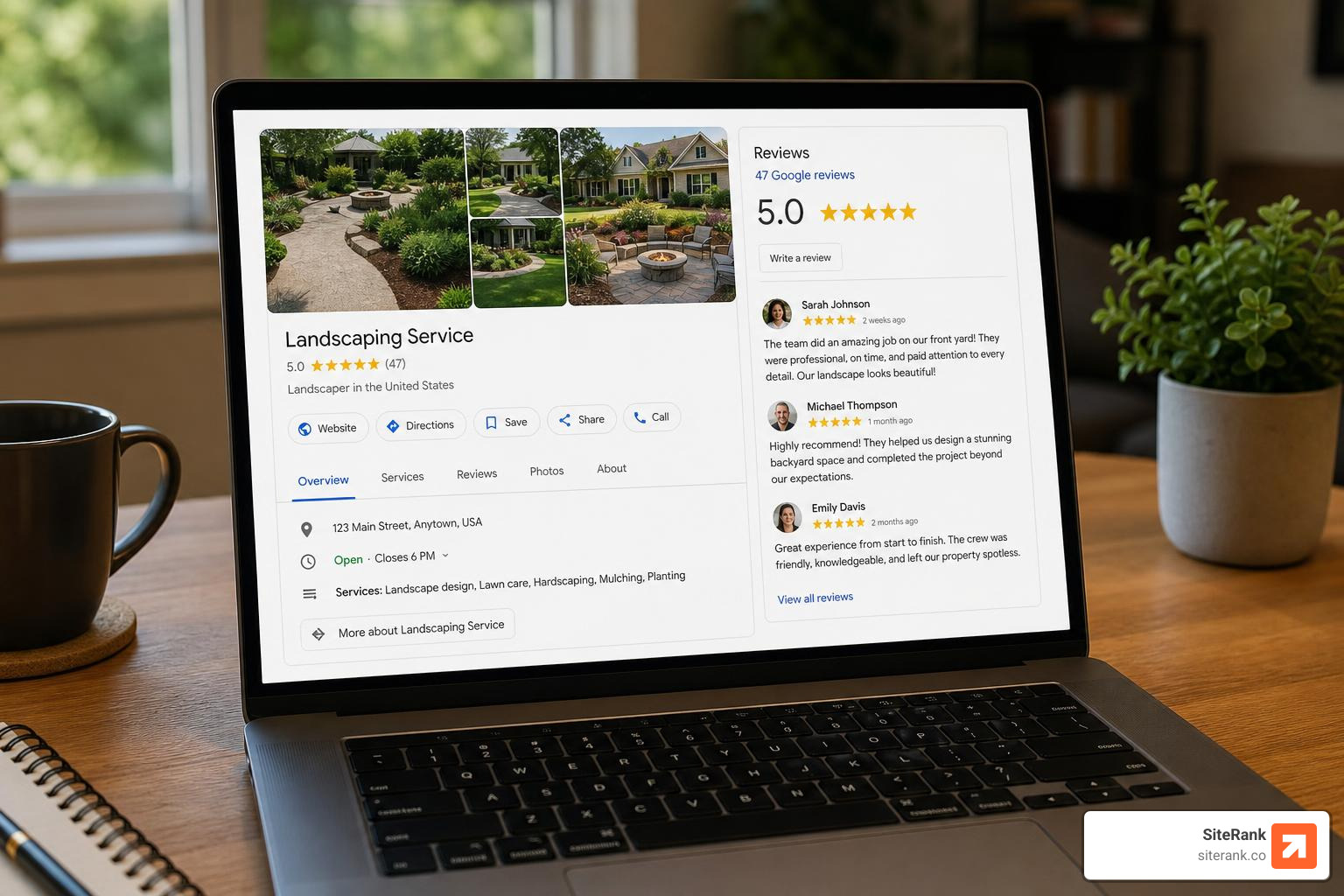
Your Google Business Profile is often the first thing a homeowner sees. In many local searches, it appears before traditional organic results.
If you want to improve your visibility in Google Maps, start with our guide: Google Maps SEO for Landscapers. You can also compare your setup against Google’s official guidance on local ranking factors: Improve your local ranking on Google.
Complete Every Business Detail
Fill out every field you can.
That includes:
- Business name
- Address or service area
- Phone number
- Website link
- Appointment or quote link
- Hours
- Holiday hours
- Primary category
- Secondary categories
- Services
- Business description
- Photos
- Q&A
Choose the most accurate primary category. For many companies, that may be “Landscaper” or “Lawn Care Service,” depending on the core business. Add secondary categories for related services when relevant.
Your NAP must be consistent: same name, same address, same phone number everywhere.
Add Visual Proof That Homeowners Trust
Landscaping is visual. Before-and-after photos can do more selling than paragraphs of copy.
Upload:
- Completed project photos
- Before-and-after transformations
- Team photos
- Equipment photos
- Seasonal work
- Patio, lighting, and garden details
- Maintenance work
- Portfolio-style project images
Use descriptive filenames before uploading to your website, such as:
paver-patio-installation-denver.jpg
Add photos regularly. Weekly is great if you have enough project activity. Real job site photos build trust and help your profile look active.
Use Services, Posts, and Q&A Strategically
Google Business Profile is not a set-it-and-forget-it listing.
Use services to describe what you offer. Add short, clear descriptions for each major service.
Use posts for:
- Spring cleanup reminders
- Fall maintenance tips
- Drainage advice before rainy seasons
- Project highlights
- Limited-time offers
- New service announcements
Use Q&A to answer common questions:
- Do you offer free estimates?
- What areas do you serve?
- Do you install patios?
- Do you handle weekly lawn maintenance?
- Are you licensed and insured?
Then link users to the most relevant landing page on your website.
Reviews and landscaping local seo Ranking Signals
Reviews affect both rankings and conversions.
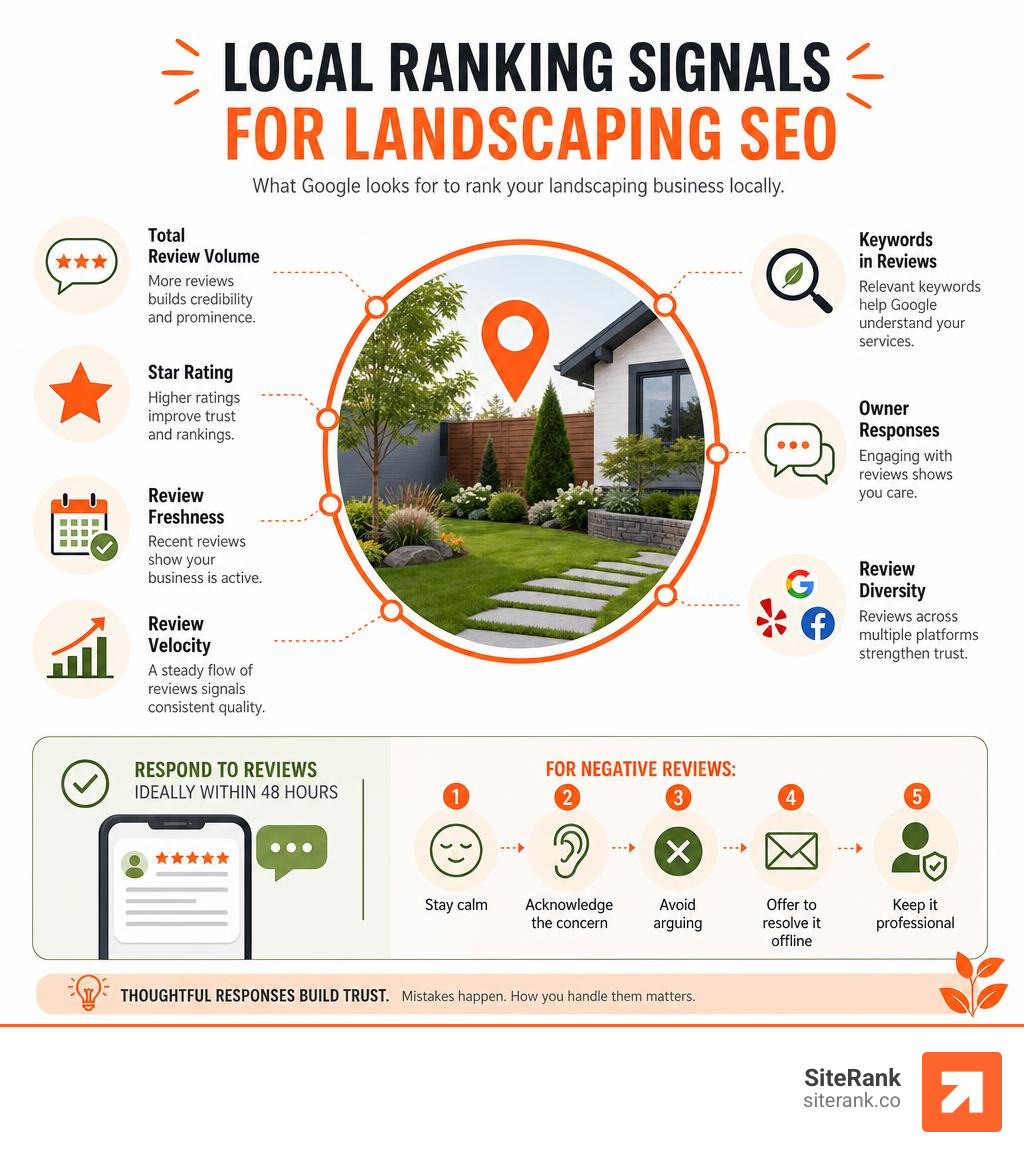
They help Google understand your prominence, and they help homeowners decide whether to call. Review signals include:
- Total review volume
- Star rating
- Review freshness
- Review velocity
- Keywords in reviews
- Owner responses
- Review diversity across platforms
Respond to reviews quickly, ideally within 48 hours. Thank happy customers and mention the service when natural.
For negative reviews:
- Stay calm
- Acknowledge the concern
- Avoid arguing
- Offer to resolve it offline
- Keep it professional
A thoughtful response can reduce damage and sometimes even build trust. Everyone knows mistakes happen. What matters is whether you handle them like a grown-up with a clipboard, not a raccoon in a trash can.
Strengthen Reputation, Citations, and Local Authority
Local SEO is not just your website. Google compares signals across the web.
| Signal | What It Means | Why It Matters |
|---|---|---|
| Citations | Business listings with your NAP | Confirms your business information |
| Reviews | Customer ratings and feedback | Builds trust and supports local rankings |
| Backlinks | Links from other websites | Shows authority and local relevance |
| Photos | Visual proof of work | Improves engagement and conversions |
| Local content | Pages tied to services and cities | Matches search intent |
Build a Repeatable Review System
Do not wait and hope for reviews. Build a process.
Use:
- Post-job SMS requests
- Email follow-ups
- Direct Google review links
- QR cards on invoices or leave-behind cards
- Team reminders after successful projects
- Review request templates
Ask customers to be specific, but never script fake reviews. A natural request might be:
“Would you be willing to mention the service we completed and your city? It helps nearby homeowners understand what we do.”
That can lead to reviews mentioning “patio installation in Plano” or “weekly lawn care in Raleigh,” which are helpful for both trust and relevance.
Keep NAP Citations Consistent Everywhere
Citations are mentions of your business information on directories, maps, apps, and local websites.
Important platforms often include:
- Google Business Profile
- Apple Maps
- Bing Places
- Yelp
- Angi
- Houzz
- BBB
- Local chambers
- Industry directories
The key is consistency. If one listing says “ABC Landscaping LLC,” another says “ABC Landscape,” and another has an old phone number, trust can drop.
Helpful resources:
Earn Quality Local Backlinks Without Spam
Backlinks are links from other websites to yours. For local landscapers, quality beats quantity.
Good local backlink opportunities include:
- Chamber of commerce listings
- Local sponsorships
- Community events
- Garden centers
- Nurseries and suppliers
- Builders and remodelers
- Realtors
- HOA resource pages
- Local news stories
- Project case studies
- Partner pages
For deeper tactics, read our Local SEO Backlinks Guide 2025 and Local Link Building Strategies.
Avoid Spammy Link and Citation Tactics
Avoid shortcuts like:
- Buying bulk directory links
- Creating fake reviews
- Using irrelevant guest posts
- Stuffing exact-match anchor text
- Listing fake addresses
- Building duplicate listings
- Joining low-quality link farms
- Paying for links that exist only to manipulate rankings
Spammy tactics can create cleanup work later. Build authority the same way you build a patio: with a solid base, not wishful thinking and loose gravel.
Fix Technical, Mobile, and Conversion Issues That Block Leads
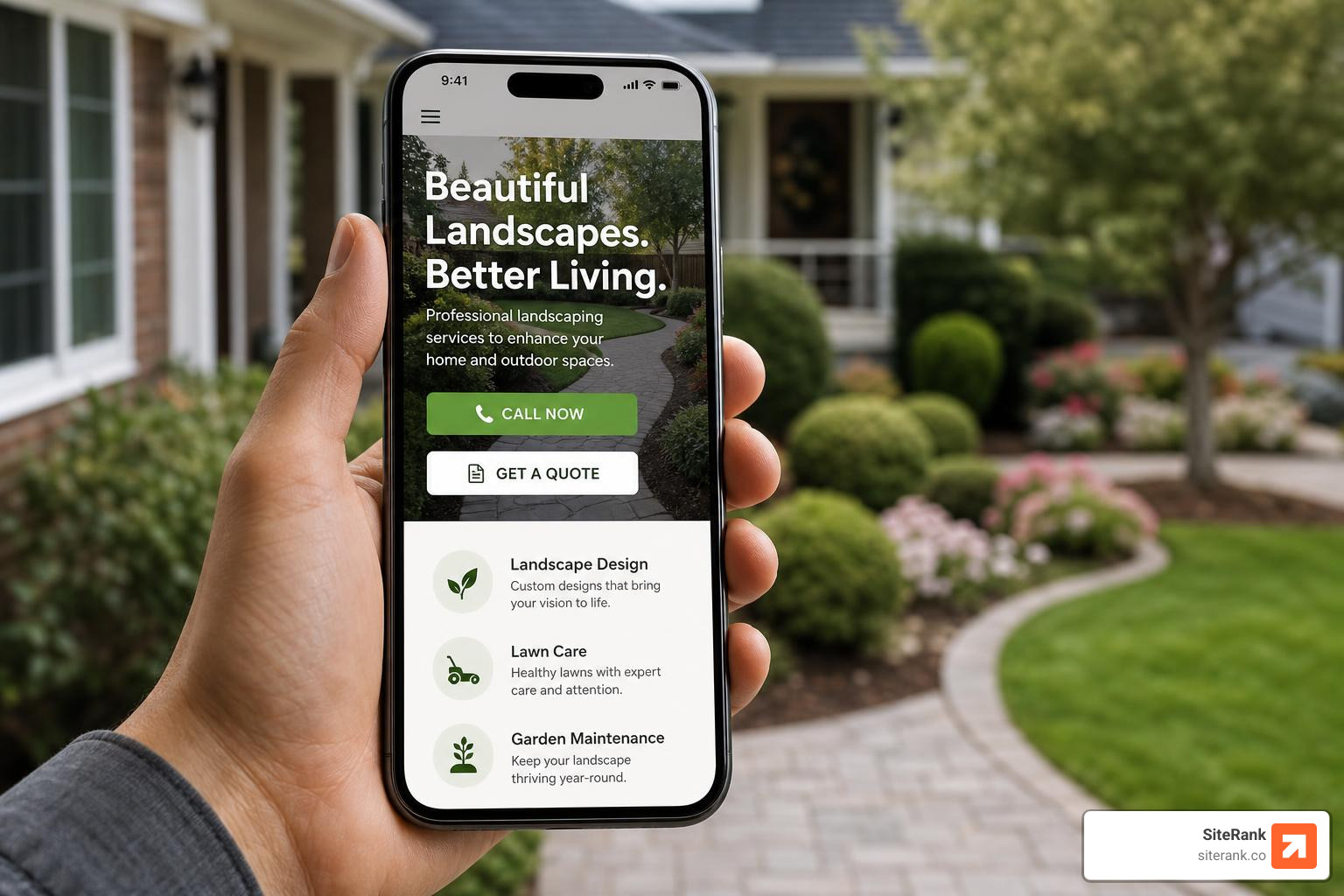
You can have great content and reviews, but if your site is slow, broken, or painful on mobile, leads will disappear.
Technical SEO is not glamorous, but neither is irrigation trenching. Both matter.
Make the Website Fast and Mobile-Friendly
83% of users expect websites to load in under 3 seconds. Mobile users account for over 60% of internet traffic, and Google uses mobile-first indexing.
Focus on:
- Responsive design
- Pages loading in under 3 seconds
- Compressed images
- Lazy loading
- Simple navigation
- Click-to-call buttons
- Sticky quote buttons
- Short mobile forms
- Large, thumb-friendly buttons
- Clear service area information
Your mobile site should make it easy to call or request a quote without pinching, zooming, or rage-tapping.
Improve Technical SEO Foundations
Technical basics include:
- HTTPS security
- XML sitemap
- Clean robots.txt file
- Fixed broken links
- Proper redirects
- Indexable important pages
- Canonical tags where needed
- Structured data
- Clean URLs
- Internal linking
- No major crawl errors
Use Google Search Console to spot indexing issues, page errors, and search performance trends.
Optimize Landscaping Images and Portfolios
Images are essential for landscaping websites, but giant files can slow everything down.
Best practices:
- Rename files descriptively
- Use alt text that describes the project
- Compress images
- Use WebP where possible
- Add project captions
- Mention service and location naturally
- Create before-and-after galleries
- Add quote CTAs to portfolio pages
Example alt text:
Backyard paver patio with outdoor lighting in Scottsdale
That is useful for accessibility, search engines, and humans.
Track Calls, Forms, Rankings, and Revenue
Rankings are useful, but leads pay the bills.
Track:
- Google Business Profile calls
- Website calls
- Form submissions
- Quote requests
- Organic traffic
- Google Search Console queries
- Local keyword rankings
- Map Pack visibility
- Leads by city
- Quote value
- Close rate
- Revenue by source
Use Google Analytics, Google Search Console, GBP Insights, call tracking, and your CRM. If you do not measure lead quality, you may end up celebrating traffic that never turns into jobs.
Common Landscaping Local SEO Mistakes and How to Avoid Them
Here are the mistakes we see most often:
- Keyword stuffing
- Thin service pages
- Duplicate city pages
- Ignored reviews
- Wrong Google Business Profile category
- Inconsistent NAP
- Slow image-heavy pages
- No call tracking
- Stale content
- Unrealistic timelines
- No seasonal strategy
- Focusing on rankings instead of revenue
Mistake: Treating Every Service Area the Same
Every city and neighborhood has different needs.
Generic pages fail because they lack local proof. Instead, add:
- Local project examples
- Local photos
- Neighborhood details
- City-specific FAQs
- Climate or soil considerations
- Internal links to nearby services
- Relevant customer reviews when available
The goal is to prove you actually serve the area, not just that you own a keyboard.
Mistake: Ignoring Seasonality
Landscaping demand changes throughout the year.
Plan content early:
- Publish spring cleanup pages before spring
- Promote lawn repair before peak growing season
- Push patio and hardscape planning before summer
- Create fall cleanup content before leaves drop
- Use winter for design planning, drainage content, and maintenance contracts
SEO takes time, so publish seasonal content 1-2 months before demand spikes.
Mistake: Focusing on Rankings Instead of Leads
A number one ranking is nice. A booked estimate is better.
Measure:
- Calls
- Qualified leads
- Estimate requests
- Job value
- Close rates
- Cost per lead
- Organic revenue
- GBP calls and direction requests
Vanity metrics are fine for dashboards. Revenue is better for payroll.
Mistake: Expecting Results Overnight
Local SEO compounds, but it is not instant.
Most landscaping businesses can expect meaningful movement in 3-6 months with consistent execution. Significant growth often takes 6-12 months, especially in competitive suburbs or large cities.
Timelines depend on:
- Competition
- Website condition
- Review volume
- Service-area size
- Content quality
- Google Business Profile strength
- Backlink profile
- Technical issues
Small towns may move faster. Large markets usually take longer. Either way, stopping after two months is like planting sod and refusing to water it.
Frequently Asked Questions About Landscaping Local SEO
How long does local SEO take for a landscaping business?
Most landscaping companies should expect early ranking improvements within 3-6 months. Stronger lead growth often appears in the 6-12 month range as content, reviews, citations, links, and Google Business Profile activity compound.
If your website is technically weak, your reviews are thin, or your market is competitive, it may take longer. If you already have a solid site and good reputation, results can come faster.
Can small landscaping companies compete with larger companies?
Yes. Local SEO can level the playing field because Google does not only rank businesses by size.
Smaller companies can compete by improving:
- Google Business Profile completeness
- Review quality and freshness
- Neighborhood-specific pages
- Niche service pages
- Local backlinks
- Fast response times
- Strong photos
- Clear service-area targeting
A small company with better local relevance and trust signals can outrank a larger company that has neglected local SEO.
Do landscapers still need SEO if they run Google Ads?
Yes. Google Ads can bring faster visibility, but traffic stops when the budget stops. SEO builds a long-term asset that can continue generating leads over time.
The best approach often combines both:
- Ads for immediate lead flow
- SEO for long-term cost efficiency
- Retargeting for homeowners still researching
- Content for education and trust
- Reviews and GBP for conversion
For a broader marketing strategy, see our guide to Digital Marketing for Home Services.
Conclusion
Landscaping local SEO is not one trick. It is a system.
To grow your landscaping business with local SEO, focus on:
- Optimizing your Google Business Profile
- Building service pages for each core offer
- Creating unique city and neighborhood pages
- Earning consistent reviews
- Keeping citations accurate
- Building quality local backlinks
- Fixing mobile and technical issues
- Tracking calls, forms, quotes, and revenue
At SiteRank, we use AI-powered SEO workflows, hands-on strategy, and advanced reporting to help local service businesses increase clicks, engagement, and qualified leads without piling on unnecessary deliverables.
If you want a tailored strategy for your landscaping company, start with our Home Services SEO services and let’s build a local SEO foundation that keeps working season after season.