

The Search Landscape Has Changed — Here’s What Contractors Need to Know
Generative engine optimization for contractors is the practice of making your business visible inside AI-generated answers — so when a homeowner asks ChatGPT, Google Gemini, or Perplexity “who’s the best roofer near me,” your company is the one they recommend.
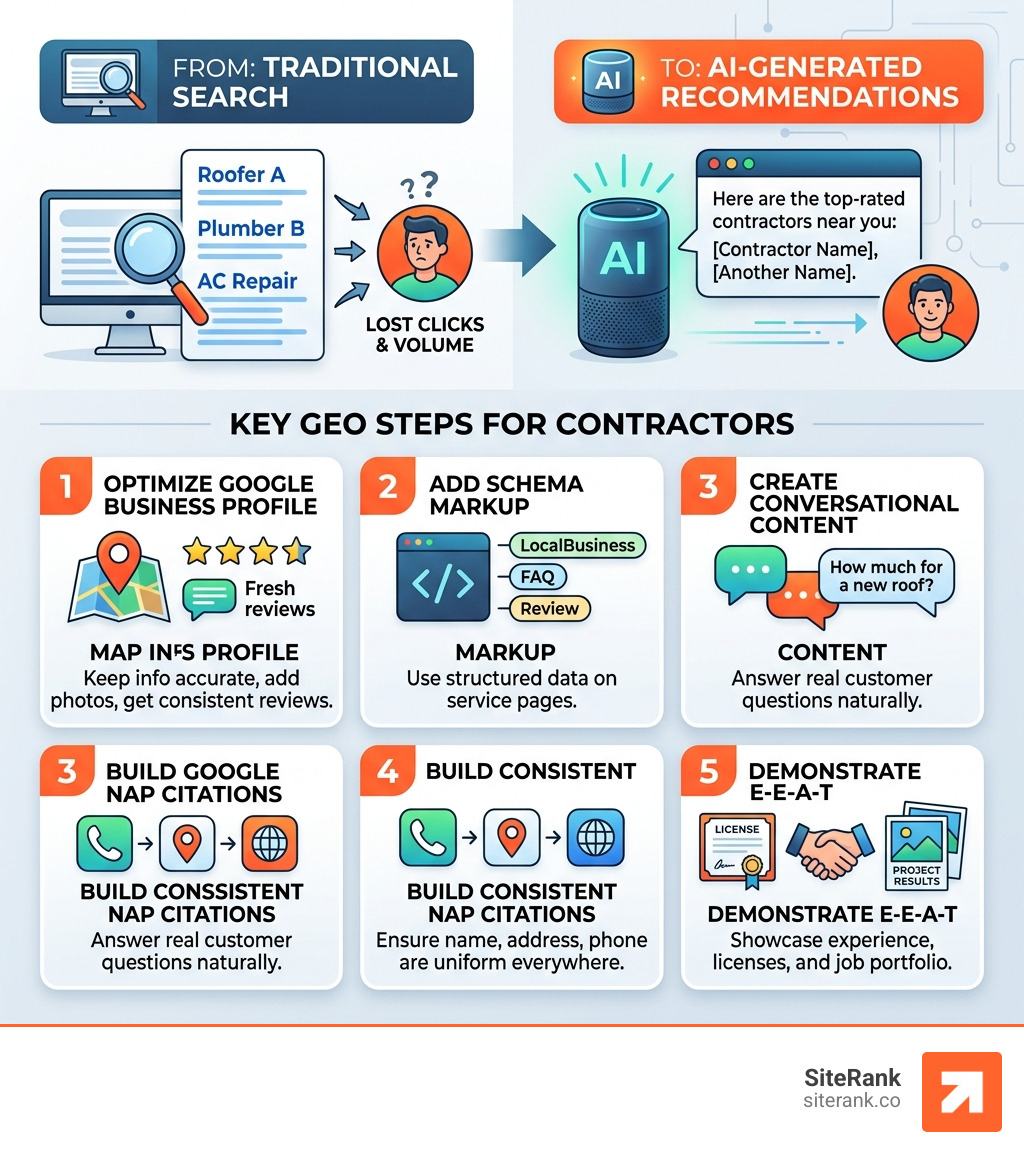
Here’s how to get started:
- Optimize your Google Business Profile — keep it complete, accurate, and stocked with fresh reviews
- Add schema markup to your service pages (LocalBusiness, FAQ, Review)
- Write conversational content that answers real homeowner questions
- Build consistent NAP citations across all directories
- Demonstrate E-E-A-T — show your licenses, experience, and real project results
The way homeowners find contractors has shifted fast. A few years ago, ranking on page one of Google was enough. Today, many searches never reach a website at all. AI tools read the web, synthesize the best sources, and hand the homeowner a short list — sometimes just one name.
That name could be yours. Or it could be your competitor’s.
Gartner predicts a 25% drop in traditional search engine volume by 2026. Some contractor websites have already lost 20–40% of their clicks since Google’s AI Overviews launched. And voice searches — which skew heavily local — are on track to make up one in four Google queries this year.
This isn’t a future trend. It’s happening right now.
I’m Craig Flickinger, founder of SiteRank and an SEO specialist with over 15 years of experience helping businesses win in competitive search environments — including navigating the shift toward generative engine optimization for contractors as AI tools reshape local discovery. In this guide, I’ll walk you through exactly what GEO is, why it matters for your trade business, and the practical steps you can take to start showing up where your next customers are already looking.
What is Generative Engine Optimization for Contractors?

At its core, Generative Engine Optimization (GEO) is the next evolution of digital marketing. While traditional SEO focuses on getting your website to rank in a list of “blue links” on a search results page, GEO focuses on making sure your business is the one an AI model chooses to talk about.
When we talk about Generative Engines, we are referring to Large Language Models (LLMs) like ChatGPT, Google Gemini, Perplexity, and Claude. These tools don’t just show a list of websites; they “read” the internet and then write a custom answer for the user. If a homeowner asks, “Who is the most reliable HVAC technician in Phoenix for emergency repairs?” the AI scans the web for signals of trust, location, and expertise to generate its recommendation.
For us in the trade industries, this means our digital footprint needs to be readable not just by humans, but by these highly sophisticated AI systems. You can learn more about the technical foundations in our guide on Generative Engine Optimization.
The Difference Between SEO, AEO, and GEO
It’s easy to get buried in acronyms, so let’s break down how these strategies work together to help your business. Think of them as layers of a house: SEO is the foundation, AEO is the framing, and GEO is the finished home that people actually want to live in.
| Feature | Traditional SEO | Answer Engine Optimization (AEO) | Generative Engine Optimization (GEO) |
|---|---|---|---|
| Primary Goal | Rank in the top 10 blue links | Appear in “Featured Snippets” or voice answers | Be cited/recommended in AI-generated chat |
| User Interaction | User clicks a link to visit your site | User gets a quick answer on the search page | User engages in a conversation with AI |
| Key Metric | Click-Through Rate (CTR) | Impressions & “Zero-Click” visibility | Brand citations and AI recommendations |
| Focus | Keywords and Backlinks | Direct Q&A and Structured Data | E-E-A-T, Sentiment, and Brand Mentions |
Traditional SEO is still vital—it’s how you build the authority that AI engines look for. Home Service SEO remains the bedrock of your leads, but AEO and GEO are how you capture the 40% of queries that are now being handled by AI-driven tools.
How AI Search Tools Decide Which Contractors to Recommend
AI doesn’t just “guess” who the best plumber is. It performs a high-speed background check on your business. It looks for E-E-A-T signals: Experience, Expertise, Authoritativeness, and Trustworthiness.
When a generative engine recommends you, it’s usually because it found:
- Co-citations: Your business name appearing alongside other top-rated competitors on “Best of” lists or industry directories.
- Brand Mentions: People talking about you on Reddit, Facebook, or local forums—even if they don’t link to your site!
- Sentiment: The overall “vibe” of your reviews. AI can detect if customers are genuinely happy or if your reviews look forced.
By focusing on Home Services SEO best practices, we ensure these AI tools see your business as a credible, local authority.
Why Your Business Needs GEO in the AI Search Era

The numbers don’t lie: search behavior is changing faster than most contractors can keep up with. Gartner predicts a 25% drop in search volume by the end of 2026. This isn’t because people aren’t looking for services; it’s because they are getting their answers directly from AI chatbots instead of clicking through five different websites.
For a residential contractor, this is a double-edged sword. On one hand, the #1 spot on Google now only gets a 3.1% click-through rate, down from over 5% just a year ago. On the other hand, AI search queries are much longer—averaging 23 words compared to the standard 4-word keyword search. This gives us a massive opportunity to capture high-intent leads who are asking very specific questions.
If you aren’t visible in these AI Overviews, you are effectively invisible to a huge chunk of your market. Check out our insights on Digital Marketing for Home Services to see how these shifts affect your bottom line. You can also read the full Gartner research on AI search impact to understand the scale of this change.
How to Implement Generative Engine Optimization for Contractors
So, how do we actually “do” GEO? It starts with making your website a feast for AI models.
- Structured Data & Schema Markup: This is “code” that tells AI exactly what your services are, where you are located, and what your customers think. Using
LocalBusiness,Service, andFAQschema can boost your visibility in AI results by 25-40%. - Scannable Content: AI models prefer content that is easy to parse. Use clear headings (H2s and H3s), bullet points, and short paragraphs. Research shows that pages that are easy to scan get 150% higher visibility in AI results.
- Conversational Language: Write like you talk to a customer on a job site. Aim for an 11th-grade reading level or lower. AI tools are built on natural language, so the more “human” your content feels, the better.
- Information Gain: Don’t just repeat what every other roofer says. Include unique statistics, specific local pricing, or first-hand project details. Adding original statistics can improve your visibility in generative responses by 30-40%.
Our On-Page SEO services focus heavily on these technical implementations to ensure your site is “AI-ready.”
The Role of Google Business Profile and Local Citations
Even in the age of AI, your Google Business Profile (GBP) is your most important asset. AI engines use GBP data as a primary source of truth for local recommendations.
- NAP Consistency: Your Name, Address, and Phone number must be identical across the web. If AI sees three different phone numbers for you, it loses trust and recommends someone else.
- Review Sentiment: AI doesn’t just count stars; it reads the text. It looks for keywords like “emergency,” “fair price,” or “arrived on time.”
- Local Citations: Getting mentioned in local news, neighborhood blogs, or trade associations acts as a “vote of confidence” for AI models.
For a deep dive into building these local signals, see our HVAC Local SEO Complete Guide and our Local SEO Backlinks Guide 2025.
Proven Tactics and Quick Wins for Home Service Pros

You don’t need a million-dollar budget to win at generative engine optimization for contractors. You just need to be more helpful than the guy down the street.
Quick Win #1: The FAQ Library Create a page that answers the top 20 questions your sales team gets. Use the exact phrasing homeowners use, like “How much does a new roof cost in [City]?” or “Can I fix a leaky faucet myself?”
Quick Win #2: Case Studies with Stats Instead of just saying “We fix roofs,” write: “We replaced a 2,500 sq. ft. shingle roof in [Neighborhood] in just 2 days, saving the homeowner 15% on their energy bills.” AI loves specific data points.
Quick Win #3: Expert Bylines Make sure every blog post has an author bio that highlights your years of experience, certifications, and local roots. This builds the “Expertise” part of E-E-A-T that AI platforms crave. If you’re looking to Increase Plumbing Leads, showing you are the local expert is the fastest way to get recommended.
Measuring Success in the Generative Engine Optimization for Contractors Era
Traditional tracking (like keyword rankings) doesn’t tell the whole story anymore. To measure GEO success, we look at:
- AI Citations: How often is your brand mentioned in a ChatGPT or Gemini response?
- Brand Share of Voice: When someone asks about your trade in your city, what percentage of the time do you appear in the “AI shortlist”?
- Referral Traffic Patterns: Are you seeing traffic from “non-traditional” sources like Perplexity.ai or Bing Chat?
Our Off-Page SEO strategies are designed to increase these brand mentions across the wider web, ensuring you have a high “share of voice” in AI conversations.
Integrating GEO with Existing Local SEO Strategies
GEO isn’t a replacement for SEO; it’s an upgrade. You still need a fast, mobile-friendly website and a strong link-building strategy.
We recommend building Topical Clusters. Instead of one page about “Plumbing,” create a cluster of pages about “Emergency Drain Cleaning,” “Water Heater Repair,” and “Sewer Line Inspection,” all linked together. This tells AI that you aren’t just a generalist—you are an authority on every aspect of your trade.
Our HVAC SEO Services and specialized Link Building programs help create this web of authority that makes your business “uncancelable” in the eyes of AI.
Frequently Asked Questions about Contractor GEO
What are the most common GEO mistakes contractors make?
The biggest mistake is hiding information. Many contractors don’t want to list price ranges or specific service details on their site. If the information isn’t there, the AI can’t find it, and it won’t recommend you. Other mistakes include duplicate content (copy-pasting descriptions for every location) and ignoring E-E-A-T signals like licenses and insurance. For better results, focus on Local Link Building Strategies to prove your local relevance.
How is AI changing local search and voice results?
Homeowners are moving away from short keywords like “plumber near me” and toward long, conversational questions like “Alexa, who can fix a burst pipe in my basement right now?” These 23-word queries require content that matches natural speech. Emergency voice calls have jumped 300% in recent years, meaning if you aren’t optimized for voice and AI, you’re missing the most urgent (and profitable) calls. This is one reason Why Backlinks Are Important for SEO—they help AI verify that you are the most trusted answer for those urgent questions.
When should contractors start implementing GEO?
Yesterday! But since we can’t go back in time, today is the next best thing. Early adopters are currently building a “competitive moat.” By the time your competitors realize they’ve lost 30% of their traffic, you will already be the established authority that the AI engines trust most. You can explore our full range of Services to see how we can help you start this transition immediately.
Conclusion
The era of the “blue link” isn’t dead, but it is sharing the stage with a new, smarter player. Generative engine optimization for contractors is about more than just staying relevant; it’s about future-proofing your livelihood.
At SiteRank, we don’t believe in “fluff” deliverables. We focus on the high-impact strategies—like structured data, E-E-A-T building, and conversational content—that actually move the needle in the AI search era. By aligning your digital presence with how AI thinks, you ensure that when a homeowner asks for the best, your business is the only answer they need.
Ready to dominate the next generation of search? Let’s build a Home Services SEO strategy that puts your business at the top of every AI recommendation. Reach out to SiteRank today, and let’s get to work.