

Why Pest Control Company SEO is Non-Negotiable in 2026
Pest control company SEO is the process of optimizing your website and online presence so your business appears at the top of Google when local customers search for pest control services.
Here’s what it covers at a glance:
| SEO Component | What It Does for Your Business |
|---|---|
| Local SEO & Google Business Profile | Gets you into the Map Pack for “near me” searches |
| Keyword Research | Targets the searches your ideal customers are actually making |
| On-Page Optimization | Makes each service page relevant and easy for Google to rank |
| Technical SEO | Ensures your site loads fast and works on mobile |
| Link Building | Builds authority so Google trusts your site over competitors |
| Reviews & Reputation | Turns happy customers into ranking signals and social proof |
| Content Strategy | Attracts leads year-round through seasonal and educational content |
If a potential customer can’t find you on page one of Google, they’ll call your competitor. It’s that simple.
75% of all search engine traffic goes to websites on the first page. For pest control companies, that’s not just a stat — it’s the difference between a full schedule and an empty one.
The pest control industry is fiercely competitive. You’re not just up against the local operator down the road. You’re competing with national chains, franchise brands, and well-funded companies that have been investing in SEO for years. Winning in organic search takes a clear strategy — not guesswork.
The good news? SEO compounds over time. One pest control company documented saving nearly $100,000 per month in ad spend after just six months of focused SEO work, relying entirely on organic leads instead. That’s the kind of shift that changes a business.
I’m Craig Flickinger, founder of SiteRank and an SEO specialist with over 15 years of experience helping businesses grow through search — including developing pest control company SEO strategies that drive real, measurable leads. Read on for a complete breakdown of exactly how to make it happen.
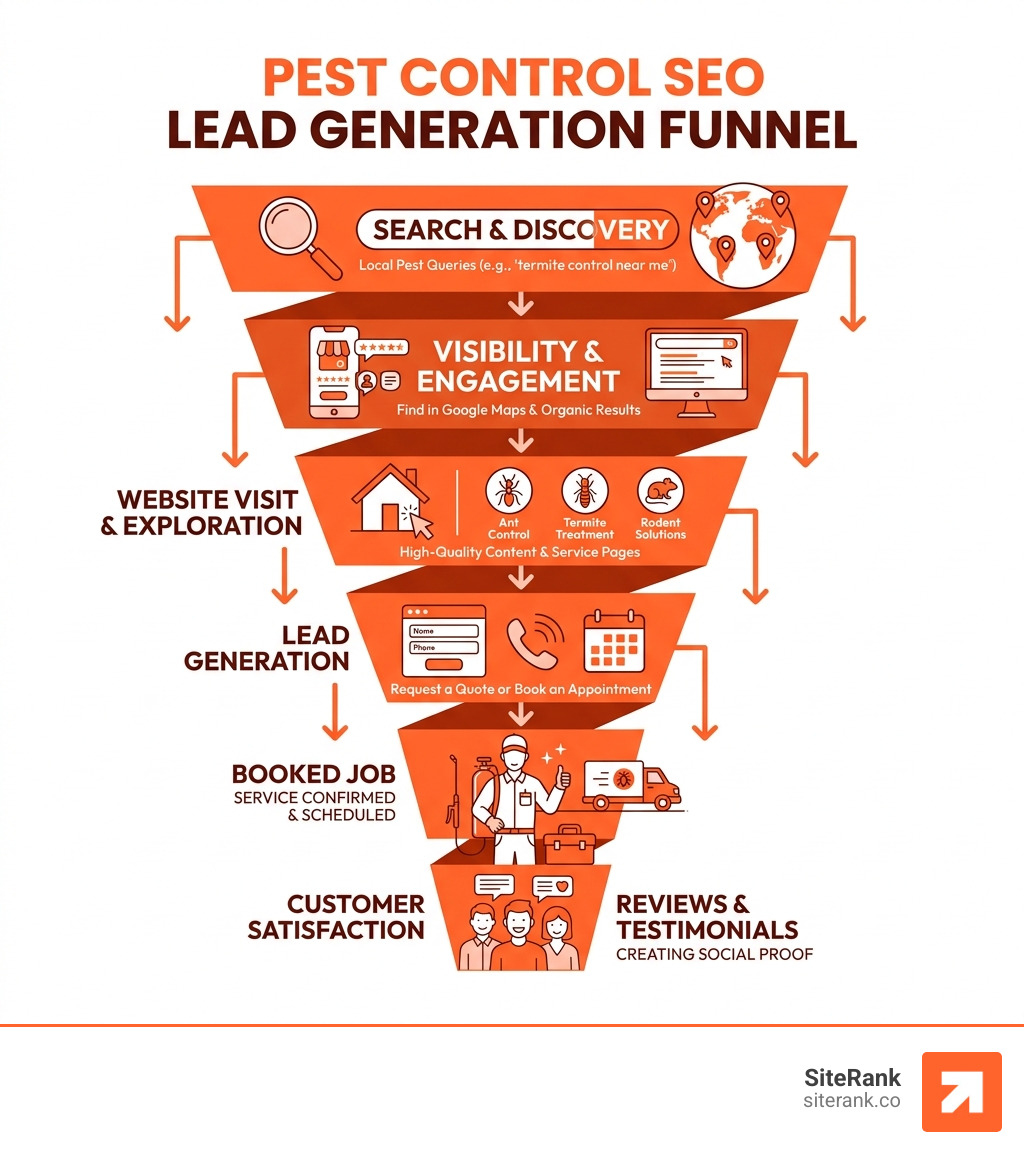
Overcoming Challenges in Pest Control Company SEO
Running SEO for a pest control business isn’t a walk in the park. We face unique hurdles that other industries don’t. First, there is the high competition. In any given city, dozens of companies are fighting for the same ten spots on page one. Many of these competitors have massive marketing budgets, making it hard for smaller firms to break through without a specialized home services SEO strategy.
Then there are the seasonal spikes. Your phone might ring off the hook for termites in the spring, but what about the dead of winter? Effective SEO must account for these shifts so your traffic doesn’t fall off a cliff when the temperature drops.
Finally, we have to deal with emergency intent. When someone finds a wasp nest in their child’s bedroom or bed bugs in their guest room, they aren’t looking to read a 3,000-word history of entomology. They need a “click-to-call” button immediately. Balancing educational content with high-conversion “emergency” landing pages is a delicate art that requires deep search intent analysis.
The Shift from Paid Ads to Organic Dominance
For years, many pest control owners relied solely on Google Ads (PPC). While PPC is great for immediate leads, it’s a “pay-to-play” model. The moment you stop paying, the leads stop coming. Furthermore, as the home services industry is projected to reach over $600 billion by 2025, the cost-per-click (CPC) for terms like “exterminator near me” continues to skyrocket.
By shifting your focus to organic dominance, you are building a long-term asset. Instead of paying $50 or $100 for a single click, you are investing in a website that generates leads for “free” 24/7. We’ve seen companies achieve a customer acquisition cost (CAC) as low as $72.04 through a mix of SEO and PPC, with the SEO portion significantly lowering the overall average over time. This transition is a core part of modern digital marketing for home services.
Local SEO: Dominating the Map Pack and Service Areas
If you want to win at pest control company SEO, you have to win the “Map Pack”—those three local listings that appear at the top of Google search results with a map.
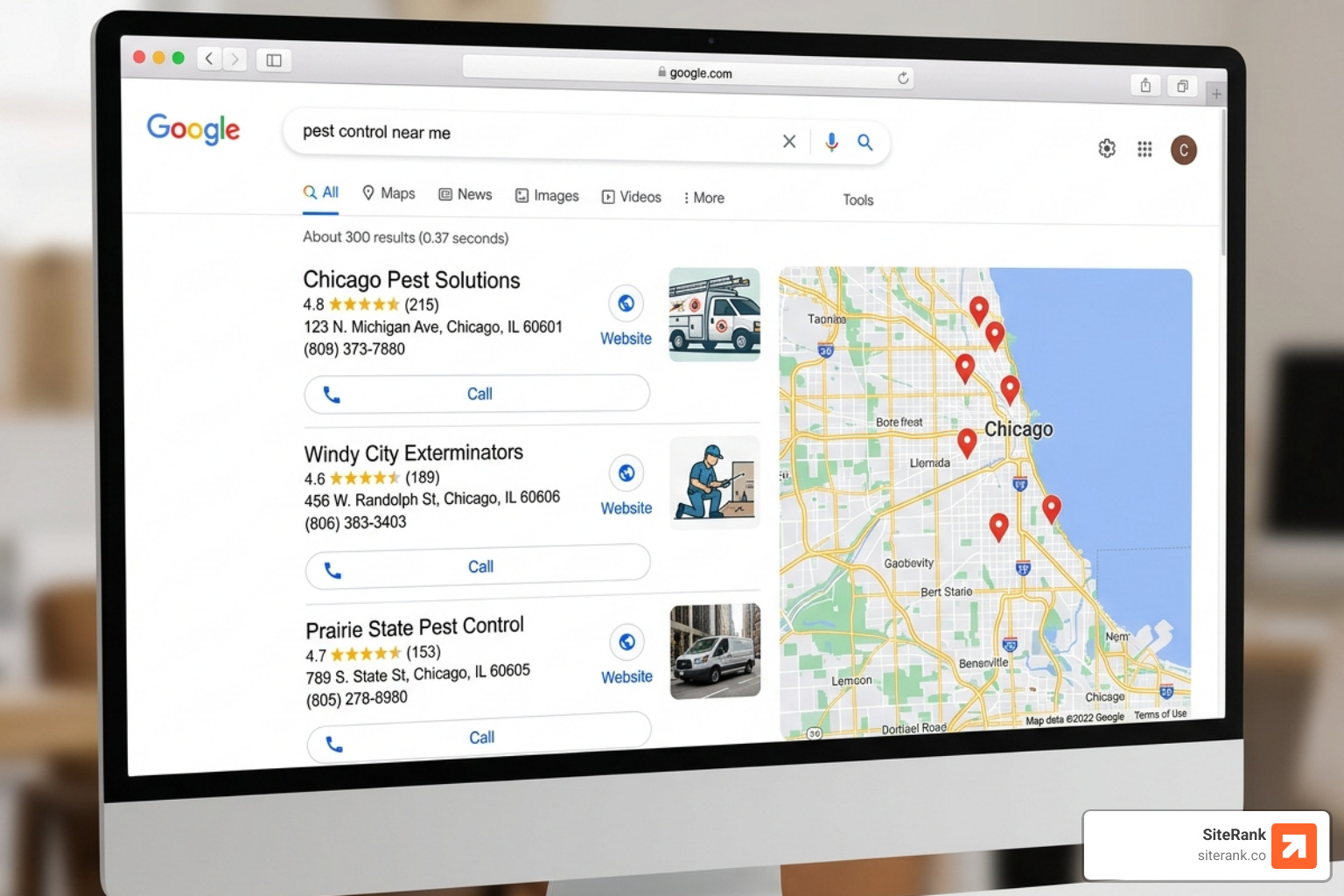
The foundation of local success is your Google Business Profile (GBP). This is often more important than your actual website for generating immediate phone calls. To optimize it, we ensure every field is filled out, from your specific service categories (e.g., “Bird Control Service,” “Termite Control Service”) to your precise service area.
Consistency is king here. Your Name, Address, and Phone number (NAP) must be identical across the web. We use local citation building services to ensure your business is listed correctly on Yelp, Yellow Pages, and industry-specific directories. These local citation backlinks act as “votes of confidence” for Google, proving that your business is a legitimate local entity.
Optimizing for “Near Me” and Emergency Searches
“Exterminator near me” is one of the most common searches in our industry. To rank for this, your site needs dedicated service-area pages. If you serve five different counties, you should have five different pages tailored to those locations. Each page should feature geo-targeted keywords, local landmarks, and even local testimonials to prove you actually work in that area.
Since most emergency searches happen on a smartphone while a customer is staring at a pest in their kitchen, mobile-first indexing is critical. If your site doesn’t load instantly or the “Call Now” button is hard to find, you’ve lost the lead. For a deeper dive into these tactics, check out The Ultimate Guide to Local SEO for Home Services.
Managing Reviews and Online Reputation
In the pest control world, trust is everything. You are sending a stranger into someone’s home to handle chemicals. Social proof in the form of Google reviews is a massive ranking signal.
We recommend a proactive review response strategy:
- Ask early: Request a review immediately after the service is completed.
- Respond to everything: Reply to both five-star reviews and the occasional “cranky” one. Google likes to see that the business is active.
- Keyword-rich reviews: While you can’t tell customers what to write, reviews that mention specific services (like “best bed bug treatment”) help your rankings for those terms.
This reputation management is a cornerstone of effective home service SEO.
Content Strategy: From Seasonal Pests to Topical Authority
Google doesn’t just rank pages; it ranks authorities. To be seen as the “pest expert” in your region, you need a robust content strategy. This involves more than just a “Services” page; it requires educational blogs and topic clusters.
By creating a library of content—articles on “How to identify termite wings” or “Why ants come out after rain”—you build topical authority. When you cover a subject exhaustively, Google is more likely to rank your main service pages. Effective keyword research allows us to find the questions your customers are asking before they even know they need a professional. This approach is vital for home services online marketing.
Leveraging Seasonal Keywords for Year-Round Leads
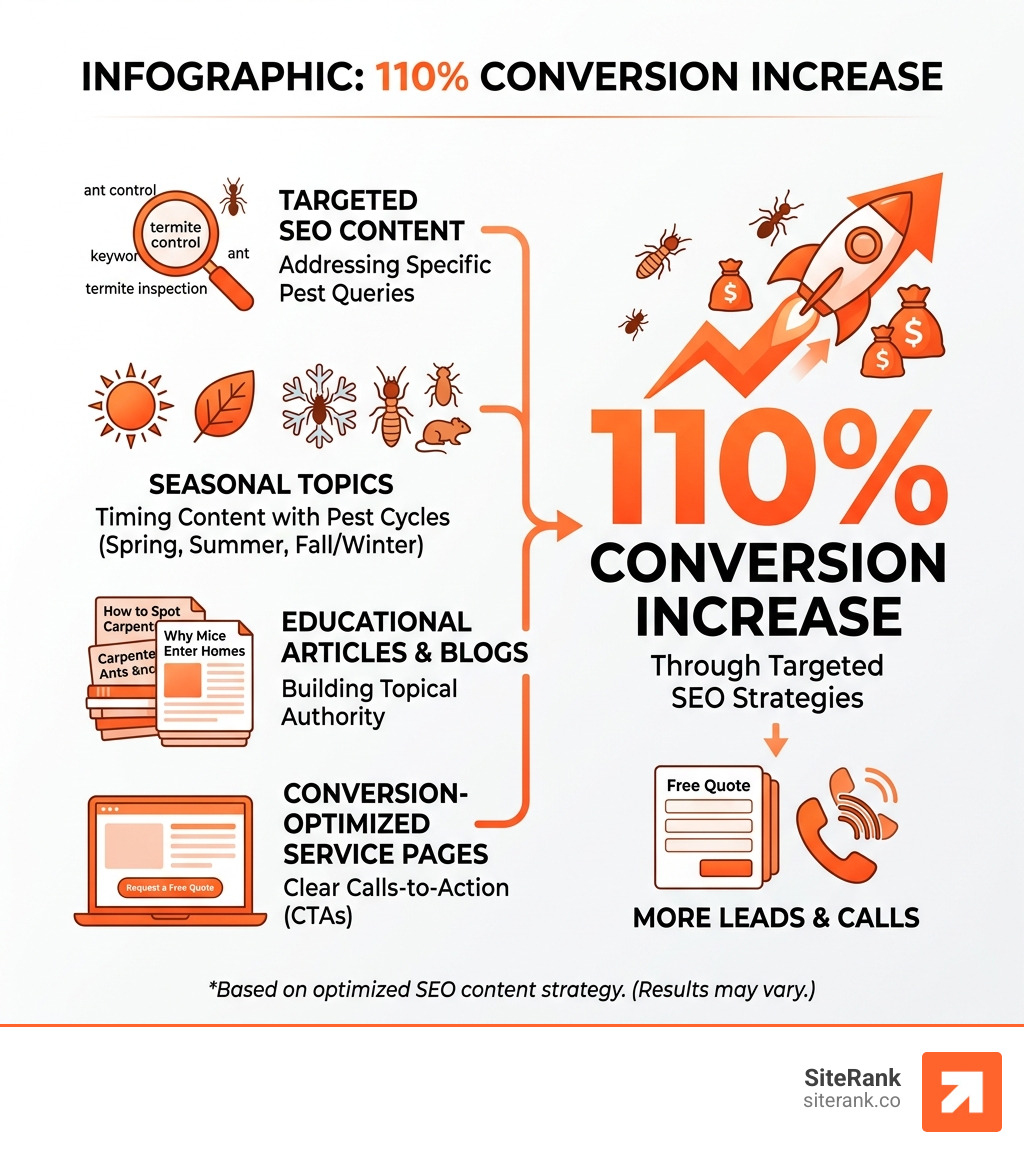
Pest problems follow the calendar. According to scientific research on the global pest control market growth, the demand for professional services is increasing due to urbanization and climate changes. We capitalize on this by targeting seasonal keywords:
- Spring: Focus on termites and carpenter ants.
- Summer: Shift to mosquitoes, wasps, and “bed bug summer” travel tips.
- Fall/Winter: Target rodents and wildlife looking for warmth.
By mapping out a content calendar, we ensure your pest control company SEO efforts are always one step ahead of the bugs. This is similar to the seasonal planning we discuss in our HVAC local SEO complete guide.
Creating High-Converting Service Pages
Traffic is great, but calls are better. Every service page on your site should be a “landing page” designed to convert. This means:
- Pest-specific content: Don’t just say “we kill bugs.” Have a page for spiders, a page for roaches, and a page for silverfish.
- Clear CTAs: “Get a Free Quote” or “Schedule Inspection” buttons should be prominent.
- Trust Icons: Display your licenses, insurance, and NPMA (National Pest Management Association) membership.
Using professional on-page SEO ensures these pages are both search-engine friendly and user-friendly.
Technical SEO Essentials for High-Converting Websites
If your website is the “truck” of your digital marketing, technical SEO is the engine. You can have the best content in the world, but if your site is slow or broken, you won’t rank.
Site speed is a major ranking factor. Users often leave a site if it doesn’t load within 3 seconds. Google’s Core Web Vitals measure things like how fast your images load and how stable the page remains as it loads. We prioritize optimizing these metrics across all our services to ensure a seamless user experience.
Implementing Schema Markup for Pest Control Services
Schema markup is a “secret language” used to tell search engines exactly what your data means. For pest control, we use:
- LocalBusiness Schema: Tells Google your hours, address, and price range.
- FAQ Markup: Allows your common questions (like “Is pest control safe for pets?”) to appear directly in search results.
- Review Schema: Can display those gold stars in the search results, which significantly boosts click-through rates.
This technical layer is just as important as the content itself, much like the strategies used in HVAC SEO services.
Site Architecture and Internal Linking
A well-organized website helps both users and Google bots. We use a silo structure, where pages are grouped logically (e.g., all “Rodent” related pages link to each other). This keeps users on the site longer and distributes “ranking juice” from your high-authority pages to your newer ones. Proper URL optimization—using /services/termite-control-cityname instead of /page123—is a simple but effective off-page SEO and on-page fundamental.
Building Authority: Link Building and Reputation Management
In the eyes of Google, a link from another website to yours is a “vote.” However, not all votes are equal. For pest control company SEO, we focus on quality backlinks from relevant sources.
Our link building strategy includes:
- Local Partnerships: Links from local chambers of commerce or community blogs.
- Guest Blogging: Writing expert articles for home improvement or real estate websites.
- Unlinked Mentions: Finding where your brand is mentioned online and asking for a link.
For more specialized tactics, see our local SEO backlinks guide 2025 and explore local link building strategies.
Measuring the ROI of Your Pest Control Company SEO
You can’t manage what you don’t measure. We move beyond “vanity metrics” like keyword rankings and focus on what actually pays the bills: qualified leads.
- Cost per lead: We’ve seen SEO bring in qualified leads for as low as $24.24.
- Conversion tracking: We track every phone call and form submission to see exactly which SEO efforts are driving revenue.
- Revenue growth: At the end of the day, the goal of our local business SEO services is to see that bottom-line number go up.
The Role of AI and GEO in 2026 Search
By April 2026, search has evolved. We are no longer just optimizing for a list of blue links; we are optimizing for Generative Engine Optimization (GEO). Platforms like ChatGPT, Gemini, and Google’s own AI-generated answers now provide direct solutions to users.
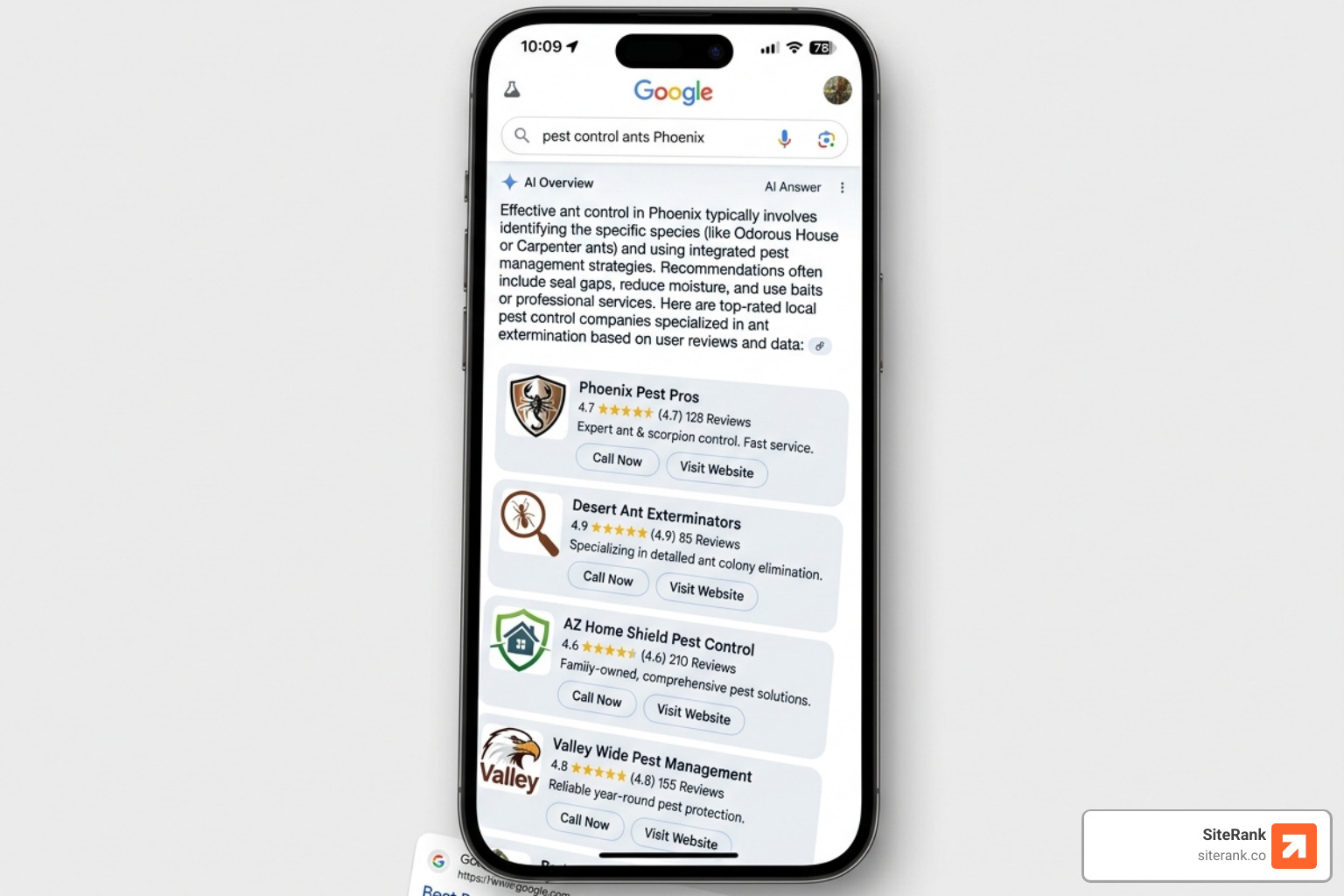
To win in this new era, your business needs entity authority. This means being mentioned in the “Knowledge Graph” as a trusted expert. Our AI-powered strategies ensure that when a user asks an AI “Who is the best exterminator for ants in Phoenix?”, your business is the one cited as the source.
Frequently Asked Questions about Pest Control SEO
How long does it take to see results from pest control SEO?
SEO is a marathon, not a sprint. Typically, you will start seeing movement in local rankings within 3 to 6 months. Competitive keywords may take 6 to 12 months to reach the first page. However, once you achieve those rankings, the growth compounds, providing a much higher long-term ROI than paid ads.
What is the typical cost of SEO for a pest control business?
The cost varies based on your market’s competitiveness and the size of your service area. Professional pest control company SEO usually ranges from $1500 to $5000 per month. While some “budget” options exist around $500, they often lack the technical depth and high-quality content needed to beat established competitors.
Should I prioritize SEO or PPC for my pest control company?
We usually recommend a hybrid strategy. PPC is excellent for getting the phone to ring today, especially for emergency services. SEO is the engine for long-term, sustainable growth and lower lead costs. Over time, as your SEO takes hold, you can often reduce your PPC spend while maintaining or even increasing your total lead volume.
Conclusion
Mastering pest control company SEO in 2026 requires a blend of local precision, technical excellence, and authoritative content. It’s about more than just “killing bugs”—it’s about building a digital presence that dominates your local market and turns searchers into lifelong customers.
At SiteRank, we specialize in these AI-powered, tailored strategies. We don’t believe in “one-size-fits-all” SEO. We focus on the metrics that matter: clicks, engagement, and most importantly, booked jobs. If you’re ready to stop chasing leads and start attracting them, let’s talk about our home services SEO solutions.