

Why Keyword Research Is the Foundation of SEO Success
Best keyword research tools are essential for any business looking to improve search visibility and drive qualified traffic. Keyword research is about understanding what your potential customers are searching for. While SEO delivers a high return on investment, this is only true when you’re targeting the right keywords. Many businesses struggle to identify which keywords will drive revenue, not just traffic.
The right tool makes this process faster and more accurate. It helps you find what people are searching for, how competitive those terms are, and whether they match the intent of someone ready to buy. Without these insights, you’re guessing what content to create.
Hundreds of keyword research tools are available, from free options to enterprise platforms. Some excel at generating long-tail keyword ideas, while others focus on competitive analysis or tracking search trends. The best approach often involves using a combination of tools for brainstorming, validation, and specialized needs.
I’m Craig Flickinger, founder of SiteRank, and I’ve spent over 15 years helping businesses identify and rank for terms that drive measurable growth. In this guide, I’ll break down the most effective types of tools available in 2025, explain when to use each one, and show you how to build a keyword research workflow that works.
What Makes a Keyword Research Tool Effective?
Before we explore the best keyword research tools, it’s worth understanding what separates an effective tool from one that just looks impressive. The difference is about delivering reliable data that helps you make smarter decisions. An effective tool should give you clarity on where to focus your efforts, not just dump mountains of data on you.
Search volume is the first metric most people look at, telling you how many people search for a term each month. However, volume fluctuates with seasons and trends. Understanding these patterns helps you time your content perfectly.
Keyword difficulty (often a score from 0 to 100) estimates how hard it will be to rank for a term. For a newer website, targeting keywords with a low difficulty score can deliver quick wins.
Cost-per-click data, while for paid ads, reveals value for organic SEO. When advertisers pay more for a click, it usually means that keyword drives conversions, signaling commercial intent.
Search trends show if a keyword’s popularity is rising, falling, or seasonal. This timing element can make or break a content strategy.
Beyond these metrics, data accuracy is paramount. Different tools show slightly different numbers, which is normal. The key is picking one reputable tool as your primary source and sticking with it for consistency. You can always cross-reference with Google Trends to validate what you’re seeing.
A good user interface is crucial. The best tools make complex data feel simple. You should be able to find what you need quickly, whether you’re a beginner or a pro.
Search intent analysis has become vital. Understanding why someone searches—whether for information, comparison, or a purchase—helps you create content that matches their needs.
SERP analysis features let you see what’s already ranking. You can see the content types, SERP features (like featured snippets or local packs), and where the competition might be vulnerable.
An effective tool gives you direction. It helps you prioritize keywords that will drive real traffic, leads, and revenue. For more guidance on turning keyword insights into optimized content, check out our guide on Content Optimization Tips for SEO.

A Breakdown of the Best Keyword Research Tools by Type
Not all keyword research tools are created equal. The best keyword research tools for your needs depend on your goals, experience, and budget. This section breaks down the different categories to help you understand which ones will serve you best.
Foundational Tools: The Best Keyword Research Tools for Beginners
If you’re new to SEO, you don’t need to break the bank. Free and freemium tools offer a great entry point. They are perfect for finding long-tail keywords, finding question-based queries, and tapping into autocomplete suggestions from search engines.
Google’s Keyword Planner remains a standard free tool, pulling data directly from its advertising platform. While it may show search volume ranges for non-advertisers, it’s invaluable for validating ideas. You can learn more here: Using Google’s Keyword Planner.
Other free tools are excellent for brainstorming and clustering. Some can generate thousands of related keywords from a single topic, organizing them into groups. This is perfect for planning content strategies without a budget. Many freemium tools offer an intuitive interface, making it simple to find easy-to-rank keywords with clear difficulty metrics. These often have daily search limits but provide substantial data in each search.
The smartest approach for a beginner is to combine these tools. Start with Google Autocomplete for real-time ideas, validate search volume with a data-driven tool, and then use a question-based tool to expand your keywords into content ideas and topic clusters. For more guidance, check out our guide on Keyword Research for Blog Posts.
Tools for In-Depth Competitive Analysis
Once you’ve mastered the basics, understanding your competitors is crucial. Comprehensive SEO platforms shine here, offering features for advanced users. These tools let you analyze competitor domains to uncover their top-ranking keywords and estimated traffic. The real power comes from keyword gap analysis, which compares your keyword profile against competitors to reveal keywords they rank for that you’re missing.
Backlink profile insights are another game-changer. Understanding where competitors get their links helps inform your own outreach strategy. For more context, read our article on Why Backlinks Are Important for SEO.
These advanced tools also show you what SERP features appear for specific keywords, like featured snippets or local packs, helping you tailor your content to capture these valuable positions. By leveraging these platforms, you can reverse-engineer competitor strategies and identify content gaps.

Specialized Tools: The Best Keyword Research Tools for Niches
Sometimes a general-purpose tool isn’t enough. For PPC research, you need tools providing detailed CPC data and competition levels. For Local SEO, you need tools that support location-specific keyword research, allowing you to find long-tail keywords for specific cities or districts. If you’re running a local business, this is essential. For deeper insights, check out our Local SEO guide or our HVAC Local SEO Complete Guide.
For e-commerce, you need to identify product-focused queries with transactional intent. For YouTube keyword research, specialized tools help find relevant keywords and tags to improve video visibility on the world’s second-largest search engine.
Tools for Content Ideation and Trend Spotting
Creating fresh, relevant content is a constant challenge. Several best keyword research tools excel at content ideation and trend analysis.
Google Trends is a free and invaluable tool for understanding search patterns and topic popularity over time, helping you identify seasonal keywords and emerging topics. Learn more at Understanding search trends with Google.
Other tools are visual powerhouses for question-based searches, making it easy to see what people are asking about any topic. This is useful for structuring blog posts. Some platforms track growth in search volume and social media conversations to help you find rising trends before they become mainstream. These tools are essential for building a robust Content Calendar Planning strategy.
Free vs. Paid Tools: When Should You Upgrade?
Ah, the age-old question that eventually pops up in every SEO journey: “Do I really need to pay for a keyword research tool?” It’s a fair question! And like many things in SEO, the answer isn’t a simple yes or no. It really boils down to what you’re trying to achieve.
Free keyword research tools, as we’ve explored, are truly a treasure trove, especially when you’re just starting out or working with a tight budget. They offer incredible value without asking you to open your wallet.
These free tools are great for:
- Sparking Ideas: They can generate thousands of keyword ideas, including those wonderfully specific long-tail keywords and common questions your audience is asking.
- Getting the Basics: You’ll find essential metrics like search volume and keyword difficulty, which help you figure out what keywords are worth targeting first.
- Content Inspiration: Tools like Google Trends are brilliant for brainstorming fresh content ideas and spotting what’s trending.
However, just like a free sample, these tools often come with a few limitations. They’re excellent for dipping your toes in the water, but they might not be enough when you’re ready to swim laps. You’ll often find daily search caps, gated features, and limited data depth. For example, some free tools give ranges for search volume rather than the precise numbers you’d see in a paid tool.
So, when does it make sense to make the leap and invest in a paid subscription?
It’s probably time to consider upgrading when:
- You’re Constantly Hitting Those Free Limits: If you find yourself consistently needing more searches or more data than your free plan allows, it’s a clear sign you’ve outgrown it.
- You Need Advanced Insights: For serious competitive analysis, tracking your keyword rankings over time, performing thorough site audits, or getting super-precise keyword difficulty calculations, paid tools become indispensable.
- You Crave Unlimited Data & Historical Trends: Paid tools offer access to huge databases of keywords, extensive historical data, and more frequent data updates. This kind of comprehensive data is vital for making informed, long-term decisions.
- You Want an All-in-One Solution: Many paid platforms combine keyword research with other essential SEO functions like Technical SEO, site audits, and content optimization. This streamlines your workflow and keeps all your SEO efforts neatly organized in one place.
To give you a clearer picture, here’s a quick comparison:
| Feature Comparison | Free Keyword Research Tools | Paid Keyword Research Tools |
|---|---|---|
| Keyword Ideas | Hundreds to thousands | Tens of thousands to millions |
| Search Volume | Ranges or basic numbers | Precise monthly figures |
| Keyword Difficulty | Basic estimation | Advanced, often proprietary scores |
| Competitor Analysis | Limited to basic overview | In-depth domain and keyword gap analysis |
| SERP Analysis | Basic overview | Detailed feature breakdown, historical data |
| Daily Usage | Limited searches/credits | High or unlimited searches |
| Data History | Limited or none | Extensive historical data |
| Integrations | Few or none | Often integrated with other SEO functions |
| Cost | Free | From $29/month to $1000+/month |
| Pros | Accessible, good for beginners, ideation | Comprehensive data, advanced features, efficiency |
| Cons | Limited data, usage caps, fewer features | Cost, potential learning curve |
So, while free tools are absolutely fantastic for getting your feet wet and for those occasional, quick checks, investing in a paid tool becomes a necessary step as your website grows and your SEO strategy matures. It open ups deeper insights, provides a competitive edge, and ultimately helps you achieve more significant, measurable results.
Frequently Asked Questions about Keyword Research Tools
Can AI chatbots be effectively used for keyword research?
With AI chatbots becoming household names, it’s natural to wonder if they can replace our dedicated keyword research tools. The honest answer? They’re helpful, but they can’t do the whole job.
AI chatbots shine when it comes to brainstorming and ideation. They’re fantastic for generating initial topic ideas, expanding on seed keywords, and even creating content outlines. You can ask them to list questions people might ask about a topic or suggest related concepts, and they’ll give you plenty to work with.
However, here’s where things get tricky. AI chatbots don’t have real-time access to current search volume, keyword difficulty, or CPC data from search engines. Their knowledge is based on training data with a cutoff date, which means they’re working with outdated information. They can’t tell you if a keyword gets 100 searches per month or 100,000. They can’t reveal whether a keyword has a high or low difficulty score.
This creates a real danger if you rely on them blindly. You might end up targeting keywords with zero search volume or facing impossibly tough competition.
The smart approach is to use AI chatbots as a supplementary tool. Let them help you brainstorm and generate initial ideas, but always validate their suggestions with dedicated keyword research tools that provide the hard metrics you need to make informed SEO decisions.
What’s the difference between a keyword research tool and a keyword clustering tool?
These two types of tools serve different but complementary purposes in your SEO workflow.
Keyword research tools focus on generation and metrics. They help you find keywords, provide search volume data, show keyword difficulty scores, and reveal CPC information. Their job is to identify relevant search queries and give you the performance data you need to evaluate them.
Keyword clustering tools, on the other hand, organize and group. They take your list of keywords and sort them into topical clusters based on search intent and SERP similarities. Their goal is to help you organize keywords into logical content topics, spot content gaps, and build a cohesive site structure. This is crucial for establishing topical authority.
The real magic happens when a tool combines both functions. This dual functionality allows you to map your content strategy more effectively and build content hubs that signal expertise to Google. For more insights on building this kind of strategic content, check out our guide on Mastering Content for SEO: A Quick Guide.
How can I create an effective workflow using multiple tools?
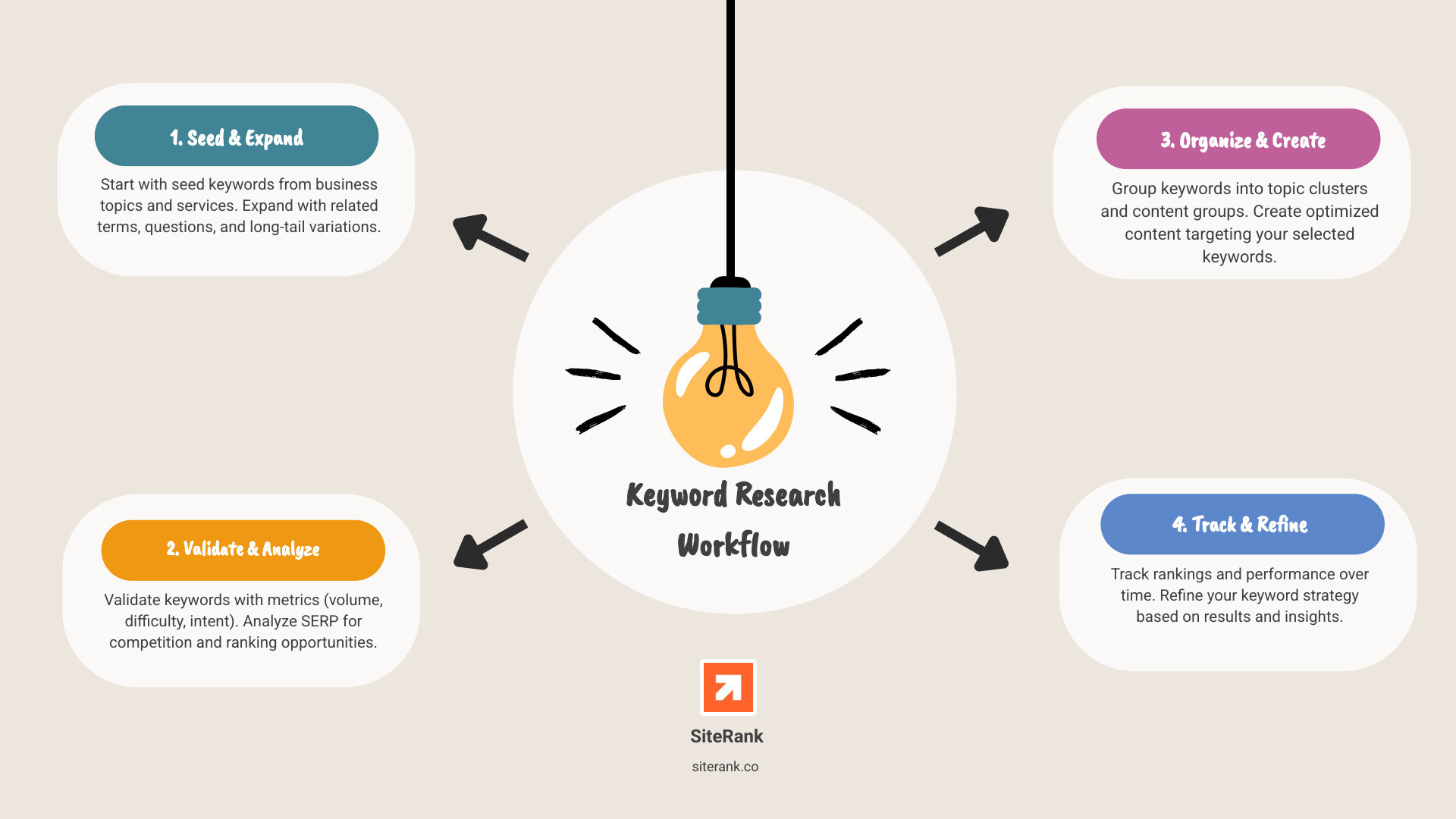
Using multiple tools might sound overwhelming, but a structured workflow actually makes keyword research faster and more effective. Here’s a proven 4-step approach that combines different tool types for maximum results:
Step 1: Ideation & Initial Findy — Start by casting a wide net. Use Google Autocomplete in incognito mode to see what people are actually searching for right now. Use question-based tools to uncover queries and related topics. Check Google Trends (find it at Understanding search trends with Google) to spot rising trends and seasonal content opportunities.
Step 2: Validation & Data Analysis — Now it’s time to separate the wheat from the chaff. Take your keyword ideas from Step 1 and plug them into data-driven tools. Use a reliable tool to validate search volume and competition levels. This step helps you filter out keywords with no search volume or impossibly high competition.
Step 3: Competitor & Gap Analysis — Don’t operate in a vacuum. Analyze what your competitors are doing using competitive analysis features in comprehensive tools. Uncover their top-ranking keywords and identify keyword gaps. For more on why this matters, read our article on Why Backlinks Are Important for SEO.
Step 4: Clustering, Optimization & Tracking — Once you have your validated keyword list, use a clustering tool to group them into topical clusters. This forms the foundation of your content strategy. Create optimized content targeting these clusters, then use Google Search Console to monitor your site’s performance for these keywords. Track impressions, clicks, and average positions to optimize existing content and identify new opportunities.
By following this structured approach, you can leverage the strengths of various free and paid best keyword research tools to create a comprehensive strategy that actually drives results.
Conclusion: Choosing the Right Tools for Your SEO Strategy
Navigating best keyword research tools can certainly feel a little overwhelming, can’t it? But as we’ve explored together, the secret isn’t finding one magic tool. Instead, it’s about understanding your unique needs and smartly leveraging the strengths of various platforms. The ideal choice always comes down to your specific goals, your budget, and where you are on your SEO journey.
For those just starting out, free options provide fantastic foundational data and sport intuitive interfaces that make getting started a breeze. As your SEO path progresses and your needs grow a bit more complex, you’ll find yourself needing tools that offer deeper competitive analysis and specialized features. That’s when upgrading becomes a really smart move!
Throughout this guide, we’ve uncovered some key truths. First, an effective tool isn’t just about flashy features; it’s about providing accurate data and actionable insights. This includes everything from reliable search volume and difficulty metrics to helping you truly understand user intent. We also found that free tools can be incredibly powerful, serving as fantastic starting points for ideation and basic validation.
Then, as your website grows and your strategy matures, you’ll see that paid tools offer a deeper dive. They open up comprehensive competitive analysis, unlimited data, and advanced features that can truly propel your SEO efforts forward. The real secret sauce to success is having a well-thought-out workflow. By combining different tools in a structured way, you ensure you cover all your bases, from initial idea generation to ongoing performance tracking.
At SiteRank, we completely understand that simply finding the right tools is just the beginning. The real magic happens when those tools are expertly combined with a strategy that’s custom-built for your unique business. As an AI-powered SEO agency, we focus on delivering customized SEO services designed to increase clicks and engagement, all without piling on unnecessary deliverables. We’re here to help you cut through the noise and identify those keywords that genuinely lead to traffic, leads, and, most importantly, revenue.
Ready to stop guessing and start seeing real growth? Let us help you craft a keyword research strategy that delivers measurable results. Get a custom Keyword Research strategy with us today!