

Why Small Wins Create Big Results for Your Practice
Dental practice growth feels overwhelming when you’re juggling patient care, staff management, and endless administrative tasks. The good news? You don’t need massive overhauls to see real results.
Quick Answer: Top Dental Practice Growth Strategies
– Local SEO optimization – Claim and optimize your Google Business Profile
– Patient retention systems – Automated reminders and membership plans
– Technology integration – AI diagnostics and teledentistry options
– Financial optimization – Track hygiene production ratios and KPIs
– Operational efficiency – Streamline scheduling and reduce overhead
The dental industry is projected to reach $65.23 billion by 2030, yet 28% of practices report not being busy enough. The difference between thriving and struggling practices often comes down to consistent, small improvements rather than dramatic changes.
Think of dental practice growth like building healthy habits. You wouldn’t expect a patient to floss perfectly after one visit – it takes daily micro-actions that compound over time.
Why bite-sized hacks work better:
– Create immediate momentum without overwhelming your team
– Allow you to test and refine before full implementation
– Build sustainable systems that don’t require constant attention
– Generate quick wins that motivate further improvements
I’m Craig Flickinger, and I’ve spent over 15 years helping healthcare practices achieve sustainable dental practice growth through strategic digital marketing and operational optimization.
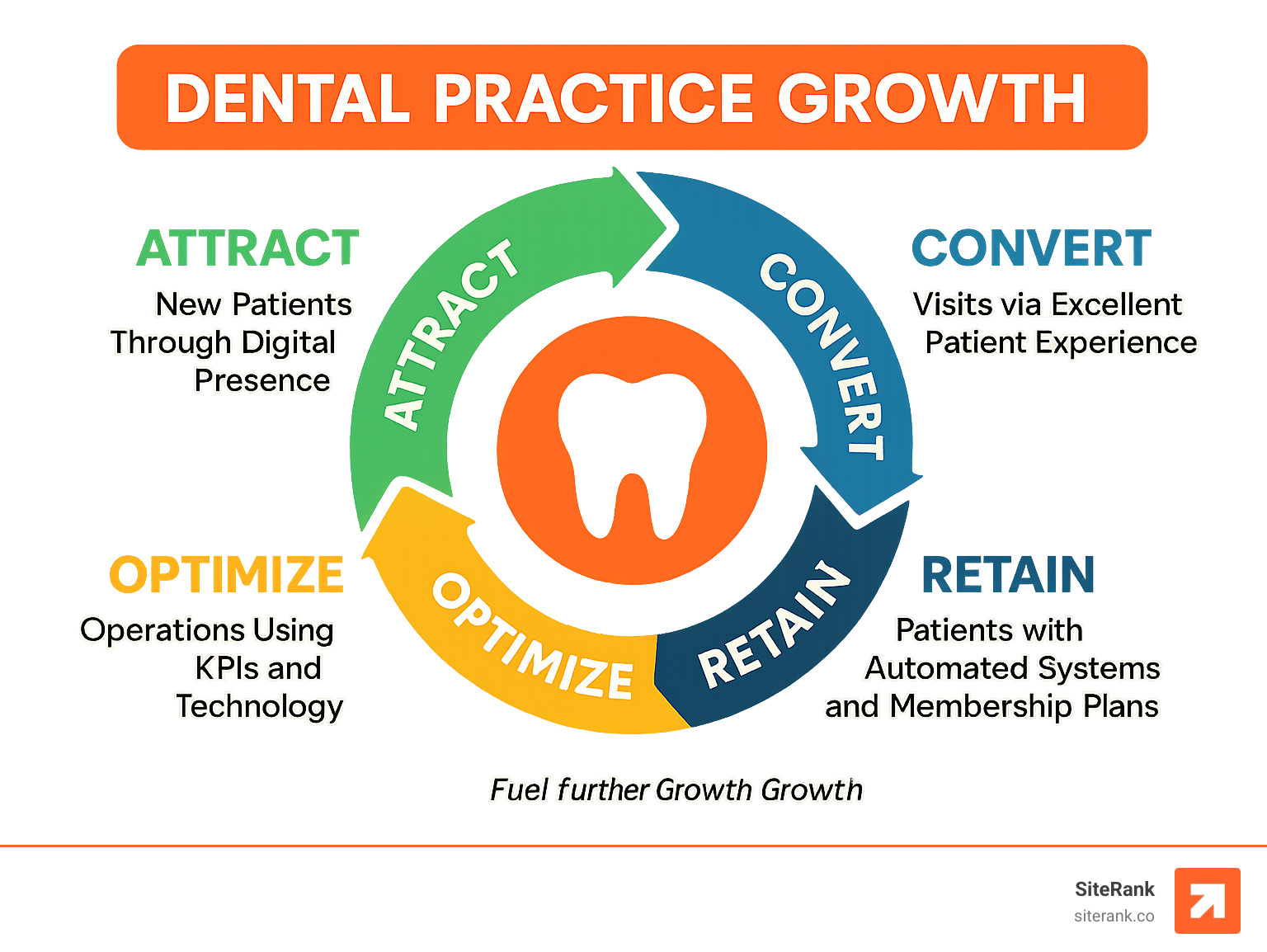
Why a “bite-sized” approach works
Practices attempting massive changes often fail because they overwhelm their teams and disrupt patient care. Instead, micro-wins create powerful momentum through habit stacking – linking small improvements together until they become automatic.
When you implement one small change successfully, it builds confidence and creates a foundation for the next improvement.
Hack #1: Polish Your Digital Front Door
Think of your online presence as the front door to your practice. Just like you wouldn’t let your physical office lobby get dusty and outdated, your digital presence needs regular attention to make that crucial first impression count.
75% of people judge your practice’s credibility based on your website design alone. Most visitors expect your pages to load in under 2 seconds. If your site takes longer, they’re already clicking away to your competitor.
Local SEO is where the magic happens for dental practice growth. While 94% of dental practices say they’re accepting new patients, many are practically invisible online. When someone searches “dentist near me” at 11 PM with a toothache, you want to be in those top three results.
More info about Local Business SEO Services
Bite 1.1: Claim & turbo-charge your Google Business Profile
Your Google Business Profile is like getting prime real estate for free – yet most practices barely scratch the surface of what it can do.
Start with NAP consistency (Name, Address, Phone number) across every platform. Google gets confused when your address is “123 Main St” on one site and “123 Main Street” on another.
Next, upload high-quality photos that show off your modern equipment, friendly team, and welcoming office space. Include photos of your treatment rooms, waiting area, and staff in action.
Add comprehensive FAQs and enable messaging. When someone has a quick question about your hours or services, they can get answers instantly through Google.
Treat your profile like a living marketing tool. Post regular updates about new services, share patient success stories (with permission), and highlight what makes your practice special.
Bite 1.2: Automate review generation for social proof
Happy patients rarely leave reviews on their own. They’re busy, they forget, or they simply don’t think about it. Meanwhile, unhappy patients are much more motivated to share their experiences online.
68% of consumers rely on reviews when choosing healthcare providers. Without a system to encourage positive reviews, your online reputation doesn’t reflect the quality care you provide.
The solution is building a reputation engine that runs automatically. The best time to ask for reviews is within 24-48 hours after a positive treatment experience.
SMS requests work incredibly well – they’re personal, immediate, and get 30-40% higher response rates than email. Keep your message short: “Hi Sarah, we hope your cleaning went smoothly yesterday! If you have a moment, we’d appreciate a quick review.”
Make it easy by including direct links to your preferred review platforms. When reviews come in, respond professionally and promptly.
Hack #2: Turn First Visits into Lifelong Loyalty
Here’s something that might surprise you: keeping an existing patient costs 25 times less than finding a new one. Yet most practices spend most of their energy chasing new patients instead of nurturing the ones walking through their doors.
I’ve seen practices transform their growth simply by shifting focus to patient experience and loyalty systems. One practice I worked with went from booking 40 new patient appointments monthly to 65 – not by spending more on marketing, but by creating an experience so good that patients couldn’t stop talking about it.
The magic happens when you create those special moments that make patients feel genuinely cared for. It’s not just about clinical excellence (though that’s essential) – it’s about every touchpoint from the moment they find you online to their follow-up care.
Dental practice growth accelerates when you master the patient journey. Think comfort touches that reduce anxiety, recall systems that actually work, membership plans that remove financial barriers, and referral rewards that turn patients into practice ambassadors.
Bite 2.1: Shorten wait times with smart tech
Nothing kills the patient experience faster than sitting in a waiting room for 30 minutes past your appointment time. I’ve watched patients get increasingly frustrated, checking their phones, sighing loudly – and sometimes walking out entirely.
The good news? Technology can virtually eliminate unexpected wait times without requiring major operational changes.
Digital intake forms transform your check-in process by letting patients complete paperwork at home. No more clipboard juggling or last-minute form filling that backs up your schedule. Patients arrive ready to go, and your front desk team can focus on creating a welcoming experience.
Two-way texting keeps patients informed when delays happen (because they will). A simple “Running 10 minutes behind – grab a coffee if you’d like!” message shows respect for their time. Even better, you can offer earlier slots when cancellations occur.
Online forms and kiosks at check-in reduce bottlenecks at your front desk. Patients can verify information quickly while your team handles more complex needs. Adding a queue management board sets realistic expectations about wait times, which actually makes delays feel shorter.
One practice reduced average wait times from 23 minutes to 8 minutes using these simple tech upgrades. Their patient satisfaction scores jumped 31% within three months, and negative reviews about wait times disappeared entirely.
Bite 2.2: Create a membership plan for dental practice growth
Here’s a startling fact: only 20% of uninsured adults get preventive dental care, compared to 50% of insured patients. That’s a massive opportunity sitting right in your community.
Membership plans bridge this gap while creating recurring revenue that stabilizes your practice finances. Instead of hoping patients return for their six-month cleanings, you have predictable monthly income and engaged patients who see regular care as affordable.
The key is designing plan tiers that work for different budgets and needs. Your basic tier might include two cleanings, exams, and necessary X-rays annually. A premium tier could add whitening, emergency visits, and significant discounts on major procedures.
Auto-renewal systems reduce administrative headaches while ensuring patients don’t accidentally lapse in coverage. Most patients appreciate the convenience once they see the value.
I’ve watched practices increase revenue by 15-25% within the first year of launching membership plans. The uninsured patients who join often become some of the most loyal because you’ve made quality dental care accessible for the first time in years.
The beauty of membership plans is they create a win-win situation. Patients get affordable care without insurance hassles, and you get steady income plus higher case acceptance rates from patients already invested in their oral health.
Hack #3: Harness Technology & Data for Faster Dental Practice Growth

The practices seeing the fastest dental practice growth aren’t necessarily the ones with the fanciest equipment. They’re the ones using technology strategically to solve real problems and make better decisions.
Technology adoption in dentistry has moved beyond “nice to have.” Digital X-rays, AI diagnostics, 3D printing, and teledentistry are becoming standard tools that patients expect. The smartest approach is identifying your biggest operational challenges, then finding technology that addresses those specific pain points.
Scientific research on AI in dentistry shows promising results for early detection and treatment planning. However, technology improves your expertise – it doesn’t replace the personal connection your patients value most.
Real-time dashboards and data analytics help you spot trends before they become expensive problems. When you can see exactly which marketing efforts bring in profitable patients or which appointment types have the highest no-show rates, you can make adjustments quickly.
More info about On-Page SEO Optimization Techniques
Bite 3.1: Automate no-show predictions & reminders
No-shows aren’t random events – they follow predictable patterns. Machine learning algorithms can identify these patterns and help you intervene before the no-show happens.
The average practice loses $200-400 per missed appointment when you factor in lost revenue, wasted chair time, and schedule disruption.
Smart reminder systems analyze each patient’s history to determine the best message, timing, and communication method. Some patients respond better to text nudges sent the morning of their appointment, while others prefer phone calls two days prior.
Smart overbooking becomes possible when you can predict no-shows accurately. Instead of guessing, you can use historical data to determine exactly how many extra appointments to schedule. One practice reduced no-shows by 35% simply by personalizing their reminder strategy based on patient risk scores.
Bite 3.2: Leverage KPIs for dental practice growth
Numbers don’t lie, but they can be overwhelming if you try to track everything at once. The secret is focusing on metrics that directly impact your bottom line and patient satisfaction.
Your production ratios tell the real story of practice health. The hygiene production ratio should hit around 3.5:1 – meaning for every dollar you pay hygienists, you should generate $3.50 in production.
Recall rate is another critical metric. You want 70% or higher of patients returning for their recommended cleanings and checkups. A declining recall rate often signals communication breakdowns or scheduling difficulties.
Case acceptance rates vary dramatically by treatment type and provider. When you track these numbers consistently, you’ll find which team members excel at patient education and which treatments need better explanation or financing options.
Real-time alerts make the difference between reactive and proactive management. Instead of finding problems during monthly reviews, you can address issues immediately.
Hack #4: Streamline Operations & Finances to Boost Profitability

Operational efficiency directly impacts profitability and dental practice growth. Small improvements in scheduling, supply management, and financial processes can generate significant bottom-line improvements without requiring additional patient volume.
One multi-practice owner improved their bottom line by almost $200,000 without picking up a handpiece, focusing entirely on operational optimizations. This demonstrates how systematic improvements compound to create substantial financial impact.
Bite 4.1: Master the hygiene production ratio
The hygiene production ratio is one of the most reliable indicators of practice health. A ratio of 3.5:1 means your hygienist generates $3.50 in production for every dollar in wages – the minimum threshold for profitability.
Optimizing hygiene productivity:
– Schedule audit – Move from 60-minute to 50-minute appointments if appropriate
– Reduce broken appointments – Implement confirmation and reminder systems
– Adult fluoride treatments – Offer to medium/high caries risk patients
– Periodontal protocols – Ensure consistent diagnosis and treatment planning
Moving to 50-minute hygiene appointments can add two daily slots, potentially generating $75,000-100,000 in additional annual revenue. The key is ensuring quality isn’t compromised while maximizing efficiency.
Bite 4.2: Know when to hire an associate
Hiring an associate represents a significant financial commitment that requires careful timing and planning. The “valley of death” typically occurs around $2-3 million in annual revenue when growth outpaces infrastructure.
Associate hiring decision factors:
– Capacity utilization – Are you consistently booked 3-4 weeks out?
– Financial readiness – Can you cover full compensation costs (salary, benefits, taxes)?
– Space availability – Do you have adequate operatory capacity?
– Growth trajectory – Are new patient numbers sustainable?
The math is straightforward: if you’re producing $1.3-1.4 million with two hygienists, adding an associate typically makes sense when hygiene production consistently exceeds capacity and you have sustainable new patient flow.
| Expense Category | Ideal Percentage of Revenue |
|---|---|
| Staffing | 30% |
| Rent/Building | 6-10% |
| Dental Supplies | 6-7% |
| Lab Costs | 5-8% |
| Other Overhead | 15% |
| Professional Compensation | 35-38% |
Key Metrics & Tracking Tools for Dental Practice Growth
You can’t improve what you don’t measure. That’s why the fastest-growing practices aren’t just busy – they’re smart about tracking the right numbers and making data-driven decisions.
Think of metrics like taking your practice’s vital signs. Just as you wouldn’t diagnose a patient without proper examination, you shouldn’t make business decisions without understanding your key performance indicators.
The difference between thriving practices and struggling ones often comes down to consistent measurement and course correction. Successful dental practice growth happens when you establish clear baselines, set realistic targets, and review performance regularly rather than flying blind.
More info about Free SEO Audit
Bite 5.1: Set SMART goals and dashboards
Saying “I want to grow my practice” is like telling a patient to “eat better” – it’s too vague to create real change. SMART goals give you the specificity needed to actually move the needle.
SMART goals work because they’re Specific, Measurable, Attainable, Relevant, and Time-bound. Instead of hoping for growth, you create a roadmap with clear milestones.
Here’s what this looks like in practice: Rather than “get more new patients,” try “increase new patient appointments from 20 to 23 per month by implementing automated review requests and optimizing our Google Business Profile over the next 90 days.”
Dashboard design makes or breaks your tracking efforts. I’ve seen practices create beautiful 20-metric reports that nobody ever looks at. Focus on 5-7 key indicators that directly impact your bottom line and patient experience.
Your dashboard should match how you actually make decisions. Check operational metrics like appointment confirmations daily, review financial indicators weekly, and analyze strategic trends monthly. This rhythm keeps you informed without creating information overload.
Bite 5.2: Benchmark against top-performing practices
Knowing your numbers is only half the battle – understanding how they compare to successful practices reveals your biggest opportunities.
Benchmarking isn’t about copying everyone else. It’s about identifying where you’re already excelling and where focused improvement could make the biggest difference. Your practice might have fantastic patient retention but struggle with new patient conversion, or excel at treatment acceptance while lagging in operational efficiency.
National averages provide helpful context, but local market conditions matter more for practical planning. A practice in Manhattan faces different realities than one in rural Iowa. Production per patient, overhead percentages, and technology adoption all vary significantly by geography and patient demographics.
ADA data gives you the big picture, while peer groups and local dental societies offer more relevant comparisons. The goal isn’t matching every benchmark perfectly – it’s understanding which improvements would have the greatest impact on your dental practice growth.
Consider joining a study club or practice management group where you can share metrics confidentially with non-competing practices. These relationships often provide the most valuable insights because you’re comparing similar challenges and patient populations.
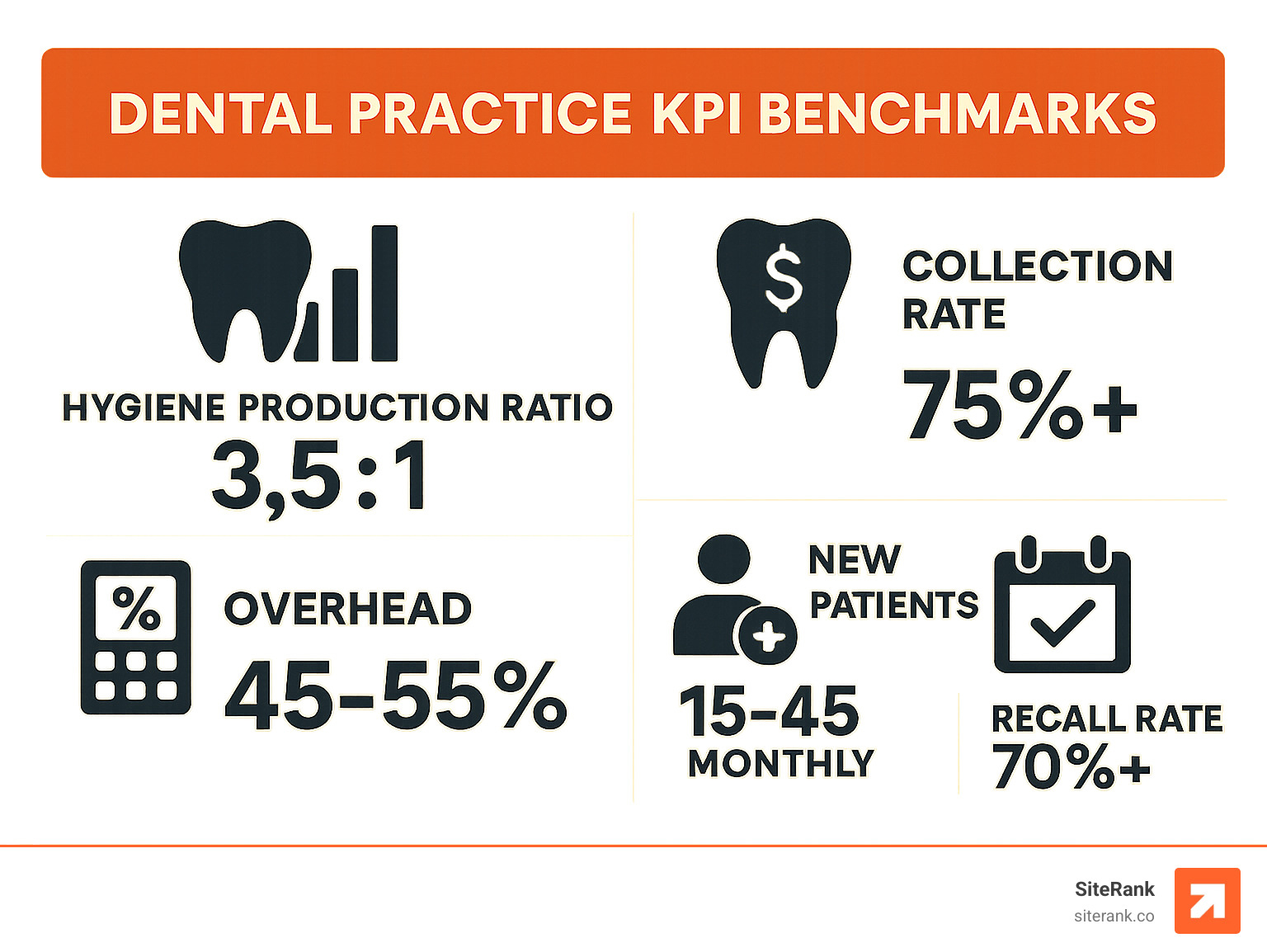
The practices that grow consistently are those that treat metrics as diagnostic tools rather than report cards. When your hygiene production ratio drops or new patient numbers decline, these aren’t failures – they’re early warning signals that help you address issues before they impact your bottom line.
Frequently Asked Questions about Bite-Sized Dental Practice Growth Hacks
How quickly can I see results?
Digital improvements like optimizing your Google Business Profile often show results within 2-4 weeks. I’ve seen practices get three new patient calls in the first week just from adding better photos and updating their business hours.
Operational changes like improving your hygiene production ratio or implementing membership plans typically take 60-90 days to show measurable impact. Your team needs time to adjust to new workflows.
Patient retention initiatives require the most patience – usually 6-12 months for full results. This makes sense because you’re measuring appointment cycles and long-term behavior changes. But most practices start seeing improved patient satisfaction scores within the first month.
The secret is starting with quick wins that build momentum while implementing longer-term strategies simultaneously.
What budget should I set for marketing?
Established practices typically spend 1-3% of revenue on marketing. So if you’re producing $1.2 million annually, you might invest $12,000-36,000 in marketing efforts.
New practices often need to invest 5-7% initially because you’re building awareness from scratch.
But here’s what really matters: focus on ROI rather than absolute spending. If you can acquire new patients for $150 each and their average lifetime value is $2,000, you should invest as much as possible in those channels.
Track your cost per acquisition by source to optimize budget allocation. You might find that your Google Business Profile generates patients for $50 each while direct mail costs $300 per patient.
Which tech upgrade pays off first?
Practice management software improvements typically deliver the fastest ROI by reducing administrative time and improving collections. If your collection rate is below 75%, start here.
Digital X-rays and intraoral cameras follow closely because they improve diagnostic capabilities and case acceptance. Patients understand their treatment needs better when they can see the problem on a screen.
Automated reminder systems and online scheduling might seem basic, but they reduce no-shows and free up front desk time for more valuable activities.
Here’s my golden rule: avoid technology for its own sake. Each upgrade should solve a specific problem or create measurable value.
Conclusion
Growing your dental practice doesn’t have to feel like climbing Mount Everest. The most successful practices we’ve partnered with understand a simple truth: dental practice growth happens through consistent, thoughtful improvements rather than dramatic overhauls that disrupt everything you’ve built.
Think about it like this – you wouldn’t tell a patient to completely change their oral hygiene routine overnight. Instead, you’d help them build better habits gradually. The same approach works for your practice.
The bite-sized hacks we’ve explored together aren’t just theory. They’re battle-tested strategies that work whether you’re running a solo practice in a small town or managing multiple locations in a busy metropolitan area. From turbo-charging your Google Business Profile to mastering your hygiene production ratios, each hack builds on the others to create real momentum.
Here’s what I’ve learned after helping hundreds of dental practices grow: the magic happens when you pick 2-3 areas to focus on first. Trying to implement everything at once is like asking your hygienist to see 20 patients in a day – technically possible, but not sustainable or effective.
At SiteRank, we get excited about helping dental practices like yours cut through the digital marketing noise. Our AI-powered approach doesn’t just throw generic strategies at your practice and hope something sticks. Instead, we dig deep to understand your specific challenges, opportunities, and goals.
We’ll analyze your current digital presence, see how you stack up against local competitors, and identify the quick wins that’ll give you the biggest boost. No cookie-cutter solutions or unnecessary busy work – just focused strategies that move the needle on your dental practice growth.
More info about Healthcare SEO Services
The dental practices thriving today share one common trait: they never stop improving while keeping patient care at the center of everything they do. They understand that small, consistent changes compound over time to create extraordinary results.
Your patients already trust you with their health. Now it’s time to build the systems and strategies that help more people find what makes your practice special. Start small, stay consistent, and watch as these bite-sized improvements transform your practice in ways you never imagined.
The best time to start was yesterday. The second-best time is right now.