

Why Ecommerce Keyword Research Is the Foundation of Online Sales
Ecommerce keyword research is the process of finding and analyzing the exact search terms your potential customers use when they’re ready to buy. Here’s what you need to know:
- What it is: Identifying search queries that reveal buyer intent, from product findy to final purchase
- Why it matters: Every search represents a potential sale—targeting the right keywords means showing up when customers are ready to buy
- Key focus areas: Commercial and transactional keywords, long-tail phrases, competitor gaps, and seasonal trends
- Expected outcome: Higher organic traffic, better conversion rates, and lower customer acquisition costs
Years of experience in ecommerce have shown that keyword research can make or break an online store. While millions of online stores compete for clicks, most miss the mark by targeting generic terms instead of the specific phrases that actually drive sales. The difference between ranking for “running shoes” and “best cushioned running shoes for flat feet” isn’t just traffic volume—it’s conversion rate. High-intent keywords attract shoppers who know exactly what they want and are ready to buy.
In ecommerce, every search represents a potential sale. But here’s the challenge: traditional keyword tools often fail to identify the commercial and transactional queries that convert browsers into buyers. Running ads without proper keyword research can quickly deplete your budget, while focusing on the wrong organic terms means investing time in content that brings traffic but not revenue. The solution lies in understanding not just what people search for, but why they search—and matching your products to those specific needs.
I’m Craig Flickinger, founder of SiteRank, and I’ve spent over 15 years helping ecommerce businesses achieve top-tier visibility through strategic keyword research and SEO. Throughout my career, I’ve seen how mastering ecommerce keyword research transforms struggling online stores into profitable ventures by connecting products with customers at the exact moment they’re ready to buy.
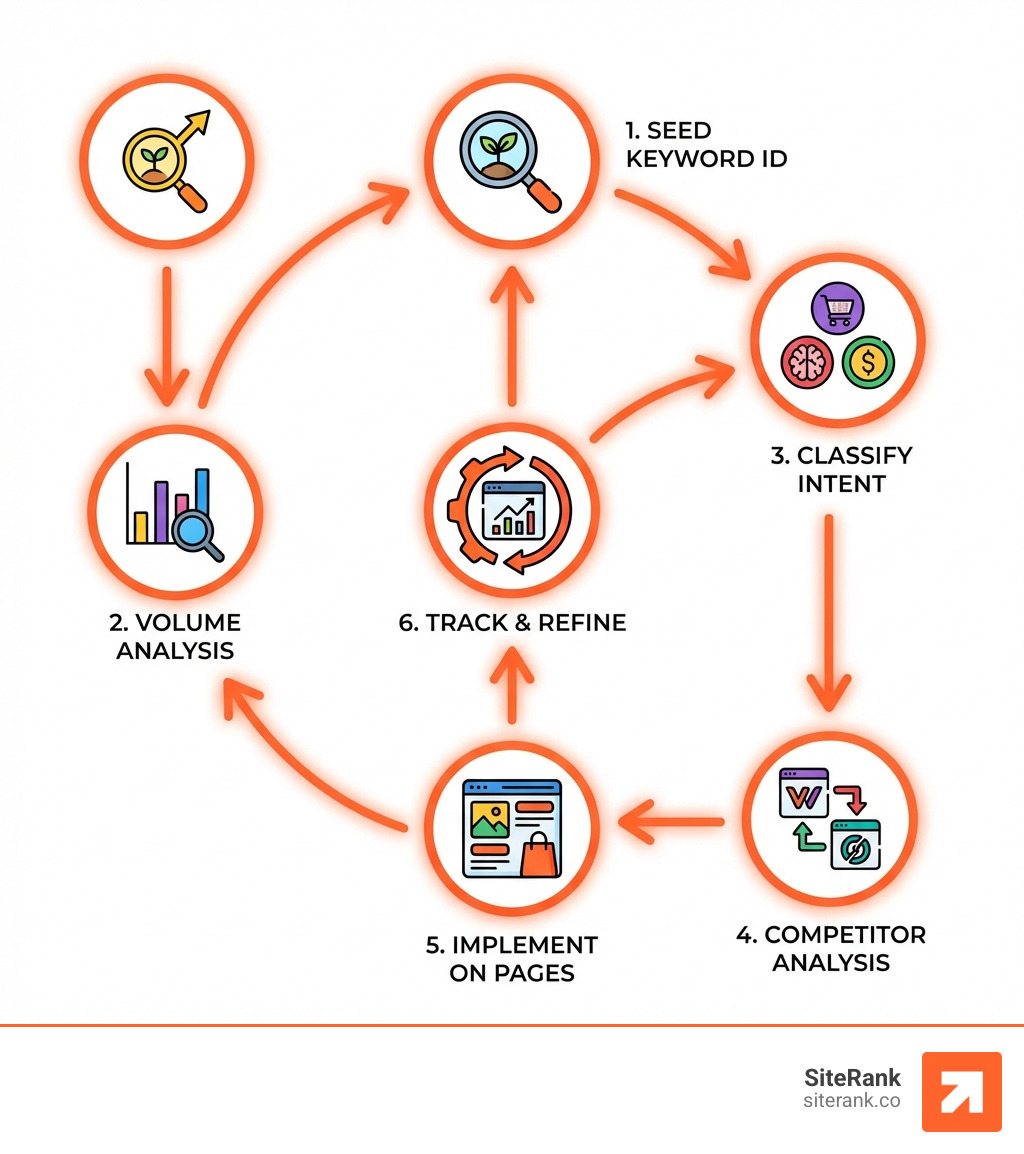
The Fundamentals of Ecommerce Keyword Research
So, what exactly is ecommerce keyword research, and why is it so incredibly crucial for online stores? Simply put, it’s the meticulous process of finding and analyzing the exact words and phrases people type into search engines when they’re looking for products and services online. It’s about understanding the language of your customers and using that knowledge to connect them directly to your offerings.
Why is this so important? Because in ecommerce, every search query represents a potential sale. Unlike general searches where someone might just be browsing for information, an ecommerce search often signals an intent to purchase. By targeting high-intent keywords, we can attract shoppers who are actively looking to buy, not just window shopping. This translates directly into more qualified organic traffic, higher conversion rates, and a healthier bottom line.
Consider these benefits:
- Drives high-intent traffic: We attract visitors who are already inclined to make a purchase.
- Improves product visibility: Our products appear prominently in search results, increasing our chances of being seen.
- Guides content strategy: We create content that directly answers customer queries and leads them to our products.
- Reveals market demand: Keyword trends show us what people care about and what they’re willing to pay for, informing our product development.
- Reduces ad spend waste: By understanding high-converting keywords, we can optimize our paid campaigns for better ROI.
- Provides a competitive advantage: We can identify opportunities our competitors might be missing.
- Boosts ROI: By bringing in more qualified leads organically, we reduce our customer acquisition costs.
Keywords are more than just search terms; they are windows into customer needs and desires. Effective Keyword Research is the foundation of online visibility, deepens our understanding of our audience, provides a competitive advantage, and significantly improves our return on investment. And remember, it’s not a one-time task! Search behavior evolves, so our keyword lists need regular updates to stay relevant and competitive.
Decoding Search Intent for Online Stores
Understanding search intent is like having a superpower in ecommerce. It’s the primary goal a user has when they enter a search query. If we can accurately guess what someone is trying to achieve with their search, we can serve them the most relevant content or product, greatly increasing our chances of a sale.
There are four main types of search intent, and each plays a distinct role in ecommerce:
| Search Intent Type | User Goal | Keywords Often Used | Ecommerce Application |
|---|---|---|---|
| Informational | Researching a topic or looking for an answer. | how to, what is, guide, tips | Blog posts and guides that build brand authority and trust. |
| Navigational | Looking for a specific website or brand. | [Brand Name], login, [Product Name] | Ensuring your brand and specific product pages rank for direct searches. |
| Commercial | Investigating products or services before buying. | best, review, vs, top 10 | Comparison pages and category pages that help users evaluate options. |
| Transactional | Ready to make a purchase. | buy, coupon, price, shipping | Optimized product pages and checkout flows to capture immediate sales. |
For a deeper dive into how these keywords function, check out Moz’s Guide to Commercial Intent. Understanding these categories allows us to map our content to the user’s journey, ensuring we meet them with the right information at the right time.
Why Ecommerce Keyword Research Is the Foundation of Online Sales
Ecommerce keyword research is the process of finding and analyzing the exact search terms your potential customers use when they’re ready to buy. Here’s what you need to know:
- What it is: Identifying search queries that reveal buyer intent, from product findy to final purchase
- Why it matters: Every search represents a potential sale—targeting the right keywords means showing up when customers are ready to buy
- Key focus areas: Commercial and transactional keywords, long-tail phrases, competitor gaps, and seasonal trends
- Expected outcome: Higher organic traffic, better conversion rates, and lower customer acquisition costs
Years of experience in ecommerce have shown that keyword research can make or break an online store. While millions of online stores compete for clicks, most miss the mark by targeting generic terms instead of the specific phrases that actually drive sales. The difference between ranking for “running shoes” and “best cushioned running shoes for flat feet” isn’t just traffic volume—it’s conversion rate. High-intent keywords attract shoppers who know exactly what they want and are ready to buy.
In ecommerce, every search represents a potential sale. But here’s the challenge: traditional keyword tools often fail to identify the commercial and transactional queries that convert browsers into buyers. Running ads without proper keyword research can quickly deplete your budget, while focusing on the wrong organic terms means investing time in content that brings traffic but not revenue. The solution lies in understanding not just what people search for, but why they search—and matching your products to those specific needs.
I’m Craig Flickinger, founder of SiteRank, and I’ve spent over 15 years helping ecommerce businesses achieve top-tier visibility through strategic keyword research and SEO. Throughout my career, I’ve seen how mastering ecommerce keyword research transforms struggling online stores into profitable ventures by connecting products with customers at the exact moment they’re ready to buy.
The Fundamentals of Ecommerce Keyword Research
So, what exactly is ecommerce keyword research, and why is it so incredibly crucial for online stores? Simply put, it’s the meticulous process of finding and analyzing the exact words and phrases people type into search engines when they’re looking for products and services online. It’s about understanding the language of your customers and using that knowledge to connect them directly to your offerings.

Why is this so important? Because in ecommerce, every search query represents a potential sale. Unlike general searches where someone might just be browsing for information, an ecommerce search often signals an intent to purchase. As Kyle Sobko, CEO at SonderCare, aptly puts it, “There’s a big difference between someone typing ‘hospital bed’ and someone searching ‘best home hospital bed for elderly with arthritis.’ The first could be anyone—perhaps a student working on a project. The second is almost definitely a caregiver ready to buy.”
By targeting high-intent keywords like the latter, we attract shoppers who are actively looking to make a purchase, not just browsing. This translates directly into more qualified organic traffic, higher conversion rates, and a healthier bottom line.
Consider these benefits:
- Drives high-intent traffic: We attract visitors who are already inclined to make a purchase.
- Improves product visibility: Our products appear prominently in search results, increasing our chances of being seen.
- Guides content strategy: We create content that directly answers customer queries and leads them to our products. Keyword research helps us plan content that matches our audience’s search queries.
- Reveals market demand: Keyword trends show us what people care about and what they’re willing to pay for, often visible through tools like Google Trends, informing our product development.
- Reduces ad spend waste: Running ads without proper keyword research can quickly deplete our budget. By understanding high-converting keywords, we can optimize our paid campaigns for better ROI.
- Provides a competitive advantage: We can identify search terms our competitors might not rank for to capture untapped market opportunities, or improve market share by finding keywords our competitors rank for that we don’t.
- Boosts ROI: By bringing in more qualified leads organically, we reduce our customer acquisition costs.
Keywords are more than just search terms; they are windows into customer needs and desires. Effective ecommerce keyword research forms the foundation of online visibility, deepens our understanding of our audience, provides a competitive advantage, and significantly improves our return on investment. And remember, it’s not a one-time task! Search behavior evolves, new competitors enter the market, and product lines change. Our keyword lists need regular updates to stay relevant and competitive.
Decoding Search Intent for Online Stores
Understanding search intent is like having a superpower in ecommerce. It’s the primary goal a user has when they enter a search query. If we can accurately guess what someone is trying to achieve with their search, we can serve them the most relevant content or product, greatly increasing our chances of a sale.
There are four main types of search intent, and each plays a distinct role in ecommerce:
| Search Intent Type | User Goal | Keywords Often Used | Ecommerce Application |
|---|---|---|---|
| Informational | Researching a topic or looking for an answer. | how to, what is, guide, tips | Blog posts and guides that build brand authority and trust. |
| Navigational | Looking for a specific website or brand. | [Brand Name], login, [Product Name] | Ensuring your brand and specific product pages rank for direct searches. |
| Commercial | Investigating products or services before buying. | best, review, vs, top 10 | Comparison pages and category pages that help users evaluate options. |
| Transactional | Ready to make a purchase. | buy, coupon, price, shipping | Optimized product pages and checkout flows to capture immediate sales. |
To further understand buyer behavior and how to target these specific intents, refer to WordStream’s Guide to Commercial Intent Keywords. Understanding these categories allows us to map our content to the user’s journey, ensuring we meet them with the right information at the right time.